CT Chest with IV Contrast — Dictation, Appropriateness, and Dose for Residents
1. The Non-Resolving Pneumonia That Isn’t Going Away
It’s a classic consult. A patient with a “persistent pneumonia” on chest X-ray for the last six weeks, despite two rounds of antibiotics. The primary team orders a CT Chest with IV contrast to look for an underlying cause. Your attending wants a definitive read: Is this a post-obstructive pneumonia from an endobronchial lesion? An empyema? Or just a slow-to-resolve infection? This isn’t a PE study or a lung cancer screening; it’s a workhorse portal-venous phase scan designed to characterize parenchymal, pleural, and mediastinal pathology. Getting the key findings into a clean, structured report is the name of the game. When I was a resident, I’d spend half the read just organizing my findings list. Having a solid template and a grasp of the protocol is your best first move. For more high-yield tools, check out the residents and fellows resource hub we’ve put together.
2. What a CT Chest with IV Contrast Covers and What Attendings Look For
A standard contrast-enhanced CT of the chest is the go-to for evaluating the lung parenchyma, mediastinum, and pleura when you need to assess enhancement. It’s not timed for a PE and it’s not a low-dose screening, but it’s perfect for characterizing masses, complex infections, and adenopathy. Your attending expects a systematic evaluation that covers all the bases.
This study is designed to answer specific clinical questions:
- Is there an enhancing lung or mediastinal mass?
- Are mediastinal or hilar lymph nodes enlarged (>1 cm short axis)?
- Is a pleural effusion simple or complex? Is there pleural enhancement to suggest empyema or malignancy (the “split pleura” sign)?
- Are there complications of pneumonia, like an abscess or necrotizing process?
- Can we stage a known lung cancer based on local invasion (T-stage) and nodal involvement (N-stage)?
- Are there signs of pulmonary infarction, often seen as a wedge-shaped peripheral opacity?
Your report should systematically address the lungs, pleura, mediastinum, and the visualized upper abdomen. Don’t forget the upper abdomen — it’s a classic spot for missed incidentalomas on the adrenals, liver, and kidneys.
3. Radiology Report Template for CT Chest with IV Contrast
This is a solid starting point for a macro. It’s structured to ensure you don’t miss anything and that your attending can quickly find the information they need. Paste this into your dictation system and modify as needed.
Technique
CT of the chest was performed after the administration of [75] mL of [Isovue 370] intravenous contrast. Images were acquired in the portal venous phase. Axial images were reconstructed at [2.5] mm thickness. Coronal and sagittal reformatted images were also reviewed. Lung windows were reviewed on [1] mm reconstructions.
Findings
LUNGS AND AIRWAYS: The trachea and central airways are patent. The lung parenchyma is clear. No consolidation, ground-glass opacity, or suspicious pulmonary nodule. No evidence of bronchiectasis or tree-in-bud opacities.
PLEURA: No pleural effusion or thickening. No pneumothorax.
MEDIASTINUM AND HILA: The heart is normal in size. The thoracic aorta and pulmonary arteries are normal in caliber. No mediastinal or hilar lymphadenopathy by size criteria.
CHEST WALL AND BONES: The visualized osseous structures are unremarkable. No suspicious osseous lesion. The soft tissues of the chest wall are unremarkable.
VISUALIZED UPPER ABDOMEN: The visualized portions of the liver, spleen, adrenal glands, and kidneys are unremarkable.
Impression
1. No acute intrathoracic process.
4. Free Template Sources from the Community
Building your own macro library is a rite of passage, but you don’t have to start from scratch. Two great free repositories exist that are curated by radiologists and are worth bookmarking. The RSNA maintains RadReport.org, which has a huge library of templates for nearly every modality. A group of Australian radiologists also runs RadiologyTemplates.com.au, another excellent source for structured reporting guides.
5. The Next-Level Move: Free-Form Dictation to Structured Report
The real friction on call isn’t finding a template, it’s populating it under pressure. You see a spiculated mass in the right upper lobe with adjacent 1.5 cm mediastinal nodes and a small right pleural effusion. Instead of clicking through a dozen fields in a macro, you just want to dictate the positive findings. This is where AI-driven tools can streamline your workflow. With GigHz Precision AI, you can dictate your findings in free form—”spiculated 3 cm right upper lobe mass, 1.5 cm right paratracheal node, small right pleural effusion”—and the software generates a clean, structured report using pre-loaded ACR and SIR templates. It helps ensure your reports are consistent and complete without slowing you down. For certain studies, it also fires the appropriate Clinical Decision Support (CDS) to guide you through complex classifications like LI-RADS or Bosniak, but for a standard chest CT, the main benefit is the structured output.
6. When Should You Order a CT Chest with IV Contrast? ACR Appropriateness Criteria
The American College of Radiology (ACR) provides evidence-based guidelines on when a particular study is the right choice. For a CT Chest with IV contrast, it’s the workhorse for several common clinical scenarios.
For a suspected mediastinal mass seen on a chest radiograph or based on clinical signs, a CT chest with contrast is rated Usually Appropriate (8/9) as the next imaging study. It’s the definitive first step for characterization.
In cases of hemoptysis (coughing up blood), the ACR guidance varies. For massive, life-threatening hemoptysis, CT with contrast is Usually Appropriate (6/9) as the initial imaging. For non-massive or recurrent hemoptysis, it’s also considered Usually Appropriate (6/9), typically after a chest X-ray has been performed.
For characterizing a pleural effusion or other pleural disease, a CT chest with contrast is also Usually Appropriate. It excels at distinguishing simple fluid from complex, loculated effusions or empyemas, which demonstrate pleural enhancement.
Finally, in immunocompromised patients with acute respiratory illness, CT with contrast is often Usually Appropriate (ratings 6/9 to 7/9) when the chest radiograph is normal, nonspecific, or shows diffuse opacities. It provides much greater detail to identify opportunistic infections or other causes.
These criteria generally apply to the initial workup. The choice of follow-up imaging depends on the findings of the initial study.
7. How Much Radiation Does a CT Chest with IV Contrast Deliver?
Patients and referring providers often ask about radiation dose. A standard portal-venous phase CT of the chest delivers an effective dose of 5-10 mSv. This places it in a tier comparable to several months to a few years of natural background radiation, which we all receive just from living on Earth. It’s important context to provide when discussing risks and benefits.
Modern scanners use automated dose modulation techniques, adjusting the radiation output based on the patient’s size and body habitus to achieve a diagnostic quality scan at the lowest possible dose (a principle known as ALARA – As Low As Reasonably Achievable). The target volume CT dose index (CTDIvol) is typically under 60 mGy.
| Imaging Study | Typical Effective Dose (mSv) | Comparison to Background Radiation |
|---|---|---|
| Chest X-ray (PA/LAT) | ~0.1 mSv | ~10 days |
| CT Chest with IV Contrast | 5-10 mSv | ~2-3 years |
| Low-Dose CT Chest (Screening) | 1-2 mSv | ~6 months |
While this is not a low-dose study, the diagnostic information gained is considered to outweigh the radiation risk for appropriate indications, such as evaluating a suspected mass or complex infection.
8. CT Chest with IV Contrast Imaging Protocol — Phases, Contrast, and Reconstructions
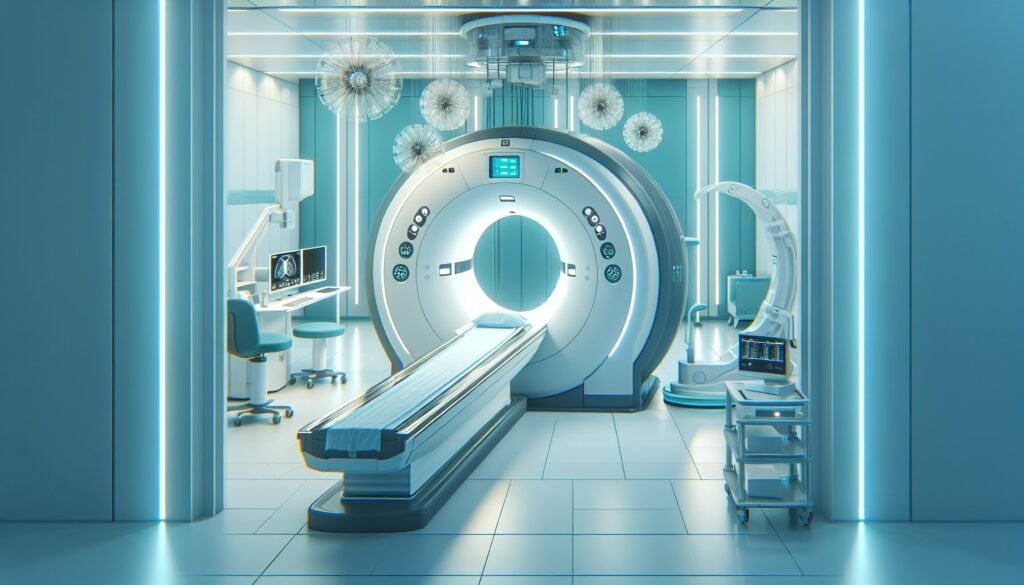
A standard CT Chest with IV contrast is a single-phase acquisition timed for the portal venous phase. This provides optimal enhancement of the mediastinal structures, pleura, and solid organs in the upper abdomen while still providing excellent detail of the lung parenchyma. The goal is to get a comprehensive look with a single bolus of contrast and a single scan.
The protocol is straightforward. A power injector pushes about 75 mL of contrast, followed by a saline chase. We use bolus tracking, placing a region of interest (ROI) in the descending aorta. Once the density hits a threshold (e.g., 80-90 Hounsfield Units), we wait about 40 seconds before scanning. This delay ensures we are solidly in the venous phase.
| Parameter | Specification |
|---|---|
| Phase | Portal Venous |
| Contrast | 75 mL of 350-370 mgI/mL nonionic contrast (e.g., Isovue 370) @ 3.7 mL/sec |
| Timing | Bolus tracking on descending aorta + 40-second delay |
| Scan Coverage | Lung apices through the adrenal glands |
| Reconstructions | – 2-3 mm soft tissue (axial, coronal, sagittal) – 1 mm lung kernel (axial) – Bone windows (optional, for trauma/mets) |
| Breath-hold | Inspiration (~10 seconds) |
A common pitfall is inadequate contrast timing or volume, which can lead to a suboptimal study. Using a fixed delay instead of bolus tracking can be problematic in patients with poor cardiac output. Always ensure the patient has a good IV (18-20 gauge) capable of handling the injection rate to avoid contrast extravasation.
9. The 3-Months-Free Offer for Residents and Fellows
Look like a rockstar on your reports. We’re offering radiology residents and fellows 3+ months of free access to GigHz Precision AI. You can dictate your positive findings in free form, and the AI will generate a clean, structured report using ACR and SIR templates, with the appropriate clinical decision support firing automatically. All we ask in return is your feedback so we can keep improving the product for trainees.
Signup is simple. There’s no credit card required and no long forms. To apply, just provide these three items:
- Your PGY year (e.g., PGY-2, PGY-4)
- Your training type (radiology residency or specific fellowship)
- Your training program / hospital name
We’ll get you set up right away. You can apply for the residents free-access program here.
10. Frequently Asked Questions
Is GigHz Precision AI HIPAA-compliant?
Yes. The platform is designed for de-identified workflows by default. No Protected Health Information (PHI) is required to use the tool for generating structured reports from your findings. It operates on the clinical data you provide, not patient identity.
Do I need my hospital’s IT department to set this up?
No. GigHz Precision AI is a secure, browser-based application. There’s no software to install on hospital machines. It works on the computer in the reading room, your personal laptop, or even an iPad on call.
Does this replace PowerScribe or other dictation systems?
No, it works alongside them. You can dictate your findings into the GigHz interface, and then copy the generated structured report into your PACS/RIS/dictation system. It’s a tool to help with report creation and organization, not a replacement for your core reporting software.
Can I use this on my phone or iPad?
Yes, the web application is fully responsive and designed to work on modern browsers across desktops, tablets, and mobile devices. It’s particularly useful for reviewing templates or guidelines on the go.
Can I customize the templates?
Yes. While the system comes pre-loaded with standard templates based on ACR and other society guidelines, you can create, modify, and save your own templates to match your personal preferences or your institution’s specific requirements.
What happens after my residency or fellowship ends?
The free access program is specifically for trainees. After you graduate, you can transition to a standard subscription for practicing radiologists. We offer discounts for recent graduates to help you get started in your new role.
Free GigHz Tools That Pair With This Article
Three free tools that complement the material above:
- Imaging Appropriateness Selector — Type an indication or clinical scenario in plain language and get the imaging studies the ACR rates for it, with adult and pediatric radiation levels. Built directly from 297 ACR topics, 1,336 clinical variants, and 15,823 procedure ratings.
- GigHz Imaging Protocol Library — A searchable library of 131 imaging protocols with the physics specs surfaced and the matching ACR Appropriateness Criteria alongside. Plain-English narratives readable in 60 seconds, organized by modality.
- GigHz Radiation Dose Calculator — Pick the imaging studies a patient has had and see total dose in millisieverts (mSv) with comparisons to natural background radiation, transatlantic flights, and chest X-rays. Useful for shared decision-making.
Reviewed by Pouyan Golshani, MD, Interventional Radiologist — August 4, 2026