
 Pogosh CDS — Clinical Decision Support
The answer was already in the chart.
No one had time to find it. It was in there — flagged, in a column of forty other values, on hour nine of a shift covering eighteen patients. The 2am hospitalist, the resident without attending backup, the locum on day one: none of them miss things because they don't know medicine. They miss them because nothing put the right value in front of them at the moment the decision got made.
Pogosh is a chart-aware clinical decision support engine. It reads the chart — including the imaging and procedures already done — and returns the labs, imaging, specialist routing, and escalation criteria that change management, plus a drafted note grounded in the encounter. Coded output your software can act on, not a reference article to go read. It supports the clinician's judgment. It never replaces it.
Pogosh CDS is built by GigHz — Member of NVIDIA Inception
Built and used daily by Pouyan Golshani, MD — practicing interventional radiologist · StatPearls IR Editorial Board · FDA AI-device research on medRxiv
The knowledge was never the problem. The retrieval was.
Physicians don't miss diagnoses or over-test from lack of knowledge. They miss them from the impossible cognitive load of synthesizing hundreds of guidelines under time pressure.
The 2am hospitalist
Eighteen patients. New admit with chest pain. Old admit with sepsis trending wrong. Discharge orders waiting. The senior attending's instincts exist — but not at this hour, not for this patient, not on this provider.
The resident without backup
Consequential calls made alone. The right escalation criteria are written down somewhere — usually a PDF or a folder of departmental SOPs that nobody navigates mid-call. Knowledge exists; access doesn't.
The locum on day one
Unfamiliar system, unfamiliar protocols, unfamiliar specialists. The locum is technically excellent and operationally blind. The patients don't know the difference until something gets missed.
Six places the chart already knew, and nobody had time to look.
Pogosh reads the open chart — notes, conditions, resulted labs, and the imaging and procedures already performed — and returns six structured outputs, each traceable to a guideline:
You ordered the panel. The one test that changes management wasn't in it.
LOINC-coded lab recommendations, ranked, each with the reasoning attached. Checked against what has already resulted, so the same test does not get sent twice and the missing one does not stay missing.
Try it on a real note →The study got ordered. It was the wrong study.
RadLex-coded imaging guidance graded Preferred, Consider, or Avoid — with radiation dose alongside each option, and prior studies taken into account before anything new is suggested.
See the appropriateness layer →The differential lived in someone's head. It never reached the chart.
A ranked differential with severity tier, built from the encounter in front of you rather than a generic presentation — so the thinking is written down where the next clinician can see it.
Watch the walkthrough →The consult went out. The reason didn't.
Specialist routing with urgency and the structured clinical reason already embedded. Cuts the "why are you calling" phase out of the consult and shortens the wait on the floor.
Try in your workflow →The numbers drifted for six hours before anyone called it.
Vital-sign thresholds, lab trigger values, and findings that mean ICU, RRT, or urgent consult — read from the live values in the record. A separate strict emergency check runs behind them for time-critical presentations.
See it on a live scenario →The care was good. The note took the rest of the shift.
A drafted note grounded in the encounter — new visit, follow-up, or disposition — carrying only what is actually in the chart. Nothing invented, and the clinician still reviews and signs.
The same idea for radiology reports →
From a free-text note to a structured, traceable decision. STEMI activation, high-yield labs, imaging, specialist routing, and disposition — generated in <200ms. Try it at pogosh.com.
Why Pogosh, not the legacy CDS vendor
Reference tools tell a clinician what to read. Pogosh tells your software what to order. Hospitals already pay heavily for clinical decision support — most of it is static reference content licensed per seat, built for compliance rather than for the bedside.
Coded output, not prose
Recommendations come back as data your software can act on — LOINC for labs, RadLex for imaging, ICD-10-CM for conditions — in under 200ms. A reference article cannot fire an order. A coded response can.
Chart-aware, not chart-blind
Pogosh reads what is already in the record — prior imaging, completed procedures, resulted labs — and stops recommending what has already been done. Generic CDS cannot see the chart, so it repeats it.
Structured + traceable
Every recommendation maps to a guideline. No hallucinated logic, no LLM-only generation. Clinicians can verify why each suggestion is on screen.
Pricing Founding pricing
Priced per location, unlimited users and API calls. No per-call fees, no throttling. Pogosh is designed as a copilot — called every time a provider opens a chart — so usage-based pricing would create perverse incentives to use it less.
💡 Pay yearly, get 2 months free — switch to annual any time.
per physical location, billed monthly
- Up to 5 providers
- Hundreds of conditions, full library
- All 40+ specialties
- High-yield lab guidance
- Imaging recommendations
- Specialist routing rules
- Escalation triggers
- Missing order alerts
- OpenEMR module included
- Email support
~$30/provider/month at 5 providers
Start Clinic — $149/mo30-day money-back guarantee. Cancel anytime.
per physical location, billed monthly
- Up to 15 providers
- Everything in Clinic
- Priority support + Slack channel
- Usage analytics dashboard
- Early access to new conditions
- BAA available
~$20/provider/month at 15 providers
Start Practice — $299/mo30-day money-back guarantee. Cancel anytime.
from $499/month — for EHR vendors and products that embed Pogosh
- For the practices your product serves
- Unlimited reference calls
- 5,000 model-backed calls a month included
- Note analysis, note writing, chart read, emergency check
- Then $0.10 per model-backed call
- HIPAA BAA
- Runs on AWS
Custom — for hospital systems and health networks
- Unlimited providers
- Custom EMR integration
- Dedicated account support
- Custom SLA
- Multi-site licensing
- Bulk condition additions on request
- BAA available
All paid tiers include the full condition library. Clinic and Practice are priced per physical location.
Clinical Validation Partner Program: 3 months free for selected sites. Details at pogosh.com/api.
Current tiers are founding pricing. Early customers keep their rate — future price increases never apply to active subscriptions.
The API in 30 seconds
Every tier ships with the same REST API. Send a clinical note, or a structured condition with patient parameters; receive JSON. Bearer-token auth. Base URL: https://api.pogosh.com
curl -X POST https://api.pogosh.com/cds/evaluate \
  -H "Authorization: Bearer YOUR_KEY" \
  -H "Content-Type: application/json" \
  -d '{ "note": "62M, crushing substernal chest pain, diaphoretic..." }'
POST /cds/evaluate— symptoms and context in; labs, imaging, routing, and escalation criteria outPOST /cds/emergency— the strict safety check for time-critical presentationsGET /cds/conditions— the full condition library, indexed by specialtyGET /cds/condition/:id— structured decision content for a single conditionGET /cds/procedures?category=&q=— the procedure library, filterable by categoryGET /cds/lookup?q=— resolve a free-text term to a conditionGET /cds/health— status check
Full API docs → pogosh.com/api
Demo keys (50 req/day) available immediately. Paid keys provisioned same-day after intake review.
Who deploys Pogosh
Pogosh is API-first — the integrations look different by use case.
EHR-embedded clinical intelligence
Hospitalist, EM, and inpatient teams. Pogosh embeds in your EMR via REST API or the OpenEMR module — at the point of order entry or chart open.
Specialty-tailored decision support
IR, urgent care, anesthesia, and specialty teams. Pogosh's specialty layer covers the conditions and decision points that generic CDS misses.
Add guideline-based logic to your platform
EHR vendors, clinical platform companies, and health-tech startups embedding decision logic. Pogosh ships as a backend API — your UX stays yours.
Standardized clinical floor across providers and sites
Locum agencies and telehealth groups whose clinicians rotate through unfamiliar systems. Pogosh provides the institutional context the system itself can't.
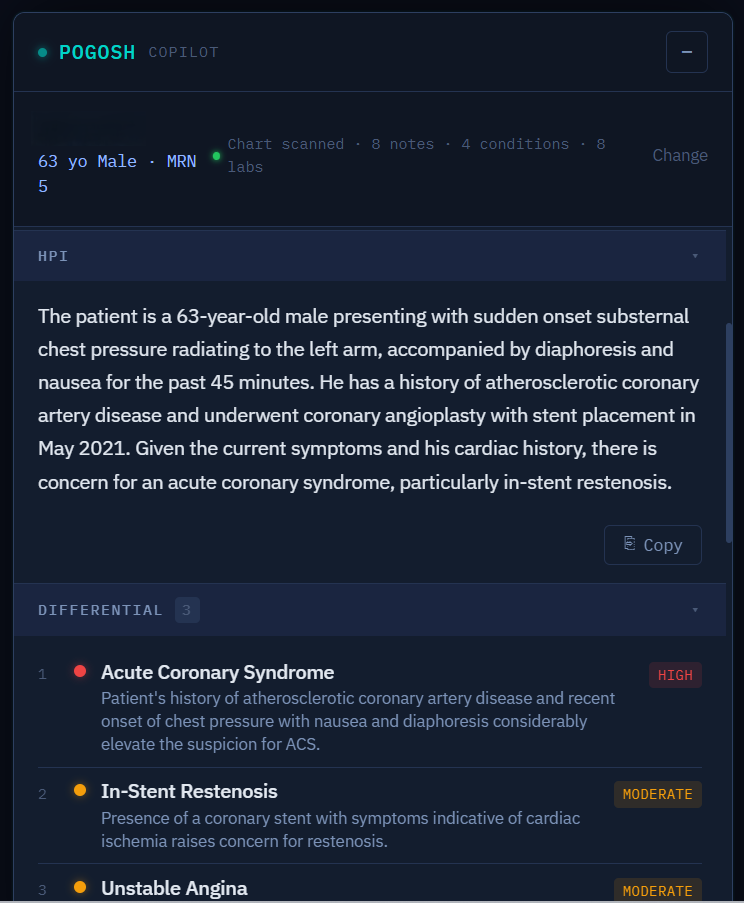
Chart-aware differential, inline. Pogosh CoPilot scans the encounter, conditions, and labs in the open chart — then surfaces a ranked differential with severity tier.
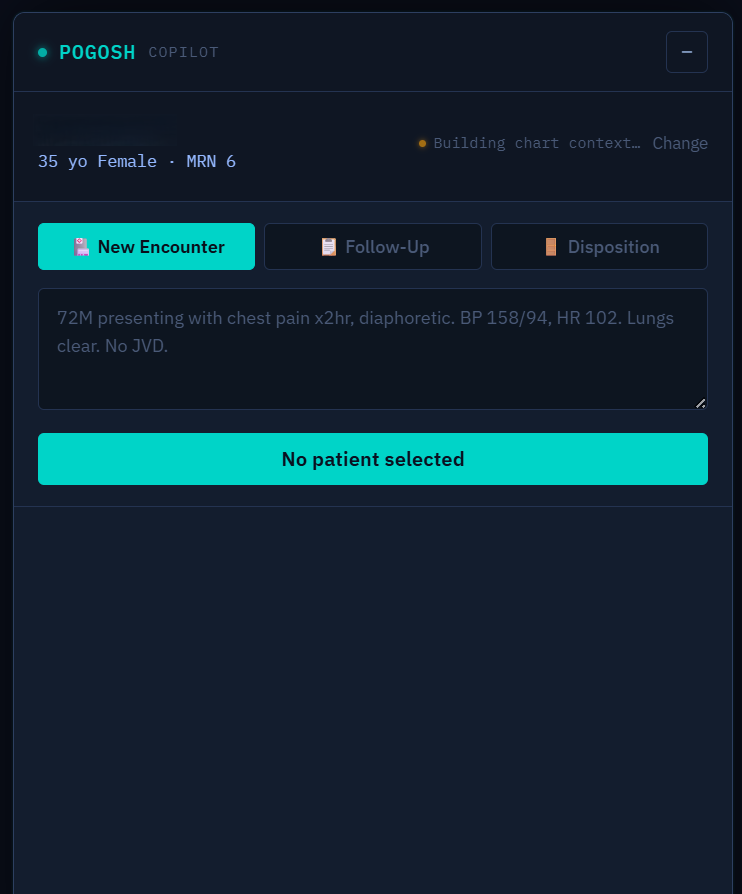
Same engine, three note modes. New encounter, follow-up, and disposition notes — plain-language input, structured note out, grounded in the same chart context.
Three ways in
Pricing is public and self-serve. Start on a tier, try the engine live first, or apply for the validation program.
💳 Start now
Pick a tier and deploy. Clinic from $149/month per physical location — unlimited users and API calls, full condition library, OpenEMR module included.
See pricing →🧪 Try it live
Paste a clinical scenario and watch the structured output — differential, high-yield labs, imaging, specialist routing, and disposition — in real time.
pogosh.com/try →🩺 Clinical Validation Partner
Three months of full Pogosh access at no cost in exchange for structured feedback. We're selecting a small number of clinical sites for real-workflow validation. Validation Partners convert at founding pricing at the end of the 3-month term — locked for the life of the subscription. Free access doesn't linger; the feedback window is the deal.
Apply →Privacy by architecture: the core API runs on condition IDs and clinical parameters, not patient identifiers. For chart-aware deployments that do process PHI, a HIPAA BAA is available. Security & Data Handling →
Common questions
Is Pogosh an LLM-based tool?
No. Pogosh is a structured rule engine — every recommendation maps to a specific clinical guideline and rationale. It does not generate free-text clinical content. Clinicians can verify the source of every suggestion.
Does Pogosh handle PHI?
Pogosh accepts condition IDs and clinical parameters — not patient identifiers. The integration architecture is designed so PHI doesn't need to leave your system to get the recommendation back.
How does Pogosh integrate with my EMR?
REST API + OpenEMR module. Most hospitals deploy via the API — embedding the response in order entry, chart open, or specialty handoff workflows. Talk to us about your specific EMR.
How does pricing work?
Clinic is $149/month per location for solo practices and small clinics, up to 5 providers, with unlimited users and API calls and no per-call fees. Practice is $299/month per location for multi-provider groups, urgent care centers and specialty practices, up to 15 providers, with priority support. Platform, from $499/month, is for EHR vendors and products that embed Pogosh for the practices they serve: unlimited reference calls and 5,000 model-backed calls a month (note analysis, note writing, chart read, emergency check), then $0.10 per call, with a HIPAA BAA, running on AWS. Enterprise pricing for hospital systems and health networks is custom. Annual billing on Clinic and Practice gets you 2 months free, and every paid tier includes the full condition library.
What specialties are covered?
Hundreds of conditions across 40+ specialties — heaviest depth in IR, hospital medicine, EM, anesthesia, vascular surgery, GI, cardiology, and pulmonary. New conditions are added on request when a Validation Partner has a structured need.
Who built it?
Pouyan Golshani, MD — a practicing interventional radiologist — and the GigHz clinical team. Built because no API-native CDS engine existed that surfaced specialty-level decisions in real time.
Support physician judgment. Never replace it.
Try the live demo, then pick a tier — Clinic from $149/month per physical location, unlimited users and API calls. 30-day money-back guarantee.
Pogosh CDS surfaces guideline-based recommendations to support clinical decision-making. It does not replace clinician judgment, and every recommendation should be evaluated by the clinician at the point of care. A GigHz product. Built by Pouyan Golshani, MD.
Written and reviewed by Pouyan Golshani, MD, Interventional Radiologist — Last updated May 26, 2026
Part of the GigHz library: systems doctors were never taught.