How Should You Evaluate an Incidental Pancreatic Cyst Over 2.5 cm with High-Risk Stigmata?
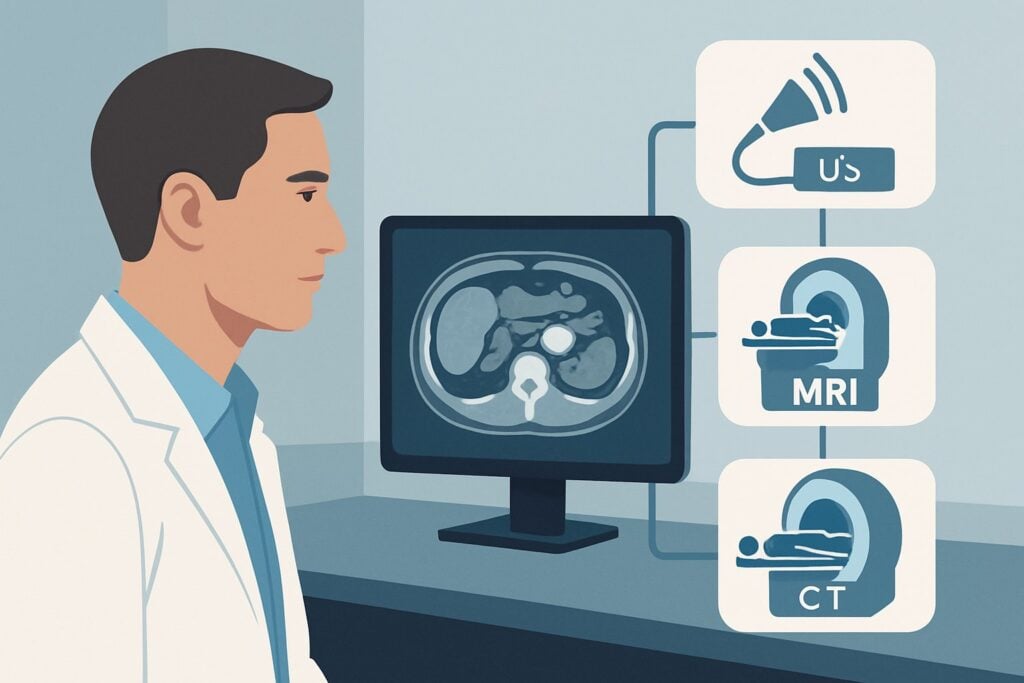
A 68-year-old patient undergoes an abdominal computed tomography (CT) scan for suspected nephrolithiasis. The scan is negative for stones but reveals an incidental finding: a 3.2 cm complex, septated cyst in the body of the pancreas with a thickened, enhancing wall. This discovery shifts the clinical focus entirely. You are now faced with a pancreatic cyst that has worrisome features, requiring a precise and timely workup to assess its malignant potential. The immediate question is which imaging study to order next for definitive characterization. For this specific scenario, the American College of Radiology (ACR) rates Endoscopic Ultrasound (EUS) as Usually Appropriate for the initial dedicated evaluation.
Who Fits This Clinical Scenario for a High-Risk Pancreatic Cyst?
This guidance applies specifically to patients with an incidentally discovered pancreatic cyst that is greater than 2.5 cm in size and possesses one or more high-risk stigmata or worrisome features. These features, often identified on the initial cross-sectional imaging (like CT or MRI), suggest a higher probability of a mucinous cyst with potential for malignant transformation.
High-risk stigmata include:
- Obstructive jaundice in a patient with a cyst in the pancreatic head
- An enhancing mural nodule ≥ 5 mm within the cyst
- A main pancreatic duct (MPD) diameter of 10 mm or more
Worrisome features include:
- Cyst size ≥ 3 cm
- Thickened, enhancing cyst walls
- Main pancreatic duct (MPD) diameter of 5–9 mm
- A non-enhancing mural nodule
- An abrupt change in the caliber of the main pancreatic duct with atrophy of the distal pancreas
- Associated lymphadenopathy
This workflow is distinct from other common pancreatic cyst presentations. This article does not apply if:
- The cyst is 2.5 cm or smaller and lacks the features above.
- The cyst is larger than 2.5 cm but has no high-risk stigmata or worrisome features.
- The patient has a history of acute or chronic pancreatitis, suggesting the lesion could be a pseudocyst.
- You are performing surveillance imaging for a previously characterized pancreatic cyst.
Each of these situations follows a different diagnostic pathway. Correctly categorizing the patient’s presentation is the critical first step.
What Diagnoses Are You Working Up with a Large, Complex Pancreatic Cyst?
The presence of a large cyst with worrisome features significantly narrows the differential diagnosis toward neoplastic lesions that require careful evaluation and potential intervention. The goal of the imaging workup is to differentiate between benign, pre-malignant, and malignant entities.
Intraductal Papillary Mucinous Neoplasm (IPMN) is a primary concern. These are mucin-producing neoplasms arising from the pancreatic ducts. The presence of a dilated main pancreatic duct, a solid component (mural nodule), or large size are key features that elevate the risk of high-grade dysplasia or invasive carcinoma. Distinguishing between main-duct, branch-duct, and mixed-type IPMNs is crucial for management.
Mucinous Cystic Neoplasm (MCN) is another important consideration. These cysts almost exclusively occur in women, typically in the body or tail of the pancreas. They do not communicate with the pancreatic duct system and are defined by the presence of an ovarian-type stroma. MCNs are considered pre-malignant and are often recommended for resection.
Solid Pseudopapillary Neoplasm (SPN), while less common, often presents as a large, well-encapsulated mass with both solid and cystic components due to hemorrhage and necrosis. SPNs typically affect younger women and have a low malignant potential, but surgical resection is curative and generally recommended.
Pancreatic Ductal Adenocarcinoma (PDAC) with cystic features is a critical diagnosis not to miss. A highly aggressive malignancy can undergo cystic degeneration or cause obstructive ductal changes that result in a cystic appearance. An enhancing solid component in a patient with symptoms like weight loss or jaundice is highly suspicious for PDAC.
Why Is Endoscopic Ultrasound the Recommended First Step for This Cyst?
The ACR Appropriateness Criteria rate both US abdomen endoscopic (Endoscopic Ultrasound or EUS) and MRI abdomen without and with IV contrast with MRCP as Usually Appropriate for this scenario. Both are excellent, radiation-free modalities, but EUS offers a unique advantage that often makes it the preferred next step.
The primary strength of EUS is its superior spatial resolution. By placing a high-frequency ultrasound transducer directly adjacent to the pancreas via the stomach or duodenum, EUS provides unparalleled detail of the cyst’s internal architecture. This is critical for identifying subtle but significant findings like small mural nodules, thick septations, or wall irregularities that may not be clearly visible on CT or even MRI.
Most importantly, EUS allows for intervention. During the same procedure, fine-needle aspiration (FNA) or fine-needle biopsy (FNB) can be performed to obtain cyst fluid and tissue from any solid components. Cyst fluid analysis for carcinoembryonic antigen (CEA) levels, amylase, and cytology can help differentiate mucinous from non-mucinous cysts. A high CEA level (>192 ng/mL) is highly specific for a mucinous cyst. Biopsy of a mural nodule can provide a definitive tissue diagnosis.
MRI with MRCP remains an outstanding and co-equal option. Its strength lies in global assessment of the entire pancreas and surrounding structures. Magnetic Resonance Cholangiopancreatography (MRCP) sequences provide non-invasive, detailed visualization of the pancreatic ductal system, which is essential for classifying IPMNs and assessing communication between the cyst and the main duct.
Why are other studies rated lower for this specific evaluation?
- CT abdomen with IV contrast multiphase is rated May be appropriate. While often the modality that initially detects the cyst, it has lower soft-tissue contrast resolution compared to MRI for characterizing internal cyst complexity. It also involves significant radiation exposure (☢☢☢☢ 10-30 mSv).
- CT abdomen without and with IV contrast (a standard biphasic protocol) is rated Usually not appropriate. This protocol is not optimized for pancreatic evaluation and is inferior to a dedicated multiphase pancreatic protocol CT or MRI.
For this high-stakes clinical question, the ability of EUS to provide both high-resolution imaging and a direct path to tissue sampling makes it a powerful and often decisive tool.
What’s Next After Endoscopic Ultrasound? Downstream Workflow
The results of the EUS with FNA/FNB will guide the subsequent management, which typically involves a multidisciplinary discussion with surgeons and gastroenterologists.
- If results confirm a high-risk lesion: Findings such as a solid component confirmed as high-grade dysplasia or carcinoma, positive cytology for malignancy, or a diagnosis of an MCN or SPN will typically lead to a recommendation for surgical resection. The specific operation (e.g., Whipple procedure, distal pancreatectomy) depends on the cyst’s location. Pre-operative staging with CT or MRI may be performed if not already done.
- If results are suspicious but not definitive: A high CEA level suggesting a mucinous cyst (IPMN or MCN) without high-grade dysplasia on cytology often leads to a decision between surgery or intensive surveillance. For branch-duct IPMNs with worrisome features, resection is often favored in surgically fit patients.
- If results suggest a benign entity: If fluid analysis and imaging features are consistent with a benign lesion like a serous cystadenoma and high-risk features are absent on EUS, the patient may be routed to a less intensive surveillance pathway. This might involve follow-up imaging with MRI. This scenario is less likely given the initial presentation with worrisome features but remains a possibility.
- If the EUS is non-diagnostic: In some cases, fluid may be too viscous to aspirate or a solid component cannot be safely biopsied. If high suspicion remains based on the imaging features, the patient may proceed to MRI/MRCP for further characterization or be referred directly for surgical consultation based on the high-risk imaging phenotype alone.
Pitfalls to Avoid (and When to Get Help)
Navigating the workup of a complex pancreatic cyst requires careful attention to detail to avoid common missteps.
- Pitfall 1: Relying solely on the initial CT. A standard abdominal CT is a screening tool, not a definitive characterization study. Failing to order a dedicated pancreatic MRI/MRCP or EUS can lead to misclassification of the cyst.
- Pitfall 2: Misinterpreting CEA levels. While a high CEA is specific for a mucinous cyst, a low CEA does not rule it out. The pre-test probability based on imaging features remains paramount.
- Pitfall 3: Not sampling the solid component. The highest-risk area of a complex cyst is an associated mural nodule or solid component. The primary goal of EUS-FNA/FNB should be to obtain tissue from this area, not just aspirate fluid.
- Pitfall 4: Delaying multidisciplinary consultation. These are complex cases. If any high-risk stigmata are present, early discussion with a pancreatic surgeon and advanced endoscopist is essential to formulate a cohesive management plan.
Related ACR Topics and Tools
For a comprehensive overview of imaging for all pancreatic cyst scenarios, from small and simple to large and complex, please see our parent guide. Additional GigHz resources can help you navigate adjacent clinical questions and technical specifications.
- Parent Topic Hub: For breadth across all scenarios in Pancreatic Cyst, see our parent guide: Pancreatic Cyst: ACR Appropriateness Decoded.
- ACR Appropriateness Criteria Lookup: ACR Appropriateness Criteria Lookup — for adjacent scenarios
- Imaging Protocol Library: Imaging Protocol Library — for technique on the recommended study
- Radiation Dose Calculator: Radiation Dose Calculator — for cumulative dose conversations
Frequently Asked Questions
Why is MRI/MRCP also rated ‘Usually Appropriate’ if EUS is so effective?
MRI with MRCP provides a superior global view of the entire pancreas, the full length of the pancreatic duct, and the surrounding abdominal organs. It is excellent for surgical planning and assessing the relationship of the cyst to the main duct, which is crucial for classifying IPMNs. While EUS excels at detailed cyst characterization and tissue sampling, MRI provides the best overall anatomical map. The two tests are complementary, and the choice often depends on local expertise and the specific clinical question.
What if the initial CT report mentions a ‘complex cyst’ but doesn’t specify any high-risk stigmata?
If the report is ambiguous, the first step is to review the images yourself or with a radiologist to look for the specific features mentioned in this article (mural nodules, duct dilation, wall thickening). If none are present, the patient may fit the different ACR scenario for a cyst > 2.5 cm *without* worrisome features, which has a different recommended workflow, often starting with MRI/MRCP for characterization before considering EUS.
Is there a role for PET/CT in the initial evaluation of these cysts?
PET/CT is generally not recommended for the initial characterization of an incidentally discovered pancreatic cyst. Its role is typically reserved for staging in cases where invasive cancer has already been diagnosed or is highly suspected, to look for metastatic disease. It lacks the spatial resolution of EUS or MRI for evaluating the primary cyst morphology.
If EUS-FNA cytology is negative for malignancy, does that mean the cyst is benign?
Not necessarily. The sensitivity of cytology from cyst fluid for detecting malignancy can be low. A negative cytology result does not rule out high-grade dysplasia or carcinoma, especially in a large mucinous cyst with worrisome imaging features. The combination of imaging findings, cyst fluid CEA levels, and cytology—interpreted within a multidisciplinary team—is used to make a final management decision.
Does the patient’s age or surgical fitness change the imaging recommendation?
The initial imaging recommendation (EUS or MRI/MRCP) to characterize the cyst remains the same regardless of the patient’s age or comorbidities. However, these factors heavily influence the *downstream management*. An elderly or frail patient with a high-risk lesion might be managed with surveillance rather than surgery, but the diagnostic workup to establish the risk is still necessary to make that informed decision.
Reviewed by Pouyan Golshani, MD, Interventional Radiologist — May 29, 2026