Imaging Workup for Transient Ischemic Attack: Why MRA Is the ACR-Recommended First Step
A 68-year-old man presents to the emergency department after an episode of slurred speech and right-hand weakness that lasted about 20 minutes and has now completely resolved. His neurologic exam is normal. You diagnose a transient ischemic attack (TIA), a critical warning sign of an impending stroke. The immediate clinical question is not just if he has cerebrovascular disease, but where it is and how severe it is, to guide urgent intervention. This article provides a focused workflow for the initial imaging survey in a patient with a suspected carotid or vertebrobasilar TIA. According to the American College of Radiology (ACR) Appropriateness Criteria, the most comprehensive initial study, MRA head and neck without and with IV contrast, is rated Usually Appropriate.
Who Qualifies for This TIA Initial Screening Workflow?
This guidance applies specifically to patients presenting after a transient ischemic attack (TIA), defined as a temporary episode of neurologic dysfunction caused by focal brain, spinal cord, or retinal ischemia, without acute infarction. The symptoms have fully resolved by the time of evaluation. The clinical suspicion should point toward a specific vascular territory:
- Carotid Territory TIA: Symptoms may include transient monocular blindness (amaurosis fugax), unilateral weakness or sensory loss (face, arm, or leg), or language disturbance (aphasia).
- Vertebrobasilar TIA: Symptoms can include dizziness or vertigo, diplopia (double vision), ataxia (impaired coordination), dysarthria (slurred speech), or bilateral weakness or sensory symptoms.
This workflow is distinct from other similar, but clinically different, scenarios. This guidance does not apply if:
- The neurologic deficit is fixed or worsening: This presentation is treated as an acute stroke, which has its own time-sensitive imaging pathway. See the ACR variant for New focal neurologic defect, fixed or worsening. Less than 6 hours. Suspected stroke.
- The patient is asymptomatic: A patient with risk factors or a cervical bruit found on physical exam but no history of TIA or stroke follows a different screening protocol.
- Hemorrhage is suspected: If the primary concern is an intracranial bleed (e.g., “thunderclap headache,” altered mental status with focal signs), the imaging algorithm prioritizes identifying blood, typically with a non-contrast head CT.
What Are the Primary Diagnoses in a TIA Workup?
The goal of imaging in a TIA is to identify the underlying cause to prevent a permanent, disabling stroke. The differential diagnosis guides the choice of study.
The most common and urgent diagnosis to identify is high-grade atherosclerotic stenosis, typically at the carotid bifurcation in the neck. A vulnerable plaque can shed a small clot (embolus) that travels to the brain, causing transient symptoms. Identifying a significant stenosis (often >70%) is critical, as procedures like carotid endarterectomy or stenting can substantially reduce future stroke risk.
A cardioembolic source is another major cause. Conditions like atrial fibrillation can form clots in the heart that travel to the brain. While brain and vessel imaging cannot diagnose atrial fibrillation, it is crucial for two reasons: it helps rule out a primary large-vessel stenosis as the cause, and diffusion-weighted imaging (DWI) sequences on an MRI can reveal small, clinically silent infarcts that confirm an embolic event occurred.
Less common but critical to diagnose is arterial dissection. This involves a tear in the wall of a carotid or vertebral artery, which can lead to thrombus formation and embolism. It is a more frequent cause of TIA and stroke in younger patients and may be associated with neck pain or recent minor trauma.
Finally, imaging helps differentiate a true TIA from TIA mimics. Conditions like migraine with aura, focal seizures (with or without a postictal Todd’s paralysis), or metabolic disturbances can present with transient neurologic symptoms. While the clinical history is key, imaging confirms the absence of an ischemic or structural cause, increasing confidence in an alternative diagnosis.
Why Is MRA of the Head and Neck the Recommended Initial Study for TIA?
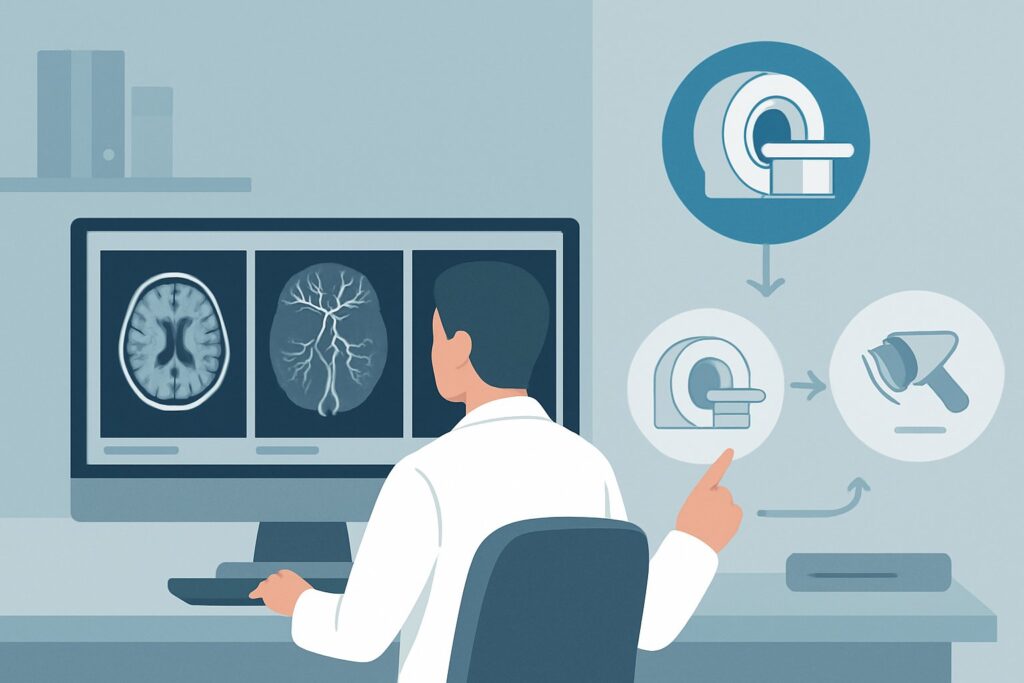
For the initial screening of a patient with a resolved TIA, the ACR designates MRA head and neck without and with IV contrast as Usually Appropriate. This recommendation is based on the modality’s unique ability to provide comprehensive, high-resolution information about both the brain parenchyma and the cervicocranial vasculature without using ionizing radiation.
The power of this study lies in its combined components. The MRI of the head, particularly with DWI sequences, is exquisitely sensitive for detecting small areas of acute or subacute ischemia, even when symptoms have resolved. Finding a DWI-positive lesion confirms a true ischemic event and localizes the affected vascular territory. The MRA portion visualizes the arteries from their origin at the aortic arch up to the intracranial circulation, allowing for direct assessment of stenosis, dissection, or other vessel wall abnormalities. The addition of intravenous contrast can improve the accuracy of stenosis grading and help characterize atherosclerotic plaque or identify vessel wall enhancement suggestive of inflammation or dissection.
Let’s compare this to other rated modalities for this specific scenario:
- CTA head and neck with IV contrast is also rated Usually Appropriate. It is an excellent and often faster alternative for visualizing the vasculature and is widely available. However, it delivers a significant dose of ionizing radiation (☢☢☢ 1-10 mSv) and provides less detail of the brain parenchyma compared to MRI. In the non-emergent TIA workup, the superior soft-tissue detail and lack of radiation often make MRA the preferred choice.
- US duplex Doppler carotid artery is rated May be appropriate. While it is a non-invasive, radiation-free method to evaluate the extracranial carotid arteries for stenosis, its utility as a primary screening tool is limited. It cannot visualize the intracranial vessels, the vertebrobasilar system, or the brain parenchyma. A negative carotid ultrasound does not rule out a significant portion of potential causes for a TIA.
The MRA provides a “one-stop shop” for the TIA workup, assessing the brain for ischemic injury and the full relevant vasculature for a potential source, all with no radiation dose (O 0 mSv). Once you’ve decided on MRA head and neck without and with IV contrast, our protocol guide covers the technique, contrast, and reading principles: MRA Neck With and Without Contrast.
What Are the Next Steps After the Initial MRA Results?
The results of the MRA will dictate the subsequent clinical pathway, which is often time-sensitive. The goal is to initiate secondary stroke prevention as quickly as possible.
- If the study is positive for significant stenosis: A finding of high-grade stenosis (typically defined as >70% luminal narrowing, or 50-69% in some symptomatic patients) in the internal carotid artery is an actionable result. This should trigger an urgent consultation with vascular surgery or neuro-interventional radiology to evaluate the patient for carotid endarterectomy (CEA) or carotid artery stenting (CAS). Medical management with antiplatelet therapy and statins should be optimized immediately.
- If the study is negative for significant stenosis: A normal MRA of the head and neck vessels effectively rules out large-vessel atherosclerosis or dissection as the cause. The clinical workup should then pivot to focus on other potential sources, primarily cardioembolic. This typically involves placing the patient on a heart monitor (telemetry or Holter monitor) to screen for paroxysmal atrial fibrillation and ordering an echocardiogram to assess for cardiac thrombus or a patent foramen ovale (PFO).
- If the study is indeterminate or shows non-stenotic plaque: Sometimes, the MRA may show mild-to-moderate plaque without a flow-limiting stenosis. This still confirms the presence of atherosclerotic disease and reinforces the need for aggressive medical management, including high-dose statin therapy, antiplatelet agents, and strict blood pressure and glucose control. If the vessel imaging is technically limited or equivocal, a CTA may be considered for clarification.
Pitfalls to Avoid (and When to Get Help)
In the TIA workup, timeliness and choosing the right initial test are paramount. Here are common pitfalls to avoid:
- Delaying the workup: A TIA is a neurologic emergency. The risk of stroke is highest in the first 48 hours after a TIA. Imaging and initiation of therapy should not be delayed.
- Ordering an incomplete study: Ordering only a carotid ultrasound or an MRA of the head without the neck vessels provides an incomplete picture. The initial survey should evaluate the entire vascular tree from the aortic arch to the brain.
- Mistaking TIA for acute stroke: If any neurologic deficit persists, the patient should be managed under acute stroke protocols, where non-contrast head CT is often the first step to rule out hemorrhage before considering thrombolysis.
- Ignoring contraindications: Ensure the patient has no contraindications to MRI (e.g., incompatible pacemaker, metallic foreign body) or gadolinium-based contrast agents (e.g., severe renal impairment).
If the imaging findings are complex, such as evidence of vasculitis, multiple dissections, or an unusual pattern of ischemia, it is crucial to escalate care by consulting a neurologist or stroke specialist.
Related ACR Topics and Tools
This article focuses on a single, common clinical scenario. For a broader understanding of imaging in cerebrovascular disease and access to related decision-support tools, please see the resources below.
- For breadth across all scenarios in Cerebrovascular Disease, see our parent guide: Cerebrovascular Disease: ACR Appropriateness Decoded.
- Imaging Appropriateness Selector — for adjacent scenarios
- Imaging Protocol Library — for technique on the recommended study
- Radiation Dose Calculator — for cumulative dose conversations
Frequently Asked Questions
Why not just start with a carotid ultrasound? It’s faster and cheaper.
A carotid ultrasound is rated ‘May be appropriate’ but is not the recommended initial survey. While excellent for evaluating the carotid arteries in the neck, it provides no information about the vertebral arteries, the intracranial circulation (e.g., middle cerebral artery), or the brain tissue itself. A TIA can be caused by disease in any of these locations, so a more comprehensive study like MRA or CTA is needed to avoid missing the diagnosis.
Is a non-contrast head CT sufficient for a TIA workup?
No. A non-contrast head CT, while rated ‘Usually Appropriate’, serves a very limited role in a TIA workup. Its primary function is to rule out hemorrhage or a large, established stroke. It cannot visualize the blood vessels to identify stenosis or dissection, and it is insensitive to the small, acute ischemic changes that an MRI with DWI can detect. It is not a sufficient screening survey on its own.
When should I choose CTA over MRA for an initial TIA workup?
CTA is an excellent alternative and is also rated ‘Usually Appropriate’. You might choose CTA over MRA if the patient has a contraindication to MRI (like a non-compatible pacemaker), if MRI is not readily available, or if the patient is claustrophobic. CTA is also significantly faster, which can be an advantage in a busy emergency department. The main tradeoff is the use of ionizing radiation and iodinated contrast.
Does every TIA patient need contrast with their MRA?
The ACR recommends ‘MRA head and neck without and with IV contrast’ as the top choice. While a non-contrast MRA is also ‘Usually Appropriate’ and can identify high-grade stenosis, adding gadolinium-based contrast can improve the accuracy of stenosis measurement, help characterize plaque (e.g., identify inflammation), and better delineate the vessel lumen in cases of complex or slow flow. In most cases, contrast is beneficial unless contraindicated by severe renal dysfunction or allergy.
What if the MRA is completely normal? Does that mean it wasn’t a TIA?
Not necessarily. A completely normal MRA of the head and neck (including DWI sequences) makes a large-vessel cause very unlikely, but it does not rule out a TIA. The event may have been caused by a small embolus from the heart (e.g., due to undiagnosed atrial fibrillation) that did not result in a visible infarct, or from a tiny plaque that is below the resolution of the MRA. A negative MRA is a crucial result that redirects the workup toward a cardioembolic source.
Reviewed by Pouyan Golshani, MD, Interventional Radiologist — May 26, 2026