US Pelvis (Transabdominal + Transvaginal) — Dictation, Appropriateness, and Dose for Residents
1. The 30-Year-Old With Acute Pelvic Pain and a Positive Beta-hCG
The stat pelvic ultrasound from the ED hits your worklist. The patient is 30, with acute right lower quadrant pain and a positive beta-hCG. The ER doc has already called once, asking, “Is it an ectopic?” Your attending expects a clean, structured report that definitively addresses the uterus, endometrium, both adnexa, and the cul-de-sac — with precise measurements and Doppler assessment. This isn’t just about finding the abnormality; it’s about communicating it clearly and quickly.
We’ve all been there: juggling a busy list while trying to recall the exact endometrial thickness cutoff for postmenopausal bleeding or the classic sonographic signs of ovarian torsion. A solid template is your safety net. It ensures you don’t miss a key component when the pressure is on. For more high-yield guides and tools, we’ve built the residents and fellows resource hub to help you navigate call and beyond.
2. What a Pelvic Ultrasound (Transabdominal and Transvaginal) Covers and What Attendings Look For
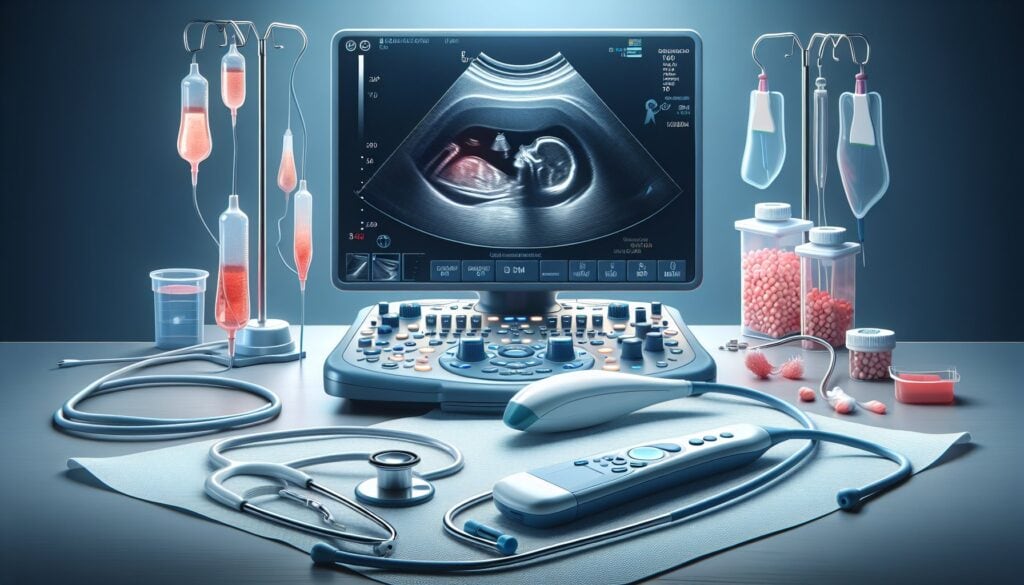
A complete pelvic ultrasound is a two-act play. The first act is the transabdominal (TA) portion, performed with a full bladder that acts as an acoustic window, pushing bowel out of the way. This gives a broad overview of the pelvic organs. The second act is the transvaginal (TV) portion, performed with an empty bladder. The higher-frequency endocavitary probe provides a much more detailed, high-resolution view of the uterus, endometrium, and ovaries.
This exam is the workhorse for a huge range of gynecologic issues. Your attending expects the report to systematically answer these key clinical questions:
- Uterus: What are its size, orientation, and contour? Are fibroids or signs of adenomyosis present?
- Endometrium: What is the endometrial thickness? Is there a focal mass like a polyp or submucosal fibroid?
- Ovaries: Are both ovaries identified? What are their volumes? Is there a cyst or mass? If so, what are its characteristics (simple vs. complex, solid components, septations)? Is there normal blood flow on Doppler?
- Adnexa & Cul-de-sac: Is there an adnexal mass separate from the ovary (e.g., ectopic pregnancy, hydrosalpinx)? Is there free fluid?
- Special Cases: If an IUD is present, where is it located relative to the fundus? In an early pregnancy, is there a gestational sac, and is it intrauterine?
3. Radiology Report Template for Pelvic Ultrasound (Transabdominal and Transvaginal)
This template provides a reliable starting point for your dictations. Modify the findings based on the specific case, but use the structure to ensure you cover all required elements.
Technique
Transabdominal and transvaginal grayscale and color Doppler images of the pelvis were obtained. The transabdominal portion was performed with a full urinary bladder. The transvaginal portion was performed with an empty urinary bladder.
Findings
UTERUS:
Orientation: [Anteverted, Retroverted, Midline]
Size: [___] x [___] x [___] cm
Myometrium: [Homogeneous, Heterogeneous, Fibroid(s) present]
Fibroids: [If present, describe number, location (subserosal, intramural, submucosal), size, and any degenerative changes.]
Cervix: [Unremarkable, Nabothian cysts noted]
ENDOMETRIUM:
Thickness: [___] mm
Appearance: [Homogeneous, Heterogeneous, Focal lesion, Fluid collection]
RIGHT OVARY:
Visualized: [Yes, No, Partially visualized]
Size: [___] x [___] x [___] cm, Volume: [___] cc
Appearance: [Normal follicles, Dominant follicle measuring __ cm, Simple cyst measuring __ cm, Complex/hemorrhagic cyst, Solid mass]
Color Doppler: [Normal arterial and venous flow demonstrated.]
LEFT OVARY:
Visualized: [Yes, No, Partially visualized]
Size: [___] x [___] x [___] cm, Volume: [___] cc
Appearance: [Normal follicles, Dominant follicle measuring __ cm, Simple cyst measuring __ cm, Complex/hemorrhagic cyst, Solid mass]
Color Doppler: [Normal arterial and venous flow demonstrated.]
ADNEXA:
[No adnexal mass identified. Describe any paratubal cysts, hydrosalpinx, or other findings.]
CUL-DE-SAC:
[No free fluid. / Physiologic free fluid. / Small/moderate/large amount of free fluid.]
BLADDER:
[Unremarkable.]
OTHER:
[Note IUD type and position if present. Note any other relevant findings.]
Impression
Key Principles for Your Impression:
- Postmenopausal Bleeding: An endometrial thickness of ≤4 mm is generally reassuring. If >4 mm, recommend further evaluation (e.g., endometrial biopsy).
- Ovarian Torsion: Mention enlarged ovary, peripheral follicles, and absent or abnormal Doppler flow (especially venous). The “whirlpool sign” of the twisted pedicle is a specific finding.
- Ectopic Pregnancy: The classic triad is an empty uterus, a positive β-hCG, and an adnexal mass. Look for the “tubal ring sign.”
- Hemorrhagic Cyst: Describe the characteristic “fishnet” or “reticular” internal echoes. Recommend short-term follow-up if needed to ensure resolution.
- Ovarian Neoplasm: Use O-RADS criteria. Comment on solid components, thick septations (>3 mm), ascites, and vascularity within solid components.
Example Impression:
1. Anteverted uterus with a normal-appearing myometrium. Endometrial stripe thickness of 8 mm, within normal limits for a premenopausal patient.
2. Simple-appearing 3 cm cyst in the right ovary, likely physiologic.
3. Normal left ovary.
4. Physiologic free fluid in the cul-de-sac.
4. Where to Find More Free Radiology Report Templates
Building a personal library of high-quality templates is one of the best things you can do as a trainee. While you’ll develop your own over time, two great free repositories exist to get you started. These are excellent, peer-reviewed sources that cover a wide range of modalities and subspecialties.
- RadReport.org: Curated by the Radiological Society of North America (RSNA), this is a comprehensive library of templates that often align with society guidelines and structured reporting initiatives.
- Radiology Templates (AU): Maintained by Australian radiologists, this site offers a fantastic collection of practical, clearly organized templates that are useful worldwide.
5. From Free-Form Dictation to a Flawless Structured Report
A static template is a great start, but the real challenge on call is integrating complex positive findings into a clean, structured report without stopping your flow. This is where AI-assisted reporting tools can make a significant difference. Instead of manually slotting measurements and descriptions into a rigid macro, you can dictate the positive findings in free form—”complex 3 cm right ovarian cyst with internal reticular echoes and normal Doppler flow”—and let the software handle the rest.
Tools like GigHz Precision AI are designed for this exact workflow. It takes your free-form dictation of findings and organizes them into a complete, structured report based on pre-loaded ACR and SIR templates. It also helps surface relevant Clinical Decision Support (CDS) guidance when a finding requires a specific classification or follow-up recommendation, like O-RADS for an ovarian mass. This approach supports a more natural dictation style while ensuring the final report is consistently well-structured and complete.
6a. When Should You Order a Pelvic Ultrasound? ACR Appropriateness Criteria
Pelvic ultrasound is the definitive first-line imaging modality for a wide range of gynecologic complaints, a fact strongly supported by the American College of Radiology (ACR) Appropriateness Criteria.
For a reproductive-age patient presenting with acute pelvic pain, a pelvic ultrasound (TA/TV) is rated “Usually Appropriate” as the initial imaging study, regardless of whether a gynecologic or non-gynecologic cause is suspected and whether the ß-hCG is positive or negative. It is the primary tool for evaluating for ectopic pregnancy, ovarian torsion, tubo-ovarian abscess, and hemorrhagic cysts. When a non-gynecologic cause like appendicitis is strongly suspected, a CT scan may be considered as an alternative.
In cases of abnormal uterine bleeding or first-trimester vaginal bleeding, transvaginal ultrasound is again “Usually Appropriate” for initial evaluation. It is unparalleled for assessing endometrial thickness, identifying polyps or fibroids, and confirming the location and viability of an early intrauterine pregnancy.
For postmenopausal patients with acute, subacute, or chronic pelvic pain, pelvic ultrasound remains the “Usually Appropriate” first step to assess for gynecologic causes. However, if the ultrasound is indeterminate, an MRI of the pelvis is the recommended next imaging study for better tissue characterization of an adnexal mass or for cancer staging.
6c. Pelvic Ultrasound Imaging Protocol — Technique and Common Pitfalls
The pelvic ultrasound protocol is standardized to ensure a comprehensive evaluation, moving from a general overview to high-resolution detail. The exam is always performed in two parts, and understanding the role of each is key to a successful study.
The initial transabdominal portion provides a wide field of view, assessing large masses and the relationship of pelvic organs to each other. The subsequent transvaginal portion provides superior anatomic detail of the endometrium and ovarian parenchyma.
| Phase | Probe | Patient Preparation | Key Views |
|---|---|---|---|
| Transabdominal (TA) | Curved Array (1-9 MHz) | Full urinary bladder (32 oz water 1 hour prior) | Sagittal and transverse views of the uterus, adnexa, and cul-de-sac. |
| Transvaginal (TV) | Endocavitary (5-9 MHz) | Empty urinary bladder | Sagittal and transverse views of uterus, detailed endometrial measurement, 3D measurements of each ovary, and color Doppler assessment. |
Common protocol pitfalls and considerations:
- Endometrial Thickness: The postmenopausal threshold of 4 mm is a critical cutoff, but remember that this can be influenced by factors like hormone replacement therapy. In premenopausal women, thickness varies significantly with the menstrual cycle.
- Saline Infusion Sonohysterography (SIS): If an endometrial polyp or submucosal fibroid is suspected but not clearly defined, SIS is an excellent adjunct procedure. Saline is instilled into the endometrial cavity to outline the lesion.
- 3D Ultrasound: While not standard everywhere, 3D ultrasound can be very helpful for evaluating the uterine contour in cases of suspected Müllerian duct anomalies (e.g., bicornuate or septate uterus).
- Chaperone: Institutional policy universally requires a chaperone to be present during the transvaginal portion of the exam. Always document their presence.
7. Get 3+ Months of GigHz Precision AI Free
3+ months free for radiology residents and fellows.
The goal is to help you look like a rockstar on your reports. You can dictate your positive findings in free form, and the AI will generate a clean, structured report using the appropriate ACR or SIR template. It helps ensure your impressions are complete and your follow-up recommendations are guideline-compliant by firing the relevant clinical decision support automatically.
In return, all we ask is your feedback so we can keep improving the product for trainees. The signup process is simple, with no credit card required. To get started, just provide the following three items:
- Your PGY year (e.g., PGY-2, PGY-4)
- Your training type (radiology residency or specific fellowship)
- Your training program or hospital name
You can apply for the residents free-access program here. We’ll get you set up right away.
8. Frequently Asked Questions for Residents and Fellows
Is GigHz Precision AI HIPAA-compliant?
Yes. The platform is designed for de-identified workflows by default. No patient-identifying information is required to use the tool to structure your report findings.
Does this require a complex IT setup?
No. It’s a browser-based tool that works on any modern computer, including the workstations in your reading room or a personal laptop or iPad. There is no software to install.
Can I use this with PowerScribe or other dictation software?
Yes. It’s designed to complement your existing dictation system, not replace it. You can use it to structure your thoughts and generate the report text, then copy and paste the final, clean report into your PACS/RIS.
Does it work on a call-room computer or iPad?
Yes. Because it’s a web-based application, it works on any device with a modern web browser, making it accessible whether you’re in the main reading room or on call.
Can I customize the templates?
Yes. While the system uses society-backed templates (like those from the ACR) as a base, you can easily edit and refine the generated report text before finalizing it to match your attending’s preferred style or specific institutional requirements.
What happens after my residency or fellowship ends?
After the free access period for trainees, you can transition to a standard subscription. We offer straightforward plans for practicing radiologists who want to continue using the tool in their daily workflow.
Free GigHz Tools That Pair With This Article
Three free tools that complement the material above:
- Imaging Appropriateness Selector — Type an indication or clinical scenario in plain language and get the imaging studies the ACR rates for it, with adult and pediatric radiation levels. Built directly from 297 ACR topics, 1,336 clinical variants, and 15,823 procedure ratings.
- GigHz Imaging Protocol Library — A searchable library of 131 imaging protocols with the physics specs surfaced and the matching ACR Appropriateness Criteria alongside. Plain-English narratives readable in 60 seconds, organized by modality.
- GigHz Radiation Dose Calculator — Pick the imaging studies a patient has had and see total dose in millisieverts (mSv) with comparisons to natural background radiation, transatlantic flights, and chest X-rays. Useful for shared decision-making.
Reviewed by Pouyan Golshani, MD, Interventional Radiologist — August 4, 2026