When to Order Imaging for Abdominal Aortic Aneurysm or Dissection-Interventional Planning and Follow-up: ACR Appropriateness Decoded

You have a patient with a known abdominal aortic aneurysm (AAA) who is now a candidate for repair, or one who has already undergone endovascular aneurysm repair (EVAR) and requires surveillance. The next step is clear: order imaging. But which study provides the precise anatomical detail needed for device sizing, landing zone assessment, or endoleak detection? Choosing between computed tomography angiography (CTA), magnetic resonance angiography (MRA), and other modalities involves balancing diagnostic yield, radiation exposure, and contrast risks. This guide breaks down the American College of Radiology (ACR) Appropriateness Criteria to help you select the optimal imaging for interventional planning and follow-up of AAA and dissection.
What Does ACR Abdominal Aortic Aneurysm or Dissection-Interventional Planning and Follow-up Cover?
This ACR topic provides evidence-based recommendations specifically for patients with a known diagnosis of abdominal aortic aneurysm or dissection who require imaging for two distinct clinical purposes: pre-procedural planning and post-procedural follow-up. The guidance is tailored for scenarios where an endovascular or open surgical intervention is being considered or has already been performed.
The criteria are designed to evaluate the aorta and its major branches, assess aneurysm morphology (size, neck length, angulation), identify access vessel anatomy, and detect complications after repair, such as endoleaks, stent migration, or graft limb thrombosis. This topic does not cover the initial diagnosis of an acute aortic syndrome, screening for asymptomatic AAA in the general population, or the evaluation of thoracic aortic pathology, which are addressed in separate ACR guidelines.
What Imaging Should I Order for Abdominal Aortic Aneurysm or Dissection-Interventional Planning and Follow-up? Recommendations by Clinical Scenario
The ACR panel provides clear, scenario-based recommendations to guide imaging selection for both pre-operative planning and post-operative surveillance of abdominal aortic aneurysms.
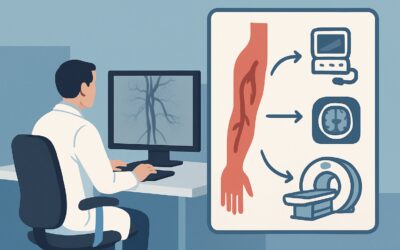
For a patient requiring planning for pre-endovascular repair (EVAR) or open repair of AAA, the ACR rates both CTA abdomen and pelvis with IV contrast and MRA abdomen and pelvis without and with IV contrast as Usually appropriate. CTA is often the workhorse for pre-procedural planning due to its high spatial resolution, rapid acquisition time, and excellent visualization of calcifications and vessel anatomy, which are critical for determining device suitability and landing zones. MRA is a strong alternative, particularly for patients with contraindications to iodinated contrast, as it avoids ionizing radiation but may have limitations in assessing calcific plaque.
For routine follow-up for post-endovascular repair (EVAR) or open repair of AAA, the same two studies—CTA abdomen and pelvis with IV contrast and MRA abdomen and pelvis without and with IV contrast—are also considered Usually appropriate. Post-EVAR surveillance is crucial for detecting complications, with endoleaks being a primary concern. CTA excels at identifying endoleaks, measuring aneurysm sac size, and evaluating the stent-graft components. MRA offers a radiation-free alternative for long-term surveillance, though specific protocols are needed to minimize artifacts from the endograft. Duplex ultrasound is rated May be appropriate and is often used in alternating fashion with CTA or MRA for long-term follow-up to reduce cumulative radiation dose, though it is less sensitive for detecting certain types of endoleaks.
ACR Imaging Recommendations Table
| Clinical Scenario | Top Procedure | ACR Rating | Adult RRL | Pediatric RRL |
|---|---|---|---|---|
| Planning for pre-endovascular repair (EVAR) or open repair of AAA. | CTA abdomen and pelvis with IV contrast | Usually appropriate | ☢ ☢ ☢ ☢ 10-30 mSv | |
| Follow-up for post-endovascular repair (EVAR) or open repair of AAA. | CTA abdomen and pelvis with IV contrast | Usually appropriate | ☢ ☢ ☢ ☢ 10-30 mSv |
Adult vs. Pediatric Abdominal Aortic Aneurysm or Dissection-Interventional Planning and Follow-up Imaging: Radiation Dose Tradeoffs
Abdominal aortic aneurysms and dissections are exceedingly rare in the pediatric population, typically occurring only in the context of specific genetic syndromes (e.g., Marfan syndrome, Loeys-Dietz syndrome), vasculitis, or trauma. Consequently, the ACR guidelines for this topic are primarily focused on the adult population, where AAA is a disease of aging and atherosclerosis. The provided relative radiation level (RRL) data reflects this adult focus.
While pediatric-specific recommendations are not detailed for these scenarios, any imaging in children and young adults necessitates a strict adherence to the As Low As Reasonably Achievable (ALARA) principle. If cross-sectional imaging is required, MRA is strongly preferred over CTA to eliminate ionizing radiation exposure. When CTA is unavoidable, pediatric-specific protocols that adjust technical parameters (e.g., kVp, mAs) to the patient’s size are mandatory to minimize radiation dose. The cumulative radiation dose from lifelong surveillance is a significant concern in any young patient with an aortic condition, making non-radiation modalities like MRA and ultrasound the cornerstones of follow-up whenever diagnostically sufficient.
Imaging Protocol Details for Abdominal Aortic Aneurysm or Dissection-Interventional Planning and Follow-up
Once you’ve decided on the right study, the technical protocol is critical for obtaining diagnostic-quality images. Key considerations for AAA imaging include the timing of contrast phases, slice thickness, and the field of view needed to assess access vessels. Our protocol guides cover technique, contrast, and interpretation principles for the studies recommended above:
Tools to Help You Order the Right Study
For clinical scenarios beyond abdominal aortic aneurysm planning and follow-up, or for quick access to protocol details and dose information, these GigHz tools can streamline your workflow.
The Imaging Appropriateness Selector provides a searchable interface for the full library of ACR guidelines, covering thousands of clinical variants across all organ systems. It’s designed to help you find the right study for your patient’s specific presentation quickly.
Our Imaging Protocol Library offers detailed, step-by-step protocols for hundreds of common and advanced imaging procedures. Use it to understand the technical details behind the studies you order, from patient prep and contrast timing to reconstruction parameters.
The Radiation Dose Calculator helps you estimate effective radiation dose for various imaging studies. This tool is valuable for tracking cumulative exposure in patients requiring long-term surveillance and for facilitating informed discussions with patients about the risks and benefits of imaging.
Frequently Asked Questions (FAQ)
Why is CTA often preferred over MRA for pre-EVAR planning?
CTA is frequently the first choice for pre-EVAR planning due to its superior spatial resolution, rapid acquisition speed, and excellent ability to visualize vessel wall calcification. These details are critical for accurate measurements of the aortic neck diameter, length, and angulation, as well as for assessing the iliofemoral access vessels. While MRA is a viable radiation-free alternative, it can be more susceptible to motion artifact and may not depict calcification as clearly, which is important for predicting the behavior of the aortic neck during device deployment.
What is an endoleak, and why is imaging surveillance after EVAR so important?
An endoleak is the persistence of blood flow into the aneurysm sac outside of the endograft after EVAR. This can lead to continued pressurization of the sac and risk of rupture. There are five types of endoleaks. Imaging surveillance, typically with multiphase CTA, is critical to detect and characterize endoleaks, monitor the aneurysm sac for size changes, and ensure the integrity and position of the stent-graft components over time.
What is the role of a non-contrast CT in AAA imaging?
A non-contrast CT phase, acquired before the administration of IV contrast, is a crucial part of a standard CTA protocol for both pre-EVAR planning and post-EVAR follow-up. In planning, it helps identify calcification and intramural hematoma. In follow-up, it serves as a baseline to distinguish pre-existing calcification from a new, subtle endoleak that might otherwise be obscured on contrast-enhanced images alone.
When is conventional catheter aortography used for AAA?
While largely replaced by CTA and MRA for diagnostic purposes, conventional aortography remains essential as an intra-procedural tool. It is used during the EVAR procedure itself for real-time visualization of anatomy, device deployment, and immediate assessment for endoleaks. It may also be used as a problem-solving tool when non-invasive imaging findings are equivocal or for planning complex endovascular interventions.
Can duplex ultrasound be used for all post-EVAR follow-up?
Duplex ultrasound is a valuable, non-radiation tool for post-EVAR surveillance and is rated as May be appropriate. It is effective for measuring aneurysm sac diameter and can detect many types of endoleaks. However, it is operator-dependent and can be limited by patient body habitus or bowel gas. It is less sensitive than CTA for detecting certain low-flow endoleaks (especially Type II). For these reasons, many surveillance protocols alternate ultrasound with CTA or MRA to provide a more comprehensive long-term assessment.
Reviewed by Pouyan Golshani, MD, Interventional Radiologist — May 26, 2026