When to Order Imaging for Preoperative and Postoperative Imaging for Bariatric Procedures: ACR Appropriateness Decoded

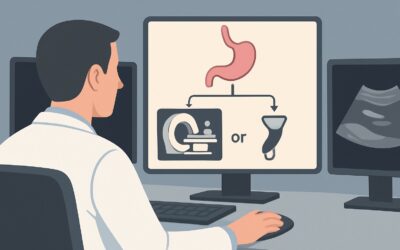
You are on call, evaluating a patient who underwent a Roux-en-Y gastric bypass two days ago and now presents with tachycardia, fever, and diffuse abdominal pain. An anastomotic leak is high on the differential, but the patient’s body habitus makes the physical exam challenging. You need to decide between a fluoroscopic upper gastrointestinal (GI) series and a computed tomography (CT) scan of the abdomen and pelvis. Each has its benefits and drawbacks for detecting a leak, and the choice has immediate implications for management. This scenario highlights the critical need for clear, evidence-based guidance. The American College of Radiology (ACR) Appropriateness Criteria offer a systematic framework for these decisions, outlining the optimal imaging pathways for patients before and after bariatric surgery.
What Does ACR Preoperative and Postoperative Imaging for Bariatric Procedures Cover?
This ACR guideline focuses on selecting the most appropriate imaging modalities for adults undergoing evaluation for or having undergone bariatric surgical procedures. The criteria are organized into distinct clinical variants that address common decision points in patient care. These include routine preoperative anatomical assessment, immediate postoperative evaluation to establish a new baseline, and urgent assessment for suspected complications following both standard and less-invasive bariatric interventions.
The guidance specifically addresses common procedures like sleeve gastrectomy and gastric bypass. It helps clinicians differentiate the roles of fluoroscopy, CT, ultrasound, and MRI in these contexts. This topic does not cover long-term follow-up for weight regain, nutritional deficiencies, or imaging for non-bariatric abdominal surgery. It is narrowly focused on the perioperative period, where questions of anatomy, staple line integrity, and acute complications like leaks, bleeds, or obstructions are paramount.
What Imaging Should I Order for Preoperative and Postoperative Imaging for Bariatric Procedures? Recommendations by Clinical Scenario
Imaging choices in the bariatric surgery patient depend entirely on the clinical context—whether it is for routine planning, immediate postoperative assessment, or suspicion of an acute complication.
For an adult undergoing routine preprocedure planning for a bariatric procedure, the ACR panel finds that fluoroscopic studies such as a biphasic esophagram, single contrast esophagram, or an upper GI series May be appropriate. These studies are primarily used to evaluate for preexisting anatomical abnormalities like a hiatal hernia, esophageal dysmotility, or gastric pathology that could influence the surgical approach. In this routine, non-urgent setting, modalities like CT, MRI, and ultrasound are considered Usually not appropriate as they provide less functional information and may involve unnecessary radiation or cost.
In the routine immediate postprocedure evaluation, the goal is often to assess the new anatomy and check for early, clinically silent leaks. For this scenario, a fluoroscopy upper GI series May be appropriate. Some institutions perform this routinely before initiating an oral diet. Abdominal and pelvic CT, either with or without IV contrast, also May be appropriate, particularly if there is a low-grade clinical concern or if the surgical team desires cross-sectional imaging to establish a baseline.
When a complication is suspected after a less-invasive bariatric procedure, several imaging options May be appropriate. These include a fluoroscopy upper GI series to look for a leak or obstruction, abdominal and pelvic radiography to assess for free air or ileus, and CT of the abdomen and pelvis with or without IV contrast. The choice depends on the specific suspected complication and institutional preference.
For a patient with a suspected complication after a standard bariatric procedure (e.g., gastric bypass), the guidelines are more definitive. A CT abdomen and pelvis with IV contrast is rated as Usually appropriate. This study is the workhorse for evaluating for leaks, abscesses, internal hernias, and bowel obstruction, providing comprehensive anatomical detail. A fluoroscopy upper GI series May be appropriate as a complementary study or initial test for a suspected leak, but CT is often required for definitive diagnosis and to evaluate for extraluminal collections.
ACR Imaging Recommendations Table
| Clinical Scenario | Top Procedure | ACR Rating | Adult RRL | Pediatric RRL |
|---|---|---|---|---|
| Adult. Bariatric procedure. Routine preprocedure planning. | Fluoroscopy upper GI series | May be appropriate | ☢ ☢ ☢ 1-10 mSv | ☢ ☢ ☢ 0.3-3 mSv [ped] |
| Adult. Bariatric procedure. Routine immediate postprocedure evaluation. | Fluoroscopy upper GI series | May be appropriate | ☢ ☢ ☢ 1-10 mSv | ☢ ☢ ☢ 0.3-3 mSv [ped] |
| Adult. Less-invasive bariatric procedure. Suspected complication. Postprocedure evaluation. | CT abdomen and pelvis with IV contrast | May be appropriate | ☢ ☢ ☢ 1-10 mSv | ☢ ☢ ☢ ☢ 3-10 mSv [ped] |
| Adult. Bariatric procedure. Suspected complication. Postprocedure evaluation. | CT abdomen and pelvis with IV contrast | Usually appropriate | ☢ ☢ ☢ 1-10 mSv | ☢ ☢ ☢ ☢ 3-10 mSv [ped] |
Adult vs. Pediatric Preoperative and Postoperative Imaging for Bariatric Procedures Imaging: Radiation Dose Tradeoffs
While bariatric surgery is less common in adolescents than in adults, it is an established treatment for severe obesity in this population. The ACR guidelines provide pediatric-specific relative radiation level (RRL) estimates, reflecting the critical importance of the As Low As Reasonably Achievable (ALARA) principle in younger patients. Children and adolescents have a longer life expectancy, which increases their lifetime risk of potential harm from ionizing radiation. Their developing tissues are also more radiosensitive than those of adults.
For this reason, clinicians must be particularly judicious when ordering studies involving radiation, such as CT and fluoroscopy. The pediatric RRLs provided in the guidelines are often in a higher category or have a different dose range compared to adults for the same study, highlighting the need for pediatric-specific protocols designed to minimize dose. For any given study, the absolute radiation dose should be tailored to the patient’s size. Non-ionizing alternatives like ultrasound or MRI, though rated as Usually not appropriate for most bariatric surgery scenarios, should always be considered if they can answer the clinical question without compromising diagnostic accuracy.
Imaging Protocol Details for Preoperative and Postoperative Imaging for Bariatric Procedures
Once you’ve decided on the right study, the protocol matters. A CT ordered for a suspected anastomotic leak requires specific oral contrast timing and scan parameters that differ from a scan for a bowel obstruction. Our protocol guides cover technique, contrast, and reading principles for the studies recommended above:
Tools to Help You Order the Right Study
Selecting the correct imaging study from a long list of possibilities can be challenging. GigHz offers several tools to support evidence-based clinical decision-making and streamline the ordering process.
For clinical scenarios beyond preoperative and postoperative imaging for bariatric procedures, the Imaging Appropriateness Selector tool provides instant access to the full library of ACR guidelines, covering thousands of clinical variants across all organ systems. This helps ensure you are always aligning your orders with expert consensus recommendations.
To ensure the selected study is performed correctly, the Imaging Protocol Library offers detailed, modality-specific protocols. These guides provide the necessary technical parameters for radiologic technologists and radiologists to optimize image quality and diagnostic yield for the specific clinical question at hand.
When discussing imaging options with patients, especially those involving radiation, the Radiation Dose Calculator is an invaluable resource. It helps estimate cumulative radiation exposure from various imaging studies, facilitating informed conversations about the risks and benefits of a recommended diagnostic plan.
Why is CT with IV contrast the preferred study for suspected complications after bariatric surgery?
CT with both intravenous (IV) and oral contrast is rated Usually appropriate because it provides the most comprehensive evaluation. IV contrast helps identify inflammatory changes, abscesses, and vascular complications like bleeding. Oral contrast is crucial for detecting anastomotic leaks by visualizing extraluminal spillage. Furthermore, CT excels at diagnosing other common serious complications, such as internal hernias and small bowel obstructions, which may not be visible on fluoroscopy.
Is routine preoperative imaging always necessary before bariatric surgery?
No, it is not universally required. The ACR rates preoperative fluoroscopic studies as May be appropriate, not Usually appropriate. The decision to perform a preoperative upper GI series or esophagram is often surgeon-dependent and based on patient symptoms. It is used to screen for significant pathology like a large hiatal hernia, achalasia, or masses that might alter the planned surgical procedure. Many asymptomatic patients proceed to surgery without any preoperative GI imaging.
What is the difference in utility between a fluoroscopic upper GI series and a CT scan for a suspected leak?
A fluoroscopic upper GI (UGI) series is a dynamic study excellent for identifying the presence and location of a leak in real-time as the patient drinks contrast. It can detect even small leaks and provides functional information about gastric emptying. However, it cannot visualize the extraluminal space well and may not identify an associated abscess. A CT scan, on the other hand, is superior for visualizing the consequences of a leak, such as fluid collections and abscesses that may require drainage. It also provides a global view of the abdomen to rule out other complications. Often, the two tests are complementary.
When should oral contrast be used with CT for postoperative bariatric patients?
Oral contrast is essential when there is a clinical suspicion of an anastomotic leak or a fistula. Water-soluble contrast (e.g., diatrizoate meglumine) is used. The contrast helps to opacify the bowel lumen, and any extravasation into the peritoneal cavity or a collection can be directly visualized on the CT images, confirming the diagnosis. For other indications, such as a suspected internal hernia or bowel obstruction, oral contrast can also help delineate the course of the bowel and identify the transition point.
Are there any non-radiation alternatives for evaluating bariatric surgery complications?
While CT and fluoroscopy are the primary modalities, non-radiation alternatives have limited but specific roles. Abdominal ultrasound is rated Usually not appropriate for a primary evaluation due to its limitations from bowel gas and the patient’s body habitus. However, it can be useful for guiding the drainage of a known fluid collection or abscess that was first identified by CT. MRI is also rated Usually not appropriate for acute complications due to longer scan times, patient motion artifacts, and less sensitivity for subtle free air, but it may be used in select cases or for long-term follow-up in stable patients, particularly to avoid repeated radiation exposure.
Frequently Asked Questions
Why is CT with IV contrast the preferred study for suspected complications after bariatric surgery?
CT with both intravenous (IV) and oral contrast is rated Usually appropriate because it provides the most comprehensive evaluation. IV contrast helps identify inflammatory changes, abscesses, and vascular complications like bleeding. Oral contrast is crucial for detecting anastomotic leaks by visualizing extraluminal spillage. Furthermore, CT excels at diagnosing other common serious complications, such as internal hernias and small bowel obstructions, which may not be visible on fluoroscopy.
Is routine preoperative imaging always necessary before bariatric surgery?
No, it is not universally required. The ACR rates preoperative fluoroscopic studies as May be appropriate, not Usually appropriate. The decision to perform a preoperative upper GI series or esophagram is often surgeon-dependent and based on patient symptoms. It is used to screen for significant pathology like a large hiatal hernia, achalasia, or masses that might alter the planned surgical procedure. Many asymptomatic patients proceed to surgery without any preoperative GI imaging.
What is the difference in utility between a fluoroscopic upper GI series and a CT scan for a suspected leak?
A fluoroscopic upper GI (UGI) series is a dynamic study excellent for identifying the presence and location of a leak in real-time as the patient drinks contrast. It can detect even small leaks and provides functional information about gastric emptying. However, it cannot visualize the extraluminal space well and may not identify an associated abscess. A CT scan, on the other hand, is superior for visualizing the consequences of a leak, such as fluid collections and abscesses that may require drainage. It also provides a global view of the abdomen to rule out other complications. Often, the two tests are complementary.
When should oral contrast be used with CT for postoperative bariatric patients?
Oral contrast is essential when there is a clinical suspicion of an anastomotic leak or a fistula. Water-soluble contrast (e.g., diatrizoate meglumine) is used. The contrast helps to opacify the bowel lumen, and any extravasation into the peritoneal cavity or a collection can be directly visualized on the CT images, confirming the diagnosis. For other indications, such as a suspected internal hernia or bowel obstruction, oral contrast can also help delineate the course of the bowel and identify the transition point.
Are there any non-radiation alternatives for evaluating bariatric surgery complications?
While CT and fluoroscopy are the primary modalities, non-radiation alternatives have limited but specific roles. Abdominal ultrasound is rated Usually not appropriate for a primary evaluation due to its limitations from bowel gas and the patient’s body habitus. However, it can be useful for guiding the drainage of a known fluid collection or abscess that was first identified by CT. MRI is also rated Usually not appropriate for acute complications due to longer scan times, patient motion artifacts, and less sensitivity for subtle free air, but it may be used in select cases or for long-term follow-up in stable patients, particularly to avoid repeated radiation exposure.
Reviewed by Pouyan Golshani, MD, Interventional Radiologist — May 26, 2026