When to Order Imaging for Staging and Follow-up of Gastric Cancer: ACR Appropriateness Decoded

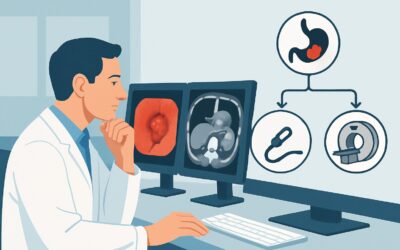
You’re evaluating a patient with newly diagnosed gastric adenocarcinoma, confirmed on endoscopy. The next critical step is staging, which will determine the entire course of treatment, from neoadjuvant therapy to surgical approach. The question is which imaging study to order first. Do you start with a CT of the abdomen and pelvis, or is a PET/CT necessary from the outset? What about follow-up after treatment? Choosing the right initial and subsequent imaging is crucial for accurate assessment of locoregional disease, nodal involvement, and distant metastases, directly impacting patient outcomes. This guide decodes the American College of Radiology (ACR) Appropriateness Criteria to help you make evidence-based decisions for imaging in gastric cancer.
What Does ACR Staging and Follow-up of Gastric Cancer Cover?
This ACR guideline focuses specifically on the use of diagnostic imaging for adults with known or suspected gastric adenocarcinoma. The recommendations are structured around four distinct clinical phases: initial imaging after diagnosis, comprehensive staging for locoregional and distant metastases, posttreatment evaluation to assess response, and long-term surveillance for recurrence. The criteria are designed to guide imaging selection for adenocarcinoma, the most common type of gastric malignancy.
These guidelines do not cover imaging for other gastric tumors, such as gastrointestinal stromal tumors (GIST), lymphomas, or neuroendocrine tumors, which have different patterns of spread and imaging characteristics. They also do not address the initial diagnosis of gastric cancer, which is typically made via esophagogastroduodenoscopy (EGD) with biopsy, nor do they cover screening protocols in high-risk populations. The focus remains on staging and follow-up once a diagnosis of adenocarcinoma is established.
What Imaging Should I Order for Staging and Follow-up of Gastric Cancer? Recommendations by Clinical Scenario
For the initial imaging of a patient with suspected gastric adenocarcinoma, the ACR designates both CT of the abdomen and pelvis with IV contrast and FDG-PET/CT from the skull base to mid-thigh as Usually appropriate. CT is the workhorse for evaluating the extent of the primary tumor, adjacent organ invasion, regional lymphadenopathy, and common sites of distant metastases like the liver and peritoneum. FDG-PET/CT is highly sensitive for detecting occult distant metastatic disease that could upstage the patient and alter management from curative to palliative intent.
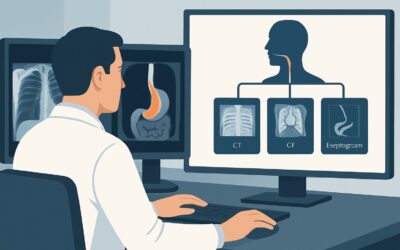
When the clinical question is specifically staging for locoregional or distant metastases, the recommendations are identical. CT abdomen and pelvis with IV contrast and FDG-PET/CT are again rated Usually appropriate. A dedicated CT chest with IV contrast is considered May be appropriate to evaluate for pulmonary metastases. MRI of the abdomen and pelvis may also be appropriate in select cases, particularly for characterizing liver lesions or in patients with contraindications to iodinated contrast.
For posttreatment evaluation, both CT abdomen and pelvis with IV contrast and FDG-PET/CT are once again Usually appropriate. CT is effective for assessing morphologic changes and tumor size after therapy, while PET/CT is valuable for evaluating metabolic response, which can precede changes in size and help differentiate post-treatment inflammation or fibrosis from residual viable tumor.
In the context of long-term surveillance of gastric adenocarcinoma, CT abdomen and pelvis with IV contrast is the primary modality rated as Usually appropriate. It provides a reliable baseline and follow-up assessment for detecting local recurrence or metastatic disease. FDG-PET/CT is considered May be appropriate in this setting, often reserved for cases where CT findings are equivocal or when there is a clinical or biochemical suspicion of recurrence not localized by CT.
Across all scenarios, modalities like abdominal ultrasound, radiography, and fluoroscopy are rated Usually not appropriate due to their limited ability to comprehensively stage the disease.
ACR Imaging Recommendations Table
| Clinical Scenario | Top Procedure | ACR Rating | Adult RRL | Pediatric RRL |
|---|---|---|---|---|
| Adult. Suspected gastric adenocarcinoma. Initial imaging. | CT abdomen and pelvis with IV contrast | Usually appropriate | ☢ ☢ ☢ 1-10 mSv | ☢ ☢ ☢ ☢ 3-10 mSv [ped] |
| Adult. Gastric adenocarcinoma. Staging for locoregional or distant metastases. | CT abdomen and pelvis with IV contrast | Usually appropriate | ☢ ☢ ☢ 1-10 mSv | ☢ ☢ ☢ ☢ 3-10 mSv [ped] |
| Adult. Gastric adenocarcinoma. Posttreatment evaluation. | CT abdomen and pelvis with IV contrast | Usually appropriate | ☢ ☢ ☢ 1-10 mSv | ☢ ☢ ☢ ☢ 3-10 mSv [ped] |
| Adult. Surveillance of gastric adenocarcinoma. | CT abdomen and pelvis with IV contrast | Usually appropriate | ☢ ☢ ☢ 1-10 mSv | ☢ ☢ ☢ ☢ 3-10 mSv [ped] |
Adult vs. Pediatric Staging and Follow-up of Gastric Cancer Imaging: Radiation Dose Tradeoffs
While gastric adenocarcinoma is exceedingly rare in the pediatric population, the principles of radiation safety are paramount when imaging younger patients for any reason. The ACR provides distinct Relative Radiation Level (RRL) categories for pediatric patients to highlight their increased radiosensitivity and the greater lifetime attributable risk of cancer from ionizing radiation. For a given study, such as a CT of the abdomen and pelvis, the measured radiation dose in millisieverts (mSv) may be similar or lower for a child due to size-based protocol adjustments, but the RRL category is often higher (e.g., ☢ ☢ ☢ ☢ for pediatric vs. ☢ ☢ ☢ for adult).
This higher RRL signifies a greater biological risk for the same dose. Therefore, adherence to the As Low As Reasonably Achievable (ALARA) principle is critical. For any pediatric patient requiring oncologic staging, each imaging study involving ionizing radiation must be carefully justified. Non-radiation modalities like MRI, though rated May be appropriate or Usually not appropriate in some adult gastric cancer scenarios, may be considered more strongly in pediatric cases if they can provide the necessary diagnostic information without compromising diagnostic accuracy.
Imaging Protocol Details for Staging and Follow-up of Gastric Cancer
Once you’ve decided on the right study, the specific imaging protocol is essential for obtaining high-quality, diagnostic images. Key considerations include the phase of IV contrast administration, the use of oral contrast to distend the stomach, and slice thickness. Our protocol guides provide detailed, scannable information on technique, contrast, and interpretation principles for the studies recommended in these guidelines.
Tools to Help You Order the Right Study
Navigating imaging guidelines and protocols can be complex. GigHz offers a suite of free reference tools designed to support clinical decision-making at the point of care.
The Imaging Appropriateness Selector provides direct access to the full ACR guidelines for hundreds of clinical variants beyond gastric cancer, helping you find evidence-based recommendations for virtually any clinical scenario you encounter.
Our Imaging Protocol Library is a comprehensive resource for detailed procedural protocols. It offers guidance on patient preparation, scanner settings, and contrast administration for a wide range of CT, MRI, and other imaging studies.
To help with patient communication and tracking cumulative exposure, the Radiation Dose Calculator allows you to estimate effective dose for common imaging studies and explain the associated risks to patients in an understandable way.
Why is CT the primary imaging modality for gastric cancer staging?
Contrast-enhanced CT of the abdomen and pelvis is considered the workhorse for staging gastric cancer due to its wide availability, rapid acquisition time, and excellent spatial resolution. It is highly effective for assessing the local extent of the tumor, invasion of adjacent structures, regional lymph node involvement, and distant metastases, particularly to the liver, lungs (with chest imaging), and peritoneum.
When is FDG-PET/CT most useful in managing gastric cancer?
FDG-PET/CT is most valuable for detecting occult distant metastases that are not apparent on conventional CT imaging. Identifying these metastases at initial staging is critical, as it can upstage the patient and change the treatment plan from curative-intent surgery to systemic or palliative therapy. It is also highly useful for assessing treatment response, as a decrease in metabolic activity (FDG uptake) can be an early indicator of tumor response to chemotherapy or radiation.
What is the role of endoscopic ultrasound (EUS) in staging?
Endoscopic ultrasound (EUS) provides high-resolution imaging of the gastric wall and perigastric lymph nodes. It is considered the most accurate modality for determining the depth of tumor invasion (T stage) and evaluating local lymph nodes (N stage). While it is excellent for locoregional staging, it cannot assess for distant metastases. For this reason, it is often used as a complementary tool to cross-sectional imaging like CT or PET/CT, rather than a replacement. The ACR notes panel disagreement on its role for initial imaging, reflecting its invasive nature and operator dependency.
Why isn’t MRI routinely recommended for gastric cancer staging?
While MRI can be excellent for problem-solving, particularly for characterizing indeterminate liver lesions, it is not typically the first-line modality for primary gastric cancer staging. Compared to CT, MRI scans are longer, more susceptible to motion artifact from breathing and peristalsis, and may be less available in emergent settings. However, it is a valuable alternative for patients who have a severe allergy to iodinated contrast media or in whom radiation exposure is a significant concern.
Is a dedicated chest CT always necessary for staging?
A dedicated chest CT is rated as May be appropriate for staging. The lungs are a potential site of metastasis for gastric cancer. Often, the initial staging CT of the abdomen and pelvis will include the lung bases, which can be reviewed for suspicious nodules. A full, dedicated chest CT may be performed if the lung bases are inconclusive, if the patient has pulmonary symptoms, or as part of an institution’s standard oncologic staging protocol to ensure a comprehensive search for metastatic disease.
Frequently Asked Questions
Why is CT the primary imaging modality for gastric cancer staging?
Contrast-enhanced CT of the abdomen and pelvis is considered the workhorse for staging gastric cancer due to its wide availability, rapid acquisition time, and excellent spatial resolution. It is highly effective for assessing the local extent of the tumor, invasion of adjacent structures, regional lymph node involvement, and distant metastases, particularly to the liver, lungs (with chest imaging), and peritoneum.
When is FDG-PET/CT most useful in managing gastric cancer?
FDG-PET/CT is most valuable for detecting occult distant metastases that are not apparent on conventional CT imaging. Identifying these metastases at initial staging is critical, as it can upstage the patient and change the treatment plan from curative-intent surgery to systemic or palliative therapy. It is also highly useful for assessing treatment response, as a decrease in metabolic activity (FDG uptake) can be an early indicator of tumor response to chemotherapy or radiation.
What is the role of endoscopic ultrasound (EUS) in staging?
Endoscopic ultrasound (EUS) provides high-resolution imaging of the gastric wall and perigastric lymph nodes. It is considered the most accurate modality for determining the depth of tumor invasion (T stage) and evaluating local lymph nodes (N stage). While it is excellent for locoregional staging, it cannot assess for distant metastases. For this reason, it is often used as a complementary tool to cross-sectional imaging like CT or PET/CT, rather than a replacement. The ACR notes panel disagreement on its role for initial imaging, reflecting its invasive nature and operator dependency.
Why isn’t MRI routinely recommended for gastric cancer staging?
While MRI can be excellent for problem-solving, particularly for characterizing indeterminate liver lesions, it is not typically the first-line modality for primary gastric cancer staging. Compared to CT, MRI scans are longer, more susceptible to motion artifact from breathing and peristalsis, and may be less available in emergent settings. However, it is a valuable alternative for patients who have a severe allergy to iodinated contrast media or in whom radiation exposure is a significant concern.
Is a dedicated chest CT always necessary for staging?
A dedicated chest CT is rated as May be appropriate for staging. The lungs are a potential site of metastasis for gastric cancer. Often, the initial staging CT of the abdomen and pelvis will include the lung bases, which can be reviewed for suspicious nodules. A full, dedicated chest CT may be performed if the lung bases are inconclusive, if the patient has pulmonary symptoms, or as part of an institution’s standard oncologic staging protocol to ensure a comprehensive search for metastatic disease.
Reviewed by Pouyan Golshani, MD, Interventional Radiologist — May 26, 2026