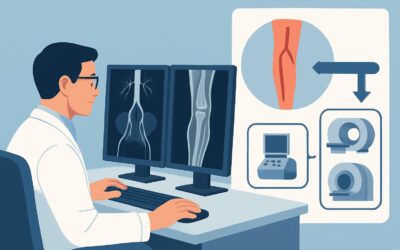
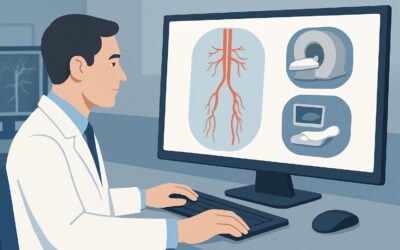
When to Order Imaging for Thoracoabdominal Aortic Aneurysm or Dissection: Treatment Planning and Follow-Up: ACR Appropriateness Decoded

A patient presents with a known thoracoabdominal aortic aneurysm (TAAA) and new, vague back pain. Another requires preoperative planning for an endovascular repair. A third is six months post-op from an open repair and needs routine surveillance. In each case, selecting the correct imaging modality is critical for patient safety and effective management. Choosing between computed tomography angiography (CTA) and magnetic resonance angiography (MRA), with or without contrast, and understanding the significant radiation dose implications requires clear, evidence-based guidance. This article decodes the American College of Radiology (ACR) Appropriateness Criteria for these common clinical scenarios, providing a framework to help you order the right study confidently and efficiently.
What Does ACR Thoracoabdominal Aortic Aneurysm or Dissection: Treatment Planning and Follow-Up Cover?
This ACR guideline, developed by the Interventional Radiology expert panel, focuses specifically on the use of diagnostic imaging for managing known or suspected thoracoabdominal aortic aneurysms or dissections. The criteria address four distinct clinical phases: surveillance of an unrepaired aorta, preoperative planning for both endovascular and open surgical repair, and postoperative follow-up after each type of intervention. The recommendations are designed to guide clinicians in obtaining the necessary anatomical detail—including aneurysm size, extent, branch vessel involvement, and potential endoleaks—while balancing diagnostic yield with risks like radiation exposure and contrast-induced nephropathy. This topic does not cover the initial diagnosis of an acute aortic syndrome in a previously undiagnosed patient, nor does it address isolated thoracic or abdominal aortic pathology; its scope is confined to the thoracoabdominal segment.
What Imaging Should I Order for Thoracoabdominal Aortic Aneurysm or Dissection: Treatment Planning and Follow-Up? Recommendations by Clinical Scenario
The optimal imaging study depends entirely on the clinical context, from initial surveillance to post-procedural follow-up. The ACR provides clear recommendations for each situation.
For a patient requiring follow-up of a known thoracoabdominal aortic aneurysm or dissection without repair, whether they have new symptoms or not, the ACR rates both CTA chest abdomen pelvis with IV contrast and MRA chest abdomen pelvis without and with IV contrast as Usually appropriate. These modalities provide excellent anatomical detail to assess for interval growth, extension of dissection, or other complications. An MRA without contrast is also rated Usually appropriate, making it a strong alternative for patients with contraindications to gadolinium or severe renal impairment.
When planning for endovascular or open repair of a thoracoabdominal aorta aneurysm or dissection, high-resolution cross-sectional imaging is paramount. Again, CTA chest abdomen pelvis with IV contrast is rated Usually appropriate. It is often the workhorse for precise measurements of aortic diameter, landing zones, and branch vessel anatomy, which are essential for device sizing and surgical planning. MRA chest abdomen pelvis without and with IV contrast is also Usually appropriate and serves as an excellent non-ionizing radiation alternative, though CTA is frequently preferred for its speed and spatial resolution.
In the context of follow-up after endovascular repair of a thoracoabdominal aortic aneurysm or dissection, surveillance for endoleaks, graft migration, or aneurysm sac changes is the primary goal. CTA chest abdomen pelvis with IV contrast is Usually appropriate for its ability to clearly delineate the stent graft and detect contrast extravasation. MRA chest abdomen pelvis without and with IV contrast is also Usually appropriate, particularly for patients requiring frequent follow-up to minimize cumulative radiation dose or for those with specific graft materials compatible with MRI.
Similarly, for follow-up after open repair of a thoracoabdominal aortic aneurysm or dissection, both CTA chest abdomen pelvis with IV contrast and MRA chest abdomen pelvis without and with IV contrast are rated Usually appropriate. These studies are used to assess the integrity of the surgical anastomosis, detect pseudoaneurysms, and monitor any remaining native aorta.
ACR Imaging Recommendations Table
| Clinical Scenario | Top Procedure | ACR Rating | Adult RRL | Pediatric RRL |
|---|---|---|---|---|
| Follow-up of known thoracoabdominal aortic aneurysm or dissection without repair. Without or with new symptoms. | CTA chest abdomen pelvis with IV contrast | Usually appropriate | ☢ ☢ ☢ ☢ ☢ 30-100 mSv | ☢ ☢ ☢ ☢ ☢ 10-30 mSv [ped] |
| Planning for endovascular or open repair of thoracoabdominal aorta aneurysm or dissection. | CTA chest abdomen pelvis with IV contrast | Usually appropriate | ☢ ☢ ☢ ☢ ☢ 30-100 mSv | ☢ ☢ ☢ ☢ ☢ 10-30 mSv [ped] |
| Follow-up after endovascular repair of thoracoabdominal aortic aneurysm or dissection. | CTA chest abdomen pelvis with IV contrast | Usually appropriate | ☢ ☢ ☢ ☢ ☢ 30-100 mSv | ☢ ☢ ☢ ☢ ☢ 10-30 mSv [ped] |
| Follow-up after open repair of thoracoabdominal aortic aneurysm or dissection. | CTA chest abdomen pelvis with IV contrast | Usually appropriate | ☢ ☢ ☢ ☢ ☢ 30-100 mSv | ☢ ☢ ☢ ☢ ☢ 10-30 mSv [ped] |
Adult vs. Pediatric Thoracoabdominal Aortic Aneurysm or Dissection: Treatment Planning and Follow-Up Imaging: Radiation Dose Tradeoffs
While thoracoabdominal aortic aneurysms are rare in children, they can occur in the context of genetic conditions like Marfan syndrome or Loeys-Dietz syndrome. For these patients, lifelong imaging surveillance is often necessary, making cumulative radiation exposure a significant concern. The ACR guidelines reflect this by providing distinct pediatric Relative Radiation Level (RRL) estimates, underscoring the importance of the As Low As Reasonably Achievable (ALARA) principle.
For example, a standard CT of the chest, abdomen, and pelvis with IV contrast carries a pediatric RRL of ☢ ☢ ☢ ☢ (3-10 mSv), which is a lower tier than the adult equivalent. The highest-dose study, CTA of the chest, abdomen, and pelvis, is estimated at ☢ ☢ ☢ ☢ ☢ (10-30 mSv) in children, compared to 30-100 mSv in adults. This highlights the critical need for pediatric-specific CT protocols that are optimized to reduce dose. Given these considerations, MRA, which involves no ionizing radiation (RRL of O), is an especially valuable tool in the pediatric population for both initial planning and long-term follow-up, provided the patient can tolerate the longer scan times and there are no contraindications.
Imaging Protocol Details for Thoracoabdominal Aortic Aneurysm or Dissection: Treatment Planning and Follow-Up
Once you’ve decided on the right study, the specific imaging protocol is crucial for diagnostic accuracy. Key parameters like contrast timing, slice thickness, and reconstruction planes can mean the difference between a definitive surgical plan and an equivocal report. Our protocol guides cover technique, contrast considerations, and interpretation principles for the studies recommended above:
Tools to Help You Order the Right Study
Navigating imaging guidelines and protocols can be complex. GigHz offers a suite of reference tools designed to support clinical decision-making at the point of care. These resources help ensure that every imaging order is evidence-based, safe, and appropriate for the clinical question at hand.
The Imaging Appropriateness Selector provides direct access to the full, searchable ACR guidelines for hundreds of clinical variants beyond thoracoabdominal aortic disease, helping you find recommendations for virtually any clinical scenario you encounter.
For detailed procedural specifics, the Imaging Protocol Library offers in-depth guides on how to perform the recommended studies, covering patient prep, scanner parameters, and post-processing techniques used at leading academic centers.
To facilitate conversations with patients about radiation exposure and to track cumulative dose over time, the Radiation Dose Calculator provides a simple way to estimate and explain the exposure associated with common diagnostic imaging tests.
Frequently Asked Questions
Here are some common questions clinicians have when ordering imaging for thoracoabdominal aortic aneurysm or dissection.
Why is CTA often preferred over MRA for preoperative planning?
While both are rated “Usually appropriate,” CTA is frequently favored for preoperative planning due to its rapid acquisition speed, superior spatial resolution, and widespread availability. It provides extremely detailed images of the aortic anatomy, branch vessels, and calcification, which are critical for precise measurements needed for endograft sizing or planning open surgical approaches. MRA is an excellent alternative, especially for reducing radiation dose, but can be more susceptible to motion artifact and may have limitations in assessing vessel wall calcification.
What does the rating “May be appropriate (Disagreement)” signify?
This rating indicates that the expert panel had a notable division of opinion. While some panelists felt the procedure could be useful in specific circumstances, a substantial portion did not believe it was generally appropriate. This often occurs with procedures that have a more limited or niche role. For example, in planning for TAAA repair, some CT variants received this rating, suggesting that while they might provide useful information, a full CTA of the chest, abdomen, and pelvis is generally the more comprehensive and standard approach.
Is there a role for non-contrast CT in these scenarios?
A non-contrast CT is rated “Usually not appropriate” for most primary planning and follow-up scenarios because it cannot assess for active dissection, endoleaks, or the patency of visceral vessels. However, a non-contrast phase is often performed as part of a comprehensive CTA protocol (i.e., a CT without and with contrast). The initial non-contrast acquisition is valuable for identifying intramural hematoma, assessing calcification, and establishing a baseline to differentiate contrast from calcium on post-contrast images, which is particularly important in endoleak detection.
How does renal function affect the choice between CTA and MRA?
Severe renal impairment is a critical factor. Iodinated contrast used for CTA carries a risk of contrast-induced nephropathy (CIN). Gadolinium-based contrast agents used for MRA carry a risk of nephrogenic systemic fibrosis (NSF) in patients with very poor renal function (e.g., GFR <30 mL/min/1.73m²), although newer macrocyclic agents have a much lower risk profile. For patients with contraindications to both types of contrast, a non-contrast MRA is rated “Usually appropriate” for surveillance and planning and may be the safest option.
Why is conventional aortography rated “Usually not appropriate” for planning and routine follow-up?
Conventional catheter aortography was once the gold standard, but it has been largely replaced by non-invasive cross-sectional imaging like CTA and MRA. Aortography is an invasive procedure with risks including vessel injury, bleeding, and stroke. It provides only a 2D luminogram, offering less information about the vessel wall, thrombus burden, or extra-luminal structures compared to CTA and MRA. While it is rated “May be appropriate (Disagreement)” for post-EVAR follow-up, this is typically reserved for problem-solving, such as when a suspected endoleak is not clearly characterized by CTA or MRA and requires interventional evaluation.
Reviewed by Pouyan Golshani, MD, Interventional Radiologist — May 26, 2026