Which Central Venous Access Device Is Best for Long-Term Chemotherapy in Cancer Patients?
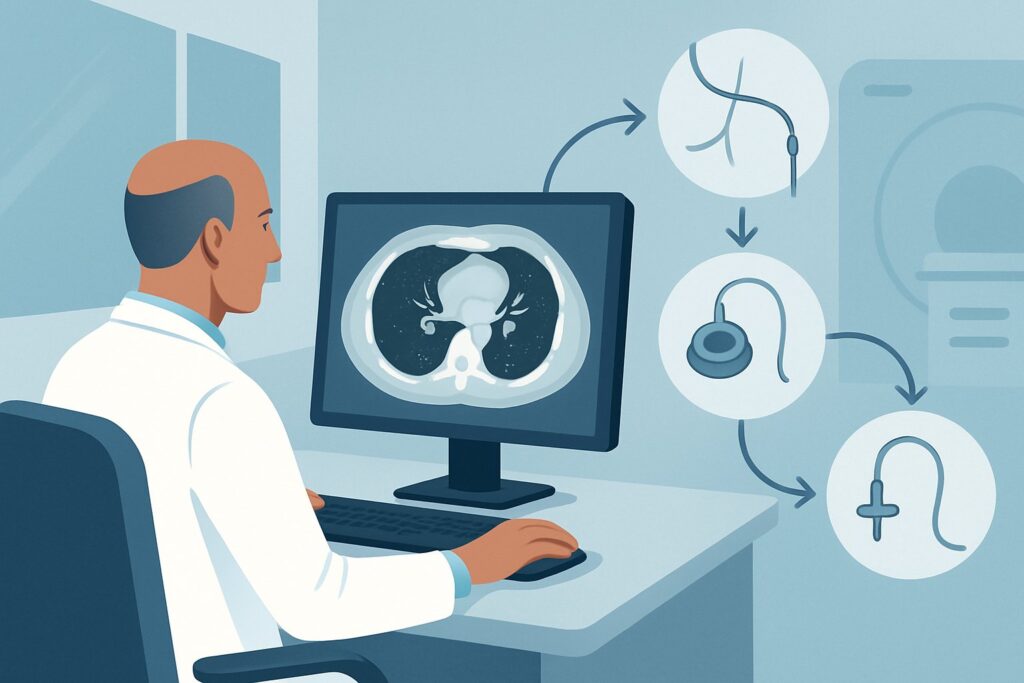
An oncologist is meeting with a 58-year-old patient newly diagnosed with stage III colon cancer. The treatment plan involves a multi-month course of weekly FOLFOX chemotherapy, a regimen known to be harsh on peripheral veins. To ensure reliable and safe administration, the oncologist must select the most appropriate long-term central venous access device. This decision involves balancing the duration of therapy, frequency of access, risk of complications like infection and thrombosis, and the patient’s quality of life. This article details the clinical workflow for this specific scenario, explaining why the American College of Radiology (ACR) rates a Chest port as Usually appropriate.
Who Fits This Clinical Scenario?
This guidance applies to patients with a confirmed cancer diagnosis who are scheduled to receive intravenous chemotherapy on an intermittent basis (e.g., weekly or every few weeks) for a duration expected to exceed two weeks, and often lasting for many months. The key factors are the chronicity of the need for access and the intermittent nature of the infusions. The chemotherapeutic agents are often vesicants or irritants, making peripheral intravenous access a poor long-term solution due to the risk of extravasation and phlebitis.
This workflow should not be applied to patients with different access requirements. Key exclusions include:
- Acutely ill patients requiring continuous infusions, hemodynamic monitoring, or frequent blood draws in an inpatient setting. These patients often need a nontunneled or tunneled central venous catheter.
- Patients needing daily or continuous access for therapies like long-term total parenteral nutrition (TPN) or frequent antibiotic infusions, where a tunneled catheter might be more suitable.
- Patients with end-stage renal disease who require access for hemodialysis, which necessitates a specialized high-flow tunneled dialysis catheter.
Correctly identifying the patient’s specific access needs—duration, frequency, and type of infusate—is the critical first step in device selection.
What Clinical Needs Drive the Device Choice?
In this scenario, the choice of a central venous access device is not about diagnosing a new condition but about selecting the optimal tool to facilitate a known, necessary treatment. The decision-making process is guided by several key clinical objectives that must be met to ensure safe and effective cancer therapy over the long term.
Reliable Long-Term Venous Access: The primary goal is to establish a durable and dependable route for chemotherapy administration that will last the entire treatment course, which can be six months or longer. This avoids the pain, anxiety, and potential treatment delays associated with repeated failed attempts at placing peripheral IVs.
Safe Administration of Vesicants: Many chemotherapy drugs are vesicants, meaning they can cause severe tissue damage if they leak outside of a vein. A central venous device delivers these agents into a large-caliber central vein (like the superior vena cava), where they are rapidly diluted by high blood flow, dramatically reducing the risk of extravasation injury.
Minimization of Infection Risk: Long-term indwelling catheters are a potential source of bloodstream infections. For intermittent therapy, the ideal device should have the lowest possible risk of catheter-related bloodstream infection (CRBSI). A device that is entirely under the skin between uses offers a significant advantage.
Preservation of Patient Quality of Life: The device should interfere as little as possible with the patient’s daily activities. Considerations include the ability to shower, swim, and maintain a normal body image without an external catheter. This is a crucial factor for patients undergoing a long and arduous treatment journey.
Why Is a Chest Port the Recommended Device for This Presentation?
The ACR Appropriateness Criteria designate a Chest port as Usually appropriate for patients requiring intermittent, long-term chemotherapy. This recommendation is based on the device’s superior profile for safety, durability, and patient convenience in this specific context. An Arm port is also rated Usually appropriate and offers a similar functional profile with a different insertion site.
A port consists of a subcutaneous reservoir (the port body) connected to a catheter that terminates in a large central vein. It is accessed percutaneously with a special non-coring needle. When not in use, the entire system is beneath the skin, which is its main advantage. This design leads to a significantly lower rate of bloodstream infections compared to devices with an external component, especially for intermittent use. It also allows patients to bathe, shower, and swim without special precautions once the insertion site has healed. Furthermore, most modern ports are power-injectable, allowing for the rapid administration of contrast for follow-up computed tomography (CT) scans used to monitor treatment response.
Alternative devices receive lower ratings for this scenario for specific reasons:
- A Peripherally Inserted Central Catheter (PICC) is rated May be appropriate. While easier to place, a PICC has an external lumen that requires regular dressing changes and flushing. It carries a higher risk of both CRBSI and deep vein thrombosis over the long term compared to a port. Its external nature can also be cumbersome and limit a patient’s activities, making it less ideal for a multi-month course of intermittent therapy.
- A Tunneled central venous catheter is also rated May be appropriate. Like a PICC, it has an external component and a higher infection risk than a port for intermittent access. Tunneled catheters are better suited for patients who need very frequent or continuous access, such as for TPN or bone marrow transplant.
- A Nontunneled central venous catheter is Usually not appropriate for this indication due to its very high infection risk and unsuitability for outpatient or long-term use.
The placement of these devices is a procedure, not a diagnostic imaging study, and typically uses ultrasound guidance, which involves no ionizing radiation. The decision for a port is often made after cancer staging is complete. Once you’ve decided on the treatment plan based on staging results, our protocol guide covers the technique for a common staging scan: CT Chest/Abdomen/Pelvis with IV Contrast.
What’s Next After Port Placement? Downstream Workflow
The workflow does not end once the port is placed. Proper management and follow-up are essential for ensuring the device functions correctly and safely throughout the patient’s chemotherapy course.
Immediate Post-Procedure: Following placement, a chest radiograph is typically obtained to confirm the catheter tip is in the proper position at the cavoatrial junction and to rule out procedural complications like a pneumothorax. Once confirmed, the port can often be used for infusion immediately. The patient and their caregivers receive education on signs of complications and any necessary site care for the first week.
Successful Long-Term Use: For each chemotherapy session, a trained nurse will access the port using a sterile technique and a non-coring Huber needle. After infusion, the port is “de-accessed” by flushing it with saline and heparin (per institutional protocol) to maintain patency. Between uses, no daily care is required by the patient.
Managing Complications: If the patient develops fever, chills, or pain and redness over the port site, a port-related infection must be considered. This requires blood cultures drawn from both the port and a peripheral vein, and often initiation of empiric antibiotics. If the port is unable to be flushed or will not aspirate blood, a catheter-related thrombosis or mechanical occlusion is suspected, which may require evaluation with a catheter-based venogram or administration of a thrombolytic agent.
Pitfalls to Avoid (and When to Get Help)
Several common pitfalls can compromise the success of long-term venous access for chemotherapy. Awareness of these issues can help guide appropriate device selection and management.
- Defaulting to a PICC for long-term therapy: While convenient to place, choosing a PICC for a patient expected to need more than 3-6 months of intermittent therapy can lead to higher rates of thrombosis and infection.
- Ignoring patient anatomy and history: Failing to assess for central venous stenosis in patients with a history of prior catheters, pacemakers, or radiation to the chest can lead to difficult or failed placement. A pre-procedural venous duplex ultrasound may be warranted.
- Not considering patient preference: The choice between a chest port and an arm port can impact body image and comfort. Discussing the options with the patient is an important part of the shared decision-making process.
- Overlooking power-injectability: Forgetting to request a power-injectable port can create future difficulties when the patient needs contrast-enhanced CT scans for disease surveillance.
If a patient with a port presents with signs of sepsis or significant swelling of the ipsilateral arm, neck, or face, escalate immediately for evaluation of CRBSI or central vein thrombosis, respectively.
Related ACR Topics and Tools
For a comprehensive overview of all clinical variants related to central venous access, refer to our parent topic guide. For tools to assist in ordering the right study and understanding the technical details, see the resources below.
- For breadth across all scenarios in Central Venous Access Device and Site Selection, see our parent guide: Central Venous Access Device and Site Selection: ACR Appropriateness Decoded.
- ACR Appropriateness Criteria Lookup — for adjacent scenarios
- Imaging Protocol Library — for technique on related diagnostic studies
- Radiation Dose Calculator — for cumulative dose conversations
Frequently Asked Questions
Why not just use a PICC line? It seems simpler to place.
While a PICC is often easier to place at the bedside, it is generally less suitable for long-term (many months to years) intermittent therapy. The external catheter portion requires regular dressing changes, carries a higher long-term risk of bloodstream infection and thrombosis, and can interfere more with a patient’s daily activities compared to a fully implanted port.
What is the difference between a chest port and an arm port?
Both are fully implanted port systems rated as ‘Usually appropriate’ for this scenario. A chest port is placed on the upper chest wall with the catheter tunneling into the subclavian or internal jugular vein. An arm port is placed in the upper arm, with the catheter typically inserted into the basilic or brachial vein and advanced centrally. The choice is often based on patient anatomy, prior surgeries or radiation, and patient preference regarding scar location and comfort.
Can a patient shower or swim with a chest port?
Yes. Once the small incision from the placement procedure has fully healed (typically 1-2 weeks), the patient can shower, bathe, and swim without any covering or special precautions. This is a major quality-of-life advantage over PICCs or tunneled catheters, which must be kept dry at all times.
How long can a chest port stay in place?
A chest port can remain in place for many years as long as it is functioning properly and is not a source of complications. It is typically removed after cancer treatment is complete and the patient is deemed to be in remission, though the exact timing is a decision made between the patient and their oncologist.
What are the most common signs of a port infection?
The most common signs of a port-related infection include fever, chills, and pain, redness, or swelling over the port site on the chest or arm. If the infection has entered the bloodstream (bacteremia), the patient may feel systemically unwell. Any of these symptoms should prompt an immediate medical evaluation.
Reviewed by Pouyan Golshani, MD, Interventional Radiologist — May 30, 2026