Which Imaging Study Is Best for Surveillance of Known Chronic Thromboembolic Disease?
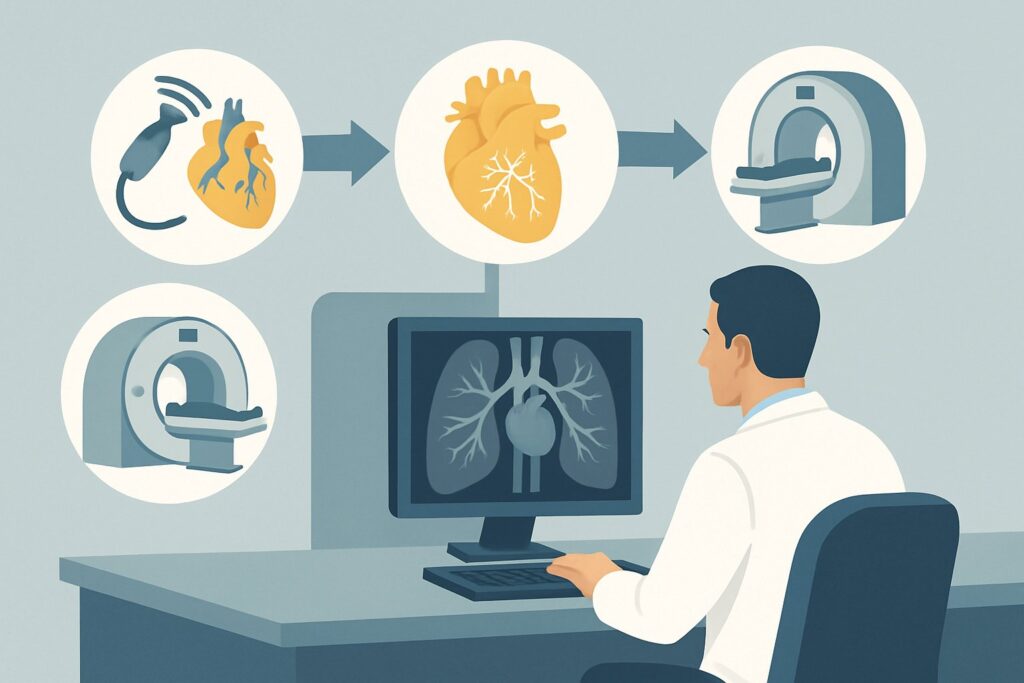
It’s a Tuesday afternoon clinic, and you’re seeing a 64-year-old patient for a routine follow-up. He has a known history of chronic thromboembolic disease (CTED), diagnosed two years ago after an extensive workup for progressive dyspnea. He is medically managed and feels his symptoms are stable, but it’s time for his scheduled surveillance imaging to assess for disease progression and evaluate the pulmonary vasculature and right heart. You need to decide which study provides the most actionable information for long-term management. This article details the clinical workflow for this specific scenario: surveillance imaging in an adult with known chronic thromboembolic disease. According to the American College of Radiology (ACR) Appropriateness Criteria, a CTA of the pulmonary arteries with IV contrast is Usually appropriate for this indication.
Who Fits This Clinical Scenario?
This guidance applies specifically to adult patients with an established diagnosis of chronic thromboembolic disease (CTED) or its more severe form, chronic thromboembolic pulmonary hypertension (CTEPH). The key context is surveillance—meaning, routine, scheduled imaging in a patient with a known, chronic condition to monitor for stability or progression. The patient is often clinically stable or has had a slow, gradual change in symptoms, and the goal is to reassess the anatomic burden of disease.
This workflow should not be applied to patients with different presentations, even if they seem related. Key exclusion criteria include:
- Initial workup for suspected acute PE: A patient presenting with new, acute symptoms concerning for a pulmonary embolism (PE) requires a different diagnostic algorithm.
- Suspected recurrent acute PE: A patient with a known history of a prior acute PE who now presents with new symptoms concerning for recurrence falls under a different ACR variant. This scenario is distinct because the pre-test probability and imaging goals are different. This article is for monitoring an established chronic condition, not investigating a new acute event.
- Initial diagnosis of CTEPH: While the imaging modalities overlap, the initial diagnostic workup for suspected CTEPH often starts with other tests (like echocardiography and V/Q scanning) before proceeding to confirmatory imaging. This article assumes the diagnosis is already made.
What Diagnoses Are You Working Up in This Scenario?
In surveillance imaging for known CTED, you are primarily assessing for changes in the established disease and its secondary effects. The differential considerations guiding the imaging choice include:
Progression of Chronic Thromboembolic Disease: This is the most direct and important question to answer. The imaging study must be able to delineate the classic signs of chronic PE—such as vessel webs, bands, stenoses, and complete occlusions—and compare the current burden to prior studies. Identifying significant progression can trigger a change in management, such as consideration for advanced therapies.
Worsening Pulmonary Hypertension and Right Heart Strain: CTED leads to increased pulmonary vascular resistance, causing pulmonary hypertension (PH) and subsequent right ventricular (RV) dysfunction. The surveillance scan provides crucial indirect evidence of the hemodynamic state by assessing the main pulmonary artery diameter, the ratio of the RV to the left ventricular (LV) diameter, and septal bowing.
Superimposed Acute Pulmonary Embolism: Patients with CTED are at ongoing risk for new, acute thromboembolic events. A high-quality study can differentiate the eccentric, acute filling defects of a new PE from the organized, wall-adherent appearance of chronic thrombus, which is a critical distinction for treatment decisions.
Alternative or Coexisting Parenchymal Lung Disease: The imaging can also reveal other causes or contributors to the patient’s respiratory status, such as interstitial lung disease, emphysema, or signs of infection, which may not be the primary target but are important incidental findings.
Why Is CTA Pulmonary Arteries with IV Contrast the Recommended Study?
The ACR designates Computed Tomography Angiography (CTA) of the pulmonary arteries with IV contrast as Usually appropriate for surveillance in patients with known chronic thromboembolic disease. This recommendation is based on its high diagnostic accuracy for visualizing the pulmonary vasculature and assessing the secondary consequences of the disease.
A dedicated CTPA protocol provides exceptional spatial resolution, allowing for detailed evaluation of the characteristic findings of CTED. These include organized thrombi that appear as mural thickening, intravascular webs or bands, abrupt vessel tapering, and post-stenotic dilatation. This level of anatomical detail is essential for comparing disease burden over time and is superior to most other non-invasive modalities. Furthermore, CTPA allows for robust assessment of right heart size (RV/LV ratio), main pulmonary artery diameter, and parenchymal changes like mosaic attenuation, all of which are critical for monitoring the severity of associated pulmonary hypertension.
Alternatives are rated lower for this specific surveillance context:
- V/Q scan lung: Rated May be appropriate (Disagreement), a V/Q scan is highly sensitive for detecting perfusion defects and is a cornerstone in the initial diagnosis of CTEPH. However, for surveillance of known disease, it provides less anatomical detail than CTPA. It cannot characterize the nature of the thrombus (e.g., webs, bands) or evaluate right heart morphology, limiting its utility for tracking specific changes over time.
- MRA chest with IV contrast: Rated May be appropriate, Magnetic Resonance Angiography avoids ionizing radiation and iodinated contrast. It can be a valuable alternative for patients with contraindications to CTPA. However, it generally has lower spatial resolution, particularly for subsegmental vessels, and can be more susceptible to motion artifacts, potentially limiting its ability to detect subtle disease progression.
The primary trade-off with CTPA is the use of ionizing radiation (ACR relative radiation level ☢☢☢, corresponding to 1-10 mSv) and iodinated contrast. However, for assessing the detailed anatomy required in CTED surveillance, these risks are generally considered acceptable given the high diagnostic yield.
What’s Next After CTA Pulmonary Arteries with IV Contrast? Downstream Workflow
The results of the surveillance CTPA directly guide the next steps in patient management. The post-imaging workflow depends on whether the findings show stable, progressive, or new disease.
- If the study shows stable disease: When the CTPA demonstrates no significant change in the thrombus burden and no worsening of secondary signs like right heart strain, the typical next step is to continue the current medical management. The patient would be scheduled for their next surveillance scan at an interval determined by their clinical stability and the recommendations of their specialist team (often annually or biennially).
- If the study shows disease progression: If there is evidence of an increased thrombus burden or worsening right ventricular enlargement, this is a significant finding that necessitates a change in management. The patient should be referred (or re-referred) to a specialized center for CTEPH. Downstream actions may include right heart catheterization to confirm worsening hemodynamics and an evaluation for advanced therapies like pulmonary endarterectomy (PEA), balloon pulmonary angioplasty (BPA), or adjustments to medical therapy.
- If the study shows a new, superimposed acute PE: If findings consistent with an acute filling defect are identified, the patient should be treated for an acute pulmonary embolism. This typically involves initiating or adjusting anticoagulation therapy according to standard guidelines.
- If the study is indeterminate or shows other pathology: A technically limited study may require a repeat scan or an alternative modality like MRA. If significant non-vascular pathology is discovered (e.g., a new lung mass), that finding would trigger a separate, appropriate diagnostic workup.
Pitfalls to Avoid (and When to Get Help)
Several common pitfalls can compromise the diagnostic value of surveillance imaging in CTED. First, ordering a generic “CT chest with contrast” instead of a dedicated “CT Pulmonary Angiography” (CTPA) can lead to suboptimal contrast timing, rendering the study non-diagnostic for the pulmonary arteries. Second, an inadequate IV line or a poorly timed contrast bolus can also degrade image quality. Third, a key interpretation pitfall is failing to look beyond the vessels; the radiologist and ordering clinician must assess for secondary signs of pulmonary hypertension, as changes in RV size can be the first indicator of hemodynamic worsening even with minimal change in thrombus. If the CTPA shows significant disease progression or if the patient’s symptoms are worsening despite stable imaging, it is critical to escalate care to a multidisciplinary CTEPH program with expertise in advanced medical and interventional therapies.
Related ACR Topics and Tools
For a comprehensive overview of imaging across all scenarios related to known pulmonary embolism, refer to our parent topic guide. For additional tools to help with ordering decisions, protocolling, and patient communication, see the resources below.
- For breadth across all scenarios in Imaging for Pulmonary Embolism, Known Clot, see our parent guide: Imaging for Pulmonary Embolism, Known Clot: ACR Appropriateness Decoded.
- To explore other clinical presentations, consult the ACR Appropriateness Criteria Lookup.
- For details on imaging techniques, browse the Imaging Protocol Library.
- To discuss radiation exposure with patients, use the Radiation Dose Calculator.
Frequently Asked Questions
How often should surveillance imaging be performed for known chronic thromboembolic disease (CTED)?
The optimal frequency is not rigidly defined and depends on the patient’s clinical stability, the severity of their disease, and the type of treatment they are receiving. For many medically managed patients, surveillance CTPA is often performed annually or every two years. However, this interval should be determined in consultation with a pulmonary hypertension or CTEPH specialist.
What is the key difference between a standard ‘CT chest with contrast’ and a ‘CTPA’?
The critical difference is the timing of the contrast bolus. A CTPA protocol is specifically timed to capture the peak enhancement of the pulmonary arteries, which requires a rapid injection rate and precise scan timing. A standard CT chest with contrast is typically timed for systemic arterial or venous phases, which means the contrast in the pulmonary arteries will be suboptimal, potentially missing or mischaracterizing intravascular thrombus.
Can I use a V/Q scan instead of a CTPA for routine surveillance?
While a V/Q scan is rated as ‘May be appropriate (Disagreement)’ by the ACR, it is generally less preferred than CTPA for surveillance of known disease. CTPA provides superior anatomical detail of the thrombus burden, vessel morphology, and right heart size, which are crucial for monitoring progression. A V/Q scan primarily shows perfusion defects and is less suited for detailed anatomical comparison over time.
What if my patient with known CTED has a contraindication to iodinated IV contrast?
In cases of severe allergy to iodinated contrast or significant renal impairment, MRA of the chest with IV contrast is a strong alternative and is rated ‘May be appropriate’ by the ACR. It avoids both radiation and iodinated contrast while still providing good visualization of the central pulmonary arteries, though its resolution for smaller, subsegmental vessels may be lower than CTPA.
Does a ‘stable’ CTPA mean the patient’s pulmonary hypertension is also stable?
Not necessarily. While stable thrombus burden is reassuring, hemodynamic changes can sometimes occur without obvious anatomical progression on CT. The CTPA provides important indirect signs (like RV size), but the gold standard for assessing pulmonary pressures is a right heart catheterization. Clinical symptoms and other data, like echocardiography and biomarkers, should be integrated with the CTPA findings to make a complete assessment.
Reviewed by Pouyan Golshani, MD, Interventional Radiologist — May 30, 2026