How Should You Evaluate Arm Swelling in a Patient with a Hemodialysis Fistula?
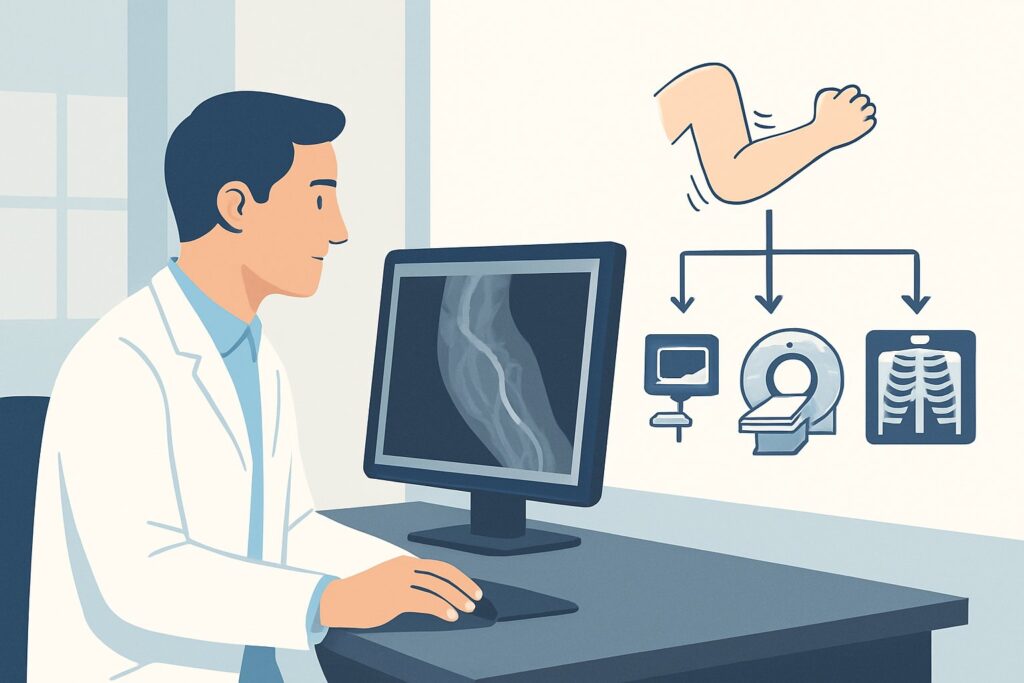
A 68-year-old male with end-stage renal disease presents to the dialysis center for his scheduled treatment. Over the past week, he has noticed progressive, non-painful swelling of his entire left arm, where his brachiocephalic arteriovenous fistula (AVF) was created two years ago. The dialysis nurse reports increasingly high venous pressures during his last few sessions and notes prominent new veins across his chest wall. You are the clinician responsible for his care, and the immediate question is how to work up this likely access-related outflow obstruction to preserve the fistula and alleviate his symptoms. This clinical workflow article addresses this specific scenario: suspected central venous stenosis in a hemodialysis patient with ipsilateral extremity swelling. According to the American College of Radiology (ACR) Appropriateness Criteria, the definitive next step, Fluoroscopy fistulography hemodialysis access with intervention, is rated Usually Appropriate.
Who Fits This Clinical Scenario?
This guidance is for a specific patient presentation: an individual with a mature upper or lower extremity hemodialysis access (either an arteriovenous fistula or graft) who develops soft tissue edema of that same limb. The swelling is the key clinical sign that points toward a significant outflow problem, distinguishing it from other forms of access dysfunction. The presence of newly visible collateral veins on the chest, shoulder, or arm further strengthens the suspicion of a downstream, central venous blockage.
This workflow specifically applies when your primary suspicion is central venous stenosis or occlusion. It is crucial to differentiate this from other related but distinct clinical problems that require different workups:
- Suspected Thrombosis: If the patient presents with a sudden loss of the fistula’s “thrill” or bruit, the primary concern is acute thrombosis, which is a different ACR variant. While swelling can occur, the absence of flow is the defining feature.
- General Dysfunction without Swelling: If the primary issues are abnormal dialysis parameters (e.g., high venous pressures, low flow rates, prolonged bleeding) without significant limb edema, the stenosis could be anywhere in the circuit. The workup is similar but the pre-test probability for a central lesion is lower.
- Failure to Mature: This guidance does not apply to a newly created fistula that has not developed sufficiently for cannulation. That scenario focuses on identifying anatomical reasons for maturation failure, such as accessory veins or a juxta-anastomotic stenosis.
What Diagnoses Are You Working Up in This Scenario?
When a patient with a hemodialysis access develops ipsilateral limb swelling, you are investigating a differential diagnosis centered on venous outflow obstruction. The imaging and subsequent intervention are designed to identify and treat the point of failure in the circuit.
Central Venous Stenosis or Occlusion is the most common and clinically significant cause for this presentation. The high-volume, turbulent flow from the AV access travels through the central veins (subclavian, brachiocephalic, and superior vena cava) en route to the heart. Over time, this can cause intimal hyperplasia and progressive narrowing. Prior central venous catheters, a common history in dialysis patients, also cause scarring and stenosis, creating a bottleneck that cannot handle the fistula’s high flow. When the outflow is restricted centrally, pressure backs up, causing the entire extremity to swell and forcing blood to find alternative pathways via collateral veins.
Stenosis within the Peripheral Access Circuit can also cause outflow obstruction, though it is less likely to cause diffuse swelling of the entire limb. A severe stenosis at the graft-vein anastomosis or in the draining vein just beyond the fistula can create a functional bottleneck. However, this typically presents with more localized swelling or issues confined to the access itself rather than the whole arm or leg.
Access-Related Venous Thrombosis is another possibility. A non-occlusive thrombus in the draining vein or central veins can impede flow and cause swelling. While a complete thrombotic occlusion usually presents with loss of thrill, a partial or chronic thrombus can manifest primarily as outflow obstruction and edema.
Less commonly, Extrinsic Compression from a tumor, lymphadenopathy, or other adjacent anatomical structure could compress the central veins, mimicking intrinsic stenosis. This is a rare but important consideration if fistulography does not reveal an obvious intrinsic lesion.
Why Is Fluoroscopy Fistulography with Intervention the Recommended Study for This Presentation?
For a patient presenting with limb swelling suggestive of central venous stenosis, the ACR designates Fluoroscopy fistulography hemodialysis access with intervention as Usually Appropriate. This procedure, often called a “fistulogram,” is the cornerstone of both diagnosis and treatment for this condition. It provides a dynamic, real-time roadmap of the entire venous outflow from the access cannulation site to the right atrium, directly visualizing the location, severity, and length of any stenosis.
The primary advantage of fistulography is its dual diagnostic and therapeutic capability. If a significant stenosis is identified, the interventional radiologist can immediately proceed with treatment during the same session. This typically involves percutaneous transluminal angioplasty (ballooning the narrowed segment) and, if necessary, stent placement to maintain patency. This “see-and-treat” approach is highly efficient, avoids delays in care, and can provide immediate symptom relief, making it the most effective and patient-centered option.
Alternative imaging and management strategies are rated lower for specific reasons in this context:
- US duplex Doppler hemodialysis access area of interest is rated Usually not appropriate. While ultrasound is excellent for evaluating the peripheral components of a fistula or graft (e.g., the anastomosis, cannulation zone, and draining vein in the arm), it cannot adequately visualize the central veins. The clavicle and ribs create acoustic shadows that obscure the subclavian vein, brachiocephalic vein, and superior vena cava, which is precisely where the suspected pathology lies in this scenario. Relying on ultrasound alone would likely miss the diagnosis.
- Placement of a new tunneled dialysis catheter is also Usually not appropriate as a primary step. Placing a catheter on the contralateral side is a temporizing measure that fails to address the underlying problem causing the arm swelling. It consumes a future access site and leaves the patient with a dysfunctional, high-pressure fistula that could still thrombose. The goal is to salvage the existing access, not abandon it.
The procedure involves iodinated contrast and ionizing radiation. However, in a symptomatic patient whose access is threatened, the clinical benefit of definitively diagnosing and treating the outflow obstruction substantially outweighs these risks. Once you’ve decided on this procedure, our protocol guide covers the technique, contrast, and reading principles: IR Central Venous Access (PICC, Tunneled, Port).
What’s Next After Fluoroscopy Fistulography? Downstream Workflow
The results of the fistulogram and any concurrent intervention will dictate the immediate next steps in patient management. The workflow is typically straightforward, as the procedure itself is often the definitive treatment.
If the study is positive for central venous stenosis and successfully treated: The most common outcome is the identification of a stenosis in the brachiocephalic vein, subclavian vein, or superior vena cava. The interventionalist will perform angioplasty, often with stent placement. Post-procedure, the patient can typically use the access for their next dialysis session. You should expect a gradual but noticeable reduction in limb swelling over the following days to weeks. The primary follow-up is clinical, monitoring for symptom resolution and stable dialysis pressures. Repeat imaging is only indicated if symptoms recur.
If the study is positive for a peripheral stenosis (not central): Occasionally, the fistulogram reveals that the critical stenosis is not central but located more peripherally, such as at the venous anastomosis or in the axillary vein. This lesion would be treated with angioplasty in the same manner. The downstream management is identical.
If the study is negative for any stenosis: This is an uncommon but important outcome. If the entire venous outflow tract is patent and no pressure gradient is measured, the cause of the limb swelling lies elsewhere. The workup must pivot to consider non-access-related etiologies. This may include a dedicated ultrasound to rule out deep vein thrombosis (DVT) in a separate, non-access-related vein, or further investigation for lymphedema or extrinsic compression, potentially with a CT or MR venogram.
Pitfalls to Avoid (and When to Get Help)
In managing suspected central venous stenosis, several common pitfalls can delay diagnosis and jeopardize the hemodialysis access. Awareness of these can help streamline patient care.
- Pitfall 1: Misattributing Swelling to Infection. Do not automatically assume limb swelling is cellulitis. While infection is possible, in a patient with a high-flow fistula, outflow obstruction is a far more likely cause, especially with concomitant high venous pressures or collateral veins.
- Pitfall 2: Ordering an Inadequate Initial Study. Requesting only a peripheral duplex ultrasound is a frequent error. This study cannot visualize the central veins and will provide false reassurance if the primary problem is in the chest. The correct order is a fistulogram.
- Pitfall 3: Delaying the Intervention. Progressive venous hypertension from an untreated central stenosis increases the risk of access thrombosis. Limb swelling is a sign of a critically failing circuit that requires prompt evaluation and treatment.
If the patient presents with severe, rapidly worsening swelling, facial edema, or shortness of breath, this may indicate Superior Vena Cava (SVC) syndrome, a clinical emergency. This requires immediate escalation to an interventional radiologist or vascular surgeon for emergent decompression.
Related ACR Topics and Tools
This article covers a single, specific scenario within the broader topic of dialysis access management. For a comprehensive overview of all related clinical variants, from thrombosis to failure to mature, please consult the parent guide. For other tools to assist in ordering the correct imaging, see the resources below.
- For breadth across all scenarios in Dialysis Fistula Malfunction, see our parent guide: Dialysis Fistula Malfunction: ACR Appropriateness Decoded.
- ACR Appropriateness Criteria Lookup — for adjacent scenarios
- Imaging Protocol Library — for technique on the recommended study
- Radiation Dose Calculator — for cumulative dose conversations
Frequently Asked Questions
What is the difference between this scenario and general fistula dysfunction?
This scenario is defined by significant limb swelling, with or without visible collateral veins. This specific sign strongly points to a downstream obstruction, most commonly in the central veins. General fistula dysfunction refers to abnormal dialysis parameters (like high pressures or low flow) without the prominent physical sign of edema, meaning the stenosis could be located anywhere in the access circuit.
Can I order a CT Venogram (CTV) instead of a fistulogram?
While a CTV can diagnose central venous stenosis, it is generally not the preferred first step. The primary reason is that a fistulogram is both diagnostic and therapeutic, allowing for immediate angioplasty or stenting in the same session. A CTV is purely diagnostic and would require a second, separate procedure for treatment. Furthermore, CTV requires a significant contrast load, which is a consideration in patients with renal failure.
Is arm swelling always a sign of central venous stenosis?
No, but in a patient with a functional hemodialysis access, it is the leading suspicion. Other causes include deep vein thrombosis (DVT) unrelated to the access, cellulitis, or lymphedema. However, the combination of swelling and a high-flow fistula makes a venous outflow problem the most probable diagnosis that must be ruled out first.
What if the patient has an allergy to iodinated contrast?
A significant contrast allergy is a relative contraindication. However, it can usually be managed with a pre-procedure steroid and antihistamine regimen. In rare cases where iodinated contrast is absolutely contraindicated, alternative imaging like MR venography or CO2 fistulography may be considered, but this should be discussed in detail with the interventional radiology team, as these techniques have their own limitations.
How urgently does this condition need to be treated?
This should be treated urgently but is not typically a same-day emergency unless symptoms are severe (e.g., signs of SVC syndrome). The high venous pressure puts the access at significant risk for thrombosis. The patient should be referred for a fistulogram within a few days to a week to prevent permanent loss of the access.
Reviewed by Pouyan Golshani, MD, Interventional Radiologist — May 30, 2026