How Should You Treat a Venous Leg Ulcer? An ACR-Guided Workflow
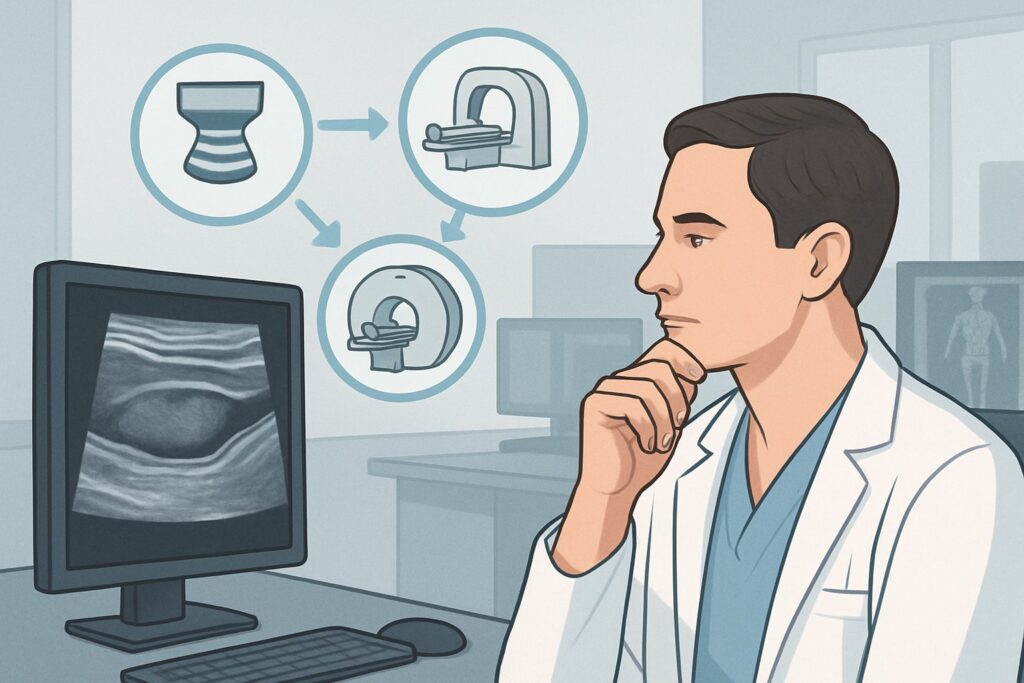
A 68-year-old patient with type 2 diabetes and a history of deep vein thrombosis presents to your clinic with a shallow, non-healing ulcer over his medial malleolus. It has been present for four months, managed with simple dressings by his primary care physician, with minimal improvement. The surrounding skin shows brawny edema and hyperpigmentation. You have already confirmed underlying venous disease with duplex ultrasound. The immediate clinical question is no longer diagnostic; it is about defining the optimal, evidence-based treatment strategy to achieve healing and prevent recurrence. This article details the American College of Radiology (ACR) Appropriateness Criteria workflow for this exact scenario. For the treatment of a venous leg ulcer, a comprehensive strategy beginning with dedicated ‘Wound care’ and ‘Compression therapy’ is rated ‘Usually Appropriate’.
Who Fits This Clinical Scenario for Venous Ulcer Treatment?
This workflow is designed for patients with an established diagnosis of a venous leg ulcer (VLU), which falls under the Clinical-Etiology-Anatomy-Pathophysiology (CEAP) classification of C6 disease. The key inclusion criterion is a patient with an active ulcer, typically in the gaiter area (from mid-calf to the ankle), where prior diagnostic evaluation has confirmed underlying chronic venous insufficiency. This confirmation usually comes from a venous duplex ultrasound that has identified superficial reflux, deep system reflux or obstruction, and/or perforator vein incompetence.
This guidance is specifically for planning treatment. It is crucial to exclude patients who fit into different clinical scenarios, as their management pathways differ:
- Patients needing initial diagnosis: If a patient presents with a leg ulcer of unclear etiology and has not yet had a diagnostic workup, they first fit the ACR variant for Venous leg ulcer, Initial diagnosis. The priority there is to confirm venous pathology and rule out other causes like arterial insufficiency or neuropathy.
- Patients with non-ulcerated venous disease: Individuals with varicose veins, edema, or skin changes (CEAP C2-C5) but no active ulceration are addressed in the Varicose veins, Treatment variant. While the underlying pathology is similar, the urgency and treatment goals are different.
- Patients with suspected arterial ulcers: An ulcer that is exquisitely painful, located on the toes or pressure points, and associated with diminished pulses and a low Ankle-Brachial Index (ABI) is not a VLU. This presentation requires an urgent arterial workup, not a venous treatment plan.
What Pathophysiology Are You Treating in a Venous Leg Ulcer?
Treating a venous leg ulcer requires addressing the specific hemodynamic failures that led to skin breakdown. While the ulcer itself is the most visible problem, it is merely the end-stage manifestation of underlying venous hypertension. The treatment plan must be tailored to the anatomical source of this pressure.
Superficial Venous Insufficiency (SVI) is the most common culprit. This involves reflux, or backward flow, in the great saphenous vein (GSV) or small saphenous vein (SSV) due to incompetent valves. Over time, this reflux transmits high pressure from the deep system into the superficial veins during muscle contraction, leading to chronic inflammation, edema, skin damage (lipodermatosclerosis), and eventual ulceration.
Deep Venous Disease, either from obstruction or reflux, presents a more complex challenge. Often a consequence of post-thrombotic syndrome (PTS), chronic scarring and obstruction within the iliac, femoral, or popliteal veins create a significant outflow blockage. This results in severe, persistent venous hypertension that can cause large, difficult-to-heal ulcers. Valvular incompetence in the deep system can also be a primary cause, though it is less common than SVI.
Incompetent Perforator Veins are another critical target. These veins connect the superficial and deep systems. When their valves fail, they allow high-pressure blood from the deep veins to flow outward into the superficial system, creating localized “hot spots” of venous hypertension that directly contribute to ulcer formation and persistence. These are often found directly beneath or adjacent to an active ulcer.
In many patients, these pathologies coexist. A successful treatment strategy often requires addressing a combination of superficial, deep, and perforator disease to fully normalize venous pressure and allow the ulcer to heal.
Why Is a Comprehensive Approach Starting with Wound Care ‘Usually Appropriate’?
For a patient with an active venous leg ulcer, the ACR guidelines emphasize a multi-modal treatment strategy rather than a single intervention. Four distinct but complementary approaches are rated ‘Usually Appropriate’: Wound care, Compression therapy, Saphenous vein ablation, and Compression sclerotherapy. This reflects the clinical reality that addressing both the wound and the underlying venous hypertension is necessary for healing.
Wound care and Compression therapy are the non-negotiable foundation of VLU management. Wound care involves regular debridement of non-viable tissue and application of appropriate dressings to manage exudate and promote a healthy wound bed. Compression therapy, delivered via multi-layer bandages or specialized stockings, is the single most effective conservative treatment. It counteracts venous hypertension by providing external pressure, reducing edema, improving calf muscle pump function, and promoting venous return. Without effective compression, any procedural intervention is likely to fail.
Saphenous vein ablation (e.g., endovenous laser or radiofrequency ablation) is also ‘Usually Appropriate’ because it directly treats the most common cause of venous hypertension: superficial reflux. By closing the incompetent saphenous vein, the primary source of reflux is eliminated, which reduces pressure at the level of the ankle and allows the ulcer to heal. This is typically performed after an initial period of compression and wound care has stabilized the local environment.
In contrast, other interventions are rated lower for the initial treatment phase. Iliac vein stenting is rated ‘May be appropriate’ because it is reserved for a specific subset of patients with documented, hemodynamically significant obstruction in the iliac veins, often from post-thrombotic syndrome. It is not a first-line therapy for the more common presentation of superficial reflux. Similarly, older surgical techniques like Ligation and stripping are also ‘May be appropriate’ but have largely been replaced by less invasive endovenous ablation techniques due to lower morbidity and faster recovery.
What’s Next After Treatment Begins? Downstream Workflow
The treatment of a venous leg ulcer is a longitudinal process, not a single event. The downstream workflow depends on the patient’s response to the initial, combined strategy of wound care, compression, and, when indicated, superficial vein ablation.
- If the ulcer heals and remains closed: This is the desired outcome. The patient transitions to long-term management, which includes lifelong use of graduated compression stockings (e.g., 20-30 mmHg or 30-40 mmHg) to prevent recurrence. Regular follow-up is essential to monitor for any signs of new venous disease or skin breakdown.
- If the ulcer fails to heal or recurs quickly: This signals that the underlying venous hypertension has not been fully addressed. The next step is a repeat, comprehensive venous duplex ultrasound to reassess the superficial, deep, and perforator systems. This investigation often reveals residual or new sources of reflux, such as incompetent perforator veins or untreated tributary varicosities, which can then be targeted with procedures like ultrasound-guided sclerotherapy.
- If the ulcer is recalcitrant despite treating superficial disease: If a VLU fails to heal after successful saphenous ablation and diligent compression, suspicion should turn to a more complex underlying cause. This is the point to consider advanced imaging to evaluate the deep venous system for obstruction. This may involve MR venography (MRV) or CT venography (CTV) to assess for iliac vein compression (e.g., May-Thurner syndrome) or post-thrombotic scarring. If significant central obstruction is found, the patient may become a candidate for iliac vein stenting, a procedure rated ‘May be appropriate’ in this scenario.
Pitfalls to Avoid (and When to Get Help)
Navigating VLU treatment requires avoiding several common pitfalls. First, never initiate compression therapy without confirming adequate arterial inflow, typically with an Ankle-Brachial Index (ABI). Applying high compression to a limb with significant peripheral arterial disease can lead to ischemia and tissue loss. Second, avoid “procedural fixation”—focusing solely on an endovenous ablation without ensuring the patient is compliant with and has access to high-quality compression therapy and wound care. The procedure corrects the plumbing, but compression is required for healing. Finally, do not underestimate the contribution of incompetent perforator veins, especially for ulcers that are slow to heal after a successful saphenous ablation. If an ulcer persists, a dedicated search for and treatment of underlying perforators is often the key to success. If an ulcer fails to improve after 4-6 weeks of optimized standard care, it is time to escalate and consider referral to a specialized wound care center or vascular specialist.
Related ACR Topics and Tools
The ACR Appropriateness Criteria provide a framework for a wide range of clinical scenarios. For a comprehensive overview of all variants related to chronic venous disease, from initial diagnosis to treatment of different presentations, please consult our parent guide. Additional tools can help you apply these guidelines in your daily practice.
- For breadth across all scenarios in Lower Extremity Chronic Venous Disease, see our parent guide: Lower Extremity Chronic Venous Disease: ACR Appropriateness Decoded.
- To look up other clinical scenarios, use the ACR Appropriateness Criteria Lookup.
- For details on specific imaging techniques, explore the Imaging Protocol Library.
- To discuss cumulative radiation exposure with patients, reference the Radiation Dose Calculator.
Frequently Asked Questions
Why is compression therapy so critical if we can ablate the bad vein?
Compression therapy is essential because it addresses the physiological consequences of venous disease—edema and venous hypertension—which an ablation alone cannot instantly reverse. It provides the necessary external support to reduce swelling, improve blood flow, and create a favorable environment for the ulcer to heal while the benefits of the ablation take effect. It is also the primary tool for preventing ulcer recurrence long-term.
When should I consider iliac vein stenting for a venous leg ulcer?
Iliac vein stenting is a specialized intervention, rated ‘May be appropriate’ by the ACR for this scenario. It should be considered only after a comprehensive workup has ruled out or treated more common causes like superficial and perforator reflux. It is indicated for patients with recalcitrant ulcers who have demonstrable, hemodynamically significant stenosis or obstruction of the iliac vein, often from post-thrombotic syndrome or iliac vein compression (May-Thurner syndrome).
What Ankle-Brachial Index (ABI) value is considered safe for compression therapy?
Generally, an ABI > 0.8 is considered safe for standard high compression (30-40 mmHg). For patients with an ABI between 0.5 and 0.8, modified or reduced compression may be applied with caution, often under the supervision of a specialist. An ABI < 0.5 is a contraindication to compression therapy, as it indicates severe peripheral arterial disease, and referral to a vascular surgeon is warranted.
How long should a patient continue compression therapy after the ulcer has healed?
Lifelong. Chronic venous insufficiency is an incurable condition, and the risk of ulcer recurrence is high. Daily use of graduated compression stockings is the most effective measure to manage the underlying disease and prevent the ulcer from returning. Patient education on this point is a critical component of successful long-term management.
Can a venous ulcer get infected, and how does that change management?
Yes, all chronic wounds are colonized with bacteria, but they can develop a true clinical infection (cellulitis or deeper infection), characterized by increasing pain, erythema, warmth, purulent drainage, and odor. If infection is suspected, wound cultures should be obtained and systemic antibiotics initiated. Local wound care should be intensified with antimicrobial dressings. Any planned procedural interventions, like vein ablation, should be postponed until the acute infection is controlled.
Reviewed by Pouyan Golshani, MD, Interventional Radiologist — May 30, 2026