How Should You Work Up an Incidental Pleural Effusion on Incomplete Imaging?

A 68-year-old patient undergoes a routine abdominal computed tomography (CT) scan for surveillance of liver cysts. The radiologist’s report is unremarkable, except for a note on the final impression: “Small left pleural effusion is incidentally noted at the lung bases.” The patient is asymptomatic from a respiratory standpoint. As the ordering clinician, you now face a common diagnostic fork in the road: the finding is unexpected, the initial imaging was incomplete for thoracic evaluation, and the clinical significance is unknown. What is the most appropriate next step to characterize this effusion without initiating an unnecessary and costly workup?
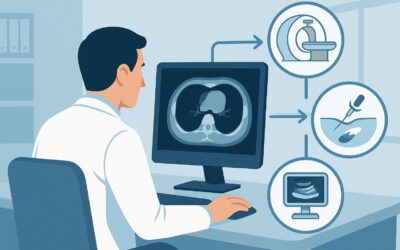
This article provides a focused, evidence-based workflow for this exact scenario. According to the American College of Radiology (ACR) Appropriateness Criteria, while several options exist, chest ultrasound is a key diagnostic step. It is rated ‘May be appropriate’, reflecting some panel disagreement but highlighting its utility as a practical, radiation-free tool to guide subsequent management.
Who Fits This Clinical Scenario for an Incidental Pleural Effusion?
This guidance is specifically for patients where a pleural effusion is discovered by chance on an imaging study not primarily intended to evaluate the chest. The defining features of this scenario are:
- Incidental Discovery: The effusion was not clinically suspected. The patient typically lacks overt symptoms like pleuritic chest pain, fever, or significant dyspnea that would have otherwise prompted thoracic imaging.
- Incomplete Initial Study: The finding was seen on a limited view of the thorax, such as the upper cuts of an abdominal CT or MRI, a cervical spine radiograph, or a shoulder study that clips the lung apex. The full extent of the lungs and pleural space has not yet been visualized.
It is critical to distinguish this situation from similar but distinct clinical presentations that follow different diagnostic pathways. This workflow does not apply if:
- Infection is suspected: The patient presents with fever, cough, and leukocytosis, suggesting a possible parapneumonic effusion or empyema. That scenario requires a different approach to assess for a complicated infection.
- There is recent trauma: The patient has a history of recent blunt or penetrating chest trauma. The workup in that context is focused on identifying hemothorax or other traumatic injuries.
- The effusion is clinically suspected: The patient presents with primary symptoms like dyspnea or cough, and the initial imaging is being ordered specifically to investigate a suspected pleural effusion.
This article is for the true “incidentaloma” of the pleural space, where the goal is to efficiently characterize the finding and determine its clinical importance.
What Diagnoses Are You Working Up with an Incidental Pleural Effusion?
The discovery of an incidental pleural effusion triggers a broad differential diagnosis, spanning from benign systemic conditions to serious localized pathology. The purpose of the next imaging study is to narrow this list and guide further testing, such as thoracentesis.
The most common underlying causes for incidental effusions, particularly if bilateral or associated with other signs of fluid overload, are transudative processes. These result from imbalances in hydrostatic and oncotic pressures. Congestive heart failure (CHF) is a primary consideration, where the effusion is a manifestation of systemic volume overload. Other major causes include cirrhosis (leading to hepatic hydrothorax) and nephrotic syndrome, both of which decrease plasma oncotic pressure. In these cases, the incidental effusion may be the first objective sign of decompensating systemic disease.
More concerning, though less common for a truly asymptomatic finding, are exudative effusions. These are caused by local inflammation or impaired lymphatic drainage that increases pleural capillary permeability. Malignancy is a critical diagnosis to exclude, especially in older patients or those with a smoking history. Lung cancer, breast cancer, and lymphoma are frequent culprits. An indolent infection, such as a subclinical parapneumonic effusion or tuberculosis, can also present this way.
Finally, a smaller subset of other conditions can cause incidental effusions. Pulmonary embolism, while often symptomatic, can sometimes present with a small, otherwise unexplained effusion. Autoimmune conditions like rheumatoid arthritis or lupus can also be associated with pleural fluid. The initial imaging workup aims to distinguish simple, likely transudative fluid from complex fluid that suggests an exudative process requiring more urgent investigation.
Why Is Chest Ultrasound a Key Next Step for an Incidental Pleural Effusion?
When an incidental pleural effusion is found on an incomplete study, the immediate goals are to confirm its presence, estimate its size, characterize its nature (simple vs. complex), and determine if it is amenable to sampling. The ACR Appropriateness Criteria panel rated three modalities—chest ultrasound, chest radiography, and CT chest with IV contrast—as ‘May be appropriate’, indicating a lack of clear consensus for a single best test. However, chest ultrasound (US) offers a unique combination of diagnostic utility and safety that makes it an excellent first-line choice in this specific workflow.
The primary strength of chest US is its ability to directly visualize and characterize pleural fluid. It can readily distinguish simple, anechoic fluid (typical of a transudate) from complex fluid containing septations, loculations, or echogenic debris (suggestive of an exudate like an empyema or malignant effusion). This characterization is fundamental to the subsequent workup. Furthermore, ultrasound is highly effective for guiding a diagnostic and potentially therapeutic thoracentesis, improving the safety and success rate of the procedure.
Another major advantage is the complete absence of ionizing radiation (adult RRL=O 0 mSv). Since the patient has already undergone one imaging study, minimizing further radiation exposure is a valid clinical consideration.
Comparing ultrasound to the other ‘May be appropriate’ options clarifies its role:
- Radiography chest: While useful for providing global context of the heart and lungs, a standard chest X-ray is less sensitive for small effusions and provides minimal information about the fluid’s internal characteristics. It can confirm a moderate or large effusion but adds little new information beyond the initial incidental finding.
- CT chest with IV contrast: This is the most comprehensive study, offering detailed views of the lung parenchyma, pleura, and mediastinum. It is superior for identifying an underlying cause like a tumor or pulmonary embolus. However, it delivers a significant radiation dose (adult RRL=☢☢☢ 1-10 mSv) and requires IV contrast. For an asymptomatic, incidental finding, proceeding directly to CT is often an unnecessary escalation. It is more appropriately reserved for cases where ultrasound reveals complex fluid or when the clinical picture is more suspicious for malignancy.
Modalities like MRI are rated ‘Usually not appropriate’ due to higher cost, limited availability, and poor visualization of lung parenchyma, offering no significant advantage in this initial workup. Therefore, starting with a non-invasive, radiation-free chest ultrasound provides the most actionable information to guide the next step.
What’s the Next Step After a Chest Ultrasound for an Incidental Effusion?
The results of the chest ultrasound create clear, actionable branches in the clinical decision tree. The downstream workflow is dictated by the size and character of the effusion, integrated with the overall clinical context of the patient.
If the ultrasound shows a small, simple (anechoic) effusion:
In a patient with a known history that explains transudative fluid (e.g., documented congestive heart failure, cirrhosis), the next step is often clinical management. This may involve optimizing medical therapy, such as adjusting diuretics for a CHF patient, and clinical follow-up. A diagnostic thoracentesis is typically not required for a small, simple effusion if the etiology is reasonably certain.
If the ultrasound shows a moderate-to-large simple effusion:
When the effusion is large enough to be safely sampled and the cause is uncertain, the definitive next step is a diagnostic thoracentesis. Ultrasound is the ideal tool to mark the optimal site for the procedure or to provide real-time guidance. The aspirated fluid should be sent for analysis, including cell count, protein, LDH (for Light’s criteria), and cytology. If the fluid is confirmed to be a transudate and the clinical picture fits, management can be directed at the underlying systemic cause.
If the ultrasound shows a complex effusion:
The presence of septations, loculations, or significant pleural thickening is a red flag. This finding strongly suggests an exudative process, such as an empyema, a complicated parapneumonic effusion, or malignancy. A complex effusion almost always warrants a more aggressive workup. The next step is typically a CT chest with IV contrast to fully evaluate the pleural surfaces, search for an underlying mass or consolidation, and assess for signs of empyema that might require drainage. Thoracentesis is still crucial, but the pre-test probability of a serious local pathology is much higher.
Common Pitfalls in Working Up an Incidental Pleural Effusion
Navigating the workup of an incidental finding requires careful judgment to avoid over-investigation or premature closure. Here are a few common pitfalls specific to this scenario:
- Ignoring the finding: Dismissing a small, incidental effusion as clinically insignificant without any characterization can lead to a delayed diagnosis of a serious underlying condition, such as an early-stage malignancy.
- Jumping directly to CT: While CT provides the most anatomical detail, ordering it as the first step for every incidental effusion leads to unnecessary radiation exposure and cost. A step-wise approach starting with ultrasound is more judicious.
- Forgetting clinical context: The interpretation of any imaging finding must be grounded in the patient’s history. A small effusion in a patient with severe, untreated CHF has a very different implication than the same finding in a healthy 50-year-old with no comorbidities.
- Delaying thoracentesis for a new, unexplained effusion: For any moderate-to-large effusion of unknown etiology, fluid analysis is the key to diagnosis. Delaying this step can postpone the diagnosis and treatment of conditions like infection or cancer.
If the initial workup is unrevealing or the clinical picture is confusing, consultation with a pulmonologist or radiologist can provide valuable guidance on the most appropriate next steps.
Related ACR Topics and Tools
This article covers one specific variant within the broader ACR guidelines on pleural disease. For a comprehensive overview of all related scenarios, from suspected empyema to traumatic effusions, please consult our parent topic hub article. Additional tools can help you apply these criteria in your daily practice.
- For breadth across all scenarios in Workup of Pleural Effusion or Pleural Disease, see our parent guide: Workup of Pleural Effusion or Pleural Disease: ACR Appropriateness Decoded.
- To explore adjacent clinical scenarios and their corresponding ACR ratings, use the ACR Appropriateness Criteria Lookup.
- For detailed procedural techniques on the recommended studies, visit the Imaging Protocol Library.
- To discuss cumulative radiation exposure with your patients, our Radiation Dose Calculator can be a helpful resource.
Frequently Asked Questions
Why is chest ultrasound rated ‘May be appropriate’ instead of ‘Usually appropriate’ for this scenario?
The ‘May be appropriate’ rating, which also applies to chest radiography and CT with contrast for this scenario, reflects disagreement among the ACR panel experts. This indicates that there is no single, universally superior next step. The choice depends on clinical judgment, local expertise, and the specific question being asked. Ultrasound is an excellent first choice for characterizing fluid and guiding thoracentesis with no radiation, while CT is better for evaluating underlying lung pathology at the cost of radiation and contrast.
If the incidental effusion is bilateral, does that change the recommended next step?
The presence of bilateral effusions strongly suggests a systemic cause, such as congestive heart failure, renal failure, or cirrhosis. While chest ultrasound is still a valuable first step to confirm the simple, anechoic nature of the fluid, the downstream focus shifts more rapidly to a clinical and laboratory workup for these systemic conditions rather than an aggressive search for a local thoracic cause. Thoracentesis may be deferred if the clinical picture is classic for a transudative cause that responds to medical management.
What if the patient is on anticoagulation? Does that affect the workup?
Anticoagulation does not change the indication for diagnostic imaging like ultrasound or CT. However, it significantly impacts the decision to perform a thoracentesis. The procedure carries a risk of bleeding, which is elevated in anticoagulated patients. The risks and benefits must be carefully weighed, and anticoagulation may need to be temporarily held or reversed based on institutional protocols and consultation with the prescribing service.
The initial study was a CT scan. Can’t I just order a dedicated chest CT to get the full picture?
While you can proceed directly to a dedicated chest CT, it’s often not the most efficient or patient-centered approach. A chest ultrasound can answer the most immediate questions—is the fluid simple or complex, and is it enough to sample?—without any additional radiation. If the ultrasound shows simple fluid in a patient with known CHF, a CT scan may be avoided entirely. The step-wise approach using ultrasound first helps reserve the higher-radiation CT for cases where it’s truly needed, such as when complex fluid is found.
Is a chest radiograph (CXR) a reasonable alternative to ultrasound as the next step?
A chest radiograph is also rated ‘May be appropriate’ and can be a reasonable step. Its main utility is to provide a complete, two-view assessment of the entire thorax, which was missing from the initial incomplete study. This can reveal other findings like cardiomegaly or pulmonary edema. However, a CXR is inferior to ultrasound for characterizing the effusion’s nature (simple vs. complex) and for guiding thoracentesis. If the primary goal is to assess the fluid itself, ultrasound is the more direct and informative test.
Reviewed by Pouyan Golshani, MD, Interventional Radiologist — May 30, 2026