Imaging an Indeterminate Adrenal Mass (2-4 cm): An ACR-Guided Workflow
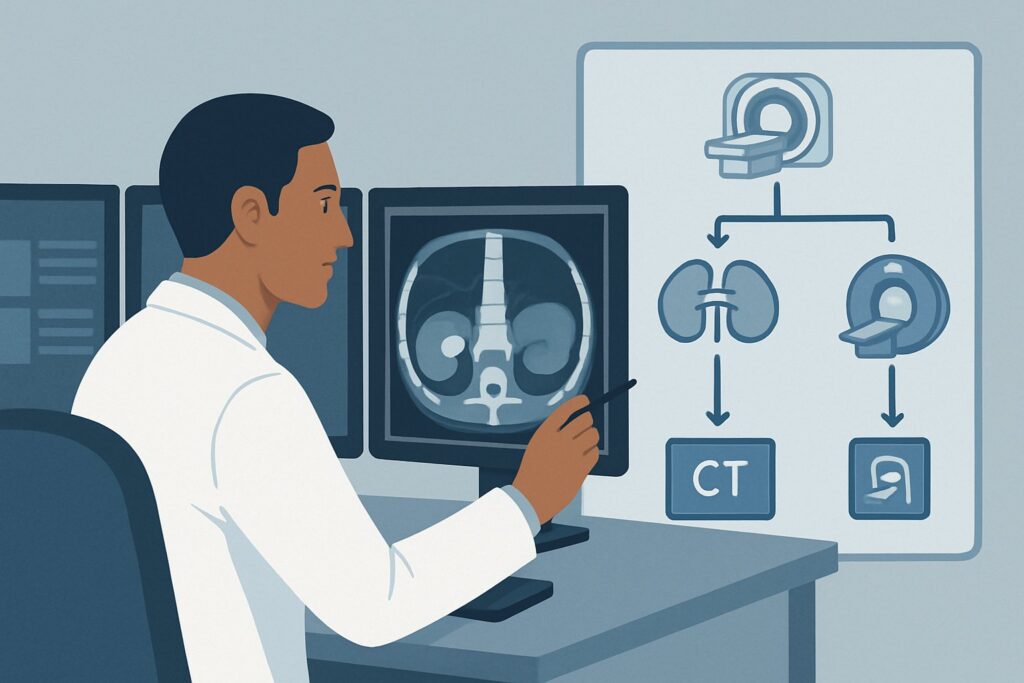
A 58-year-old patient undergoes a computed tomography (CT) scan of the abdomen and pelvis for unrelated abdominal pain, which reveals an incidental 3.2 cm left adrenal mass. The mass measures 25 Hounsfield units (HU) on the non-contrast phase, making it indeterminate, and it lacks the macroscopic fat that would suggest a myelolipoma. The patient has no personal history of cancer. You now face the critical decision of how to characterize this mass to distinguish a benign, non-functional adenoma from a potentially malignant or hormonally active tumor. This article provides a detailed workflow for this specific clinical scenario, guiding your choice of the next imaging study. According to the American College of Radiology (ACR) Appropriateness Criteria, for an indeterminate adrenal mass between 2 and 4 cm in a patient without a history of malignancy, an `MRI abdomen without and with IV contrast` is rated as Usually Appropriate.
Who Fits This Clinical Scenario for Adrenal Mass Evaluation?
This guidance is specifically for patients presenting with an incidentally discovered adrenal mass that meets a precise set of criteria. Correctly identifying if your patient fits this scenario is the first step to ordering the right test and avoiding unnecessary procedures.
Inclusion Criteria:
- The adrenal mass measures greater than 2 cm and less than 4 cm in its largest dimension.
- The mass is “indeterminate” on its initial imaging study, most often a non-contrast or single-phase contrast-enhanced CT. This typically means it has a density greater than 10 HU and lacks specific benign features (e.g., macroscopic fat of a myelolipoma, simple cystic characteristics).
- The patient has no known current or prior history of an extra-adrenal malignancy. The workup changes significantly if there is a known primary cancer, as the likelihood of metastasis becomes a primary concern.
Exclusion Criteria (These patients require a different workflow):
- Masses <2 cm or ≥4 cm: Smaller masses are overwhelmingly benign and may be followed more conservatively, while larger masses have a significantly higher risk of malignancy, often prompting a more aggressive workup. These scenarios are covered in separate ACR guidelines.
- Patients with a known primary cancer: In a patient with a history of lung, renal, or other cancer, an adrenal mass is considered a potential metastasis until proven otherwise, and the imaging workup (often involving PET/CT) is different.
- Masses with diagnostic benign features: If the initial CT shows a simple cyst or a density of ≤10 HU (consistent with a lipid-rich adenoma), or contains macroscopic fat (diagnostic of a myelolipoma), no further adrenal-specific imaging is typically needed.
What Diagnoses Are You Working Up in This Scenario?
When faced with a 2-4 cm indeterminate adrenal mass, the primary goal of imaging is to differentiate between several key diagnostic possibilities. The differential diagnosis drives the selection of an imaging modality that can best assess the specific tissue characteristics of the lesion.
Lipid-Poor Adrenal Adenoma
This is the most common diagnosis for an incidental adrenal mass. While many adenomas are “lipid-rich” and easily diagnosed on non-contrast CT (≤10 HU), a significant subset are “lipid-poor” and thus indeterminate. These benign tumors are the most frequent cause of an incidentaloma in this size range, and confirming this diagnosis can prevent unnecessary surgery or prolonged surveillance.
Pheochromocytoma
Though less common, this catecholamine-secreting tumor of the adrenal medulla is a critical “can’t-miss” diagnosis. They can cause life-threatening hypertensive crises, especially if manipulated during a biopsy or surgery. Imaging plays a key role in raising suspicion for pheochromocytoma, which often displays characteristic features like marked T2 hyperintensity (“lightbulb bright”) on MRI.
Adrenocortical Carcinoma (ACC)
This is a rare but highly aggressive malignancy. While ACC is more common in masses greater than 4 cm, it can occur in the 2-4 cm range. The primary goal of advanced imaging is to identify features suggestive of malignancy, such as irregular margins, central necrosis, hemorrhage, or invasion of adjacent structures, which would prompt urgent surgical consultation.
Metastasis from an Occult Primary
In a patient with no known history of malignancy, a solitary adrenal metastasis from an undiscovered primary cancer is uncommon but remains a possibility. Imaging features can overlap with ACC, but a definitive diagnosis often relies on a comprehensive clinical evaluation and, in some cases, biopsy after a pheochromocytoma has been biochemically excluded.
Why Is MRI of the Abdomen Without and With IV Contrast the Recommended Study?
The ACR rates `MRI abdomen without and with IV contrast` as Usually Appropriate for this scenario because of its superior ability to characterize adrenal tissue without using ionizing radiation. Its diagnostic power comes from specific sequences that can identify intracellular fat and assess vascularity, directly addressing the key differential diagnoses.
The cornerstone of adrenal MRI is chemical shift imaging, which includes in-phase and out-of-phase T1-weighted sequences. Lipid-poor adenomas, while having insufficient lipid to lower their density on CT, still contain enough microscopic intracellular lipid to cause a signal drop on out-of-phase images compared to in-phase images. This finding is highly specific for an adenoma and can confidently establish a benign diagnosis. For other entities, MRI provides crucial clues. Pheochromocytomas are typically markedly hyperintense on T2-weighted sequences, and both pheochromocytomas and adrenocortical carcinomas show avid, often heterogeneous enhancement after gadolinium administration.
Comparison to Other Modalities:
- CT abdomen without and with IV contrast: This is also rated Usually Appropriate and is an excellent alternative, particularly if MRI is unavailable or contraindicated. A dedicated adrenal protocol CT relies on assessing the rate of contrast “washout” from the mass. Adenomas typically enhance rapidly and wash out quickly, while malignant lesions and pheochromocytomas tend to retain contrast. However, this modality involves significant radiation exposure (ACR Relative Radiation Level ☢☢☢☢), which is a key consideration, especially in younger patients.
- Image-guided biopsy of the adrenal gland: This is rated Usually not appropriate. Biopsy is actively discouraged as a primary diagnostic tool for an indeterminate adrenal mass. There is a substantial risk of a non-diagnostic sample, and for ACC, there is a theoretical risk of needle-tract seeding. Most importantly, biopsying an unsuspected pheochromocytoma can precipitate a catastrophic hypertensive crisis. Biopsy is reserved for very specific situations, such as when imaging is inconclusive in a patient with a known malignancy where confirmation of metastasis would change management, and only after pheochromocytoma has been biochemically excluded.
The primary advantage of MRI is its ability to provide a definitive benign diagnosis (lipid-poor adenoma) via chemical shift imaging while simultaneously evaluating for features of more sinister pathology, all with a radiation dose of 0 mSv.
What’s Next After MRI? Downstream Workflow
The results of the adrenal MRI will guide the subsequent clinical pathway, which almost always involves biochemical testing and may involve specialty consultation or further surveillance.
If the MRI suggests a lipid-poor adenoma:
A clear signal drop on out-of-phase imaging is highly indicative of an adenoma. The essential next step is a biochemical workup to determine if the adenoma is hormonally active. This includes screening for hypercortisolism (e.g., 1-mg dexamethasone suppression test), primary aldosteronism (if hypertensive), and pheochromocytoma (plasma or urine metanephrines). If the adenoma is non-functional, management is typically conservative, often with a follow-up scan in 6-12 months to ensure stability, after which surveillance may be discontinued.
If the MRI is suspicious for pheochromocytoma:
Findings like marked T2 hyperintensity should prompt immediate biochemical testing for plasma free metanephrines and normetanephrines. If elevated, the patient requires an endocrinology consultation for medical optimization (alpha-blockade) in preparation for surgical resection. No intervention should be performed until the biochemical diagnosis is confirmed and the patient is appropriately prepared.
If the MRI is suspicious for adrenocortical carcinoma:
Features such as large size within the 2-4 cm range, irregular shape, necrosis, or invasion warrant urgent referral to a surgical oncologist or urologist with expertise in adrenal surgery. A full biochemical workup is still mandatory prior to any surgery to rule out a co-secreting tumor or pheochromocytoma.
If the MRI remains indeterminate:
If chemical shift imaging is equivocal and there are no clear features of malignancy or pheochromocytoma, the mass remains indeterminate. In this case, options include performing a dedicated adrenal protocol CT to assess washout characteristics or proceeding with imaging surveillance. A follow-up scan (CT or MRI) in 6-12 months to assess for growth is a common strategy. Growth would be a concerning feature prompting reconsideration for surgery.
Pitfalls to Avoid (and When to Get Help)
Navigating the workup of an indeterminate adrenal mass requires careful attention to detail to avoid common errors that can lead to patient harm or diagnostic delay.
- Forgetting the biochemical workup: Imaging characterizes anatomy, not function. Every patient with an adrenal mass, regardless of its appearance, requires a biochemical evaluation to rule out hormonal hypersecretion.
- Ordering a premature biopsy: Never biopsy an adrenal mass until pheochromocytoma has been rigorously excluded through biochemical testing. This is a critical safety step to prevent a potentially fatal hypertensive crisis.
- Using a non-dedicated imaging protocol: Ordering a “routine” abdomen MRI or CT is insufficient. You must specify an “adrenal protocol” to ensure the inclusion of chemical shift sequences for MRI or the proper non-contrast, early- and delayed-postcontrast phases for CT washout calculation.
- Ignoring size thresholds: The management algorithm changes significantly for masses ≥4 cm. Be precise with measurements and ensure you are applying the correct size-based workflow. If a mass is 3.9 cm, it follows this pathway; if it is 4.1 cm, it falls into a higher-risk category.
If imaging findings are complex, equivocal, or concerning for malignancy, or if the biochemical workup is abnormal, escalate care by consulting with endocrinology and/or a surgeon specializing in adrenal disease.
Related ACR Topics and Tools
This article covers one specific scenario in adrenal mass evaluation. For a comprehensive overview of all related clinical presentations and for tools to help with ordering and patient communication, please see the resources below.
- For breadth across all scenarios in Adrenal Mass Evaluation, see our parent guide: Adrenal Mass Evaluation: ACR Appropriateness Decoded.
- To explore other clinical situations, use the ACR Appropriateness Criteria Lookup.
- For technical details on the recommended study, visit the Imaging Protocol Library.
- To discuss radiation exposure with patients, consult the Radiation Dose Calculator.
Frequently Asked Questions
Why not just order a dedicated adrenal protocol CT instead of an MRI?
Both dedicated adrenal protocol CT and MRI are rated ‘Usually Appropriate’ by the ACR for this scenario. MRI is often preferred because it involves no ionizing radiation and its use of chemical shift imaging is highly specific for diagnosing lipid-poor adenomas. However, a CT with washout analysis is an excellent and widely available alternative, especially if a patient has contraindications to MRI (e.g., certain implants) or if MRI is not readily accessible.
What if my patient has a contraindication to MRI, like a non-compatible pacemaker?
In cases where MRI is contraindicated, `CT abdomen without and with IV contrast` using a dedicated adrenal washout protocol is the appropriate alternative study. It is also rated ‘Usually Appropriate’ and provides the necessary information to characterize the mass based on its contrast enhancement and washout patterns.
Is a biochemical workup always necessary for a 3 cm indeterminate adrenal mass?
Yes, absolutely. All adrenal masses, regardless of their size or imaging characteristics, require a baseline biochemical evaluation to screen for hormonal hypersecretion. This typically includes testing for excess cortisol, aldosterone (in hypertensive patients), and catecholamines to rule out Cushing’s syndrome, Conn’s syndrome, and pheochromocytoma, respectively. The functional status of the mass is a critical component of management.
What exactly makes an adrenal mass ‘indeterminate’ on an initial CT scan?
An adrenal mass is typically considered indeterminate if it does not meet the criteria for a definitive benign lesion on a non-contrast or portal-venous phase CT. This usually means it has an attenuation value greater than 10 Hounsfield units (HU) on a non-contrast scan (ruling out a lipid-rich adenoma) and lacks features of a simple cyst or the macroscopic fat seen in a myelolipoma.
If the mass is stable on a 12-month follow-up scan, can we stop imaging?
For a biochemically non-functional, indeterminate adrenal mass that has shown no growth over a 12- to 24-month period, many guidelines suggest that further routine imaging surveillance can be discontinued. This decision implies that the mass has demonstrated benign behavior. However, this should always be made in the context of the complete clinical picture and often in consultation with an endocrinologist.
Reviewed by Pouyan Golshani, MD, Interventional Radiologist — May 29, 2026