Market Pulse November 2025: How Rate Cuts and a Housing Freeze Affect Physician Financing and Real Estate
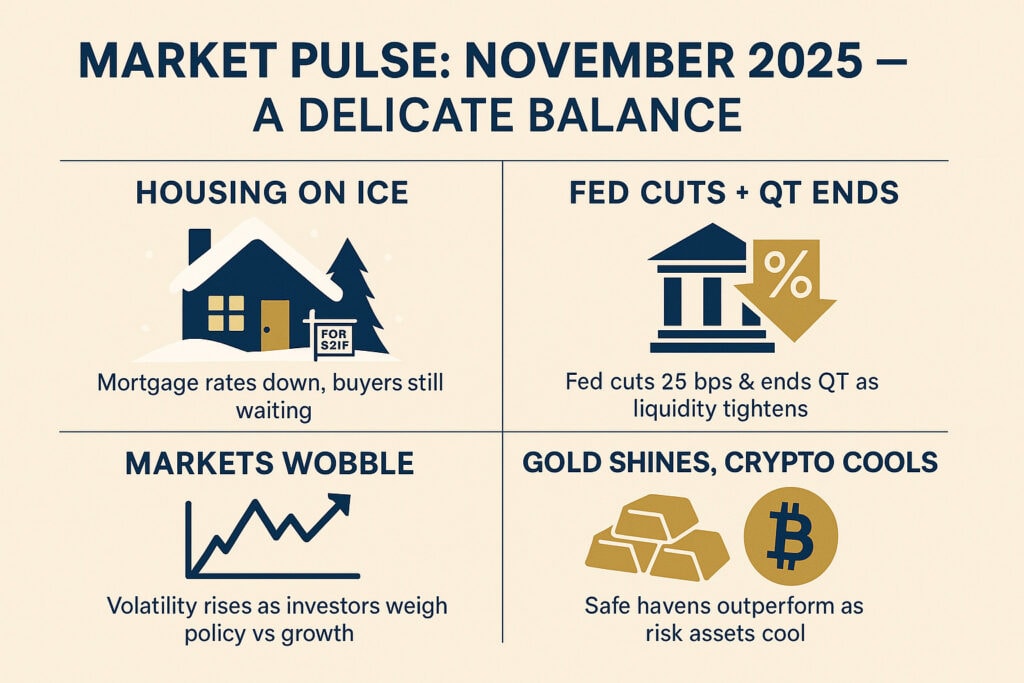
While you’re focused on patient care, the financial systems that govern your practice and personal wealth are shifting. This month’s moves in interest rates, liquidity, and housing aren’t just abstract headlines; they directly influence the cost of a new imaging center, the terms of an equipment loan, and the long-term health of your retirement portfolio.
Understanding these signals is the first step in making sound capital decisions without derailing your clinical focus. Below is a breakdown of the key economic moves from November 2025.
🏠 Housing on Ice
Mortgage rates have ticked lower — but not enough to thaw the market.
HELOC borrowing is climbing again as homeowners tap equity instead of selling, yet demand from buyers remains weak.
Prices are flat to slightly down in most big metros, and inventory is creeping up as people hold off for clarity on rates.
It’s not a crash — just a long, slow freeze.
—
🏦 The Fed Blinks
The Federal Reserve cut rates by 25 basis points and confirmed it will end quantitative tightening in December.
That’s the biggest policy shift in two years — a quiet acknowledgment that liquidity is drying up faster than expected.
Short-term relief, sure.
But ending QT this soon means the Fed is seeing cracks they won’t say out loud.
—
📊 Markets Wobble
Stocks are caught between optimism and exhaustion.
AI names are still carrying much of the weight, but volatility’s picking up.
The services sector is holding up, yet job creation is cooling — a mix that feels more like late-cycle tension than new momentum.
—
🥇 Gold Shines, Crypto Cools
Gold’s hovering near record highs, pulling in capital that used to chase yield.
Bitcoin’s slipped from its recent highs, reminding everyone that “digital gold” still behaves like a risk asset.
When gold leads and credit tightens, it usually means investors are bracing for turbulence — not chasing growth.
—
⚖️ What It Means
The economy isn’t breaking — it’s rebalancing.
Housing remains locked, liquidity’s tightening, and markets are adjusting to a new reality: slower growth, higher costs, and more selective opportunities.
For physicians and professionals, that means staying liquid, staying tax-aware, and being intentional about where capital sits.
At GigHz, we’ll keep breaking down what’s actually moving — without the noise.
What this means for your practice and portfolio
- Financing Costs are Shifting: The Fed’s policy change suggests a window may be opening for more favorable financing on practice acquisitions, equipment, or ASC build-outs. It’s critical to model your costs now with tools like CenterIQ before the market fully reprices these moves.
- Real Estate Math is Changing: A cooling housing market alters the analysis for purchasing a practice property or a personal residence. This is a time to carefully evaluate entry points and financing structures, a core focus of our work with physicians at Repit.
- Portfolio Defense is Key: Market volatility and a flight to safety assets signal a defensive posture among investors. Review your portfolio’s allocation to ensure it aligns with your risk tolerance and timeline, a key principle we explore at Savng.
This content is for educational purposes and is not investment advice. You are responsible for your own financial decisions.
Last reviewed by Pouyan Golshani, MD — 2026-06-23.
Frequently Asked Questions
What investment strategies should physicians consider in 2025?
In 2025, physicians should consider investment strategies that prioritize liquidity and tax awareness. With the Federal Reserve cutting rates and ending quantitative tightening, maintaining accessible capital is crucial. The housing market remains stagnant, and gold is near record highs, indicating a shift towards safer assets. Physicians should focus on selective opportunities, avoiding high-risk investments as markets experience volatility. Staying informed about economic adjustments will enable better decision-making in a landscape characterized by slower growth and higher costs.
How can physicians stay liquid during market fluctuations?
Physicians can maintain liquidity during market fluctuations by being intentional about their capital allocation and staying tax-aware. As liquidity tightens, it is crucial to assess where investments are placed, ensuring funds are accessible when needed. This involves diversifying assets, possibly favoring more liquid investments such as cash equivalents or short-term bonds. Additionally, monitoring economic indicators, like the Federal Reserve's rate adjustments, can provide insights into market conditions. Staying informed about market trends, such as the shift towards gold as a safer asset, can also guide strategic financial decisions.
Why is liquidity important for physician investors now?
Liquidity is crucial for physician investors now due to tightening market conditions and a shift in economic policy. The Federal Reserve's recent decision to cut rates by 25 basis points and end quantitative tightening indicates that liquidity is drying up faster than anticipated. This environment necessitates that investors maintain access to cash to navigate potential market volatility and capitalize on selective opportunities. As housing remains stagnant and credit tightens, having liquidity allows physicians to respond effectively to changing market dynamics and protect their investments.
When should physicians adjust their investment portfolios?
Physicians should consider adjusting their investment portfolios when economic indicators signal a shift in market conditions. Currently, with the Federal Reserve cutting rates by 25 basis points and ending quantitative tightening, liquidity is tightening, suggesting a cautious approach is warranted. Additionally, the housing market is stagnant, and volatility in the stock market is increasing. Staying liquid and tax-aware while being intentional about capital allocation is essential during this rebalancing phase. Monitoring these factors can help physicians make informed decisions about their investments.
Does the current market environment affect physician investment opportunities?
The current market environment significantly impacts physician investment opportunities. With the Federal Reserve cutting rates and ending quantitative tightening, liquidity is tightening, indicating a shift in the economic landscape. Housing markets are stagnant, with prices flat or slightly declining, and inventory increasing. This creates a cautious atmosphere for investments. Physicians should remain liquid and tax-aware, focusing on selective opportunities as the economy rebalances. The emphasis on intentional capital allocation is crucial in navigating this environment, where slower growth and higher costs are prevalent.
Reviewed by Pouyan Golshani, MD, Interventional Radiologist — June 27, 2026