Market Update (Oct 4–11, 2025): How Falling Yields Could Reshape Your Practice & Real Estate Math
Most market updates are noise. This one contains signals that directly affect the large-capital decisions physicians make: financing a practice acquisition, buying new imaging equipment, or funding an ASC buildout. These aren’t just portfolio moves; they are career-defining investments where timing and interest rates are critical.
The data below on falling Treasury yields, a cooling labor market, and a frozen housing sector isn’t abstract. It’s direct input for the financial models you run on your practice and personal balance sheet. Understanding these shifts helps you see risk and opportunity before they become expensive.
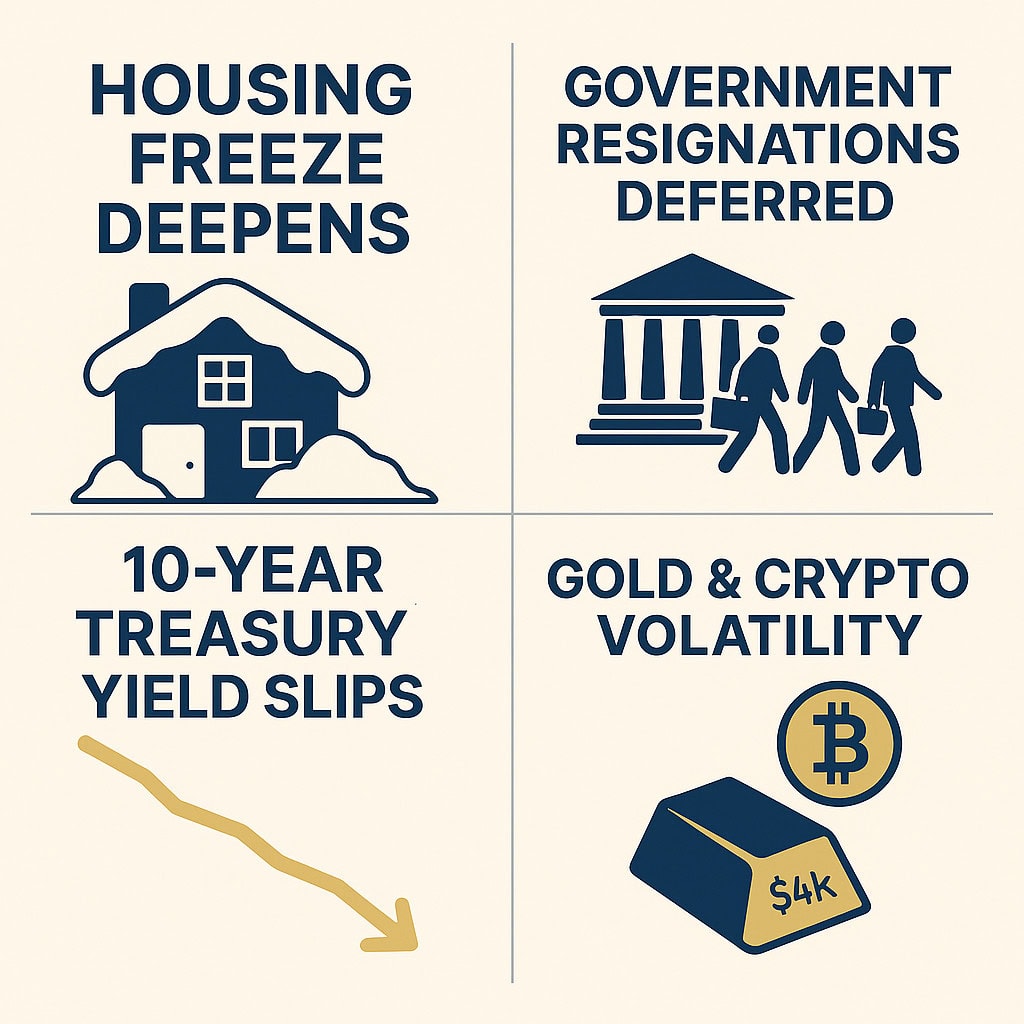
Infographic summarizing the Oct 4–11 2025 market update:
Top-left shows a house with a snowflake, indicating a frozen housing market despite a small mortgage-rate dip;
top-right shows government workers leaving a building, representing 100 k federal resignations;
bottom-left displays a line graph of falling Treasury yields;
bottom-right shows a gold bar breaking $4 000 and a small Bitcoin coin, symbolizing record gold prices and crypto volatility📊 Executive Overview
Housing remains stuck in a deep freeze: a small decline in mortgage rates sparked only a brief refinancing rush, and purchase demand is still down 32% from 2019. Meanwhile, 100,000 federal “deferred resignations” will soon appear in the jobs data, the bond market is reacting to tariff headlines, and gold smashed through $4,000/oz.
🏠 Housing & Real Estate
• Rates too high: Even after dipping to 6.43%, mortgage rates remain far above early‑2024 lows. A two‑week refi spike fizzled quickly.
• Demand deep-freeze: Purchase mortgage applications are flat and 32% below 2019 levels. High prices and lingering lock‑in keep buyers on the sidelines.
💼 Labour Market & Policy
• Deferred resignations: About 100k federal workers left payrolls on Sept 30 and will show up in the November jobs report. Total federal losses for 2025 will likely exceed 200k.
• Private hiring cools: August saw about 50k private-sector jobs; the three‑month average is 48k.
• Yields tumble: The 10‑yr Treasury yield fell to 4.04% as markets digested threats of new China tariffs. The bond market now expects one more Fed cut this year.
💰 Liquidity & Safe Havens
• T‑bill pivot: The Treasury is issuing more short-term bills; some auction sizes are up 10–17% vs August. This should relieve pressure on long-term yields and keep money-market rates attractive.
• Gold rockets: Spot gold reached $4,031/oz, up roughly 50% year‑to‑date. ETF inflows and central-bank buying continue.
• Crypto wobbles: Bitcoin pulled back to about $115k after spiking to $125k. New IRS 1099‑DA reporting rules are a looming headwind.
💡 Takeaway
This market remains a study in contrasts: housing stays depressed, labour is cooling, and bond markets are whipsawed by politics more than policy. Investors are rushing into safe havens like gold while eyeing short-term yields and waiting for more clarity on inflation and regulation. Stay diversified across cash, real assets, and select risk assets—and watch for data volatility as deferred resignations hit the jobs report next month.
What this means for your practice and portfolio
- Financing Costs Are Shifting: Falling Treasury yields often precede lower rates on commercial and equipment loans. If you’re considering a practice acquisition, expansion, or major equipment purchase, now is the time to model the costs. A small rate change has a large impact on total cost over the life of a loan. Use a tool like CenterIQ to analyze your facility’s economics against different financing scenarios.
- Real Estate Calculus is Changing: A stalled housing market can signal shifts in commercial real estate as well. This may change the math for buying your first clinic, expanding your current space, or investing in medical office buildings. For physicians exploring real estate, platforms like Repit help analyze these specific opportunities.
- Portfolio Risk Review: The flight to safe havens like gold alongside continued crypto volatility is a reminder to review your own asset allocation. Ensure your investment mix, whether managed through a platform like Savng or with an advisor, aligns with your risk tolerance as market sentiment shifts.
This information is for educational purposes only and does not constitute investment, financial, or legal advice. You are solely responsible for your own decisions.
Last reviewed by Pouyan Golshani, MD — 2026-06-23.
Frequently Asked Questions
What factors contributed to the drop in Treasury yields?
The drop in Treasury yields can be attributed to several factors. The 10-year Treasury yield fell to 4.04% as markets reacted to the potential for new China tariffs and anticipated one more Federal Reserve interest rate cut this year. Additionally, the Treasury's increased issuance of short-term bills, with auction sizes up 10-17% compared to August, is expected to relieve pressure on long-term yields. This environment has led investors to seek safe havens, contributing to the decline in yields.
How did gold prices surge past $4,000 per ounce?
Gold prices surged past $4,000 per ounce, reaching $4,031/oz, primarily due to increased demand for safe-haven assets amid economic uncertainty. Factors contributing to this rise include a significant drop in Treasury yields, with the 10-year yield falling to 4.04%, and substantial inflows into gold exchange-traded funds (ETFs) alongside central bank purchases. These dynamics reflect investor behavior in response to a cooling labor market and political pressures affecting the bond market. Gold has increased approximately 50% year-to-date, highlighting its appeal during periods of market volatility.
Why is the housing market experiencing a deep freeze?
The housing market is experiencing a deep freeze due to several factors. Despite a slight dip in mortgage rates to 6.43%, purchase mortgage applications remain flat and are 32% below 2019 levels. High home prices and a phenomenon known as "lock-in," where current homeowners are reluctant to sell due to favorable existing mortgage rates, keep potential buyers sidelined. Additionally, the recent wave of 100,000 federal resignations adds uncertainty to the economic landscape, further dampening housing demand. This combination of high rates and decreased buyer interest contributes to the stagnation in the housing market.
When will the impact of federal resignations appear in job reports?
The impact of the 100,000 federal "deferred resignations" will appear in the November jobs report. These resignations occurred on September 30, 2025, and will contribute to the total federal job losses for the year, which are expected to exceed 200,000. This significant shift in federal employment will likely influence labor market metrics and economic analysis in the upcoming report.
Can investors expect more Fed cuts this year?
The bond market currently expects one more Federal Reserve interest rate cut this year. This anticipation follows a decline in the 10-year Treasury yield, which recently fell to 4.04%. Investors are reacting to various economic indicators, including the impact of recent federal resignations and tariff headlines. The overall economic landscape remains uncertain, with housing demand significantly down and inflation concerns lingering.
Reviewed by Pouyan Golshani, MD, Interventional Radiologist — June 27, 2026