Should You Order CT for an Acute Flare in a Patient with Chronic Pancreatitis?
A 55-year-old man with a known history of alcohol-induced chronic pancreatitis presents to the emergency department with a three-day history of severe, boring epigastric pain radiating to his back. The pain is far worse than his baseline, and his lipase is markedly elevated. You suspect an acute exacerbation, but the severity of his symptoms raises concern for complications like necrosis or a vascular catastrophe. This clinical scenario requires a specific imaging strategy to differentiate uncomplicated inflammation from life-threatening sequelae. This article details the American College of Radiology (ACR) workflow for this exact presentation, where a `CT abdomen and pelvis with IV contrast` is rated Usually Appropriate as the initial imaging study.
Who Fits This Clinical Scenario?
This guidance applies to adult patients with a pre-existing, established diagnosis of chronic pancreatitis who now present with signs and symptoms concerning for a superimposed episode of acute pancreatitis. Key features include a significant worsening of abdominal pain from baseline, often accompanied by new or worsening nausea, vomiting, and a substantial elevation in pancreatic enzymes (amylase and/or lipase) above their typical levels.
This workflow is distinct from the initial workup of a patient with suspected chronic pancreatitis for the first time. That scenario, covered in a separate ACR variant, focuses on identifying the morphologic features of chronic disease itself, such as calcifications, ductal dilation, and atrophy. The current scenario assumes those chronic changes are already known; the primary clinical question is to identify and grade the severity of a new acute inflammatory process and its immediate complications. It also differs from the surveillance of known complications, such as a stable pseudocyst, which may follow a different imaging algorithm.
What Diagnoses Are You Working Up in This Scenario?
When a patient with chronic pancreatitis presents with an acute flare, the differential diagnosis extends beyond simple inflammation. The imaging study is chosen to assess for several critical, and potentially life-threatening, conditions that can arise in this setting.
Acute Interstitial or Necrotizing Pancreatitis: The most immediate concern is to confirm the presence of acute pancreatitis and, crucially, to determine its severity. Imaging helps differentiate edematous (interstitial) pancreatitis from necrotizing pancreatitis, where portions of the pancreatic parenchyma or peripancreatic tissues have lost viability. This distinction is paramount as necrotizing pancreatitis carries a much higher morbidity and mortality and often requires a more aggressive management strategy, including potential ICU admission and delayed intervention.
Vascular Complications (e.g., Pseudoaneurysm, Venous Thrombosis): The inflamed, fibrotic pancreas in chronic disease is prone to eroding into adjacent blood vessels. This can lead to the formation of a pseudoaneurysm, most commonly involving the splenic, gastroduodenal, or pancreaticoduodenal arteries. Rupture of a pseudoaneurysm is a catastrophic event with high mortality. Additionally, inflammation can cause thrombosis of the splenic or portal veins, leading to gastric varices or portal hypertension.
Complicated Fluid Collections or Pseudocysts: While pseudocysts are a hallmark of chronic pancreatitis, an acute flare can cause them to rapidly enlarge, become infected, or hemorrhage. Imaging is essential to assess the size, character, and stability of any pre-existing fluid collections and to identify new ones that may require drainage or intervention.
Underlying Pancreatic Ductal Adenocarcinoma: Though less common as a cause of an acute presentation, a small subset of patients with what appears to be acute-on-chronic pancreatitis may have an underlying malignancy obstructing the pancreatic duct. Chronic pancreatitis is a significant risk factor for pancreatic cancer, and imaging can sometimes reveal a suspicious mass that might otherwise be missed.
Why Is CT Abdomen and Pelvis with IV Contrast the Recommended Study?
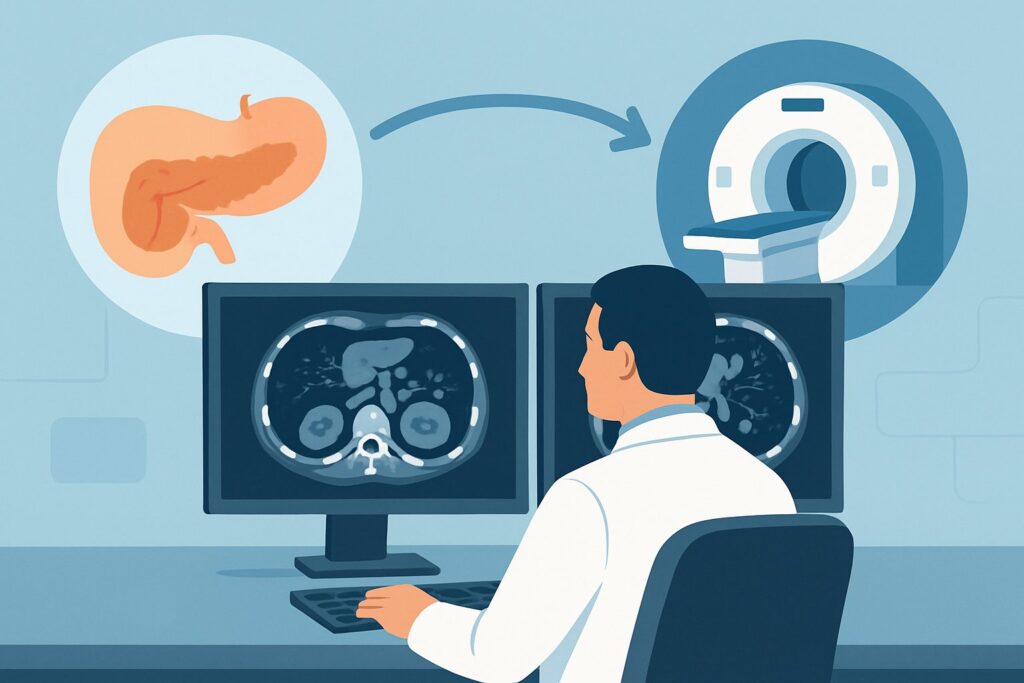
For an adult with known chronic pancreatitis and a suspected acute flare, the ACR designates `CT abdomen and pelvis with IV contrast` as Usually Appropriate. This recommendation is based on the modality’s speed, availability, and superior ability to evaluate the key differential diagnoses in the acute setting.
The administration of intravenous contrast is the critical component. A contrast-enhanced CT, particularly with imaging in the portal venous phase (typically 60-70 seconds after injection), allows for robust assessment of pancreatic parenchymal enhancement. Areas that fail to enhance are indicative of necrosis, a key prognostic factor. Contrast also opacifies the arterial and venous systems, making it the best non-invasive test to rapidly identify vascular complications like pseudoaneurysms and splenic or portal vein thrombosis. It effectively characterizes peripancreatic fluid collections and can detect other intra-abdominal pathologies that may mimic a pancreatitis flare.
Alternative studies are rated lower for specific reasons in this acute context:
- MRI abdomen without and with IV contrast with MRCP: While rated May be appropriate, MRI is generally less available on an emergent basis and takes significantly longer to perform. Although it offers excellent soft tissue contrast and avoids ionizing radiation, its primary strength—detailed evaluation of the biliary and pancreatic ducts via MRCP—is often a secondary concern during the initial, acute stabilization phase.
- US abdomen: This is rated Usually not appropriate as a primary study. While ultrasound is non-invasive and uses no radiation, it is often severely limited in patients with acute pancreatitis due to overlying bowel gas from ileus. It cannot reliably assess for necrosis or deep peripancreatic collections and provides no information about vascular complications.
- CT abdomen and pelvis without IV contrast: This is also rated Usually not appropriate. A non-contrast CT can show calcifications, gross fluid collections, and pancreatic enlargement, but it cannot assess for parenchymal necrosis or vascular complications, which are the most critical questions to answer in this scenario. Omitting contrast severely limits the diagnostic utility of the study.
The recommended CT study carries a moderate radiation dose (ACR RRL ☢☢☢, 1-10 mSv). This risk is generally considered acceptable given the high diagnostic yield and the seriousness of the potential findings. Once you’ve decided on this study, our protocol guide covers the technical details. For technique, contrast, and reading principles, see our guide: CT Chest/Abdomen/Pelvis with IV Contrast.
What’s Next After CT Abdomen and Pelvis with IV Contrast? Downstream Workflow
The results of the contrast-enhanced CT will directly guide the subsequent clinical management and potential need for further imaging or intervention.
- If the CT confirms uncomplicated acute interstitial pancreatitis: The patient is typically managed supportively with intravenous fluids, pain control, and nutritional support. Repeat imaging is generally not needed unless the patient fails to improve clinically or develops new signs of complications.
- If the CT demonstrates pancreatic or peripancreatic necrosis: This finding often prompts a higher level of care, such as ICU admission. Management focuses on aggressive resuscitation and monitoring for signs of infected necrosis, which may develop days to weeks later. If infection is suspected (e.g., fever, leukocytosis, gas in the collection), a CT-guided fine-needle aspiration may be performed. Infected necrosis often requires delayed drainage, either endoscopically or surgically.
- If the CT identifies a vascular complication (e.g., pseudoaneurysm): This is a radiological emergency. An urgent consultation with interventional radiology is warranted for potential trans-arterial embolization.
- If the CT is negative for acute pancreatitis but pain persists: The patient’s symptoms may be due to their underlying chronic pancreatitis without a superimposed acute process. In this case, further evaluation may focus on ductal anatomy and potential obstructions. An MRI/MRCP, which is rated May be appropriate in the initial setting, becomes a more logical next step to evaluate for strictures or stones that might be amenable to endoscopic therapy (ERCP).
Pitfalls to Avoid (and When to Get Help)
Navigating this clinical scenario requires avoiding several common pitfalls. First, do not order a CT without intravenous contrast; it fails to answer the most critical questions about necrosis and vascular integrity. Second, ensure the patient’s renal function is adequate for contrast administration or that appropriate pre-medication/hydration protocols are in place. Third, avoid imaging too early; pancreatic necrosis may not be evident on CT within the first 48-72 hours of symptom onset. If clinical suspicion is high but the initial CT is negative, a repeat scan in 3-5 days may be necessary if the patient is not improving. Finally, remember that chronic pancreatitis itself causes significant morphologic changes; be careful not to misinterpret chronic atrophy or calcifications as acute findings. If the findings are complex or suggest a vascular complication, immediate consultation with interventional radiology or a surgical specialist is critical.
Related ACR Topics and Tools
This article focuses on a single, specific clinical scenario. For a comprehensive overview of imaging for all presentations of chronic pancreatitis, from initial diagnosis to surveillance, please see our parent guide. The tools below can help you apply appropriateness criteria to other scenarios, understand imaging protocols, and discuss radiation dose with your patients.
- For breadth across all scenarios in Chronic Pancreatitis, see our parent guide: Chronic Pancreatitis: ACR Appropriateness Decoded.
- ACR Appropriateness Criteria Lookup — for adjacent scenarios
- Imaging Protocol Library — for technique on the recommended study
- Radiation Dose Calculator — for cumulative dose conversations
Frequently Asked Questions
Why not start with an abdominal ultrasound in this scenario?
Abdominal ultrasound is rated ‘Usually not appropriate’ for suspected acute-on-chronic pancreatitis. The primary reason is that the pancreas is often obscured by overlying bowel gas, a common issue in patients with acute pancreatitis due to ileus. Furthermore, ultrasound cannot reliably detect pancreatic necrosis or vascular complications like pseudoaneurysms, which are critical findings that guide management.
What should I do if the patient has a severe contrast allergy or poor renal function?
If IV contrast is contraindicated, an MRI/MRCP becomes the best alternative and is rated ‘May be appropriate’. Gadolinium-based contrast agents can often be used in patients with an iodine contrast allergy. For patients with severe renal impairment, a non-contrast MRI can still provide valuable information about fluid collections and ductal anatomy, though it is less sensitive for necrosis. The decision should be made in consultation with the radiology department.
Is there a role for endoscopic ultrasound (EUS) in this acute setting?
Endoscopic ultrasound (EUS) is rated ‘Usually not appropriate’ for the initial imaging of a suspected acute flare. EUS is an invasive procedure that requires sedation and is primarily used for detailed morphologic assessment, tissue sampling of masses, or therapeutic drainage of fluid collections in a non-acute or sub-acute setting. It is not a first-line tool for assessing the severity of an acute episode.
How soon after symptom onset should the CT scan be performed?
While a CT can be performed at any time, its ability to detect pancreatic necrosis is highest after 72 hours from symptom onset. If a scan is performed very early (e.g., within the first 24-48 hours) and is negative for necrosis, but the patient remains severely ill, a repeat CT in 3-5 days may be warranted to re-assess for developing complications.
The ACR lists ‘CT abdomen and pelvis without and with IV contrast’ as ‘May be appropriate (Disagreement)’. Why is this different from the recommended study?
The recommended study is a single-phase, contrast-enhanced CT (portal venous phase). The ‘without and with’ protocol involves acquiring two sets of images: one before contrast and one after. While this provides more information (e.g., identifying calcifications on the non-contrast series), it doubles the radiation dose (ACR RRL ☢☢☢☢, 10-30 mSv). The ACR panel had disagreement on whether this extra radiation is justified, as most of the critical information for acute management is available from the post-contrast images alone.
Reviewed by Pouyan Golshani, MD, Interventional Radiologist — May 30, 2026