What Imaging Is Best for Routine Esophageal Cancer Follow-Up Without Recurrence?

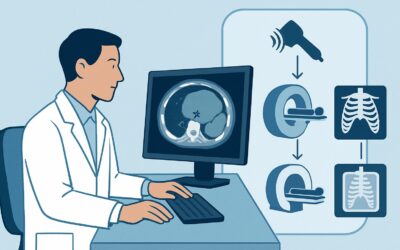
A 68-year-old patient is in your clinic for his 18-month follow-up after completing chemoradiation and esophagectomy for a T3N1 adenocarcinoma of the distal esophagus. He feels well, has regained some weight, and reports no dysphagia, cough, or pain. His physical exam is unremarkable. You are planning his routine surveillance imaging, but he has no symptoms to suggest recurrence. The central question is which study provides the most effective surveillance for asymptomatic disease detection without subjecting him to unnecessary tests or radiation. For this specific clinical scenario—posttreatment imaging with no suspected or known recurrence—the American College of Radiology (ACR) rates CT chest and abdomen with IV contrast as Usually Appropriate.
Who Fits This Clinical Scenario for Esophageal Cancer Surveillance?
This guidance applies specifically to patients who have completed definitive therapy for esophageal cancer and are now in the surveillance phase. The key inclusion criteria are:
- A confirmed history of esophageal cancer (either squamous cell carcinoma or adenocarcinoma).
- Completion of curative-intent treatment, which may include surgery (esophagectomy), chemotherapy, radiation therapy, or a combination thereof.
- The patient is currently asymptomatic, with no new or worsening symptoms (e.g., dysphagia, odynophagia, weight loss, chest pain) that would raise clinical suspicion for recurrence.
- The imaging is being ordered for routine, scheduled surveillance as part of a standard posttreatment follow-up plan.
It is critical to distinguish this scenario from similar but distinct clinical presentations that require a different imaging approach. This workflow does not apply if:
- The patient has symptoms concerning for recurrence. New dysphagia, significant weight loss, or localized pain shifts the scenario to Posttreatment imaging. Suspected or known recurrence, where FDG-PET/CT often plays a more prominent role.
- The patient is newly diagnosed and requires initial staging. This falls under the Pretreatment clinical staging variant, which has a different set of primary imaging recommendations.
- The patient is currently undergoing neoadjuvant or definitive chemoradiation. Evaluating treatment response during therapy is a separate clinical question covered in the Imaging during treatment scenario.
What Diagnoses Are You Working Up With Surveillance Imaging?
In an asymptomatic patient after esophageal cancer treatment, surveillance imaging is not a broad screening tool but a focused search for specific, clinically significant findings. The primary goal is to detect recurrence at a subclinical stage when it may be more amenable to salvage therapy.
Asymptomatic Locoregional Recurrence
This is a primary concern. Recurrence can occur at the surgical anastomosis, in the tumor bed, or within regional lymph node basins (mediastinal, supraclavicular, or celiac). Early detection is challenging, as post-treatment changes like fibrosis and inflammation can mimic or obscure small tumor deposits. Imaging aims to identify subtle new soft tissue thickening, enlarging lymph nodes, or nodularity that deviates from the expected post-surgical or post-radiation appearance.
Distant Metastatic Disease
The most common sites for distant metastases from esophageal cancer are the liver, lungs, distant lymph nodes, and adrenal glands. CT is highly effective at surveying these organs. The goal is to identify small, asymptomatic metastatic nodules before they cause organ dysfunction or widespread symptoms, potentially opening avenues for systemic therapy or targeted local treatments like stereotactic radiation.
Second Primary Malignancy
Patients with a history of esophageal cancer, particularly squamous cell carcinoma linked to smoking and alcohol, have an elevated risk of developing a second primary cancer in the aerodigestive tract, including the head, neck, and lungs. While not the primary purpose of the scan, surveillance imaging of the chest can incidentally detect a new lung primary at an early stage.
Why Is CT Chest and Abdomen with IV Contrast Usually Appropriate for Surveillance?
The ACR designates CT chest and abdomen with IV contrast as Usually Appropriate for routine surveillance because it offers an excellent balance of anatomic detail, accessibility, and diagnostic utility for the most common patterns of recurrence.
The rationale for this choice is multifactorial. CT provides high-resolution cross-sectional images of the thorax and abdomen, allowing for detailed evaluation of the primary sites of potential recurrence. Intravenous contrast is crucial, as it enhances the visibility of lymph nodes, delineates vascular structures from soft tissue, and significantly increases the sensitivity for detecting liver and other solid organ metastases. Without contrast, small nodal or hepatic lesions can be easily missed.
While FDG-PET/CT skull base to mid-thigh is also rated Usually Appropriate, its role in routine asymptomatic surveillance is more nuanced. PET/CT is highly sensitive for detecting metabolically active tumor cells. However, it can have a higher rate of false-positive findings due to post-treatment inflammation, which can persist for many months after radiation or surgery. For this reason, many institutional protocols favor anatomic imaging with CT as the primary surveillance modality, reserving PET/CT for cases where CT findings are equivocal or when clinical suspicion of recurrence arises despite a negative CT.
Other imaging modalities are rated lower for this specific scenario:
- MRI chest and abdomen without and with IV contrast is rated Usually not appropriate. MRI has limited utility in evaluating the lungs for small nodules due to respiratory motion and lower spatial resolution compared to CT. While excellent for the liver, it offers no significant advantage over a high-quality contrast-enhanced CT for the overall surveillance needs in this context.
- Fluoroscopy upper GI series is also Usually not appropriate for surveillance. While useful for assessing anastomotic leaks or strictures, it provides no information about nodal or distant metastatic disease, which is the primary goal of surveillance.
The radiation dose for a CT of the chest and abdomen is significant (ACR RRL®: ☢☢☢☢, 10-30 mSv), a key consideration in patients undergoing serial scans over several years. This underscores the importance of adhering to evidence-based surveillance intervals and avoiding imaging more frequently than recommended by national guidelines.
Once you’ve decided on CT, our protocol guide covers the technique, contrast, and reading principles: CT Chest/Abdomen/Pelvis with IV Contrast. Note that while the primary ACR recommendation is for the chest and abdomen, extending coverage to the pelvis is often performed and is rated May be appropriate.
What’s Next After CT? Downstream Workflow
The results of the surveillance CT will guide the subsequent clinical pathway. The workflow branches based on whether the findings are negative, positive, or indeterminate.
- If the CT is negative: If the scan shows no evidence of recurrent or metastatic disease and only expected post-treatment changes, the patient continues with the scheduled surveillance plan. The next imaging study will be performed at the subsequent recommended interval (e.g., in 6 or 12 months, depending on the protocol and time from treatment).
- If the CT is positive for suspected recurrence: If the scan reveals a new or enlarging soft tissue mass, suspicious lymphadenopathy, or new lesions in the liver or lungs, the next step is typically pathologic confirmation. This often involves an EGD with biopsy for suspected luminal recurrence or a CT-guided or EUS-guided biopsy for nodal or metastatic disease. An FDG-PET/CT is frequently ordered at this stage to confirm metabolic activity in the suspicious lesion and to screen for additional sites of disease that might alter the treatment plan. This effectively moves the patient into the “suspected or known recurrence” clinical scenario.
- If the CT is indeterminate: Indeterminate findings, such as a stable but nonspecific soft tissue thickening or a sub-centimeter lung nodule, are common challenges. The downstream workflow may involve a shorter-interval follow-up CT (e.g., in 3 months) to assess for change, or proceeding to a problem-solving study like FDG-PET/CT to assess for metabolic activity. The decision depends on the level of suspicion, the location of the finding, and the patient’s overall clinical picture.
Pitfalls to Avoid (and When to Get Help)
Several common pitfalls can compromise the value of surveillance imaging in this scenario. First, avoid ordering the CT without intravenous contrast, as this severely limits its sensitivity for nodal and visceral metastases. Second, be cautious about over-interpreting post-radiation inflammation or fibrosis as recurrence, especially within the first 6-12 months after treatment. Comparing with prior scans is essential. Third, do not deviate from established surveillance schedules without a clear clinical indication; overly frequent scanning increases cumulative radiation dose and the risk of false-positive findings without a proven survival benefit. If a finding is truly indeterminate and concerning, escalation to a multidisciplinary tumor board or obtaining a second-opinion radiology read can provide critical guidance before proceeding to invasive procedures.
Related ACR Topics and Tools
For a comprehensive overview of imaging across all clinical situations related to this condition, from initial diagnosis to symptomatic recurrence, please consult our parent topic hub article. It provides a breadth of information that complements this in-depth workflow guide.
- For breadth across all scenarios in Staging and Follow-up of Esophageal Cancer, see our parent guide: Staging and Follow-up of Esophageal Cancer: ACR Appropriateness Decoded.
- To explore other clinical scenarios, use the ACR Appropriateness Criteria Lookup.
- For detailed procedural techniques, visit the Imaging Protocol Library.
- To discuss cumulative radiation exposure with your patients, the Radiation Dose Calculator can be a helpful tool.
Frequently Asked Questions
Why is CT preferred over FDG-PET/CT for routine surveillance if both are ‘Usually Appropriate’?
While both are highly rated, CT is often preferred for routine, asymptomatic surveillance due to its lower cost, wider availability, and lower rate of false-positive results from post-treatment inflammation. FDG-PET/CT is extremely sensitive but can mistake inflammatory changes for cancer, leading to unnecessary anxiety and further testing. Many guidelines recommend CT for routine surveillance, reserving PET/CT for when there is a clinical suspicion of recurrence or to evaluate an indeterminate finding on CT.
How often should surveillance CT scans be performed after treatment for esophageal cancer?
The optimal frequency and duration of surveillance imaging are still debated, but most national guidelines (like NCCN) suggest imaging every 6 to 12 months for the first 2 to 3 years, then annually up to 5 years. The schedule may be adjusted based on the initial stage of the cancer, the type of treatment received, and individual patient risk factors.
Is there a role for endoscopy in surveillance for asymptomatic patients?
Yes, upper endoscopy (EGD) is a critical component of surveillance, complementary to cross-sectional imaging. While CT is excellent for detecting disease outside the esophageal lumen (nodes, distant organs), endoscopy is superior for detecting early mucosal recurrence at the primary site or anastomosis. Surveillance plans typically include both imaging and periodic endoscopy.
Should the CT scan include the pelvis?
The ACR’s top recommendation specifies ‘CT chest and abdomen.’ However, ‘CT chest abdomen pelvis with IV contrast’ is rated as ‘May be appropriate.’ While the most common sites of distant metastasis (liver, lungs, adrenals) are covered by the chest and abdomen scan, pelvic metastases can occur. The decision to include the pelvis is often based on institutional protocol or the primary tumor’s specific histology and location, as some may have a higher propensity for pelvic spread.
What if my patient has renal insufficiency and cannot receive IV contrast?
This presents a clinical challenge. A non-contrast CT can be performed, but its sensitivity for detecting nodal and hepatic metastases is significantly lower. In this situation, alternative strategies might be considered, such as a non-contrast CT of the chest combined with a contrast-enhanced MRI of the abdomen (if renal function permits a gadolinium-based agent) or an FDG-PET/CT, which does not require iodinated contrast for the PET component. The decision should be made in consultation with a radiologist.
Reviewed by Pouyan Golshani, MD, Interventional Radiologist — May 30, 2026