TEE or CTA for Acute Aortic Syndrome? ACR Workflow for Acute Chest Pain
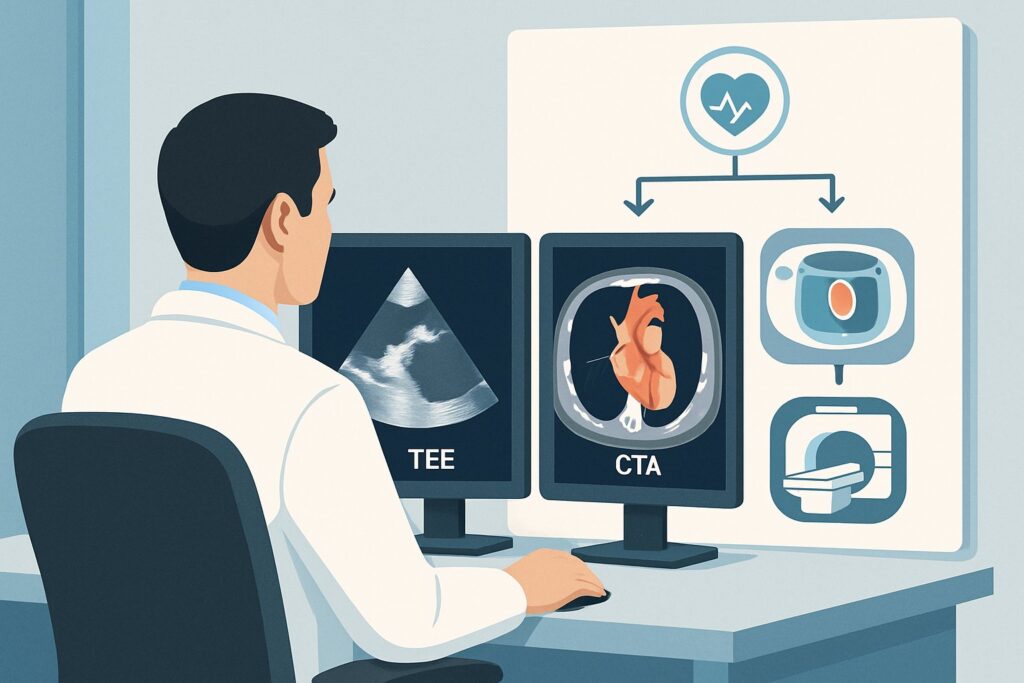
A 68-year-old man with a history of hypertension presents to the emergency department at 2 a.m. with sudden, severe chest pain radiating to his back, which he describes as a “tearing” sensation. His blood pressure is 190/110 mmHg in the right arm and 165/95 mmHg in the left. The initial EKG is non-specific, and cardiac enzymes are pending. Your clinical suspicion for an acute aortic syndrome (AAS) is high, and the next decision is critical: which imaging study will provide a definitive diagnosis with the least delay? This article provides a detailed workflow for this exact scenario, guiding you through the American College of Radiology (ACR) Appropriateness Criteria. For this presentation, US echocardiography transesophageal is rated Usually appropriate, offering a rapid, non-radiation option at the bedside for unstable patients.
Who Fits This Clinical Scenario?
This guidance applies to patients presenting with acute, severe chest, back, or abdominal pain where there is a strong clinical suspicion for an acute aortic syndrome. Key features raising this suspicion include a tearing or ripping quality of pain, a pulse or blood pressure differential between limbs, new-onset aortic regurgitation, or focal neurologic deficits. Patients with known risk factors such as chronic hypertension, Marfan syndrome, Ehlers-Danlos syndrome, bicuspid aortic valve, or a known aortic aneurysm who present with these symptoms fit squarely within this scenario.
This workflow is distinct from that for patients with undifferentiated, low-risk chest pain. A patient with pleuritic chest pain and risk factors for pulmonary embolism (PE), or one with exertional, pressure-like pain suggestive of acute coronary syndrome (ACS), would follow different diagnostic pathways. While the initial presentation can overlap, the high-risk features described above are what specifically trigger the AAS workup. This guidance is for the moment a clinician has placed AAS at or near the top of the differential and needs to select the most appropriate initial definitive imaging test.
What Diagnoses Are You Working Up in This Scenario?
When ordering imaging for suspected acute aortic syndrome, you are evaluating a spectrum of life-threatening conditions involving the aorta. The primary goal is to confirm or exclude these diagnoses rapidly to guide immediate management, which often involves emergency surgery or intensive medical therapy.
Aortic Dissection: This is the most common and classic form of AAS. It occurs when a tear in the aortic intima allows blood to surge between the layers of the aortic wall, creating a false lumen. The key imaging finding is the intimal flap separating the true and false lumens. The location of the tear (Stanford Type A involving the ascending aorta vs. Type B confined to the descending aorta) dictates management, with Type A being a surgical emergency.
Intramural Hematoma (IMH): Considered a variant of dissection, an IMH is a hemorrhage within the aortic wall without a visible intimal tear or flap. It is thought to arise from ruptured vasa vasorum. On imaging, it appears as a crescentic thickening of the aortic wall. IMH can progress to an overt dissection, rupture, or resolve with medical management.
Penetrating Atherosclerotic Ulcer (PAU): This condition occurs when an atherosclerotic plaque ulcerates and erodes through the internal elastic lamina into the aortic media. This can lead to a localized hematoma within the wall, saccular aneurysm formation, or frank rupture. PAUs most commonly occur in the descending thoracic aorta in elderly patients with extensive atherosclerosis.
Why Is US Echocardiography Transesophageal the Recommended Study for This Presentation?
In the high-stakes scenario of suspected acute aortic syndrome, the choice of imaging balances diagnostic accuracy, speed, and patient safety. The ACR designates multiple modalities as Usually appropriate, reflecting the need to tailor the choice to the patient’s hemodynamic stability and local institutional resources. While CTA is the most common initial test in many centers, US echocardiography transesophageal (TEE) holds a critical role.
TEE is rated Usually appropriate because it can be performed rapidly at the bedside, making it an excellent choice for hemodynamically unstable patients who cannot be safely transported to a CT scanner. It offers superb visualization of the aortic root and ascending aorta, providing high sensitivity and specificity for identifying an intimal flap characteristic of a Type A dissection. Furthermore, TEE involves no ionizing radiation (O 0 mSv) and does not require iodinated intravenous contrast, a significant advantage in patients with severe renal insufficiency. It can also simultaneously assess for complications like pericardial effusion, tamponade, and severe aortic regurgitation.
However, other studies are also highly rated. CTA chest abdomen pelvis with IV contrast is also Usually appropriate and is often the de facto first-line test in stable patients. It provides a comprehensive view of the entire aorta, from the root to the iliac bifurcation, which is essential for classifying the dissection, identifying the entry tear, and assessing for branch vessel involvement or end-organ malperfusion. The trade-offs are a significant radiation dose (☢☢☢☢☢ 30-100 mSv) and the need for IV contrast.
In contrast, a transthoracic echocardiogram (TTE) is only rated May be appropriate. While it can be a useful screening tool and may identify a dissection flap in the aortic root, its sensitivity is limited due to poor acoustic windows for the aortic arch and descending aorta. A negative TTE is insufficient to rule out AAS. Similarly, a CT chest without IV contrast is also May be appropriate. It can reveal an intramural hematoma, which appears as a high-attenuation crescent along the aortic wall, or a widened mediastinum, but it cannot reliably visualize an intimal flap and is therefore inadequate for ruling out a classic dissection.
What’s Next After the Results? Downstream Workflow
The results of the initial imaging study will trigger a rapid cascade of clinical decisions. The downstream workflow is determined by the specific diagnosis and its location within the aorta.
Positive for Stanford Type A Dissection: If TEE or CTA confirms a dissection involving the ascending aorta, this is a surgical emergency. The immediate next step is an urgent consultation with a cardiothoracic surgeon. The patient should be stabilized in an intensive care unit with aggressive heart rate and blood pressure control (typically with beta-blockers and vasodilators) while preparing for the operating room. Mortality increases with every hour that surgery is delayed.
Positive for Uncomplicated Stanford Type B Dissection: If the dissection is confined to the descending aorta and there is no evidence of rupture, malperfusion, or rapidly expanding aneurysm, the initial management is typically medical. This involves admission to an ICU for aggressive anti-impulse therapy (heart rate and blood pressure control) and serial imaging to monitor for complications. A vascular surgery consultation is still necessary for management planning.
Negative or Indeterminate Study: If the initial study (e.g., a TEE) is negative but clinical suspicion for AAS remains high, a second, complementary imaging modality is required. The most common next step is a CTA of the chest, abdomen, and pelvis. TEE has blind spots in the distal ascending aorta and arch, and a CTA provides a complete, definitive evaluation of the entire aorta. If the CTA is also negative, the focus of the workup should shift to other causes of acute chest pain, such as pulmonary embolism or acute coronary syndrome.
Pitfalls to Avoid (and When to Get Help)
In the workup of suspected acute aortic syndrome, several common pitfalls can lead to diagnostic delays and adverse outcomes. First, avoid anchoring on a diagnosis of acute coronary syndrome; administering antiplatelet or thrombolytic agents to a patient with an aortic dissection can be catastrophic. Second, do not rely on a normal chest radiograph or a negative D-dimer to rule out AAS in a patient with high-risk features. While a widened mediastinum on a chest x-ray is a classic sign, its absence does not exclude the diagnosis. Third, recognize that a transthoracic echocardiogram (TTE) is an inadequate rule-out test due to its limited views of the aorta. Finally, do not delay definitive imaging for non-essential tests. If your clinical suspicion is high and the patient is unstable, escalate immediately to a bedside TEE or, if stable, to the CT scanner. This is a time-critical diagnosis where minutes matter.
Related ACR Topics and Tools
This article focuses on a single, critical clinical scenario. For a comprehensive overview of all patient presentations related to this condition, please consult our parent guide. For further exploration of imaging guidelines and technical parameters, the following GigHz resources are available:
- For breadth across all scenarios in Suspected Acute Aortic Syndrome, see our parent guide: Suspected Acute Aortic Syndrome: ACR Appropriateness Decoded.
- To explore other clinical scenarios, use the ACR Appropriateness Criteria Lookup.
- For detailed technical specifications of imaging studies, visit the Imaging Protocol Library.
- To discuss radiation exposure with patients, use the Radiation Dose Calculator.
Frequently Asked Questions
Why are both CTA and TEE rated ‘Usually appropriate’ for suspected acute aortic syndrome?
Both CTA and TEE are highly accurate for diagnosing acute aortic syndrome, but they serve different roles. TEE is ideal for hemodynamically unstable patients as it can be performed quickly at the bedside without radiation or contrast. CTA is often preferred for stable patients because it provides a complete, detailed map of the entire aorta and its branches, which is crucial for surgical planning and identifying malperfusion syndromes.
What is the best imaging option if my patient has severe renal failure?
For patients with severe renal failure or a significant allergy to iodinated contrast, both TEE and non-contrast MRA are excellent options. TEE avoids contrast and provides a rapid diagnosis, especially for Type A dissections. MRA of the chest, abdomen, and pelvis without contrast is also rated ‘May be appropriate’ and can provide detailed anatomical information without nephrotoxic agents, though it is less available on an emergency basis and takes longer to perform.
Can a normal chest radiograph rule out an acute aortic syndrome?
No. While a chest radiograph is rated ‘Usually appropriate’ as an initial screening tool, a normal result cannot definitively rule out an acute aortic syndrome. It may show suggestive findings like a widened mediastinum, a ‘calcium sign,’ or a pleural effusion, but up to 40% of patients with aortic dissection have a normal or non-specific chest radiograph. Definitive cross-sectional imaging (CTA, TEE, or MRA) is required when clinical suspicion is high.
What is the role of D-dimer in the workup of suspected aortic dissection?
In patients with a low pre-test probability for aortic dissection, a negative D-dimer can be useful to help rule out the diagnosis and avoid further imaging. However, its specificity is low, and it is often elevated in other conditions. In patients with high-risk clinical features, D-dimer testing should not be used and should never delay definitive imaging with CTA or TEE.
When should I order an MRA instead of a CTA or TEE?
MRA is rated ‘Usually appropriate’ and is an excellent choice for hemodynamically stable patients, particularly for follow-up imaging of a known dissection, in younger patients to avoid radiation, or in those with a contraindication to iodinated contrast. Its primary limitations in the acute setting are longer acquisition times and limited availability in many emergency departments compared to CT.
Reviewed by Pouyan Golshani, MD, Interventional Radiologist — June 27, 2026