What Imaging Is Best for Follow-Up in Adults with Bronchiectasis? An ACR Workflow

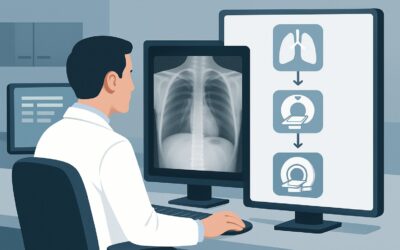
A 58-year-old patient with a known history of bronchiectasis secondary to a childhood viral pneumonia presents to your clinic with a three-week history of worsening productive cough and increased fatigue. They completed a course of oral antibiotics prescribed by their primary care physician with minimal improvement. You are now considering whether this is a simple exacerbation, a superimposed infection with a more resistant organism, or another complication. The immediate clinical question is what imaging, if any, is needed to guide the next steps in management. This article details the American College of Radiology (ACR) Appropriateness Criteria workflow for this specific scenario: assessing complications or treatment response in an adult with established bronchiectasis. For this presentation, a standard Radiography chest is rated Usually appropriate as the initial imaging study.
## Who Fits This Clinical Scenario?
This guidance applies specifically to adult patients with a pre-existing, confirmed diagnosis of bronchiectasis who are now being evaluated for one of two reasons:
1. Suspected Complication: The patient presents with new or worsening symptoms, such as increased sputum production, changes in sputum color, new-onset hemoptysis, fever, or pleuritic chest pain, raising suspicion for an acute exacerbation, superimposed infection, or other sequelae.
2. Treatment Response Assessment: The patient has recently undergone treatment for an exacerbation or a specific complication (like a nontuberculous mycobacterial infection), and imaging is being considered to evaluate the therapeutic response.
It is critical to distinguish this situation from similar but distinct clinical questions. This workflow does not apply to:
- Initial Diagnosis of Bronchiectasis: A patient with a chronic cough and recurrent infections but no confirmed diagnosis of bronchiectasis falls under a different ACR variant. The imaging approach for initial diagnosis is different from that of follow-up.
- Suspected Tracheal or Bronchial Stenosis: If the primary clinical concern is a focal airway narrowing, rather than a diffuse process like bronchiectasis, a different imaging pathway is indicated.
- Suspected Tracheomalacia: Patients with dynamic airway collapse on expiration also follow a separate and distinct diagnostic algorithm that often involves specialized imaging techniques.
Applying this workflow to the correct patient population—those with known disease requiring follow-up—is key to appropriate image ordering.
## What Diagnoses Are You Working Up in This Scenario?
When ordering follow-up imaging for a patient with bronchiectasis, you are typically investigating a specific set of common and consequential complications. The imaging study is intended to differentiate a routine exacerbation from a more complex problem that may require a change in management.
Acute Infectious Exacerbation or Superimposed Pneumonia: This is the most frequent reason for clinical worsening. Damaged and dilated airways are prone to bacterial colonization and infection. Imaging aims to identify new or worsening mucous plugging, bronchial wall thickening, and adjacent parenchymal consolidation that would confirm an active infectious process.
Nontuberculous Mycobacterial (NTM) Infection: Patients with bronchiectasis, particularly the nodular-bronchiectatic form, are at high risk for NTM infection (e.g., Mycobacterium avium complex). This is a crucial diagnosis to consider, as it requires prolonged, multi-drug therapy. Imaging findings suggestive of NTM include tree-in-bud opacities, new centrilobular nodules, and progressive cystic bronchiectasis or cavitation.
Hemoptysis: Bleeding is a feared complication, ranging from blood-streaked sputum to life-threatening hemorrhage. It often arises from hypertrophied and fragile bronchial arteries running adjacent to the inflamed airways. While minor hemoptysis may not require urgent imaging, significant bleeding necessitates a search for the vascular source.
Allergic Bronchopulmonary Aspergillosis (ABPA) or Aspergilloma: In some patients, particularly those with cystic fibrosis or asthma, a hypersensitivity reaction to Aspergillus species can lead to ABPA, characterized by central bronchiectasis and high-attenuation mucous plugging. In other cases, a fungus ball (aspergilloma) can form within a pre-existing bronchiectatic cavity or cyst.
## Why Is a Chest Radiograph the Recommended First Study for This Presentation?
For assessing complications or treatment response in known bronchiectasis, the ACR panel designates Radiography chest as Usually appropriate. This recommendation is based on a careful balance of diagnostic utility, radiation exposure, and clinical pragmatism.
The primary strength of a chest radiograph is its ability to detect significant interval changes quickly and with minimal radiation. With an adult relative radiation level of ☢ (<0.1 mSv), it is an excellent tool for comparison against prior films to identify new consolidations suggesting pneumonia, large-volume mucous plugging, or the development of an air-fluid level within a cavity. For many routine exacerbations, a chest radiograph provides sufficient information to confirm the clinical suspicion and guide antibiotic therapy. While a CT chest without IV contrast is also rated Usually appropriate, it is not typically the first-line study due to its significantly higher radiation dose (☢☢☢ 1-10 mSv). CT offers far greater detail and is superior for detecting subtle findings like tree-in-bud opacities (suggesting NTM), small nodules, or mild mucous plugging. However, for the initial assessment of a common exacerbation, this level of detail is often unnecessary, and the chest radiograph serves as an effective screening and triage tool.
Other imaging modalities are rated lower for this specific scenario:
- MRI chest without and with IV contrast is rated Usually not appropriate. While it avoids ionizing radiation, MRI has inferior spatial resolution for the fine details of the lung parenchyma and airways compared to CT. It is also highly susceptible to motion artifact from breathing and cardiac pulsation, limiting its utility for evaluating bronchiectasis.
- CTA chest with IV contrast is rated May be appropriate, but only in the specific clinical context of significant hemoptysis. In that situation, its ability to visualize the bronchial and pulmonary arterial systems is essential for identifying the bleeding source, making it the preferred study over a non-contrast exam or radiograph.
## What’s Next After Radiography chest? Downstream Workflow
The results of the initial chest radiograph guide the subsequent clinical and diagnostic pathway. The workflow is a branching decision tree based on the findings in the context of the patient’s symptoms.
- If the radiograph is positive for a new consolidation: This finding, coupled with clinical symptoms, is typically sufficient to diagnose a superimposed pneumonia or severe exacerbation. The next step is to initiate or adjust antibiotic therapy based on local resistance patterns and prior culture data. Follow-up imaging is often not required if the patient responds well clinically.
- If the radiograph is negative or shows only chronic, stable changes: When the chest X-ray does not explain the patient’s worsening symptoms, the clinical suspicion for a complication remains. This is the primary indication to proceed to the next step: a CT chest without IV contrast. This higher-resolution study can reveal subtle findings missed on the radiograph, such as early NTM infection, diffuse mucous plugging, or mild interstitial changes.
- If the radiograph is indeterminate: An ambiguous finding, such as a new nodule or a complex opacity, may also warrant a follow-up CT. In this case, a CT chest with IV contrast (May be appropriate) might be considered to better characterize the lesion and differentiate between an infectious process, an organized pneumonia, or another etiology.
- If the primary symptom is significant hemoptysis: The workflow changes. Given the need to identify a potential vascular source for bleeding, it is often appropriate to bypass the chest radiograph and proceed directly to a CTA chest with IV contrast (May be appropriate). A positive finding may lead to an interventional radiology consultation for bronchial artery embolization.
## Pitfalls to Avoid (and When to Get Help)
When managing imaging for bronchiectasis follow-up, several common pitfalls can lead to diagnostic delays or unnecessary radiation exposure.
1. Over-relying on radiography for subtle disease: Do not hesitate to order a non-contrast CT if a patient fails to improve or if you have a high suspicion for NTM disease, as a normal chest X-ray does not rule out these conditions.
2. Failing to compare with prior studies: The most valuable information from follow-up imaging comes from direct comparison to the patient’s baseline. Always ensure prior images are available to the interpreting radiologist to avoid misinterpreting chronic changes as acute.
3. Ordering the wrong CT protocol for hemoptysis: A non-contrast CT is inadequate for evaluating a bleeding source. If hemoptysis is the primary question, a CTA protocol is required to visualize the bronchial arteries.
4. Routine imaging for every minor exacerbation: Avoid repeated imaging for every mild increase in cough or sputum if the patient is otherwise stable. Reserve imaging for significant clinical changes, failure to respond to therapy, or suspicion of a specific complication to minimize cumulative radiation dose.
If a patient presents with massive hemoptysis or rapid respiratory decline, this constitutes a medical emergency. The immediate next step is to stabilize the patient, secure the airway if necessary, and obtain an urgent consultation with interventional radiology and/or thoracic surgery.
## Related ACR Topics and Tools
This article covers one specific scenario within the broader topic of tracheobronchial disease. For a comprehensive overview of imaging recommendations across all related presentations, please consult our parent guide. The following GigHz tools can also support your clinical decision-making:
- For breadth across all scenarios in Tracheobronchial Disease, see our parent guide: Tracheobronchial Disease: ACR Appropriateness Decoded.
- To look up appropriateness ratings for thousands of other clinical scenarios, visit the ACR Appropriateness Criteria Lookup.
- For detailed technical parameters on how imaging studies are performed, see the Imaging Protocol Library.
- To help discuss radiation exposure with your patients, use the Radiation Dose Calculator.
Frequently Asked Questions
Why is a chest CT not the first-line test if it provides more detail?
While a chest CT is more sensitive for subtle changes, a chest radiograph is recommended first because it effectively answers the most common clinical question (is there a new pneumonia?) with significantly less radiation and lower cost. The ACR Appropriateness Criteria prioritize a stepwise approach, escalating to CT only when the radiograph is negative or inconclusive in a symptomatic patient, or when a specific complication requiring CT’s detail is suspected.
If a patient has hemoptysis, should I still start with a chest X-ray?
It depends on the severity. For minor, blood-streaked sputum in a stable patient, a chest radiograph is a reasonable start. However, for significant hemoptysis (e.g., more than a few tablespoons of blood), the ACR rates CTA chest with IV contrast as ‘May be appropriate.’ In this case, it is often best to proceed directly to CTA to identify the bleeding vessel, as this information is critical for potential intervention like bronchial artery embolization.
How often should I order follow-up imaging in a patient with stable bronchiectasis?
There is no fixed schedule for routine surveillance imaging in stable, asymptomatic bronchiectasis. Imaging should be driven by clinical changes. Ordering a chest radiograph or CT on a routine annual basis in an asymptomatic patient is generally not recommended due to cumulative radiation exposure and a low likelihood of altering management.
Does this guidance apply to children with bronchiectasis?
This specific ACR variant is for adults. While the general principles are similar, imaging decisions in children must always more heavily weigh the risks of cumulative radiation dose. Pediatric-specific guidelines and consultation with a pediatric pulmonologist or radiologist are recommended. The ACR provides separate pediatric radiation relative level (RRL) estimates for this reason.
What is the role of MRI in evaluating bronchiectasis?
For evaluating the lung parenchyma and airways in bronchiectasis, MRI is rated ‘Usually not appropriate’ by the ACR. Its spatial resolution is lower than CT, and it is prone to motion artifacts. While research is ongoing, particularly for radiation-free follow-up in conditions like cystic fibrosis, CT remains the gold standard for high-resolution assessment of the airways and lung tissue.
Reviewed by Pouyan Golshani, MD, Interventional Radiologist — May 30, 2026