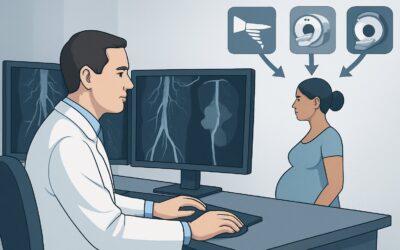
What Imaging Is Best for Surveillance After Endovascular Thoracoabdominal Aortic Repair?

A 68-year-old man with a history of a Crawford Type II thoracoabdominal aortic aneurysm is in your clinic for his one-year follow-up after a complex, multi-branch endovascular repair. He is asymptomatic and his blood pressure is well-controlled. You know that lifelong surveillance is critical to monitor for device-related complications, but the optimal imaging strategy needs to balance diagnostic accuracy with cumulative radiation exposure. This article provides a clinical workflow for this exact scenario, detailing the rationale for the recommended imaging, the key diagnoses to monitor, and the downstream decision-making based on the results. Based on the American College of Radiology (ACR) Appropriateness Criteria, the primary recommended study is CTA chest abdomen pelvis with IV contrast, which is rated Usually Appropriate.
## Who Fits This Clinical Scenario for Aortic Surveillance?
This guidance applies specifically to asymptomatic patients undergoing routine, scheduled imaging follow-up after endovascular repair of a thoracoabdominal aortic aneurysm or dissection. This includes patients who have undergone procedures like Thoracic Endovascular Aortic Repair (TEVAR), Fenestrated EVAR (FEVAR), or Branched EVAR (BEVAR) that extend into or originate from the thoracic aorta. The key is that the patient is stable, without new or worsening symptoms, and the imaging is for surveillance purposes to ensure the long-term integrity of the repair.
This workflow is not intended for patients who:
- Have new or worsening symptoms: A patient presenting with acute chest pain, back pain, syncope, or signs of malperfusion after an endovascular repair requires an emergent workup, not routine surveillance. The imaging protocol and urgency are different.
- Underwent open surgical repair: Follow-up after open repair involves different potential complications, such as pseudoaneurysm formation at suture lines, which may have different imaging considerations. This is covered in a separate ACR scenario.
- Have a known aneurysm or dissection that has not been repaired: The imaging goals for native, unrepaired aortic pathology focus on growth rate and suitability for intervention, which is a distinct clinical question from post-repair surveillance.
## What Complications Are You Monitoring For After Endovascular Aortic Repair?
Surveillance imaging is not simply to look at the aorta; it is an active search for specific, well-defined complications that can occur after endovascular repair. The primary goal is to detect issues before they become life-threatening. The differential for surveillance includes several key findings.
The most common and critical complication is an endoleak, which is the persistent perfusion of the aneurysm sac outside the endograft. This pressurizes the sac and carries a risk of rupture. Endoleaks are classified by their source: Type I (inadequate seal at the proximal or distal landing zones), Type II (retrograde flow from branch vessels like lumbar or intercostal arteries), Type III (device component separation or fabric tear), Type IV (graft porosity), and Type V (endotension, where the sac expands without a visible leak).
Another key concern is device migration or component separation. The imaging must assess whether the endograft has moved from its original position, which could compromise the seal and lead to a Type I endoleak. The relative position of all graft components must be confirmed.
Clinicians are also assessing aneurysm sac dynamics. A successful repair should result in sac shrinkage or stability over time. Any increase in the aneurysm sac diameter is a highly concerning finding, strongly suggesting an endoleak, even if one is not immediately visible.
Finally, the imaging evaluates stent graft integrity and branch vessel patency. This involves looking for signs of metal stent fractures, which can compromise the device’s structure, and ensuring that stents placed into visceral arteries (e.g., renal, superior mesenteric) as part of a branched or fenestrated repair remain open and free of stenosis.
## Why Is CTA the Primary Modality for Surveillance After Endovascular Aortic Repair?
The ACR rates CTA chest abdomen pelvis with IV contrast as Usually Appropriate for surveillance after endovascular thoracoabdominal aortic repair. This recommendation is driven by CTA’s unique ability to comprehensively evaluate for the full spectrum of potential complications.
The rationale for CTA’s primary role includes:
- High Spatial and Temporal Resolution: CTA provides exquisite anatomical detail, allowing for precise measurement of the aneurysm sac, clear visualization of the endograft’s position relative to key landmarks, and detection of subtle stent fractures.
- Endoleak Detection and Characterization: A multi-phase CTA protocol is the gold standard for identifying and classifying endoleaks. A non-contrast phase establishes a baseline, an arterial phase shows the initial opacification of any leak, and a delayed phase helps differentiate slow-flow leaks (like Type II) from other findings. This characterization is crucial for determining the need for and type of re-intervention.
- Speed and Availability: CTA is widely available and can be performed quickly, which is a practical advantage in many clinical settings.
While CTA is the workhorse, it’s important to understand the role of alternatives:
- MRA chest abdomen pelvis without and with IV contrast is also rated Usually Appropriate. MRA’s primary advantage is the lack of ionizing radiation, a significant benefit for patients requiring lifelong surveillance. However, it can be limited by metallic artifacts from the endograft, which may obscure the graft-aortic wall interface or small endoleaks. Furthermore, MRA is less effective at detecting stent fractures. It is an excellent alternative, particularly in younger patients or those with contraindications to iodinated contrast, but CTA often remains the first choice for its superior detail in assessing the device itself.
- US duplex Doppler aorta abdomen is rated Usually Not Appropriate for this scenario. Ultrasound cannot visualize the thoracic components of the repair and is often limited by bowel gas and body habitus in the abdomen. While it can sometimes detect sac expansion or large, high-flow endoleaks, it has poor sensitivity for the most common low-flow Type II endoleaks and provides no information on graft integrity or migration.
The primary trade-off with serial CTA is the significant cumulative radiation dose (adult_rrl=☢☢☢☢☢ 30-100 mSv per scan). This necessitates careful adherence to ALARA (As Low As Reasonably Achievable) principles, using dose-reduction techniques, and potentially alternating with MRA in suitable patients to mitigate long-term risk.
Once you’ve decided on CTA, our protocol guide covers the technique, contrast, and reading principles: CT Chest/Abdomen/Pelvis with IV Contrast.
## What’s Next After CTA? Downstream Workflow
The results of the surveillance CTA will direct the subsequent clinical workflow. The decision tree is typically based on the presence of an endoleak and changes in aneurysm sac size.
- If the study is negative (no endoleak, stable or shrinking sac): This is the desired outcome. The patient continues with the established surveillance protocol, typically with the next imaging study scheduled in one to two years, depending on the specific type of repair and institutional guidelines.
- If the study shows a significant endoleak (e.g., Type I or III) or any sac expansion: This is an urgent finding that requires prompt intervention. The patient should be referred back to the treating vascular surgeon or interventional radiologist for planning of endovascular or open repair of the leak. Sac expansion, even without a visualized leak, is treated as a high-risk feature and warrants intervention.
- If the study shows a Type II endoleak with a stable sac size: This is the most common scenario requiring nuanced management. Many Type II endoleaks are low-pressure and resolve spontaneously. The typical next step is continued, often more frequent, imaging surveillance (e.g., in 6 months) to monitor the sac size. Intervention is generally reserved for Type II endoleaks associated with persistent sac growth.
## Pitfalls to Avoid (and When to Get Help)
Several common pitfalls can compromise the effectiveness of surveillance in this clinical scenario.
- Ordering a single-phase CTA: A non-contrast and delayed phase are essential for detecting and characterizing endoleaks. Ordering only an arterial-phase CTA is a frequent error that can miss critical findings.
- Inconsistent measurements: Measurements of the aneurysm sac must be made consistently at the same level and orientation on every follow-up scan. Using multi-planar reformats to measure the true short-axis diameter is crucial.
- Ignoring the radiation dose: Failing to consider the cumulative radiation dose over a patient’s lifetime is a significant oversight. Strategies like using lower-dose protocols or alternating with MRA should be considered.
- Misinterpreting calcification: Dense aortic wall calcification on non-contrast images can mimic contrast on subsequent phases, leading to a false-positive diagnosis of an endoleak. Comparison with the true non-contrast acquisition is mandatory.
If any scan demonstrates aneurysm sac expansion or a Type I or III endoleak, this constitutes a red flag requiring immediate escalation to the interventional or surgical team that performed the initial repair.
## Related ACR Topics and Tools
For a comprehensive overview of all clinical variants related to aortic pathology, and for tools to help with study selection and patient communication, the following resources are available:
- For breadth across all scenarios in Thoracoabdominal Aortic Aneurysm or Dissection: Treatment Planning and Follow-Up, see our parent guide: Thoracoabdominal Aortic Aneurysm or Dissection: Treatment Planning and Follow-Up: ACR Appropriateness Decoded.
- To explore other clinical scenarios and their corresponding ACR recommendations, use the ACR Appropriateness Criteria Lookup tool.
- For detailed procedural techniques on recommended studies, consult the Imaging Protocol Library.
- To discuss cumulative radiation exposure with your patients, the Radiation Dose Calculator can help frame the conversation.
Frequently Asked Questions
Why is a CTA of the chest, abdomen, and pelvis needed if the repair was only in the chest?
Endovascular repairs for thoracoabdominal aneurysms often have distal landing zones in the abdominal aorta or iliac arteries. Furthermore, complications like distal embolization or the development of new aneurysms can occur. Comprehensive imaging of the entire thoracoabdominal aorta and iliac arteries is necessary to assess the entire repair and detect any downstream issues.
Can I use MRA instead of CTA for all follow-up scans to avoid radiation?
MRA is an excellent radiation-free alternative and is also rated ‘Usually Appropriate’ by the ACR. It is particularly valuable for younger patients. However, CTA is often preferred for the initial post-operative scan and if there is any concern for stent fracture or subtle endoleak, as it has superior spatial resolution and is less affected by metallic artifact from the endograft. Many centers use a hybrid approach, alternating between CTA and MRA for long-term surveillance.
What is the standard follow-up imaging schedule after endovascular thoracoabdominal aortic repair?
A typical surveillance protocol involves imaging at 1 month, 6 months, and 12 months post-procedure, followed by annual imaging thereafter. However, this schedule can be modified based on the complexity of the repair, the specific device used, and any findings on previous scans. If a low-risk Type II endoleak is being monitored, for example, the interval may be shortened to 6 months.
What should I do if my patient has renal insufficiency?
For patients with significant renal dysfunction (e.g., GFR < 30 mL/min/1.73m²), the risk of contrast-induced nephropathy from CTA must be weighed carefully. MRA with a macrocyclic gadolinium-based contrast agent is often the preferred alternative, as these agents carry a very low risk of nephrogenic systemic fibrosis in this patient population. A non-contrast CT can also provide information on sac size and device position but cannot detect endoleaks.
Is a simple chest radiograph useful for follow-up?
No. A chest radiograph is rated ‘Usually Not Appropriate’ for this indication. While it can grossly show the position of the metallic stent graft, it provides no information about the aneurysm sac, cannot detect endoleaks, and is insensitive to most forms of device migration or component separation. It is not an adequate tool for surveillance.
Reviewed by Pouyan Golshani, MD, Interventional Radiologist — May 30, 2026