What Is the Best Initial Imaging for Recurrent Claudication After a Stent or Bypass?
A 68-year-old man with a history of a femoropopliteal stent placed two years ago for peripheral artery disease returns to your clinic. He reports that his left calf pain, which had resolved after the procedure, has now returned. He can only walk one block before the familiar, cramping pain forces him to stop. His ankle-brachial index (ABI) on that side has dropped from 1.0 post-procedure to 0.65 today. You suspect the cause is either in-stent restenosis or new disease progression, but you need to confirm the location and severity of the problem before planning the next step. What is the most appropriate initial imaging study to order? For this specific clinical scenario, the American College of Radiology (ACR) rates US duplex Doppler lower extremity as Usually Appropriate.
Who Fits This Clinical Scenario for Post-Revascularization Imaging?
This guidance applies to a specific patient population: individuals with a history of prior infrainguinal revascularization who are now presenting with new or recurrent symptoms.
Inclusion criteria for this workflow:
- Previous Intervention: The patient has undergone a prior endovascular therapy (such as angioplasty or stenting) or a surgical bypass graft below the inguinal ligament.
- Symptomatic Presentation: The patient is now experiencing symptoms of peripheral artery disease, which can range from claudication (exertional pain in the calf, thigh, or buttock that resolves with rest) to Critical Limb Ischemia (CLI), a more severe condition characterized by rest pain, non-healing ulcers, or gangrene.
- Initial Imaging: This is the first imaging study being ordered for this new or recurrent set of symptoms.
Exclusion criteria (patients who require a different workflow):
- Asymptomatic Surveillance: This guidance does not apply to patients who are feeling well and are undergoing routine, scheduled imaging to monitor the patency of their stent or graft. That represents a different clinical scenario.
- Acute Limb Ischemia: Patients presenting with the “6 Ps” (pain, pallor, pulselessness, paresthesia, paralysis, poikilothermia) have a vascular emergency. Their workup is more urgent and may follow a different pathway than the one described here.
- Non-Vascular Symptoms: If the patient’s leg pain is more suggestive of a neurologic or musculoskeletal cause (e.g., consistent with spinal stenosis or arthritis), this vascular imaging workflow may not be the appropriate starting point.
What Diagnoses Are You Working Up in This Scenario?
When a patient with a prior infrainguinal intervention develops recurrent symptoms, the imaging workup is focused on identifying the point of failure in the arterial system. The differential diagnosis is targeted and includes several key possibilities.
The most common cause is in-stent restenosis or bypass graft stenosis. Over time, neointimal hyperplasia—the growth of smooth muscle cells within the vessel wall—can cause a progressive narrowing at the site of the previous treatment. This is the primary concern in most patients presenting with a gradual return of claudication.
A more severe finding is thrombosis of the stent or graft. This involves a complete occlusion by a blood clot, which typically leads to a more abrupt and severe onset of symptoms compared to the gradual progression of stenosis.
Another important consideration is the progression of atherosclerotic disease in native vessels. The original intervention may be perfectly patent, but new blockages may have developed either proximal (inflow) or distal (outflow) to the treated segment. These new lesions can restrict blood flow and cause the patient’s symptoms to return.
Less commonly, aneurysmal degeneration can occur, particularly at the anastomotic sites of a surgical bypass graft. This weakening and ballooning of the vessel wall can lead to turbulent flow, thrombus formation, or even rupture. While rare, it is a consequential diagnosis that imaging can detect.
Why Is US Duplex Doppler the Recommended First Study for Recurrent Claudication?
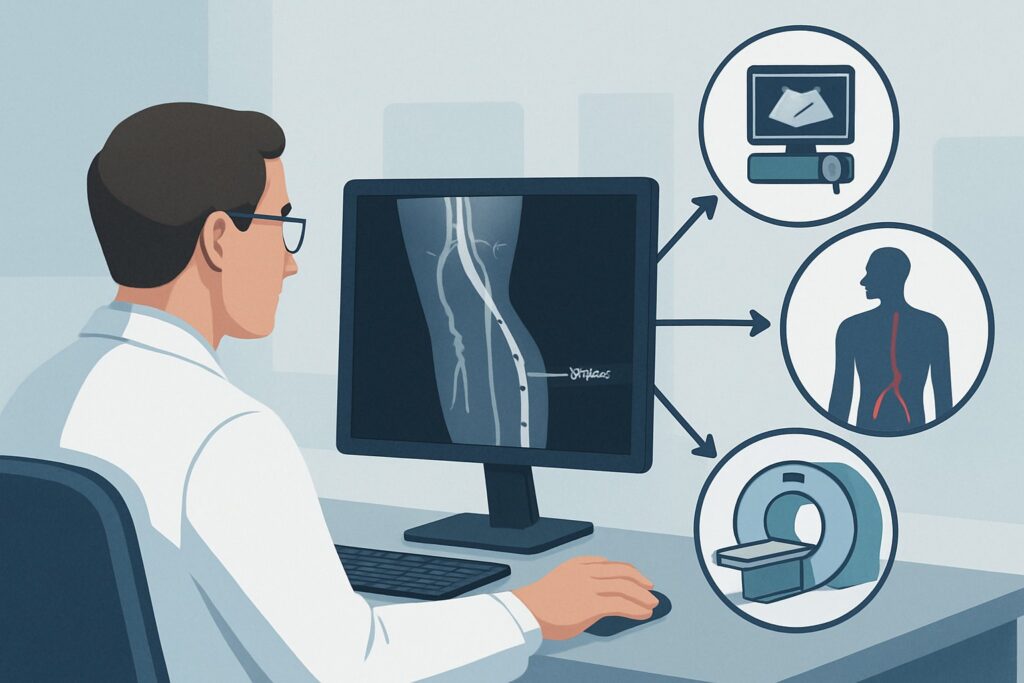
The ACR Appropriateness Criteria rate US duplex Doppler lower extremity as Usually Appropriate for this scenario, making it the preferred initial imaging test. The rationale is based on its diagnostic accuracy, safety profile, and ability to provide comprehensive physiologic data without the risks of radiation or nephrotoxic contrast.
Ultrasound duplex combines two modalities: B-mode imaging, which provides a direct anatomical picture of the vessel, stent, or graft, and Doppler ultrasound, which measures the velocity and direction of blood flow. This combination is highly effective for evaluating the key differential diagnoses. Sonographers can directly visualize neointimal hyperplasia causing in-stent restenosis and use peak systolic velocity (PSV) measurements to accurately grade the severity of the narrowing. An absence of a Doppler signal confirms occlusion. Furthermore, the exam can assess the native vessels proximal and distal to the intervention, identifying any new areas of disease.
While other modalities are also highly rated, they have specific trade-offs that make them less ideal as a first-line test in this context:
- CTA lower extremity with IV contrast is also rated Usually Appropriate. It provides an excellent anatomic roadmap, which is invaluable for pre-procedural planning. However, it exposes the patient to ionizing radiation (☢☢☢ 1-10 mSv) and requires iodinated intravenous contrast, which carries a risk of allergic reaction and contrast-induced nephropathy, a significant concern in a patient population with a high prevalence of diabetes and chronic kidney disease.
- MRA lower extremity without and with IV contrast is also Usually Appropriate and avoids radiation. However, the metallic composition of many stents can create significant magnetic susceptibility artifacts, which may obscure the view of the stented segment and limit the ability to diagnose in-stent restenosis.
For these reasons, the non-invasive, risk-free, and physiologically informative duplex ultrasound is the recommended starting point. Once you’ve decided on US duplex Doppler lower extremity, our protocol guide covers the technique and reading principles: US Lower Extremity Doppler.
What’s Next After US Duplex Doppler Lower Extremity? Downstream Workflow
The results of the duplex ultrasound will guide the subsequent clinical management and determine if further imaging or intervention is necessary.
- If the study is positive for significant stenosis or occlusion: A finding of hemodynamically significant stenosis (typically defined by a high peak systolic velocity ratio) or a complete occlusion responsible for the patient’s symptoms warrants referral back to a vascular specialist (interventional radiology or vascular surgery). The specialist may use the duplex findings to proceed directly to a catheter-based digital subtraction angiography (DSA), which is both the gold standard for diagnosis and allows for immediate endovascular treatment. Alternatively, they may order a CTA or MRA to create a detailed anatomic map for planning a more complex endovascular or open surgical procedure.
- If the study is negative: If the duplex ultrasound shows that the prior intervention is patent and there is no other significant stenosis in the interrogated vessels, the focus should shift. First, reconsider the diagnosis. The patient’s symptoms may be from a non-vascular cause, such as neurogenic claudication from lumbar spinal stenosis or musculoskeletal pain. If vascular suspicion remains high despite the negative ultrasound, a CTA or MRA could be considered to evaluate for disease in areas that are difficult to assess with ultrasound, such as the aortoiliac inflow vessels.
- If the study is indeterminate: In some cases, the duplex exam may be technically limited due to factors like severe vessel calcification, patient body habitus, or extensive edema. If the results are inconclusive but clinical suspicion is high, proceeding to a cross-sectional imaging modality like CTA or MRA is the appropriate next step to clarify the vascular anatomy.
Pitfalls to Avoid (and When to Get Help)
Navigating the workup for recurrent limb ischemia requires attention to a few common pitfalls.
- Not providing adequate clinical history: When ordering the duplex scan, always specify the patient’s history, including the type and location of the prior intervention (e.g., “History of left fem-pop stent, evaluate for patency and restenosis”). This information is critical for the sonographer to perform a focused and accurate exam.
- Ignoring the ABI: A drop in the ankle-brachial index is a strong objective indicator of worsening vascular disease. A normal duplex scan in the face of a newly abnormal ABI should raise suspicion for a missed lesion or technically limited study.
- Delaying workup in CLI: While claudication can be managed on an outpatient basis, a patient presenting with signs of Critical Limb Ischemia (rest pain or tissue loss) requires a more urgent evaluation to prevent limb loss.
- Misinterpreting stent artifact: When reviewing CTA or MRA images, be aware that beam hardening (on CT) or susceptibility artifact (on MRI) can mimic or obscure in-stent stenosis.
If a patient presents with signs of acute limb ischemia (a cold, painful, pulseless extremity), this constitutes a vascular emergency. Escalate immediately with a direct consultation to vascular surgery or interventional radiology for emergent intervention.
Related ACR Topics and Tools
For a comprehensive overview of imaging after lower extremity revascularization, related protocols, and decision-support tools, please see the following resources:
- For breadth across all scenarios in Lower Extremity Arterial Revascularization-Post-Therapy Imaging, see our parent guide: Lower Extremity Arterial Revascularization-Post-Therapy Imaging: ACR Appropriateness Decoded.
- To look up appropriateness criteria for adjacent or different clinical scenarios, use the ACR Appropriateness Criteria Lookup tool.
- To review technical details for various imaging studies, explore our Imaging Protocol Library.
- For discussions about radiation exposure with patients, our Radiation Dose Calculator can help quantify and contextualize the dose from studies like CTA.
Frequently Asked Questions
Why is duplex ultrasound preferred over CTA if both are rated ‘Usually Appropriate’?
Duplex ultrasound is preferred as the initial test because it provides excellent diagnostic information without exposing the patient to ionizing radiation or potentially nephrotoxic intravenous contrast. It also offers unique physiologic data (blood flow velocities) that directly quantify the hemodynamic significance of a stenosis. CTA is often reserved as a second step for pre-procedural planning if an intervention is needed.
What if my patient has a stent that is known to cause artifact on MRA?
This is a key limitation of MRA for this scenario. Many modern nitinol stents produce less artifact than older stainless steel ones, but significant artifact can still obscure the in-stent lumen. If you know the patient has a stent type that limits MRA, duplex ultrasound or CTA are better choices for evaluating in-stent restenosis.
My patient’s duplex scan was negative, but their ABI is low and they still have claudication. What now?
This situation warrants further investigation. The duplex may have been technically limited, or the disease may be in a location that is difficult to visualize with ultrasound, such as the aortoiliac system (inflow disease). The next logical step would be a CTA or MRA to get a complete anatomical picture of the arterial tree from the aorta down to the feet.
Is there a role for non-contrast MRA in this scenario?
Non-contrast MRA is rated as ‘May be appropriate’ by the ACR. While it avoids gadolinium, it generally has lower spatial resolution and can be more prone to artifacts compared to contrast-enhanced MRA, making it less reliable for detecting subtle stenoses. It may be considered in patients with a severe contraindication to both iodinated and gadolinium-based contrast agents, but its diagnostic limitations should be recognized.
How soon after a revascularization procedure should a patient with recurrent symptoms be imaged?
Imaging should be performed as soon as symptoms recur and are impacting the patient’s quality of life or functional status. For patients with claudication, this can be done in a routine outpatient setting. However, for patients presenting with signs of Critical Limb Ischemia (rest pain, ulcers), the workup should be expedited to avoid the risk of tissue loss and amputation.
Reviewed by Pouyan Golshani, MD, Interventional Radiologist — May 29, 2026