What Is the Best Initial Imaging for Retrosternal Dysphagia in Immunocompromised Patients?
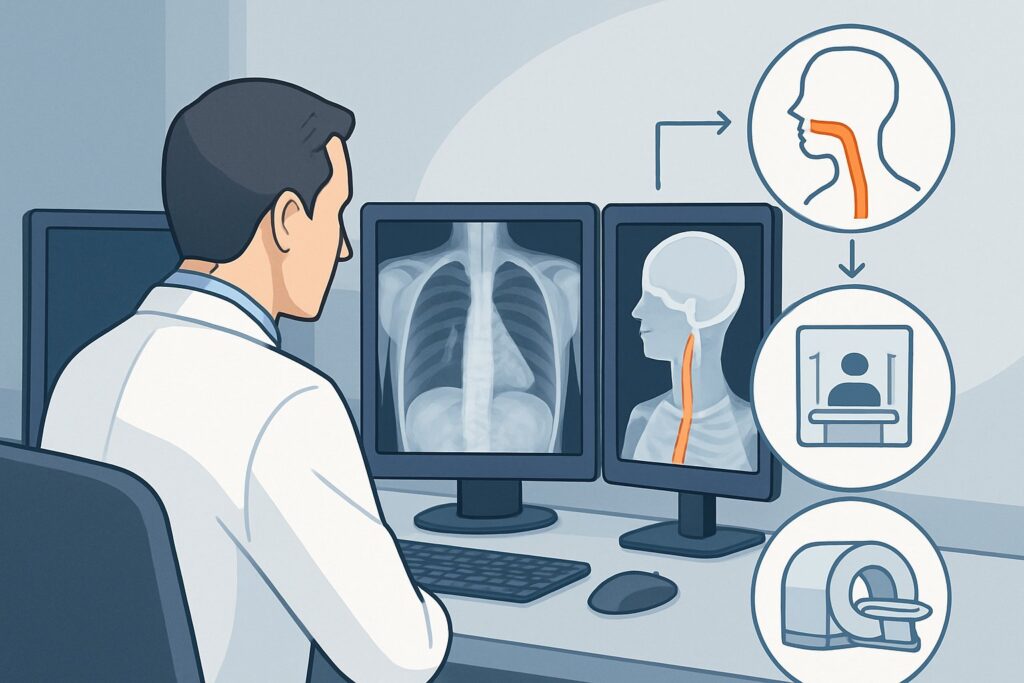
A 45-year-old patient with a history of a solid organ transplant, maintained on tacrolimus and mycophenolate, presents to your clinic. For the past two weeks, they have experienced worsening pain with swallowing and a persistent sensation of food getting stuck in their chest. The symptoms are now limiting their oral intake. You suspect an opportunistic esophageal infection, but other causes are possible. The immediate clinical question is which imaging study will most effectively and safely evaluate their symptoms to guide initial management. This article details the American College of Radiology (ACR) recommended workflow for this specific scenario. For initial imaging in retrosternal dysphagia in an immunocompromised patient, a Fluoroscopy biphasic esophagram is rated as Usually Appropriate.
Who Fits This Clinical Scenario?
This guidance applies specifically to patients with a compromised immune system who present with dysphagia localized to the retrosternal or chest region. The sensation is one of food “hanging up” after it has been successfully swallowed from the pharynx. The underlying cause of immunosuppression is broad and includes:
- Human Immunodeficiency Virus (HIV) / Acquired Immunodeficiency Syndrome (AIDS)
- Post-transplant patients on immunosuppressive medications
- Patients undergoing active chemotherapy or radiation therapy
- Chronic use of high-dose corticosteroids or other immunomodulators
It is critical to distinguish this scenario from similar but distinct clinical presentations that follow different diagnostic pathways. This workflow does not apply to:
- Immunocompetent patients: A healthy patient with retrosternal dysphagia has a different pre-test probability for conditions like eosinophilic esophagitis or gastroesophageal reflux disease (GERD)-related strictures. This presentation is covered in the ACR variant for retrosternal dysphagia in immunocompetent patients.
- Oropharyngeal dysphagia: If the patient’s symptoms are difficulty initiating a swallow, coughing, choking, or nasal regurgitation, the pathology is likely in the pharynx, not the esophagus. This requires a different evaluation, often starting with a modified barium swallow.
- Postoperative patients: Dysphagia developing shortly after thoracic or esophageal surgery has a unique differential, including anastomotic leak or stricture, and is addressed in its own ACR variant.
What Diagnoses Are You Working Up in This Scenario?
In an immunocompromised patient, the differential diagnosis for retrosternal dysphagia is heavily weighted toward opportunistic infections, though other etiologies must be considered. The imaging choice is tailored to identify the subtle mucosal changes characteristic of these conditions.
Infectious Esophagitis: This is the most common and pressing concern. The causative agent influences the radiographic appearance. Candida albicans is the most frequent pathogen, often presenting as linear plaques or a “shaggy” appearance on esophagram. Viral causes are also significant; Cytomegalovirus (CMV) typically causes large, flat, ovoid ulcers, while Herpes Simplex Virus (HSV) characteristically produces multiple, small, discrete “punched-out” ulcers.
Pill-Induced Esophagitis: Many medications, including some antiretrovirals, antibiotics (like doxycycline), and bisphosphonates, can adhere to the esophageal mucosa and cause focal inflammation and ulceration. The clinical history of medication use is key, and imaging can help localize the site of injury.
Graft-versus-Host Disease (GVHD): For post-transplant patients, particularly allogeneic stem cell transplant recipients, GVHD can target the esophagus. This may manifest as diffuse inflammation, desquamation, webs, or eventual stricture formation, leading to significant dysphagia.
Neoplasm: Though less common, malignancy should remain on the differential, especially in patients with long-standing immunosuppression. In the context of AIDS, this includes Kaposi sarcoma and non-Hodgkin lymphoma, which can involve the esophagus and cause dysphagia through mass effect or mucosal infiltration.
Why Is Fluoroscopy Biphasic Esophagram the Recommended Initial Study?
The ACR designates the fluoroscopy biphasic esophagram as Usually Appropriate because it is uniquely suited to evaluate both the mucosal lining and the function of the esophagus, directly addressing the primary differential diagnoses in this scenario.
The “biphasic” nature of the study is its key advantage. The examination consists of two distinct parts:
- Double-Contrast Phase: The patient swallows a high-density barium suspension followed by an effervescent agent (gas-forming crystals). The resulting gas distends the esophagus while the dense barium coats the mucosal surface. This technique is exceptionally sensitive for detecting subtle mucosal abnormalities like the plaques of candidiasis, the shallow ulcers of viral esophagitis, or the webs seen in GVHD.
- Single-Contrast Phase: The patient swallows a larger volume of low-density barium. This fully distends the esophageal lumen, providing a “road map” view. This phase is superior for evaluating motility, identifying strictures, assessing for extrinsic compression from mediastinal masses, and detecting larger lesions that might be obscured by the coating in the double-contrast phase.
This combined approach provides a comprehensive initial assessment with a moderate radiation dose (adult relative radiation level ☢☢☢, corresponding to 1-10 mSv).
Why Alternatives Are Rated Lower
Other imaging studies are considered less appropriate as the initial step for this specific clinical question:
- CT of the Neck and Chest with IV Contrast is rated Usually not appropriate. While excellent for evaluating mediastinal structures, CT has poor sensitivity for the fine mucosal detail needed to diagnose infectious esophagitis. It would fail to detect the plaques or shallow ulcers that are the hallmark of the most likely pathologies. Furthermore, it carries a significantly higher radiation dose (☢☢☢☢, 10-30 mSv) without answering the primary clinical question.
- A Fluoroscopy Single Contrast Esophagram is rated May be appropriate. It is a reasonable alternative if a biphasic study is unavailable or the patient cannot tolerate the effervescent agent. However, by omitting the double-contrast phase, it is less sensitive for detecting early or subtle mucosal disease, potentially leading to a false-negative result.
What’s Next After Fluoroscopy Biphasic Esophagram? Downstream Workflow
The results of the esophagram guide the subsequent management steps in a logical, tiered fashion. The goal is to confirm a diagnosis and initiate therapy while reserving more invasive procedures for when they are truly needed.
If the study is positive for infectious esophagitis: When the esophagram reveals findings highly characteristic of a specific infection (e.g., classic candidal plaques or herpetic ulcers), it is often appropriate to begin empiric antimicrobial or antiviral therapy. The patient’s response to treatment serves as a diagnostic confirmation. If symptoms do not resolve, or if the findings are atypical, the next step is upper endoscopy (EGD) with brushing and biopsy for definitive pathogen identification and sensitivity testing.
If the study is negative or non-specific: A normal esophagram in a patient with persistent, severe symptoms does not rule out esophageal pathology. Mild mucosal inflammation or very early disease may not be visible on fluoroscopy. In this case, the recommended next step is upper endoscopy (EGD) for direct visualization and tissue sampling. EGD is the gold standard for diagnosing esophagitis and can identify subtle changes missed on imaging.
If the study shows a stricture, mass, or extrinsic compression: These findings demand further investigation to rule out malignancy or complex stricturing disease (like from GVHD). The immediate next step is upper endoscopy (EGD) with biopsy of any suspicious lesion. Depending on the findings, a subsequent CT of the chest may be necessary to stage a malignancy or evaluate the extent of mediastinal disease.
Common Pitfalls to Avoid in This Clinical Scenario
Navigating this workup requires attention to a few key details to ensure an accurate and timely diagnosis.
- Not providing adequate clinical history: The radiologist’s interpretation is significantly enhanced by knowing the patient is immunocompromised. This context narrows the differential and focuses their attention on signs of opportunistic infection. Always specify the patient’s immune status and the primary concern (e.g., “rule out infectious esophagitis”) on the imaging requisition.
- Over-relying on a negative esophagram: While sensitive, the biphasic esophagram can miss very mild or early mucosal disease. If clinical suspicion remains high despite a normal study, do not delay referral for endoscopy.
- Mistaking retained debris for pathology: Food or pills retained in the esophagus can mimic the appearance of candidal plaques. A skilled fluoroscopist can use maneuvers, such as having the patient drink water, to wash away debris and clarify the findings.
If a patient presents with signs of a complicated course, such as an inability to manage secretions, severe chest pain suggesting perforation, or systemic signs like fever and hemodynamic instability, escalate immediately to inpatient care. This may warrant an urgent EGD or a CT scan to look for life-threatening complications like a contained perforation or mediastinal abscess.
Related ACR Topics and Tools
For breadth across all scenarios in Dysphagia, see our parent guide: Dysphagia: ACR Appropriateness Decoded. To explore the evidence for other clinical presentations or to refine your understanding of imaging techniques, the following GigHz resources are available:
- Imaging Appropriateness Selector — for adjacent scenarios
- Imaging Protocol Library — for technique on the recommended study
- Radiation Dose Calculator — for cumulative dose conversations
Frequently Asked Questions
Why not go straight to endoscopy (EGD) for every immunocompromised patient with dysphagia?
While EGD is the gold standard, a biphasic esophagram is a less invasive, widely available initial test that can often provide a diagnosis (especially for Candida) without the risks and resource requirements of sedation and endoscopy. It helps triage patients, reserving EGD for those with negative or equivocal imaging, atypical features, or failure to respond to empiric therapy.
Is there a role for CT scan at all in this scenario?
Yes, but not as the initial imaging test for mucosal disease. A CT scan of the chest is valuable as a downstream study if the esophagram or EGD reveals a mass, a complex stricture, or if there is suspicion of an extra-esophageal process like a mediastinal abscess or perforation. It is the wrong first test for suspected infectious esophagitis.
What if my patient cannot tolerate the effervescent crystals for the double-contrast portion?
If a patient cannot tolerate the gas-forming crystals, a single-contrast esophagram is a reasonable alternative and is rated ‘May be appropriate’ by the ACR. While less sensitive for subtle mucosal detail, it can still identify significant motility disorders, large ulcers, or strictures. Be aware of its limitations, and maintain a lower threshold to proceed to endoscopy if it is negative.
Does the type of immunosuppression (e.g., HIV vs. post-transplant) change the initial imaging choice?
No, the initial imaging choice of a biphasic esophagram remains the same regardless of the cause of immunosuppression. However, the specific cause does influence the pre-test probability of the differential diagnoses. For example, GVHD is a primary concern only in transplant recipients, while Kaposi sarcoma is more specific to patients with AIDS.
How should I manage this patient if the esophagram is normal but symptoms persist?
A normal esophagram in the face of persistent retrosternal dysphagia in an immunocompromised patient warrants escalation to the next diagnostic step. The recommended next step is an upper endoscopy (EGD) to allow for direct visualization of the mucosa and to obtain biopsies for histology and culture, which can diagnose microscopic or very early-stage disease.
Reviewed by Pouyan Golshani, MD, Interventional Radiologist — May 26, 2026