
What Is the Best Initial Imaging for Suspected Congenital Aortic Disease?
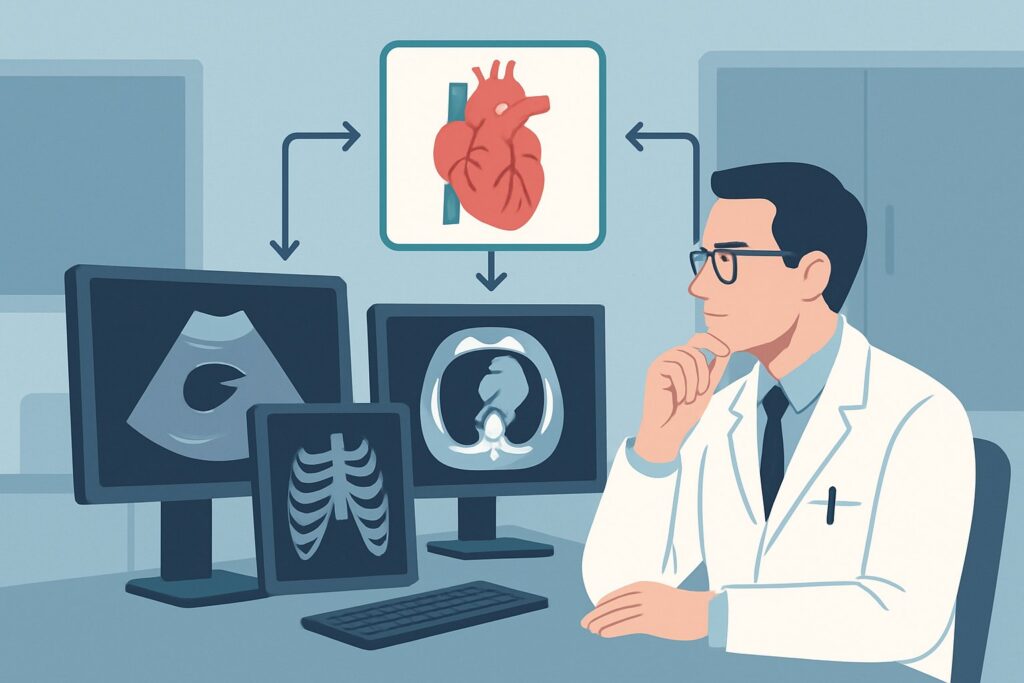
A 24-year-old patient presents for a new-patient visit. On exam, you note a systolic ejection click and a faint murmur. They mention their father had a heart valve issue, but they are otherwise asymptomatic. You are now considering the possibility of a congenital aortic anomaly, like a bicuspid aortic valve with an associated aortopathy. The critical question is which imaging study to order first to evaluate the aorta without exposing a young patient to unnecessary risk. This article provides a step-by-step clinical workflow for this exact scenario, grounded in the American College of Radiology (ACR) Appropriateness Criteria, which rate a resting transthoracic echocardiogram as Usually Appropriate for the initial evaluation of suspected congenital aortic disease.
Who Fits This Clinical Scenario?
This guidance applies to the initial, non-emergent imaging workup of a patient with suspected congenital aortic disease. The clinical suspicion may arise from several findings:
- A physical exam revealing a murmur, click, or thrill suggestive of a bicuspid aortic valve (BAV).
- Signs of aortic coarctation, such as a brachial-femoral pulse delay or differential blood pressures between the arms and legs.
- A known personal or family history of a genetic syndrome associated with aortopathy, such as Marfan syndrome, Loeys-Dietz syndrome, Turner syndrome, or Ehlers-Danlos syndrome.
- An incidental finding of an abnormal aortic contour on a chest radiograph ordered for another reason.
This workflow is distinct from other clinical presentations. It does not apply to patients with signs of an acute aortic syndrome (e.g., tearing chest pain), which requires an emergent evaluation. It also differs from the workup of elderly patients with suspected degenerative or atherosclerotic aortic disease, where the pre-test probability and imaging choices are different. Similarly, if there is suspicion for an inflammatory or infectious process, such as large-vessel vasculitis or an infected aneurysm, the workup follows a separate pathway focused on identifying vessel wall inflammation.
What Diagnoses Are You Working Up in This Scenario?
When ordering initial imaging for suspected congenital aortic disease, you are primarily investigating a spectrum of structural abnormalities that place the patient at lifelong risk. The differential is focused on identifying these conditions early to allow for surveillance and timely intervention.
Bicuspid Aortic Valve (BAV) and Associated Aortopathy: This is the most common congenital cardiac anomaly. Patients with a BAV are at significantly increased risk for developing progressive aortic root and ascending aortic dilatation, leading to aneurysm formation and a higher lifetime risk of aortic dissection. The initial imaging must clearly define the valve morphology and measure the aortic root and ascending aorta diameters.
Aortic Coarctation: This is a discrete narrowing of the aorta, typically in the thoracic aorta just distal to the left subclavian artery. It can lead to significant upper extremity hypertension and left ventricular hypertrophy. While classic cases present in infancy, milder forms may not be diagnosed until adolescence or adulthood.
Connective Tissue Disorders: Syndromes like Marfan or Loeys-Dietz cause inherent weakness in the aortic wall, leading to progressive aortic root and ascending aortic aneurysms. Early diagnosis and surveillance are critical, as these patients have a very high risk of dissection, often at smaller aortic diameters than in the general population.
Aortic Arch Anomalies: This category includes vascular rings and other abnormal branching patterns of the great vessels. While some are asymptomatic, others can cause compressive symptoms like dysphagia or stridor. The initial imaging may be the first to suggest an anomalous vessel course.
Why Is US Echocardiography Transthoracic Resting the Recommended Initial Study?
For the initial evaluation of suspected congenital aortic disease, the ACR designates US echocardiography transthoracic resting (TTE) as Usually Appropriate. This recommendation is based on the test’s unique ability to provide critical diagnostic information safely and non-invasively, making it the ideal first step in the workup.
The primary strength of TTE is its excellent assessment of the aortic valve and aortic root. It can directly visualize the number of aortic valve leaflets, confirming or excluding a bicuspid aortic valve. It also provides precise, reproducible measurements of the aortic root at multiple levels (annulus, sinuses of Valsalva, sinotubular junction) and the proximal ascending aorta. Furthermore, Doppler imaging adds crucial functional data, assessing for aortic stenosis or regurgitation. For a young patient who will likely require years of surveillance, TTE’s lack of ionizing radiation (0 mSv) is a paramount advantage.
Several other advanced imaging modalities are also rated Usually Appropriate, but they serve better as second-line or complementary studies in this specific scenario:
- CTA chest and abdomen with IV contrast: While providing superb, high-resolution anatomic detail of the entire aorta, CTA delivers a very high radiation dose (☢☢☢☢ 10-30 mSv). This is a significant concern in a young patient who may need many follow-up scans over their lifetime. Therefore, CTA is typically reserved for pre-operative planning, acute settings, or when MRA is contraindicated.
- MRA chest and abdomen without and with IV contrast: Like TTE, MRA is radiation-free (O 0 mSv) and provides excellent visualization of the entire aorta, from the root to the iliac bifurcation. It is the gold standard for comprehensive aortic assessment and surveillance. However, TTE is often more readily available, less expensive, and provides superior dynamic information about the aortic valve itself, making it the more logical initial test. MRA is frequently the next step after an abnormal TTE.
A chest radiograph is also rated Usually Appropriate and can be a useful, very low-dose (☢ <0.1 mSv) screening tool. It may show a dilated aortic silhouette or rib notching in coarctation, but its findings are non-specific and cannot replace dedicated aortic imaging.
What’s Next After US Echocardiography Transthoracic Resting? Downstream Workflow
The results of the initial TTE guide the subsequent management and imaging plan. The goal is to confirm the diagnosis, establish a baseline for the entire aorta, and initiate a long-term surveillance strategy.
If the TTE is positive: If the echocardiogram confirms a bicuspid aortic valve, aortic root dilatation, or another significant anomaly, the next step is almost always comprehensive imaging of the entire thoracoabdominal aorta. The preferred modality for this is a radiation-free one: MRA chest and abdomen without and with IV contrast. This study establishes a crucial baseline, measuring the maximal aortic diameter at all levels and identifying any associated anomalies like coarctation or arch abnormalities that are beyond the view of TTE. The patient would then be referred to a cardiologist or cardiothoracic surgeon for ongoing management and surveillance planning.
If the TTE is negative but suspicion is high: In some cases, the TTE may be normal, but a strong clinical suspicion remains (e.g., a patient with physical stigmata of Marfan syndrome). Because TTE has limited views of the aortic arch and descending aorta, a normal study does not fully exclude disease in these segments. In this situation, proceeding to a comprehensive MRA of the chest and abdomen is the appropriate next step to definitively evaluate the entire vessel.
If the TTE is indeterminate or technically limited: Poor acoustic windows can sometimes limit the quality of a TTE. If the aortic root or ascending aorta is not well visualized, two options are available. US echocardiography transesophageal (TEE), rated May be appropriate, provides much clearer images but is an invasive procedure. Alternatively, proceeding directly to MRA can answer the anatomical questions non-invasively.
Pitfalls to Avoid (and When to Get Help)
Navigating the workup of congenital aortic disease requires avoiding several common pitfalls to ensure patient safety and accurate diagnosis.
- The “Normal Root” Trap: Do not assume a normal aortic root on TTE excludes all significant pathology. Aortopathy, especially in connective tissue disorders, can affect the descending or abdominal aorta, which TTE cannot visualize. Maintain a low threshold for comprehensive MRA if clinical suspicion is high.
- Dismissing Family History: A patient’s family history of aneurysm, dissection, or sudden death is a major red flag. This history alone may warrant a more aggressive initial workup with both TTE and a baseline MRA.
- Premature CTA Use: Avoid ordering CTA as the first-line test in a young, stable patient. The cumulative radiation exposure from a lifetime of surveillance imaging can be substantial. Reserve CTA for acute scenarios or when MRA is not feasible.
If a patient with known or suspected congenital aortic disease presents with acute chest or back pain, pulse deficits, or signs of malperfusion, escalate immediately. This is a potential aortic emergency requiring urgent transfer to an emergency department and definitive imaging, typically with CTA.
Related ACR Topics and Tools
This article focuses on one specific clinical scenario. For a broader view of imaging for all types of nontraumatic aortic disease, from degenerative to inflammatory, please consult our comprehensive parent guide. For additional tools to help with ordering decisions and patient communication, see the resources below.
- Parent Topic Hub: For breadth across all scenarios in Nontraumatic Aortic Disease, see our parent guide: Nontraumatic Aortic Disease: ACR Appropriateness Decoded.
- ACR Appropriateness Criteria Lookup: Look up other clinical variants and compare study ratings directly.
- Imaging Protocol Library: Review detailed imaging techniques for studies like MRA and CTA of the aorta.
- Radiation Dose Calculator: Help patients understand cumulative radiation exposure from different imaging plans.
Frequently Asked Questions
Why not just start with MRA since it visualizes the entire aorta?
While MRA provides a comprehensive view, transthoracic echocardiography (TTE) is often more accessible, faster, and provides superior real-time, dynamic information about the aortic valve’s function and morphology. This is critical for diagnosing conditions like a bicuspid aortic valve and assessing associated stenosis or regurgitation, making TTE the ideal initial test.
How useful is a chest radiograph in this scenario?
The ACR rates a chest radiograph as ‘Usually Appropriate.’ It is a very low-dose test that can provide initial clues, such as a widened mediastinum suggesting an aortic aneurysm or rib notching classic for coarctation. However, its findings are non-specific and it cannot replace dedicated aortic imaging like echocardiography or MRA for a definitive diagnosis.
When is a Transesophageal Echocardiogram (TEE) indicated for congenital aortic disease?
A TEE, rated ‘May be appropriate’ for initial imaging, is typically used as a problem-solving tool. It is indicated when the images from a standard transthoracic echo (TTE) are technically limited due to poor acoustic windows, or when higher-resolution detail of the aortic valve, aortic root, or a suspected dissection flap is required. It is more invasive than a TTE.
Does this guidance change for a patient with a known diagnosis of Marfan syndrome?
A patient with a known connective tissue disorder like Marfan syndrome fits this clinical scenario perfectly. The initial imaging strategy remains the same: TTE is the first step to evaluate the aortic valve and root. However, it is mandatory for these patients to also have a baseline comprehensive imaging study of the entire aorta, for which MRA is the preferred modality. TTE is then used for routine surveillance of the aortic root, with periodic MRA to monitor the distal aorta.
Is CTA ever the right first choice in a young patient?
In the non-emergent initial workup, CTA is generally avoided as the first test due to its high radiation dose. However, in an acute or emergent setting where there is suspicion of aortic dissection or rupture, CTA is the fastest and most robust imaging modality and becomes the test of choice, as the immediate diagnostic need outweighs the long-term radiation risk.
Reviewed by Pouyan Golshani, MD, Interventional Radiologist — May 29, 2026