
What Is the Best First Imaging Study for Degenerative Aortic Disease?
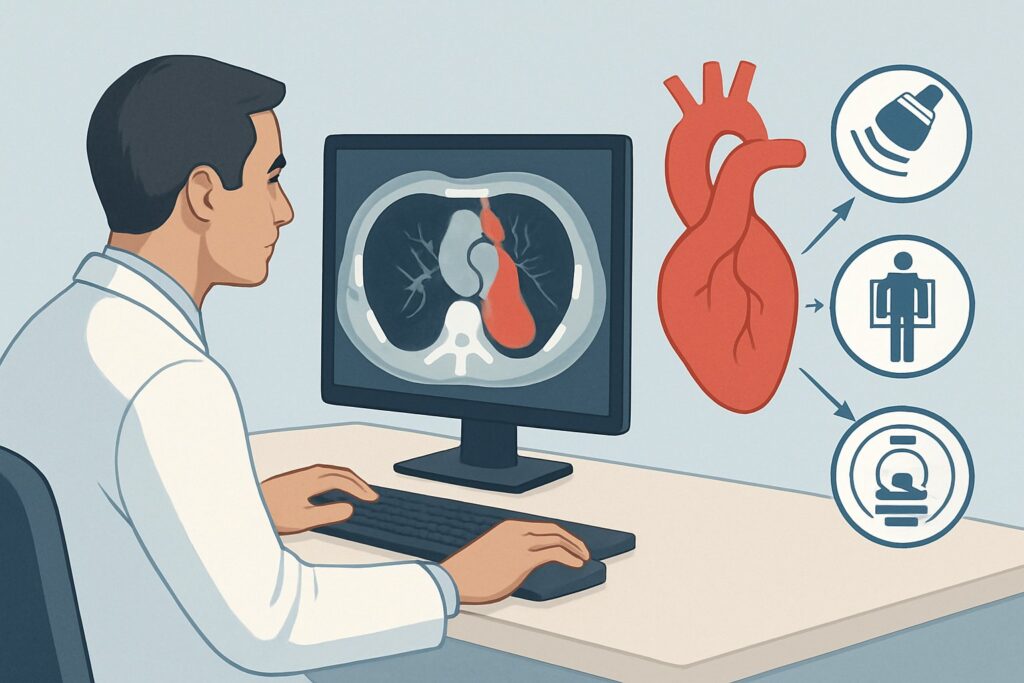
A 72-year-old male with a long history of hypertension and hyperlipidemia presents for a routine physical. He is asymptomatic, but on abdominal examination, you palpate a prominent, pulsatile midline mass. Your primary concern is a potential abdominal aortic aneurysm (AAA) secondary to degenerative atherosclerotic disease. You need to confirm the diagnosis, measure the aortic diameter, and establish a baseline for future surveillance or intervention. This article provides a step-by-step clinical workflow for this exact scenario, guiding your initial imaging choice based on the American College of Radiology (ACR) Appropriateness Criteria. For this presentation, the ACR rates `US abdomen` as Usually appropriate.
Who Fits This Clinical Scenario?
This guidance is for the initial imaging of a patient with suspected degenerative or atherosclerotic aortic disease. This category typically includes older adults, often with established cardiovascular risk factors such as a history of smoking, hypertension, hyperlipidemia, or a family history of aortic aneurysms. The clinical presentation is often asymptomatic, with findings discovered incidentally on physical exam (e.g., a pulsatile abdominal mass) or on imaging performed for other reasons. It also applies to patients who meet established criteria for AAA screening.
This workflow is specifically for nontraumatic conditions. It is crucial to distinguish this from other aortic pathologies that require different workups:
- Exclusion 1: Acute Aortic Syndromes. If the patient presents with acute, severe chest, back, or abdominal pain, syncope, or signs of malperfusion, an emergent workup for aortic dissection or rupture is required, which prioritizes rapid, comprehensive imaging like CTA.
- Exclusion 2: Suspected Congenital Aortic Disease. Younger patients, or those with known connective tissue disorders (e.g., Marfan syndrome, Ehlers-Danlos syndrome) or congenital conditions (e.g., bicuspid aortic valve, coarctation), fall under a different clinical variant focused on congenital disease.
- Exclusion 3: Suspected Inflammatory or Infectious Aortitis. Patients with constitutional symptoms like fever, weight loss, elevated inflammatory markers (ESR, CRP), or a known history of large-vessel vasculitis (e.g., Giant Cell Arteritis, Takayasu arteritis) require a workup tailored to inflammatory or infectious etiologies.
What Diagnoses Are You Working Up in This Scenario?
When ordering initial imaging for suspected degenerative aortic disease, you are primarily evaluating for conditions driven by atherosclerosis. The differential is focused on identifying and characterizing the extent of this chronic process.
Abdominal Aortic Aneurysm (AAA) is the most common and clinically significant diagnosis in this scenario. It is defined as a focal aortic dilatation of at least 1.5 times its normal diameter, or an infrarenal aortic diameter greater than 3.0 cm. Identifying and accurately measuring an AAA is critical for determining the risk of rupture and guiding the strategy for surveillance or elective repair.
Aortic Ectasia refers to a more diffuse, mild-to-moderate dilatation of the aorta that does not meet the criteria for a true aneurysm. While the rupture risk is low, identifying ectasia is important as it signifies underlying atherosclerotic disease and can progress to a true aneurysm over time, warranting periodic follow-up.
Penetrating Atherosclerotic Ulcer (PAU) is a less common but consequential finding. This occurs when an atherosclerotic plaque erodes through the internal elastic lamina of the aortic wall, potentially leading to an intramural hematoma, saccular aneurysm, or frank rupture. While often better characterized on cross-sectional imaging, a complex or irregular aortic wall on ultrasound may raise suspicion.
Severe Atherosclerotic Plaque and Mural Thrombus are also key findings. Extensive, calcified plaque confirms the underlying disease process. The presence of a mural thrombus, typically within an aneurysm sac, is an important finding as it can be a source of distal embolization, leading to acute limb ischemia or other ischemic events.
Why Is Abdominal Ultrasound the Recommended Initial Study?
For the initial evaluation of suspected degenerative or atherosclerotic aortic disease, the ACR designates `US abdomen` as a Usually appropriate study. This recommendation is based on its excellent diagnostic capability for the primary differential, combined with a superior safety and accessibility profile for this specific clinical question.
The primary strength of ultrasound is its high sensitivity and specificity for detecting and measuring abdominal aortic aneurysms. It provides accurate anteroposterior and transverse diameter measurements, which are the key metrics for risk stratification and management decisions. As a screening and initial diagnostic tool, it is unparalleled in this context because it is non-invasive, widely available, relatively inexpensive, and, crucially, involves no ionizing radiation (0 mSv). This makes it ideal for both initial diagnosis and for long-term surveillance of small aneurysms without exposing the patient to cumulative radiation doses.
Several other advanced imaging modalities are also rated for this scenario, but they are generally reserved for specific downstream questions:
- CTA chest and abdomen with IV contrast: While also rated Usually appropriate, this study is not the preferred initial test. It is the gold standard for pre-operative planning once an aneurysm meets the size threshold for repair. It provides comprehensive detail of the aneurysm’s morphology, neck anatomy, and relationship to branch vessels. However, its use for initial diagnosis comes with the significant trade-offs of high radiation dose (☢☢☢☢ 10-30 mSv) and the risks associated with iodinated IV contrast.
- MRA chest and abdomen: Also rated Usually appropriate, MRA offers a radiation-free alternative to CTA for detailed anatomical assessment. However, it is more costly, less widely available, and has a longer acquisition time than CT or ultrasound. It is a valuable tool for pre-operative planning in patients with a contraindication to iodinated contrast but is not practical or necessary for the initial yes/no question of whether an aneurysm is present.
- Radiography chest: This is rated Usually appropriate but has a very limited role. It can sometimes reveal an enlarged thoracic aortic silhouette or aortic calcification, but it cannot be used to diagnose or accurately measure an abdominal aneurysm. Its utility is largely as an incidental finding that prompts a more definitive study like ultrasound.
What’s Next After Abdominal Ultrasound? Downstream Workflow
The results of the initial abdominal ultrasound will directly guide your next steps, branching into distinct clinical pathways for surveillance, further characterization, or referral for intervention.
If the study is positive for an AAA: The downstream workflow is dictated by the maximum aortic diameter. For small aneurysms (e.g., 3.0-4.4 cm), the next step is typically surveillance with serial ultrasounds. The frequency of follow-up depends on the size, with larger aneurysms requiring more frequent monitoring. As the aneurysm approaches the size threshold for intervention (typically 5.0-5.5 cm in women and men, respectively), the next step is a referral to a vascular surgeon. The surgeon will then typically order a `CTA chest and abdomen with IV contrast` for detailed pre-operative planning to assess the aneurysm’s suitability for endovascular (EVAR) or open repair.
If the study is negative (normal aortic diameter): If the aorta is of normal caliber (e.g., <3.0 cm), no further aortic imaging is generally required unless the patient meets specific high-risk criteria for future screening. The focus shifts to aggressive medical management of the patient's underlying atherosclerotic risk factors, such as hypertension, hyperlipidemia, and smoking cessation.
If the study is indeterminate or shows complex features: Occasionally, an ultrasound may be technically limited (e.g., due to overlying bowel gas or body habitus) or may reveal complex features like a suspected penetrating ulcer or mural thrombus that are not fully characterized. In these cases, the next step is to proceed to cross-sectional imaging. `CTA chest and abdomen with IV contrast` is often the preferred modality to resolve the ambiguity and provide definitive anatomical detail.
Pitfalls to Avoid (and When to Get Help)
In the workup of degenerative aortic disease, several common pitfalls can impact patient care. First, avoid ordering a CTA as the initial diagnostic test in an asymptomatic, stable patient; ultrasound is safer, faster, and sufficient for the initial question. Second, ensure accurate measurements are obtained on ultrasound, as management decisions are highly dependent on diameter. Anteroposterior and transverse diameters should be measured outer-wall to outer-wall. Third, do not overlook the thoracic aorta; while AAA is more common, atherosclerotic disease is a systemic process. A chest radiograph, if not already done, can be a simple, low-dose screen for significant thoracic aortic ectasia or aneurysm. If the patient reports any new, even mild, abdominal or back pain in the setting of a known AAA, this is a red flag. Escalate immediately with an urgent referral to vascular surgery and consider emergent imaging, as this may signal aneurysm expansion or impending rupture.
Related ACR Topics and Tools
The ACR Appropriateness Criteria are a powerful resource for evidence-based imaging decisions. For a comprehensive overview of all clinical scenarios related to nontraumatic aortic disease, including congenital and inflammatory conditions, please see our parent topic hub article. The following GigHz tools can also support your clinical workflow.
- Parent Topic Hub: For breadth across all scenarios in Nontraumatic Aortic Disease, see our parent guide: Nontraumatic Aortic Disease: ACR Appropriateness Decoded.
- ACR Criteria Lookup: To explore adjacent scenarios or alternative patient presentations, use the ACR Appropriateness Criteria Lookup.
- Imaging Protocols: For detailed technical specifications on how imaging studies are performed, consult the Imaging Protocol Library.
- Dose Calculation: To discuss cumulative radiation exposure with patients when considering studies like CT, the Radiation Dose Calculator can be a helpful aid.
Frequently Asked Questions
Why not order a CTA for everyone to get the most detailed picture from the start?
While CTA provides excellent detail, it is not the recommended initial test for a stable, asymptomatic patient due to its significant radiation dose (10-30 mSv) and the risks of IV contrast. Abdominal ultrasound is highly accurate for the primary goal—detecting and measuring a potential AAA—without any radiation or contrast risk. CTA is reserved for pre-procedural planning or when ultrasound is inconclusive.
What if the patient’s body habitus makes the ultrasound technically difficult?
If an ultrasound is reported as ‘technically limited’ or ‘nondiagnostic’ due to factors like body habitus or overlying bowel gas, it is appropriate to move to the next imaging step. In this case, a non-contrast CT of the abdomen and pelvis can accurately measure aortic diameter. If there’s a higher suspicion for complex disease, a CTA or MRA would be the next logical choice.
Does this guidance apply to screening for AAA in an asymptomatic patient?
Yes. This clinical scenario and the recommendation for abdominal ultrasound as the initial imaging test align perfectly with established guidelines for AAA screening, such as the USPSTF recommendation for a one-time ultrasound screening in men aged 65 to 75 who have ever smoked.
If an aneurysm is found, is ultrasound sufficient for follow-up surveillance?
Absolutely. For small- to medium-sized aneurysms that do not meet the criteria for repair, serial abdominal ultrasound is the standard of care for surveillance. It is accurate, safe, and cost-effective for monitoring changes in diameter over time.
What if the ultrasound mentions a ‘saccular’ aneurysm instead of the more common ‘fusiform’ type?
A saccular aneurysm, which is an eccentric outpouching of the aortic wall, is less common and can carry a higher risk of rupture at smaller sizes compared to a fusiform (symmetric, circumferential) aneurysm. This finding should prompt a lower threshold for ordering a CTA for better characterization and an earlier referral to a vascular specialist, even if the maximum diameter is below the typical threshold for intervention.
Reviewed by Pouyan Golshani, MD, Interventional Radiologist — May 29, 2026