Which Imaging Study Is Best for Suspected PAVM in a Symptomatic HHT Patient?
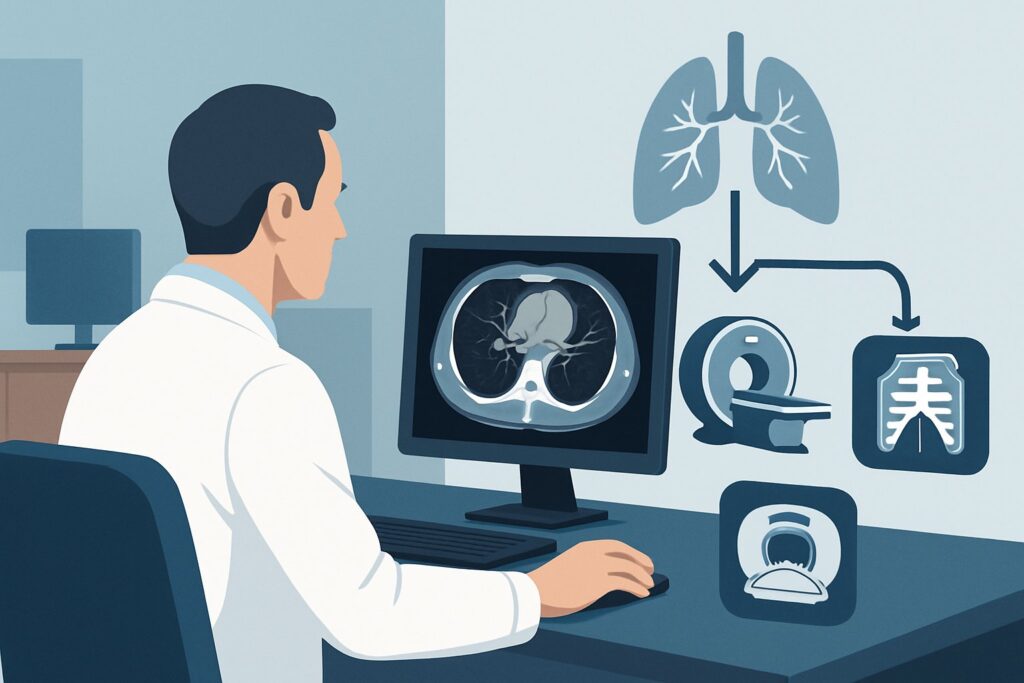
A 48-year-old woman presents to the emergency department with acute shortness of breath and a single episode of blood-tinged sputum. She has a long history of frequent, severe nosebleeds and mentions her father was diagnosed with “something with blood vessels in his lungs.” You suspect a pulmonary arteriovenous malformation (PAVM) related to hereditary hemorrhagic telangiectasia (HHT). The immediate clinical question is which imaging study to order first to confirm the diagnosis and guide management. This article provides a step-by-step workflow for this specific scenario, grounded in the American College of Radiology (ACR) Appropriateness Criteria. For this patient, the initial recommended study, `US echocardiography transthoracic with IV contrast`, is rated Usually Appropriate.
Who Fits This Clinical Scenario?
This guidance is for a specific patient profile: an adult presenting with symptoms directly attributable to a potential PAVM, combined with a strong clinical suspicion for hereditary hemorrhagic telangiectasia. The inclusion criteria are:
- Patient: Adult.
- Symptoms: One or more of the following: shortness of breath (dyspnea), hemothorax (blood in the pleural space), or hemoptysis (coughing up blood).
- History: Personal history of epistaxis (nosebleeds) and a family history suggestive of HHT.
- Indication: Initial diagnostic imaging for a suspected PAVM.
This workflow is distinct from other related clinical situations. This article does not apply to:
- Asymptomatic Screening: An adult with a family history of HHT but no current pulmonary symptoms. That scenario involves screening protocols, not an acute workup.
- Neurologic Presentations: A patient presenting with a transient ischemic attack, seizure, or brain abscess suspected to be from a paradoxical embolus through a PAVM. While related, the urgency and imaging choices may differ.
- Incidental Findings: A patient with a lung nodule suspicious for a PAVM found on a chest CT or radiograph done for another reason. This represents a diagnostic confirmation pathway, not an initial workup for symptoms.
What Diagnoses Are You Working Up in This Scenario?
When a patient with suspected HHT presents with pulmonary symptoms, the differential diagnosis is focused but must include other critical possibilities. The choice of initial imaging is designed to efficiently evaluate these potential causes.
Pulmonary Arteriovenous Malformation (PAVM)
This is the leading diagnosis. PAVMs are abnormal, direct connections between pulmonary arteries and veins that bypass the capillary bed. In patients with HHT, these vessels are often fragile and prone to rupture, leading to hemoptysis or life-threatening hemothorax. The shunting of deoxygenated blood from the right to the left side of the heart causes chronic hypoxemia and dyspnea on exertion.
Pulmonary Embolism (PE)
Acute shortness of breath and, less commonly, hemoptysis are classic symptoms of PE. While the HHT history strongly points toward a PAVM, PE remains a crucial and more common diagnosis to consider in any patient with acute dyspnea. The initial imaging choice must be sensitive enough not to miss a large, concurrent PE, though a dedicated PE study may be a downstream step.
Diffuse Alveolar Hemorrhage (DAH)
This condition involves widespread bleeding into the alveolar spaces and can be caused by systemic vasculitides, coagulopathies, or other insults. While less common than a ruptured PAVM in this specific clinical context, it can present similarly with hemoptysis and respiratory distress. The imaging findings, however, are typically more diffuse than the focal bleeding from a PAVM.
Other Causes of Hemoptysis
Less likely but still on the differential are conditions like bronchiectasis, lung cancer, or severe infection (e.g., tuberculosis, aspergilloma). The patient’s specific history of HHT makes these secondary considerations, but they may be revealed during the diagnostic workup.
Why Is Transthoracic Echocardiography with IV Contrast the Recommended Initial Study?
The ACR designates `US echocardiography transthoracic with IV contrast` as Usually Appropriate for this scenario because it directly answers the most important physiologic question: is there a significant intrapulmonary right-to-left shunt? This test, often called a “bubble study,” is a highly sensitive and specific screening tool for detecting the shunting characteristic of PAVMs.
During the procedure, agitated saline (containing microbubbles) is injected into a peripheral vein. In a normal circulatory system, these microbubbles are filtered out by the pulmonary capillaries and never reach the left side of the heart. In a patient with a PAVM, the bubbles bypass the capillary bed via the shunt and appear in the left atrium and ventricle within 3 to 5 cardiac cycles. This finding confirms the presence of an intrapulmonary shunt.
Key advantages of this approach include:
- No Ionizing Radiation: The procedure uses ultrasound and has a radiation dose of 0 mSv, a significant benefit compared to CT-based options.
- High Sensitivity: It is excellent for detecting the presence of a shunt, even from small PAVMs that might be missed on other imaging.
- Non-Invasive: It is a safe and well-tolerated outpatient or inpatient procedure.
Comparison to Alternative Studies
While other studies are also rated Usually Appropriate, the bubble study serves as the best initial gatekeeper test.
- CTA Pulmonary Arteries with IV Contrast: This study is also Usually Appropriate and provides superb anatomic detail of the PAVMs, which is essential for treatment planning (e.g., embolization). However, it carries a radiation dose of 1-10 mSv and requires iodinated contrast. It is typically the second step after a positive bubble study confirms a shunt, as it is less of a screening tool and more of a definitive mapping tool.
- Radiography Chest: A standard chest X-ray is rated Usually Not Appropriate. It has very low sensitivity for PAVMs, which often appear as subtle, ill-defined nodules or may be completely invisible. A normal chest radiograph absolutely does not rule out a clinically significant PAVM and can provide false reassurance.
When ordering, it is critical to specify “with bubble study for shunt evaluation” to ensure the correct protocol is performed. A standard transthoracic echo without agitated saline contrast will not provide the necessary diagnostic information.
What’s Next After Echocardiography? Downstream Workflow
The results of the transthoracic echo with contrast guide the subsequent diagnostic and therapeutic pathway. The workflow branches based on whether a shunt is detected.
If the Study is Positive (Shunt Detected)
A positive bubble study confirms an intrapulmonary shunt and solidifies the diagnosis of PAVM in this clinical context. The next mandatory step is to define the anatomy of the malformation(s) to plan for treatment. The standard of care is to proceed to a `CTA pulmonary arteries with IV contrast`. This high-resolution CT scan will delineate the number, size, and location of all PAVMs and, most importantly, identify the feeding artery for each. Any PAVM with a feeding artery of 2-3 mm or larger is typically a candidate for transcatheter embolization to prevent rupture and reduce shunting.
If the Study is Negative (No Shunt Detected)
A negative bubble study makes a hemodynamically significant PAVM extremely unlikely as the cause of the patient’s symptoms. The clinical workup must then pivot to the other differential diagnoses. The next step would depend on the dominant symptom. If dyspnea is the primary concern, a workup for pulmonary embolism (e.g., with CTA) or intrinsic lung or heart disease should be pursued. If hemoptysis continues, a standard chest CT and potential bronchoscopy may be warranted to investigate for airway-based causes.
If the Study is Indeterminate
In rare cases, the echo may be technically limited (e.g., due to poor acoustic windows in a patient with obesity or severe COPD). If clinical suspicion remains high despite an equivocal echo, proceeding directly to a non-radiation alternative like `MRA pulmonary arteries without and with IV contrast` (Usually Appropriate) or a definitive `CTA pulmonary arteries with IV contrast` (Usually Appropriate) is a reasonable next step.
Pitfalls to Avoid (and When to Get Help)
Navigating this workup requires avoiding several common missteps that can delay diagnosis or lead to inappropriate management.
- Pitfall 1: Relying on a Chest X-ray. Never use a normal chest radiograph to rule out a PAVM. Its low sensitivity makes it an inappropriate screening tool in a high-suspicion patient.
- Pitfall 2: Ordering the Wrong Echo. A “transthoracic echocardiogram” without specifying “with IV contrast” or “bubble study” is insufficient. The key diagnostic information comes from tracking the agitated saline microbubbles.
- Pitfall 3: Delaying Anatomic Imaging. In a patient with active hemoptysis or hemothorax and a positive bubble study, proceeding to CTA for anatomic mapping should be done urgently. These symptoms signify a high risk of rupture.
If a patient presents with massive hemoptysis or hemodynamic instability from a suspected hemothorax, this represents a medical emergency. In this situation, it is appropriate to bypass the echo and proceed directly to CTA and/or emergent consultation with Interventional Radiology for potential angiography and embolization.
Related ACR Topics and Tools
For a comprehensive overview of all clinical variants related to Pulmonary Arteriovenous Malformation, please consult the parent topic article. Additional GigHz tools can help refine imaging decisions for this and other scenarios.
- For breadth across all scenarios in Pulmonary Arteriovenous Malformation (PAVM), see our parent guide: Pulmonary Arteriovenous Malformation (PAVM): ACR Appropriateness Decoded.
- To explore imaging guidelines for other clinical presentations, use the ACR Appropriateness Criteria Lookup.
- For details on imaging techniques, refer to the Imaging Protocol Library.
- To discuss radiation exposure with patients, the Radiation Dose Calculator can help quantify and contextualize the dose from CT scans.
Frequently Asked Questions
Why not just start with a CTA since it’s also rated ‘Usually Appropriate’?
While CTA provides excellent anatomic detail, the transthoracic echo with a bubble study is preferred as the initial test because it is non-invasive, uses no ionizing radiation (0 mSv vs. 1-10 mSv for CT), and directly answers the primary physiologic question of whether a right-to-left shunt exists. It functions as a highly effective screening test, reserving the radiation and contrast dose of a CTA for patients with a confirmed shunt who require pre-procedural mapping.
What if my patient is pregnant? Is the workflow the same?
For a pregnant patient, avoiding ionizing radiation is a primary goal, making transthoracic echocardiography with a bubble study an even more ideal first-line test. If a shunt is confirmed and anatomic imaging is required, MRA of the pulmonary arteries without and with IV contrast would be the next preferred step over CTA to avoid radiation exposure to the fetus. Gadolinium-based contrast agents should be used cautiously and in consultation with the radiologist and obstetrician.
Is a transesophageal echo (TEE) a better alternative?
No. For this specific indication, the ACR rates TEE (with or without contrast) as ‘Usually Not Appropriate.’ While TEE is excellent for evaluating intracardiac shunts like a patent foramen ovale (PFO), it does not offer a better view of the pulmonary vasculature to detect an intrapulmonary shunt. The transthoracic approach is sufficient and less invasive.
How does this workflow change if the patient’s primary symptom was a stroke (TIA) instead of shortness of breath?
That represents a different clinical scenario focused on identifying a source of paradoxical emboli. While the bubble study is still the key test to prove a right-to-left shunt, the workup would also include dedicated neuroimaging, such as a brain MRI, and a more thorough evaluation for cardiac shunts (like a PFO) in addition to the intrapulmonary shunt (PAVM). The urgency and sequence of tests may be altered by the neurologic presentation.
Can a bubble study quantify the size of the shunt?
Yes, to some extent. The timing of bubble appearance and the density of opacification in the left atrium can provide a qualitative or semi-quantitative estimate of the shunt size (e.g., small, moderate, large). However, it does not provide the precise anatomic detail needed for intervention. Definitive characterization of the PAVM’s feeding artery diameter and anatomy requires a cross-sectional imaging study like a CTA.
Reviewed by Pouyan Golshani, MD, Interventional Radiologist — May 30, 2026