What Is the Best Initial Imaging for Suspected Acute Superior Vena Cava Occlusion?
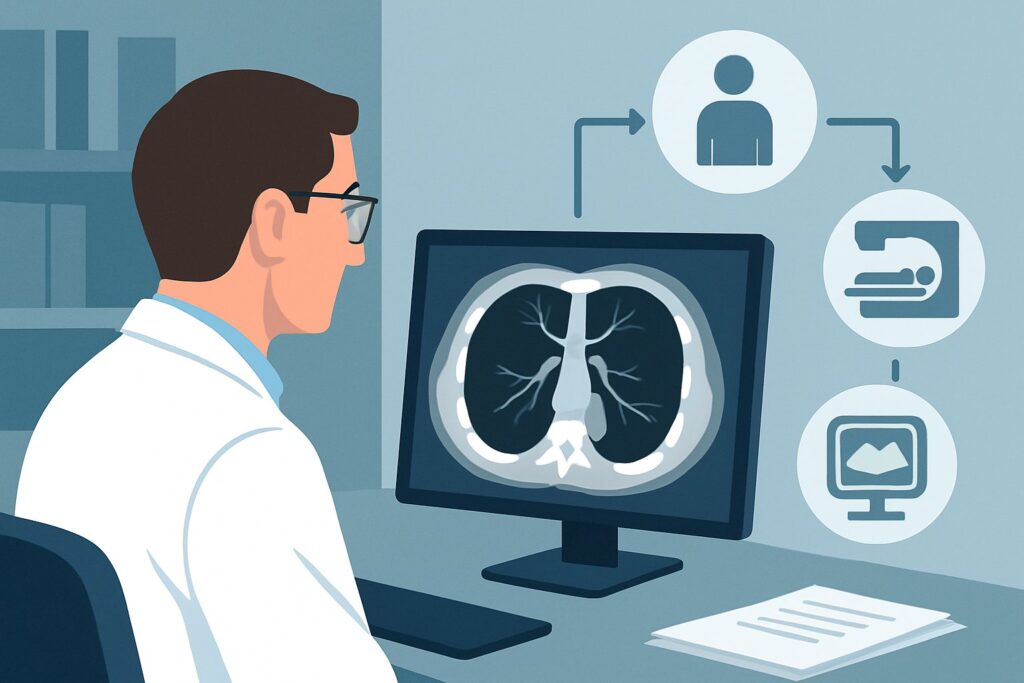
A 55-year-old man with a history of lung cancer presents to the emergency department with two days of progressive facial plethora, arm swelling, and shortness of breath. On exam, you note prominent, non-pulsatile jugular venous distention and dilated collateral veins across his chest wall. You suspect an acute superior vena cava (SVC) obstruction, a potential oncologic emergency. The immediate clinical question is clear: what is the most appropriate initial imaging study to confirm the diagnosis, identify the cause, and guide urgent management? For this specific presentation, the American College of Radiology (ACR) Appropriateness Criteria rates MRA and MRV chest without and with IV contrast as a Usually Appropriate initial study. This article provides a detailed workflow for this exact clinical scenario.
Who Fits This Clinical Scenario for Acute SVC Occlusion?
This guidance applies specifically to an adult patient with a suspected acute occlusion of the superior vena cava or brachiocephalic vein who is undergoing initial imaging. The key clinical feature is the acuity of symptom onset, typically developing over hours to a few days. Classic signs and symptoms include:
- Facial, neck, or upper extremity edema
- Facial plethora (a ruddy, cyanotic complexion)
- Dyspnea or cough
- Visible collateral veins on the chest and neck
- Jugular venous distention
This workflow is distinct from several related but different clinical situations:
- Chronic Occlusion: This guidance does not apply to patients with an insidious onset of similar symptoms over weeks or months. A gradual occlusion allows for the development of extensive collateral circulation, which alters the diagnostic priorities and imaging strategy. That presentation is covered in the ACR variant for suspected chronic thoracic venous occlusion.
- Isolated Upper Extremity DVT: If the clinical suspicion is limited to a deep vein thrombosis (DVT) of an arm vein without signs of central compression (e.g., facial swelling), the imaging workup is different and often begins with duplex ultrasonography.
- Pediatric Patients: This workflow is intended for adults. Imaging in children requires specific attention to radiation dose and involves a different spectrum of potential causes.
What Diagnoses Are You Working Up in Suspected Acute SVC Occlusion?
When ordering imaging for suspected acute SVC syndrome, you are primarily investigating a few critical and time-sensitive conditions. The choice of study must be able to differentiate between these potential causes, as the downstream management varies significantly.
Malignant Obstruction is the most common cause of SVC syndrome, accounting for the majority of cases. The obstruction can result from direct invasion or external compression by a primary mediastinal tumor. The most frequent culprits are non-small cell lung cancer, small cell lung cancer, and non-Hodgkin lymphoma. Imaging must not only confirm the venous occlusion but also delineate the extent of the tumor and its relationship to adjacent structures to guide potential radiation therapy, chemotherapy, or endovascular stenting.
Thrombosis from Indwelling Devices is an increasingly prevalent non-malignant cause. Central venous catheters, pacemakers, and implantable cardioverter-defibrillators can induce thrombus formation, leading to acute occlusion. In this context, imaging must clearly distinguish bland thrombus from tumor thrombus and assess the full extent of the clot, which is critical for planning anticoagulation or thrombolysis.
Fibrosing Mediastinitis is a less common, benign cause characterized by an excessive fibrotic reaction in the mediastinum that encases and constricts the SVC. It is often a delayed complication of infections like histoplasmosis or tuberculosis. Imaging can reveal a diffuse, infiltrative soft tissue mass that is typically less discrete than a malignant tumor, a key feature for differentiating the two.
Why Is MRA and MRV of the Chest the Recommended Initial Study?
For an adult with suspected acute SVC or brachiocephalic vein occlusion, the ACR designates MRA and MRV chest without and with IV contrast as a Usually Appropriate initial study. This recommendation is based on its high diagnostic yield and safety profile for this specific clinical question.
The primary advantage of Magnetic Resonance Angiography (MRA) and Venography (MRV) is its superior soft-tissue contrast. This allows for excellent characterization of the cause of the obstruction—whether it is an extrinsic compressing tumor, an intrinsic bland thrombus, or diffuse fibrotic tissue. It can precisely define the level and length of the venous occlusion and, crucially, map the collateral venous pathways that have developed. This detailed anatomical information is vital for planning subsequent interventions, such as stenting or bypass surgery.
A significant benefit of MR-based imaging is the complete absence of ionizing radiation (0 mSv). This is particularly relevant for patients, such as those with malignancy, who may require multiple follow-up scans over the course of their treatment.
While MR is highly rated, several other studies are also considered effective:
- CT chest with IV contrast (including CTA/CTV) is also rated Usually Appropriate. CT is often faster and more widely available than MRI, making it an excellent alternative, especially in unstable patients or when MRI is contraindicated. It provides superb spatial resolution for defining the occlusion and collateral vessels. However, it involves significant ionizing radiation (ranging from ☢☢☢ 1-10 mSv to ☢☢☢☢ 10-30 mSv) and relies on iodinated contrast, which can be a concern in patients with renal insufficiency.
- US duplex Doppler upper extremity and chest is rated Usually Not Appropriate for this indication. While ultrasound is the primary tool for evaluating peripheral upper extremity veins, its utility for the central thoracic veins (SVC, brachiocephalic) is severely limited by the overlying sternum and clavicles. It cannot reliably visualize the site or determine the cause of a central obstruction.
What’s Next After MRA and MRV? Downstream Workflow
The results of the initial MRA/MRV will dictate the subsequent clinical pathway. The goal is to move from diagnosis to a management plan that addresses both the underlying cause and the acute venous obstruction.
- If the study is positive for malignant obstruction: The immediate next steps involve a multidisciplinary consultation with oncology, radiation oncology, and potentially interventional radiology or thoracic surgery. A tissue diagnosis via biopsy is often required if not already established. Urgent management may include radiation therapy to shrink the tumor, chemotherapy, and/or endovascular SVC stenting to rapidly relieve symptoms.
- If the study is positive for bland thrombus: The primary treatment is anticoagulation. If the thrombus is related to an indwelling catheter, a decision must be made about whether the line can be safely removed. For extensive or life-threatening thrombosis, catheter-directed thrombolysis or mechanical thrombectomy may be considered by an interventional specialist.
- If the study is negative for central venous occlusion: If the MRA/MRV is unequivocally negative but clinical suspicion remains high, reconsider the differential diagnosis. Could the symptoms be from congestive heart failure, pericardial effusion with tamponade, or an allergic reaction (angioedema)? Further diagnostic workup should be guided by these alternative possibilities.
- If the study is indeterminate: In rare cases where MR findings are equivocal (e.g., differentiating bland thrombus from tumor thrombus), a CT with IV contrast may provide complementary information. In very select cases, direct catheter venography, though invasive, may be necessary to clarify the anatomy and measure pressure gradients before an intervention.
Pitfalls to Avoid (and When to Get Help)
Navigating the workup for acute SVC syndrome requires avoiding several common pitfalls to ensure timely and accurate diagnosis.
- Delaying Imaging: Acute SVC syndrome can progress to airway compromise or cerebral edema. It should be treated as a medical emergency, and definitive imaging should be obtained promptly.
- Ordering a Non-Contrast Study: A non-contrast CT of the chest is rated Usually Not Appropriate. It cannot adequately assess vascular patency, characterize the cause of obstruction, or delineate collateral pathways. IV contrast is essential.
- Misinterpreting Flow Artifacts on MR: Slow or turbulent flow in compressed veins can sometimes mimic thrombus on certain MR sequences. Ensure the study is reviewed by a radiologist experienced in cardiovascular imaging.
- Ignoring Contrast Allergies or Renal Function: Before ordering a contrast-enhanced study (either CT or MR), always screen for severe contrast allergies and assess renal function to ensure the appropriate contrast agent and protocol are used.
If a patient presents with stridor, confusion, or syncope, this suggests severe obstruction with laryngeal or cerebral edema. This is a medical emergency requiring immediate escalation for airway management and consultation with interventional radiology or thoracic surgery for emergent decompression.
Related ACR Topics and Tools
For a comprehensive overview of all clinical scenarios related to this topic, please consult our parent guide. For other tools to assist in your clinical workflow, see the resources below.
- For breadth across all scenarios in Thoracic Venous Occlusions-Suspected Superior Vena Cava Syndrome, see our parent guide: Thoracic Venous Occlusions-Suspected Superior Vena Cava Syndrome: ACR Appropriateness Decoded.
- ACR Appropriateness Criteria Lookup — for adjacent scenarios
- Imaging Protocol Library — for technique on the recommended study
- Radiation Dose Calculator — for cumulative dose conversations
Frequently Asked Questions
Why is MRA/MRV preferred over CTA/CTV if both are rated ‘Usually Appropriate’?
While both are excellent and appropriate choices, MRA/MRV is often highlighted because it provides superb soft-tissue detail to characterize the cause of obstruction (e.g., tumor vs. thrombus vs. fibrosis) without using any ionizing radiation. However, CT is faster and more accessible, making it a very strong and often-used alternative, particularly in unstable patients or facilities where MR is less available.
Is a chest radiograph useful as a first step for suspected acute SVC syndrome?
A chest radiograph is rated ‘May be appropriate (Disagreement)’ by the ACR. It can sometimes reveal a large mediastinal mass, which might be the underlying cause, but it cannot directly visualize the SVC or confirm an occlusion. A normal chest radiograph does not rule out SVC syndrome. Therefore, it is not a definitive study and should not delay cross-sectional imaging with CT or MR if the clinical suspicion is high.
What if my patient has a pacemaker and cannot get an MRI?
If a patient has a non-MRI-conditional device or other contraindication to MRI, then CT with IV contrast (specifically a CTV or CTA protocol) is the best alternative. It is also rated ‘Usually Appropriate’ and provides excellent diagnostic information regarding the location of the occlusion, the cause, and the collateral pathways.
Should I order a study of the neck in addition to the chest?
Protocols like ‘CT neck and chest with IV contrast’ are also rated ‘Usually Appropriate’. Including the neck can be beneficial for fully evaluating the brachiocephalic and jugular veins and for assessing the superior extent of a mediastinal mass. This is often a decision based on institutional protocol and the specific clinical presentation, but imaging should, at a minimum, cover the entire superior mediastinum and central thoracic veins.
What is the role of catheter venography for initial diagnosis?
Conventional catheter venography is rated ‘Usually Not Appropriate’ for the *initial diagnosis* of SVC syndrome. It is an invasive procedure that has been largely replaced by non-invasive cross-sectional imaging like CT and MR. Its primary role today is as part of a therapeutic intervention, such as stenting, where it is used to confirm findings, measure pressure gradients, and guide device placement.
Reviewed by Pouyan Golshani, MD, Interventional Radiologist — May 30, 2026