When to Order Imaging for Pulmonary Arteriovenous Malformation (PAVM): ACR Appropriateness Decoded

A patient presents with a history of recurrent nosebleeds and new-onset shortness of breath. Another presents with a cryptogenic stroke, and a chest radiograph shows a subtle lung nodule. In both cases, a pulmonary arteriovenous malformation (PAVM) is on the differential. These abnormal connections between pulmonary arteries and veins create a right-to-left shunt, bypassing the capillary filter of the lungs and leading to complications from hypoxemia to paradoxical emboli. Deciding on the optimal initial imaging study—balancing diagnostic yield, radiation exposure, and invasiveness—is critical. This guide decodes the American College of Radiology (ACR) Appropriateness Criteria to help you select the right test for the right clinical scenario.
What Does ACR Pulmonary Arteriovenous Malformation (PAVM) Cover?
This ACR Appropriateness Criteria document, last updated by the Vascular panel on May 11, 2026, focuses on the diagnostic evaluation and surveillance of suspected or known pulmonary arteriovenous malformations in adults. The guidelines address several distinct clinical presentations, providing a framework for choosing the most suitable imaging modality in each context.
The scenarios covered include:
- Initial evaluation for patients with neurological symptoms (e.g., TIA, stroke, brain abscess) concerning for paradoxical emboli.
- Workup for patients with pulmonary symptoms (e.g., dyspnea, hemoptysis) and a personal or family history of hereditary hemorrhagic telangiectasia (HHT).
- Screening for asymptomatic individuals with a family history of HHT.
- Follow-up imaging for patients with a previously treated PAVM.
- Characterization of a suspected PAVM seen incidentally on other imaging.
These criteria do not cover the primary workup of other causes of lung nodules, pulmonary embolism, or initial evaluation of stroke where PAVM is not a primary consideration. The focus remains specifically on the confirmation, characterization, and surveillance of PAVMs.
What Imaging Should I Order for Pulmonary Arteriovenous Malformation (PAVM)? Recommendations by Clinical Scenario
The optimal imaging for a suspected PAVM depends entirely on the clinical context, from initial screening to post-treatment follow-up. The ACR provides clear guidance for these common situations.
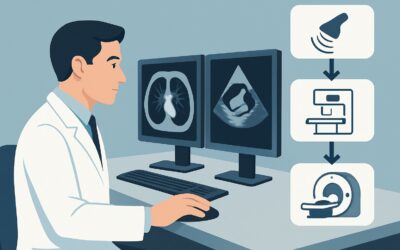
For an adult presenting with a transient ischemic attack, seizures, or brain abscess where a chest radiograph reveals a lung nodule, the primary goal is to confirm a PAVM as the source of a paradoxical embolus. In this high-suspicion scenario, several studies are rated as Usually appropriate. Transthoracic echocardiography (TTE) with IV contrast (a “bubble study”) is an excellent non-invasive test to establish a right-to-left shunt. For anatomic definition, both CTA of the pulmonary arteries and non-contrast CT of the chest are also Usually appropriate to visualize the malformation directly. MRA of the pulmonary arteries without and with IV contrast is another non-ionizing radiation alternative that is also rated Usually appropriate.
When an adult presents with shortness of breath, hemothorax, or hemoptysis and has a history suggestive of hereditary hemorrhagic telangiectasia (HHT), the pre-test probability of a PAVM is high. The ACR rates multiple modalities as Usually appropriate for initial imaging. These include contrast-enhanced TTE for shunt detection, as well as CT chest (with or without contrast) and CTA (chest or pulmonary arteries) for direct anatomical visualization. MRA of the pulmonary arteries with and without contrast is also a strong, radiation-free option.
Similarly, for an asymptomatic adult with a family history of HHT, screening is key to preventing future complications. The recommendations mirror those for symptomatic HHT patients. Contrast-enhanced TTE, CT chest without contrast, CTA (chest or pulmonary arteries), and MRA of the pulmonary arteries are all considered Usually appropriate. The choice often depends on institutional preference and the desire to avoid radiation in a younger, asymptomatic screening population, making TTE or MRA attractive initial options.
For an adult with a previously treated PAVM requiring follow-up imaging, surveillance is crucial to detect recanalization or the growth of new PAVMs. The ACR again lists several options as Usually appropriate, including contrast-enhanced TTE, various CT/CTA protocols (chest or pulmonary arteries), and MRA of the pulmonary arteries. The selection often involves alternating modalities, such as a baseline CTA followed by surveillance with TTE or MRA to minimize cumulative radiation dose over the patient’s lifetime.
Finally, if a PAVM is suspected based on an abnormal finding on a prior CT or chest radiograph in an asymptomatic patient, the next step is definitive characterization. CTA of the pulmonary arteries is Usually appropriate to delineate the feeding artery and draining vein, which is essential for treatment planning. Contrast-enhanced TTE and MRA of the pulmonary arteries are also Usually appropriate to confirm the shunt and provide anatomical detail without radiation.
ACR Imaging Recommendations Table
| Clinical Scenario | Top Procedure | ACR Rating | Adult RRL | Pediatric RRL |
|---|---|---|---|---|
| Adult with neurologic symptoms (TIA, seizure, abscess) and lung nodule on CXR. | CTA pulmonary arteries with IV contrast | Usually appropriate | ☢ ☢ ☢ 1-10 mSv | ☢ ☢ ☢ ☢ 3-10 mSv [ped] |
| Adult with pulmonary symptoms (dyspnea, hemoptysis) and HHT history. | US echocardiography transthoracic with IV contrast | Usually appropriate | O 0 mSv | O 0 mSv [ped] |
| Adult, asymptomatic with family history of HHT. | CT chest without IV contrast | Usually appropriate | ☢ ☢ ☢ 1-10 mSv | ☢ ☢ ☢ ☢ 3-10 mSv [ped] |
| Adult with history of treated PAVM for follow-up. | MRA pulmonary arteries without and with IV contrast | Usually appropriate | O 0 mSv | O 0 mSv [ped] |
| Adult, asymptomatic with abnormal imaging suggestive of PAVM. | CTA pulmonary arteries with IV contrast | Usually appropriate | ☢ ☢ ☢ 1-10 mSv | ☢ ☢ ☢ ☢ 3-10 mSv [ped] |
Adult vs. Pediatric Pulmonary Arteriovenous Malformation (PAVM) Imaging: Radiation Dose Tradeoffs
While the imaging recommendations are broadly similar for adults and children, radiation safety is a paramount concern in the pediatric population. Children are inherently more radiosensitive than adults, and their longer life expectancy increases the lifetime risk associated with cumulative radiation exposure. This principle, known as As Low As Reasonably Achievable (ALARA), guides imaging choices.
For CT-based studies, the ACR guidelines reflect this concern. While the absolute millisievert (mSv) dose for a pediatric chest CT may be lower than for an adult, the relative radiation level (RRL) is often rated higher (e.g., ☢ ☢ ☢ ☢ for pediatric vs. ☢ ☢ ☢ for adult). This higher rating signifies the greater biological risk for the same dose. Consequently, non-ionizing modalities like transthoracic echocardiography with contrast and MRA are particularly valuable for screening and surveillance in children with suspected or known HHT. When CT is necessary for pre-procedural planning, protocols must be meticulously optimized to use the lowest possible radiation dose while maintaining diagnostic quality.
Imaging Protocol Details for Pulmonary Arteriovenous Malformation (PAVM)
Once you’ve decided on the right study, the specific imaging protocol is essential for diagnostic accuracy. Our protocol guides cover technique, contrast timing, and interpretation principles for many of the studies recommended by the ACR. For patients presenting with neurologic symptoms, initial brain imaging is also a key part of the workup to evaluate for ischemic or infectious complications of a right-to-left shunt.
Tools to Help You Order the Right Study
Navigating imaging guidelines and radiation safety can be complex. GigHz offers a suite of reference tools designed to support clinical decision-making at the point of care.
For clinical scenarios beyond Pulmonary Arteriovenous Malformation (PAVM), the Imaging Appropriateness Selector provides a searchable interface to find the latest ACR recommendations for hundreds of clinical variants. It helps ensure your imaging orders are evidence-based and appropriate.
To ensure technical excellence for the chosen study, the Imaging Protocol Library offers detailed, step-by-step protocols for a wide range of CT, MRI, and ultrasound examinations. This resource is invaluable for standardizing imaging quality across an institution.
For discussing radiation exposure with patients and tracking cumulative dose, the Radiation Dose Calculator is a practical tool. It helps translate mSv values into understandable terms, facilitating shared decision-making and promoting radiation safety awareness.
What is the best initial screening test for a suspected PAVM?
Transthoracic echocardiography with IV contrast (a “bubble study”) is an excellent, non-invasive, and widely available initial screening test. It is highly sensitive for detecting the right-to-left shunt characteristic of a PAVM. If bubbles appear in the left atrium 3-8 cardiac cycles after injection into a peripheral vein, it strongly suggests an intrapulmonary shunt.
Why is CTA often preferred over MRA for pre-treatment planning?
While MRA is a great radiation-free alternative, CTA of the pulmonary arteries generally offers superior spatial resolution. This allows for precise measurement of the feeding artery diameter—a critical factor in determining the need for treatment (typically for feeders >3 mm)—and provides a clear anatomical map for interventional radiologists planning embolization.
What is the role of conventional pulmonary arteriography?
Today, conventional catheter-based pulmonary arteriography is primarily a therapeutic procedure, not a diagnostic one. It is rated as “May be appropriate” or “Usually not appropriate” for initial diagnosis in most ACR scenarios. Its main role is to be performed concurrently with transcatheter embolization once a PAVM has been identified by non-invasive imaging like CT or MRI.
What is the connection between PAVMs and brain abscesses?
The lungs’ capillary network normally filters small bacterial clumps from the venous circulation. In a patient with a PAVM, this filter is bypassed by the right-to-left shunt. This allows bacteria, often from minor sources like dental work, to travel directly to the arterial circulation and seed the brain, leading to the formation of a brain abscess. This is a form of paradoxical embolism.
Why is a plain chest radiograph rated “Usually not appropriate” for evaluating a suspected PAVM?
While a chest radiograph is often the first imaging study a patient receives and may incidentally show a PAVM as a well-defined nodule or mass (often in the lower lobes), it has low sensitivity. Many PAVMs are too small or are obscured by other structures to be visible. Therefore, it is not a reliable tool to screen for or rule out a PAVM, and a negative chest radiograph should not stop further investigation if clinical suspicion is high.
Frequently Asked Questions
What is the best initial screening test for a suspected PAVM?
Transthoracic echocardiography with IV contrast (a “bubble study”) is an excellent, non-invasive, and widely available initial screening test. It is highly sensitive for detecting the right-to-left shunt characteristic of a PAVM. If bubbles appear in the left atrium 3-8 cardiac cycles after injection into a peripheral vein, it strongly suggests an intrapulmonary shunt.
Why is CTA often preferred over MRA for pre-treatment planning?
While MRA is a great radiation-free alternative, CTA of the pulmonary arteries generally offers superior spatial resolution. This allows for precise measurement of the feeding artery diameter—a critical factor in determining the need for treatment (typically for feeders >3 mm)—and provides a clear anatomical map for interventional radiologists planning embolization.
What is the role of conventional pulmonary arteriography?
Today, conventional catheter-based pulmonary arteriography is primarily a therapeutic procedure, not a diagnostic one. It is rated as “May be appropriate” or “Usually not appropriate” for initial diagnosis in most ACR scenarios. Its main role is to be performed concurrently with transcatheter embolization once a PAVM has been identified by non-invasive imaging like CT or MRI.
What is the connection between PAVMs and brain abscesses?
The lungs’ capillary network normally filters small bacterial clumps from the venous circulation. In a patient with a PAVM, this filter is bypassed by the right-to-left shunt. This allows bacteria, often from minor sources like dental work, to travel directly to the arterial circulation and seed the brain, leading to the formation of a brain abscess. This is a form of paradoxical embolism.
Why is a plain chest radiograph rated “Usually not appropriate” for evaluating a suspected PAVM?
While a chest radiograph is often the first imaging study a patient receives and may incidentally show a PAVM as a well-defined nodule or mass (often in the lower lobes), it has low sensitivity. Many PAVMs are too small or are obscured by other structures to be visible. Therefore, it is not a reliable tool to screen for or rule out a PAVM, and a negative chest radiograph should not stop further investigation if clinical suspicion is high.
Reviewed by Pouyan Golshani, MD, Interventional Radiologist — May 26, 2026