What Is the Best Initial Therapy for Symptomatic Fibroids Without Fertility Desire?
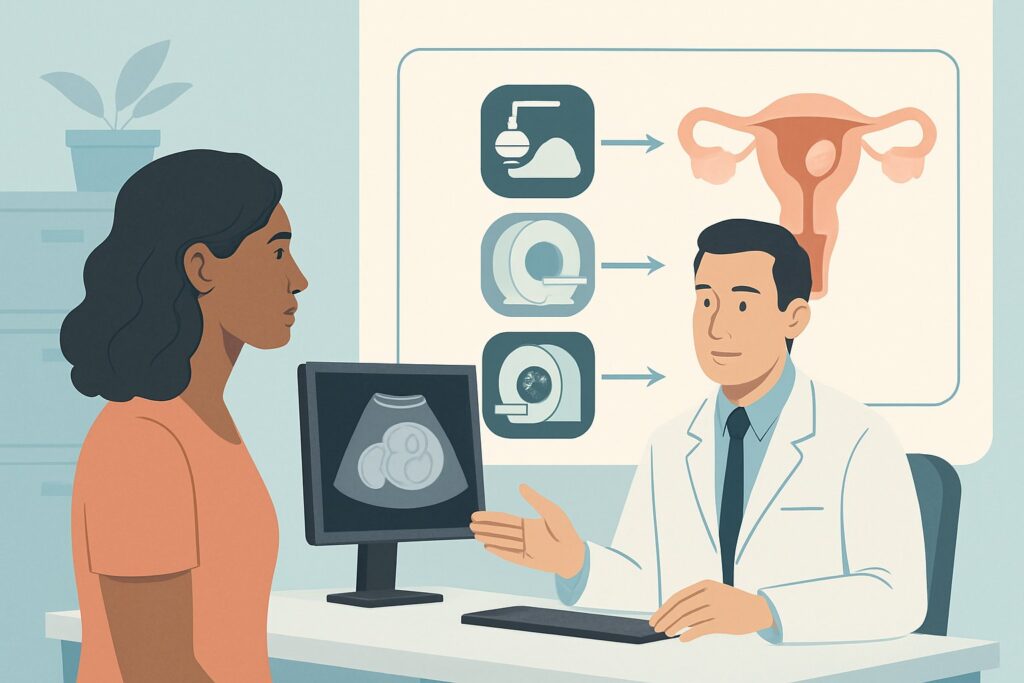
A 42-year-old G2P2 presents to your clinic with progressively heavier menstrual bleeding and a constant, bothersome pelvic pressure that she says feels “like a grapefruit” is sitting in her pelvis. She has completed her family and is not interested in future pregnancy. An initial pelvic ultrasound confirms multiple uterine leiomyomas, the largest measuring 7 cm. You are now counseling her on the best initial therapeutic options. This article provides a clinical workflow for this exact scenario, navigating the multiple first-line treatments recommended by the American College of Radiology (ACR). For a reproductive-age patient with symptomatic fibroids and no desire for future fertility, the ACR rates several initial therapies, including Uterine Artery Embolization and Laparoscopic or open myomectomy, as Usually appropriate.
Who Fits This Clinical Scenario for Uterine Fibroid Management?
This guidance is specifically for a reproductive-age patient with symptomatic uterine fibroids who does not desire future fertility and is considering initial therapy.
Inclusion Criteria:
- Patient Age: Premenopausal/reproductive age.
- Diagnosis: Known uterine fibroids, typically confirmed on initial imaging like pelvic ultrasound.
- Symptoms: Clinically significant symptoms directly attributable to the fibroids, such as heavy uterine bleeding (menorrhagia) or bulk-related symptoms (pelvic pain, pressure, urinary frequency, or constipation).
- Fertility Status: The patient has definitively completed childbearing and does not desire future pregnancy.
Exclusion Criteria (These patients require a different workflow):
- Patients Desiring Future Pregnancy: This is a critical distinction. For these patients, the primary goal is fertility preservation, making uterine-sparing procedures like myomectomy the primary consideration. Embolization and ablation techniques are generally avoided.
- Postmenopausal Patients: New or worsening symptoms in a postmenopausal patient raise a higher suspicion for malignancy (e.g., leiomyosarcoma) and require a different diagnostic and management pathway.
- Patients with Confirmed Concurrent Adenomyosis: While adenomyosis and fibroids often coexist, a diagnosis of predominant adenomyosis can influence treatment success. For example, the efficacy of Uterine Artery Embolization may be lower for adenomyosis-related symptoms.
- Patients with Pedunculated Submucosal Fibroids: These fibroids, which hang into the uterine cavity by a stalk, are often best managed with hysteroscopic myomectomy, a distinct procedure.
What Diagnoses Are You Working Up in This Scenario?
While the patient often arrives with a diagnosis of “fibroids” from an initial ultrasound, the pre-procedural workup aims to confirm the fibroids are the true cause of her symptoms and to rule out other conditions that could mimic them or alter the treatment plan.
Symptomatic Uterine Leiomyomas (Fibroids)
This is the primary diagnosis. The goal of further evaluation, often with MRI, is to precisely map the number, size, location (submucosal, intramural, subserosal), and vascularity of the fibroids. This information is crucial for determining which of the available therapies is most suitable. For example, a large number of small fibroids may be better suited for embolization, while a single, large fibroid causing bulk symptoms might be better addressed with myomectomy.
Adenomyosis
A common confounding diagnosis, adenomyosis involves endometrial tissue growing into the muscular wall of the uterus. It can cause heavy bleeding and pelvic pain, similar to fibroids, and frequently co-exists with them. Pelvic MRI is highly effective at differentiating adenomyosis from fibroids or confirming their co-existence. Identifying significant adenomyosis is key, as it may make a patient a less-than-ideal candidate for certain fibroid-directed therapies like MR-guided focused ultrasound.
Endometrial Polyp or Hyperplasia
These conditions are important considerations in any patient with heavy uterine bleeding. While ultrasound can suggest their presence, they may require further evaluation with saline-infusion sonohysterography, hysteroscopy, or an endometrial biopsy to rule out hyperplasia or malignancy, especially if bleeding patterns are atypical or risk factors are present.
Leiomyosarcoma
This rare uterine cancer is the most consequential diagnosis to consider, although it is uncommon in premenopausal patients. Features that raise suspicion include rapid growth of a presumed fibroid, particularly near or after menopause. While no imaging modality can definitively rule out leiomyosarcoma preoperatively, certain features on contrast-enhanced MRI can increase or decrease suspicion and are critical in the decision-making process, especially when considering uterine-preserving options.
Why Are Multiple Therapies ‘Usually Appropriate’ for This Patient?
For a patient with symptomatic fibroids who does not desire future fertility, the ACR Appropriateness Criteria reflect a modern, patient-centered approach where multiple effective options exist. The choice is not about one “best” procedure, but about a shared decision-making process that aligns the procedure’s benefits and risks with the patient’s specific anatomy, symptoms, and personal preferences.
The following four initial therapies are all rated Usually appropriate:
- Uterine Artery Embolization (UAE): This minimally invasive procedure is performed by an interventional radiologist. Microspheres are injected into the uterine arteries to block blood flow to the fibroids, causing them to shrink and symptoms to resolve. It is highly effective for both heavy bleeding and bulk symptoms and preserves the uterus. Recovery is typically much faster than with surgical options.
- Laparoscopic or Open Myomectomy: This is a surgical procedure to remove the fibroids while leaving the uterus in place. It is highly effective, particularly for large or pedunculated fibroids causing significant bulk symptoms. The approach (laparoscopic, robotic, or open) depends on the size, number, and location of the fibroids.
- MR-guided High-Frequency Focused Ultrasound (MRgFUS): This is a non-invasive outpatient procedure that uses focused ultrasound energy to thermally ablate (destroy) fibroid tissue under real-time MRI guidance. It is an excellent option for patients with a limited number of accessible fibroids who wish to avoid any incision or hospital stay. Not all patients are candidates based on fibroid location and characteristics.
- Medical Management: For patients who wish to avoid a procedure, hormonal therapies can be effective, particularly for controlling heavy bleeding. Options include hormonal IUDs, oral contraceptives, or GnRH agonists. Their effect on bulk symptoms is limited, and symptoms typically return after cessation of therapy.
Why are other procedures rated lower for this initial therapy scenario?
- Hysterectomy (May be appropriate): While hysterectomy provides a definitive cure, it is a major surgery involving removal of the uterus. It is generally reserved for cases where less invasive, uterus-preserving options have failed, are contraindicated, or if the patient has other uterine pathology and desires a definitive solution.
- Endometrial Ablation (Usually not appropriate): This procedure destroys the uterine lining to control bleeding but does not treat the fibroids themselves. It is ineffective for bulk symptoms. Furthermore, the presence of intramural or subserosal fibroids can distort the uterine cavity, making the procedure less safe and effective.
None of these therapeutic procedures involve ionizing radiation, except for the fluoroscopy used during Uterine Artery Embolization, which involves a low to moderate dose.
What’s Next? Downstream Workflow After the Initial Consultation
The initial consultation and imaging workup lead to a crucial decision-making phase, typically involving a gynecologist and potentially an interventional radiologist. The next steps are guided by the patient’s primary symptoms and imaging findings.
- If Pelvic MRI Confirms Fibroids Are the Clear Symptom Driver: The conversation shifts to a detailed comparison of the Usually appropriate options. A patient whose primary complaint is heavy bleeding with smaller fibroids might be an excellent candidate for UAE or medical management. A patient with a single large fibroid causing significant pelvic pressure may be better served by a myomectomy. A patient averse to surgery with favorable fibroid anatomy might opt for MRgFUS. This is the core of the shared decision-making process.
- If MRI Suggests Significant Co-existing Adenomyosis: The treatment plan must be adjusted. While UAE can treat adenomyosis, its long-term efficacy may be lower than for fibroids alone. Hysterectomy (May be appropriate) may become a more prominent part of the discussion for patients with severe, combined symptoms who desire a definitive solution.
- If Imaging Is Indeterminate or Suggests Malignancy: Any suspicion of leiomyosarcoma on MRI is a red flag that halts consideration of uterine-sparing procedures. The patient should be referred to a gynecologic oncologist for further evaluation and management. The risks of morcellation during a laparoscopic myomectomy or leaving malignant tissue behind after UAE are too high.
- If the Patient is a Poor Candidate for All Procedures: In rare cases, a patient’s comorbidities may preclude both surgery and embolization. In this situation, medical management becomes the primary therapeutic option, with a focus on symptom control.
Pitfalls to Avoid (and When to Get Help)
- Pitfall 1: Underestimating the Role of Pelvic MRI. Relying solely on ultrasound can be insufficient for complex cases. MRI provides a detailed roadmap of fibroid location, size, and character, and is crucial for identifying confounders like adenomyosis, which directly impacts procedural choice and success.
- Pitfall 2: Offering Endometrial Ablation as a Primary Solution. For this scenario, endometrial ablation is rated Usually not appropriate. It fails to address the underlying fibroids causing bulk symptoms and can make future surveillance of the uterine cavity more difficult.
- Pitfall 3: Not Involving Interventional Radiology Early. For patients who are candidates for UAE or MRgFUS, a consultation with an interventional radiologist is essential. They can provide a detailed explanation of the procedures, recovery, and expected outcomes, enabling a truly informed shared decision.
- Escalation: If imaging reveals features concerning for malignancy, such as rapid growth or atypical vascularity, immediate escalation to a gynecologic oncologist is mandatory before any intervention is planned.
Related ACR Topics and Tools
This article covers one specific clinical scenario. For a comprehensive overview of all variants and the full ratings tables, please see our parent guide. Additional GigHz resources can help you apply these criteria in your practice.
- For breadth across all scenarios in Management of Uterine Fibroids, see our parent guide: Management of Uterine Fibroids: ACR Appropriateness Decoded.
- ACR Appropriateness Criteria Lookup — for adjacent scenarios
- Imaging Protocol Library — for technique on the recommended study
- Radiation Dose Calculator — for cumulative dose conversations
Frequently Asked Questions
Why is hysterectomy only ‘May be appropriate’ if the patient doesn’t want more children?
While hysterectomy is a definitive cure for fibroids, it is a major surgery with greater risks and a longer recovery period than minimally invasive options like Uterine Artery Embolization (UAE) or myomectomy. For initial therapy, the ACR prioritizes less invasive, uterus-preserving options that are highly effective. Hysterectomy is an excellent option but is often reserved for patients who have failed other therapies, have contraindications to other procedures, or have additional uterine pathology.
If my patient’s main symptom is heavy bleeding, can’t I just do an endometrial ablation?
The ACR rates endometrial ablation as ‘Usually not appropriate’ as an initial therapy in this scenario. The procedure only addresses the uterine lining (endometrium) and does not treat the fibroids themselves. Bulk symptoms will not improve, and fibroids distorting the uterine cavity can make the procedure technically difficult, less safe, and less effective.
Does the patient need an MRI if an ultrasound already showed fibroids?
While not always mandatory, a pre-procedural pelvic MRI is highly recommended. It provides superior detail on fibroid number, size, and exact location (e.g., submucosal vs. intramural), which is critical for selecting the best therapy. MRI is also the best imaging modality for diagnosing co-existing conditions like adenomyosis, which can significantly alter the treatment plan and predicted outcomes.
What is the key difference in choosing between Uterine Artery Embolization (UAE) and myomectomy?
The choice often comes down to the patient’s specific fibroid burden and personal preference. Myomectomy physically removes the fibroids, which can be ideal for a patient with a few very large fibroids causing significant bulk symptoms. UAE treats all fibroids in the uterus by cutting off their blood supply, which is highly effective for patients with multiple fibroids and heavy bleeding. UAE is less invasive with a faster recovery, while myomectomy is a surgical procedure.
If a patient is close to menopause, should she just wait it out?
Waiting for menopause is a valid option for patients with mild or manageable symptoms, as fibroids typically shrink and symptoms resolve after menopause. However, for a patient with severe, quality-of-life-limiting symptoms like debilitating bleeding or significant pelvic pressure, waiting several years for relief is often not a practical or desirable choice. The therapies rated ‘Usually appropriate’ offer effective and timely symptom control.
Reviewed by Pouyan Golshani, MD, Interventional Radiologist — May 30, 2026