What Is the Next Step for a Retrievable IVC Filter After a Failed Retrieval Attempt?
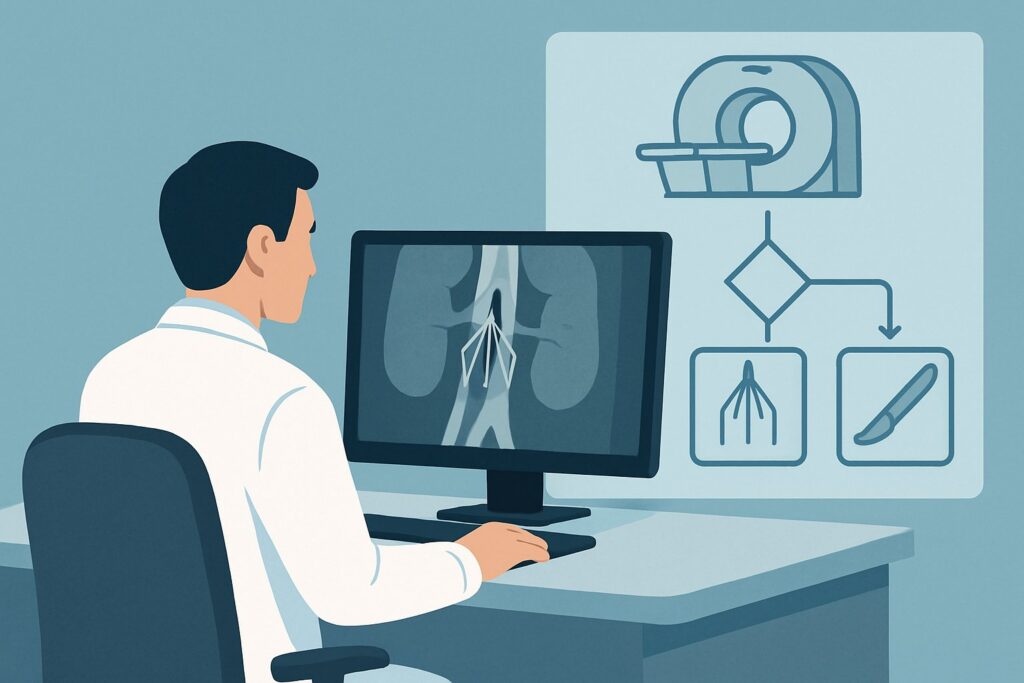
A 45-year-old patient is in your clinic for follow-up. Six months ago, after a severe motor vehicle accident, they had a retrievable inferior vena cava (IVC) filter placed due to a contraindication to anticoagulation. They have since recovered, the contraindication has resolved, and they are now therapeutically anticoagulated. Last week, an interventional radiologist attempted a standard retrieval, but the procedure was unsuccessful as the filter’s hook was embedded in the caval wall. You and your interventional radiology colleague must now decide the next step. This article details the clinical workflow for this specific scenario, where a second attempt is considered. According to the American College of Radiology (ACR) Appropriateness Criteria, the next step—’Re-attempt retrieval with advanced techniques’—is rated as Usually Appropriate.
Who Fits This Clinical Scenario for a Failed IVC Filter Retrieval?
This guidance applies specifically to patients with an indwelling retrievable inferior vena cava filter for whom an initial, standard retrieval attempt has already been performed and was unsuccessful. The key inclusion criterion is that the original indication for the filter is no longer present, and the patient is a suitable candidate for filter removal (e.g., they can be safely anticoagulated if needed). The decision to pursue a second, more complex retrieval is based on the principle that a temporary device should be removed to avoid long-term complications.
This workflow is not intended for:
- Patients presenting for their first retrieval attempt. Standard retrieval techniques are the appropriate first step and are covered in a different clinical context.
- Patients with a permanent IVC filter. These devices are not designed for removal, and the considerations are entirely different.
- Patients who still have an absolute contraindication to anticoagulation. In such cases, the risk-benefit analysis may favor leaving the filter in place, as its prophylactic benefit is still required. This aligns more closely with the ACR variant for acute venous thromboembolism with a contraindication to anticoagulation.
- Patients with known, occlusive IVC thrombosis at the filter level. This is a separate, complex clinical problem that requires management of the thrombosis before any retrieval can be considered.
What Complications Are You Working Up After a Failed Retrieval?
A failed initial retrieval attempt prompts a workup for the underlying cause, which will guide the strategy for a second attempt. The differential is not for a new disease but for the specific anatomic or technical reasons for failure. Pre-procedural imaging, often with a CT venogram, is crucial to evaluate these possibilities before a complex retrieval.
Filter Tilt
One of the most common reasons for failed retrieval is significant filter angulation, typically defined as a tilt greater than 15 degrees relative to the long axis of the IVC. This angulation causes the filter’s retrieval hook to abut or embed into the caval wall, making it inaccessible to a standard snare approaching from the internal jugular or femoral vein. CT imaging can precisely measure the degree of tilt and the hook’s location.
Hook Epithelialization or Ingrowth
Over time, the body’s natural healing process can cause the endothelial lining of the IVC to grow over the filter’s hook and struts. This tissue incorporation, or epithelialization, effectively anchors the filter to the vessel wall. The longer a filter remains indwelling, the higher the likelihood of significant ingrowth, which can make simple snaring impossible and necessitate more advanced dissection techniques.
Filter Strut Penetration
In some cases, one or more of the filter’s legs or struts may perforate the wall of the IVC. While often asymptomatic, this complication can make retrieval challenging and risky, as pulling on the filter could potentially extend the perforation or damage adjacent structures like the duodenum, aorta, or renal arteries. A pre-procedural CT is essential for identifying strut penetration and its relationship to nearby organs.
Organized Thrombus Within the Filter
Although the patient may be on anticoagulation, chronic, organized thrombus can become trapped within the filter’s cone. This thrombus can prevent the filter from collapsing properly during retrieval, leading to failure. A CT venogram can help identify significant thrombus burden that may need to be addressed before or during the advanced retrieval attempt.
Why Is Re-attempting Retrieval with Advanced Techniques Usually Appropriate?
The ACR rates ‘Re-attempt retrieval with advanced techniques’ as Usually Appropriate because the long-term risks associated with indwelling IVC filters often outweigh the risks of a complex retrieval performed by an experienced operator. FDA guidance has highlighted potential long-term complications, including filter fracture, embolization of filter fragments, IVC perforation, and IVC thrombosis. Therefore, removing a device that is no longer medically necessary is the primary clinical goal.
Advanced retrieval refers to a suite of endovascular techniques that go beyond the simple snare-and-sheath method used in standard retrievals. The specific technique is chosen based on the cause of the initial failure, which is often clarified by pre-procedural CT imaging. These techniques may include:
- Specialized Snares and Catheters: Using different snare configurations (e.g., loop snares) or deflecting-tip catheters to access a tilted filter hook.
- Dissection Techniques: Employing rigid endobronchial forceps, guidewires, or balloons to carefully dissect an epithelialized hook from the caval wall.
- Laser-Assisted Removal: Using an excimer laser sheath to ablate the fibrous, overgrown tissue encapsulating the filter, freeing it for retrieval. This is a highly specialized technique reserved for heavily embedded filters.
- Dual Access: Using both jugular and femoral venous access to gain better control and manipulation of the filter.
Comparison to Other Options
The ACR rates alternative approaches lower for this specific scenario:
- Convert to permanent device is rated as May be appropriate. This essentially means making a conscious decision to leave the filter in place indefinitely. This may be a reasonable choice if the patient’s life expectancy is short or if the risks of a complex retrieval (e.g., in a patient with severe comorbidities or hostile anatomy) are deemed unacceptably high. It is a patient-specific risk-benefit decision.
- Refer for surgical evaluation for retrieval is rated as Usually not appropriate. Open surgical removal of an IVC filter is a major operation associated with significant morbidity and mortality. It requires a cavotomy (a surgical incision into the IVC) and is reserved for rare, extreme circumstances, such as a filter that has perforated into a vital adjacent organ and is causing symptoms. For most cases of failed endovascular retrieval, the risks of surgery far exceed the risks of leaving the filter in situ.
These procedures are performed under fluoroscopic guidance, which involves ionizing radiation. There is no specific radiation level assigned by the ACR for this procedure, as the dose is highly variable depending on the complexity and duration of the case. The interventionalist will use techniques to minimize radiation exposure while ensuring procedural success.
What’s Next After Re-attempting Retrieval with Advanced Techniques? Downstream Workflow
The outcome of the advanced retrieval attempt dictates the subsequent clinical pathway. The decision tree is straightforward, focusing on success, failure, and the management of any complications.
- If the advanced retrieval is successful: The patient has the filter removed. The primary downstream action is to ensure appropriate anticoagulation continues for the underlying VTE indication, if still present. Access site hemostasis is confirmed, and the patient is typically discharged the same day. No further imaging or management related to the filter is needed.
- If the advanced retrieval is unsuccessful: The interventional radiologist and referring physician must again weigh the risks and benefits. At this point, having failed both standard and advanced endovascular techniques, the option to ‘Convert to permanent device’ becomes the most likely pathway. The patient and their family should be counseled that the filter will be left in place permanently and informed about the small but lifelong risks. A plan for clinical follow-up is established.
- If a complication occurs during the procedure: Management depends on the specific event. A minor, contained IVC perforation may be managed conservatively with observation. A more significant perforation or injury to an adjacent structure could require endovascular stent-grafting or, in rare cases, emergency surgical consultation.
In the rare event that an unsuccessful advanced retrieval is coupled with a new, high-risk feature (e.g., evidence of progressive filter migration or perforation causing symptoms), the ‘Usually not appropriate’ option of surgical consultation may be reconsidered, but this remains an exceptional circumstance.
Pitfalls to Avoid (and When to Get Help)
Navigating a failed IVC filter retrieval requires careful planning to avoid common pitfalls. Success often depends on anticipating challenges before the second attempt.
- Failing to obtain pre-procedural imaging: Attempting a complex retrieval without a high-quality CT venogram is a significant error. The CT provides a crucial roadmap, identifying tilt, penetration, and hook location, which dictates the entire procedural strategy.
- Underestimating dwell time: Do not assume a filter that has been in place for over a year will come out easily. The probability of epithelialization increases significantly with time, and the proceduralist should be prepared with advanced tools from the outset.
- Using the wrong tools: Persisting with a standard snare when the filter hook is clearly embedded is inefficient and can increase procedural time and risk. Recognizing the need for advanced hardware like forceps or laser sheaths early is key.
If significant caval perforation is suspected on pre-procedural imaging or occurs during the attempt, immediate escalation to or consultation with a vascular surgeon is warranted, even if surgical intervention is not ultimately required.
Related ACR Topics and Tools
This deep-dive article focuses on a single clinical scenario. For a comprehensive overview of all scenarios related to IVC filter management, from initial placement to routine retrieval, please consult the parent topic article. For additional resources on imaging guidelines, protocols, and radiation safety, the following tools are available.
- For breadth across all scenarios in Radiologic Management of Venous Thromboembolism-Inferior Vena Cava Filters, see our parent guide: Radiologic Management of Venous Thromboembolism-Inferior Vena Cava Filters: ACR Appropriateness Decoded.
- ACR Appropriateness Criteria Lookup — for adjacent scenarios
- Imaging Protocol Library — for technique on the recommended study
- Radiation Dose Calculator — for cumulative dose conversations
Frequently Asked Questions
What is the typical success rate for advanced IVC filter retrieval?
Success rates for advanced retrieval techniques performed at experienced centers are high, often reported to be over 90%. Success depends heavily on the operator’s experience, the specific cause of initial failure, the filter type, and the filter’s dwell time.
Is a CT scan always necessary before a second retrieval attempt?
Yes, a pre-procedural contrast-enhanced CT venogram is considered standard of care before attempting a complex retrieval. It provides essential information about filter tilt, strut perforation, hook location relative to the caval wall, and adjacent organ relationships, which is critical for planning a safe and effective procedure.
How long is too long to leave a retrievable IVC filter in place?
There is no absolute cutoff, but the risk of retrieval failure and complications increases with longer dwell times. The FDA recommends that implanting physicians and clinicians responsible for the ongoing care of patients with retrievable IVC filters consider removing the filter as soon as protection from pulmonary embolism is no longer needed. Many complex retrievals are for filters that have been in place for several years.
What are the main risks of an advanced retrieval procedure?
While generally safe in experienced hands, risks are higher than with standard retrieval. Potential complications include IVC injury (dissection or perforation), bleeding, damage to adjacent structures, filter fracture and embolization, and access site complications. These risks must be weighed against the long-term risks of leaving the filter in place.
If advanced retrieval fails, is it safe to leave the filter in permanently?
In many cases, yes. If a well-positioned, intact filter cannot be removed even with advanced techniques, the risk of leaving it in place may be lower than the risk of an open surgical procedure. The decision to ‘convert to permanent’ is a common outcome after a failed complex retrieval, and patients are typically monitored clinically thereafter.
Reviewed by Pouyan Golshani, MD, Interventional Radiologist — May 29, 2026