What Is the Next Step for an Indeterminate Adrenal Mass Under 1 cm?
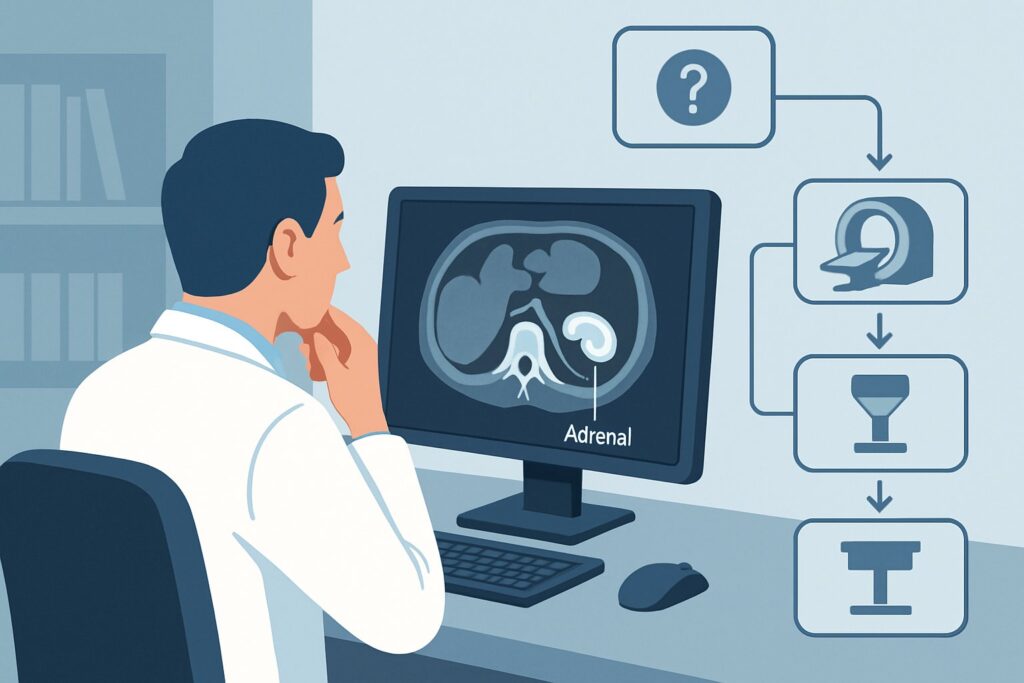
It’s the end of a long clinic day, and you’re reviewing imaging ordered for an unrelated issue—a 58-year-old male’s renal colic. The final report from the non-contrast Computed Tomography (CT) of the abdomen and pelvis confirms a distal ureteral stone, but also notes a 7 mm, indeterminate, low-density nodule in the left adrenal gland. The patient has no history of cancer and no symptoms of hormonal excess. This finding, often called an “incidentaloma,” presents a common clinical crossroads: pursue an aggressive workup or opt for surveillance? This article provides a detailed workflow for this specific scenario, explaining why the American College of Radiology (ACR) Appropriateness Criteria rates advanced imaging and biopsy as Usually not appropriate for these small, indeterminate lesions.
Who Fits This Clinical Scenario?
This guidance applies to a very specific patient population: those with an incidentally discovered adrenal mass that is less than 1 centimeter in its greatest dimension. The scenario is further defined by two critical factors: the mass has no definitively benign features on the initial scan (such as macroscopic fat typical of a myelolipoma), and the patient has no known history of a primary malignancy.
It is crucial to distinguish this situation from similar, yet distinct, clinical presentations that require a different approach. This workflow does not apply if:
- The mass is larger. An indeterminate adrenal mass measuring between 1 cm and 4 cm, or one greater than 4 cm, falls into different risk categories and follows separate ACR guidelines, often warranting dedicated adrenal protocol imaging.
- The patient has a known primary cancer. In a patient with a history of malignancy (e.g., lung, renal, or breast cancer), even a small adrenal nodule must be considered a potential metastasis until proven otherwise, triggering a more aggressive diagnostic pathway.
- The patient has clear symptoms of hormonal excess. If the patient presents with new-onset, difficult-to-control hypertension, hypokalemia, or physical signs of Cushing’s syndrome, a biochemical workup is indicated regardless of lesion size.
Correctly identifying that your patient fits this low-risk profile is the essential first step in avoiding unnecessary and potentially harmful investigations.
What Diagnoses Are You Working Up in This Scenario?
When an indeterminate adrenal mass is found, the primary goal is to differentiate benign, non-functional lesions from the rare but clinically significant alternatives. For a sub-centimeter finding in a patient without a cancer history, the differential is heavily weighted toward benign causes.
Non-functioning Adenoma
This is, by a significant margin, the most common diagnosis. The vast majority of small, incidentally discovered adrenal nodules are benign cortical adenomas that do not produce excess hormones. Their prevalence increases with age, and they typically require no treatment, only confirmation of their benign nature through stability on follow-up imaging.
Adrenocortical Carcinoma (ACC)
This is the primary malignancy clinicians aim to exclude. However, ACC is extremely rare, with an incidence of about one case per million people per year. More importantly, it is exceptionally rare for an ACC to present as a sub-centimeter lesion. The risk of malignancy in an adrenal mass less than 4 cm is low, and in one less than 1 cm, it is vanishingly small.
Pheochromocytoma
These catecholamine-secreting tumors are a critical “can’t-miss” diagnosis. While they can be small, they are typically associated with clinical symptoms like paroxysmal hypertension, palpitations, headaches, and sweating. The evaluation for pheochromocytoma is primarily biochemical, not radiological, especially when a lesion is too small for definitive imaging characterization.
Functioning Adenoma
A small adenoma could potentially secrete cortisol (causing subclinical or overt Cushing’s syndrome) or aldosterone (causing primary aldosteronism). As with pheochromocytoma, the investigation for hormonal overproduction is driven by clinical and biochemical findings, not the incidental discovery of a tiny nodule alone.
Why Is Further Imaging or Biopsy Usually Not Appropriate for This Presentation?
The ACR designates all advanced imaging modalities and biopsy as Usually not appropriate for this specific scenario. This recommendation is rooted in a risk-benefit analysis: for a sub-centimeter indeterminate adrenal mass, the pre-test probability of a dangerous diagnosis is so low that the risks associated with further investigation outweigh the potential benefits.
The rationale for avoiding more aggressive steps includes:
- Low Diagnostic Yield of Imaging: Modalities like multiphase CT and chemical-shift MRI are less reliable for characterizing very small lesions. The spatial resolution may be insufficient to accurately measure Hounsfield units on non-contrast phases or to detect intracellular lipid on MRI. A study may be technically successful but ultimately remain indeterminate, leading to further testing without providing a definitive answer.
- High Risk of Biopsy: An image-guided biopsy of a sub-centimeter adrenal mass is technically challenging, with a higher risk of a non-diagnostic sample. More importantly, it carries significant risks, including hemorrhage, pneumothorax, and pancreatitis. The most feared complication is precipitating a life-threatening hypertensive crisis if the lesion is an unsuspected pheochromocytoma. For this reason, biochemical screening must always precede any consideration of biopsy.
- Radiation and Contrast Exposure: Further CT imaging, such as a multiphase adrenal protocol (Adult RRL ☢☢☢☢ 10-30 mSv) or a PET/CT (Adult RRL ☢☢☢☢ 10-30 mSv), exposes the patient to significant ionizing radiation. IV contrast carries a risk of allergic reaction and contrast-induced nephropathy. These risks are not justified given the low likelihood of a clinically significant finding.
In the rare circumstance where a lesion grows on follow-up imaging or high clinical suspicion for malignancy persists despite the small size, a dedicated imaging study may be reconsidered. Once you’ve decided on a dedicated adrenal CT for a different, higher-risk scenario, our protocol guide covers the technique, contrast, and reading principles: CT Adrenal (Multiphase).
What’s Next? The Downstream Workflow for a Sub-Centimeter Adrenal Nodule
If advanced imaging and biopsy are off the table, what is the appropriate management? The workflow shifts from aggressive diagnosis to a more conservative strategy focused on biochemical assessment and imaging surveillance.
Step 1: Clinical and Biochemical Evaluation
The first step is to assess for hormonal hypersecretion, especially if the patient has suggestive symptoms like hypertension or features of Cushing’s syndrome. A baseline evaluation should be considered for all patients, even if asymptomatic. This typically includes:
- Screening for pheochromocytoma with plasma free metanephrines or 24-hour urinary fractionated metanephrines.
- Screening for hypercortisolism with a 1-mg overnight dexamethasone suppression test.
- If hypertension and/or hypokalemia are present, screening for primary aldosteronism with a plasma aldosterone concentration and plasma renin activity.
Consultation with an endocrinologist is highly recommended to guide this workup.
Step 2: Imaging Surveillance
If the biochemical workup is negative, the recommended course is watchful waiting with follow-up imaging to ensure stability. A common approach is to repeat a non-contrast CT of the abdomen in 12 months. If the lesion is unchanged in size, further imaging is generally not required. The goal is simply to demonstrate stability, which is a strong indicator of benignity.
Step 3: Re-categorize if the Lesion Grows
If follow-up imaging demonstrates unequivocal growth (e.g., the lesion is now >1 cm and has increased in size by >20%), the patient no longer fits this low-risk scenario. They have now transitioned to a different clinical variant, such as “Indeterminate adrenal mass, 1 to 2 cm,” which triggers a different ACR workflow and may warrant a full adrenal protocol CT or MRI for characterization.
Pitfalls to Avoid (and When to Get Help)
Navigating the management of an incidental adrenal nodule requires careful avoidance of common missteps. Key pitfalls specific to this sub-centimeter scenario include:
- Premature Imaging Workup: The most common error is ordering a dedicated adrenal protocol CT or MRI immediately, before considering the low pre-test probability of malignancy and the limitations of imaging for such small lesions.
- Neglecting the Biochemical Screen: Focusing solely on the imaging finding while forgetting to screen for hormonal activity is a significant oversight. A functional tumor is a more immediate clinical concern than the remote possibility of a sub-centimeter malignancy.
- Biopsying Without a Pheochromocytoma Screen: This is a critical safety error. Never biopsy an adrenal mass without first biochemically excluding pheochromocytoma.
If you are uncertain about the biochemical workup, the interpretation of results, or the appropriate surveillance interval, this is the time to escalate. An early consultation with an endocrinologist can streamline the workup and provide crucial long-term management guidance.
Related ACR Topics and Tools
This article focuses on a single, low-risk clinical scenario. For a comprehensive overview of all clinical variants and imaging modalities in adrenal mass evaluation, please refer to our parent guide. For other tools to assist in your clinical decision-making, see the resources below.
- For breadth across all scenarios in Adrenal Mass Evaluation, see our parent guide: Adrenal Mass Evaluation: ACR Appropriateness Decoded.
- To explore other clinical situations, use the ACR Appropriateness Criteria Lookup.
- To review technical details for various studies, consult the Imaging Protocol Library.
- For discussions about cumulative exposure with patients, use the Radiation Dose Calculator.
Frequently Asked Questions
What if the patient has symptoms like high blood pressure or palpitations?
If a patient with a sub-centimeter adrenal nodule has symptoms suggestive of hormonal excess (like difficult-to-control hypertension, palpitations, or signs of Cushing’s syndrome), a biochemical workup is the immediate next step, regardless of the lesion’s small size. This should be prioritized over any further imaging.
Is an MRI better than a CT for a lesion this small?
For a sub-centimeter lesion, neither modality is reliably diagnostic, which is why both are rated ‘Usually not appropriate’ by the ACR. The ability of chemical-shift MRI to detect intracellular lipid, a key feature of benign adenomas, is significantly reduced in very small nodules. Similarly, accurate Hounsfield unit measurement on CT is also challenging.
If the initial scan was an ultrasound, what should I do?
Ultrasound has very low sensitivity and specificity for characterizing adrenal masses. If an adrenal nodule is suspected on ultrasound, the next step is typically a non-contrast CT to confirm the finding and provide a baseline for size and density. If the CT confirms a sub-centimeter indeterminate lesion, the workflow described in this article applies.
What defines ‘stability’ on a follow-up scan?
Stability is generally defined as no significant change in size over the follow-up period. While there is no universal consensus, most guidelines consider growth of less than 20% in diameter and remaining under 1 cm as evidence of stability. If a lesion is stable on a 12-month follow-up scan, further imaging is typically unnecessary.
Should I refer every patient with a sub-centimeter adrenal incidentaloma to an endocrinologist?
While not always mandatory, a referral to endocrinology is highly recommended. An endocrinologist can expertly guide the biochemical workup, interpret the results in clinical context, and establish the most appropriate and cost-effective surveillance plan, providing reassurance to both the patient and the referring physician.
Reviewed by Pouyan Golshani, MD, Interventional Radiologist — May 29, 2026