What Is the Optimal Imaging Workup for Staging Small-Cell Lung Carcinoma?
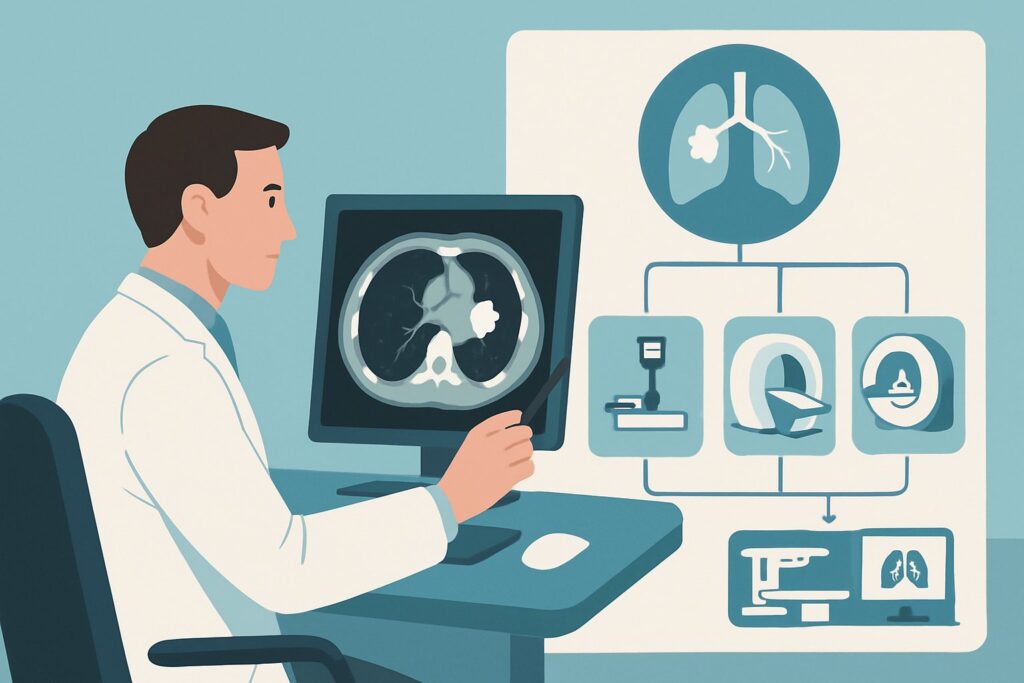
A 68-year-old patient with a 40-pack-year smoking history presents with a persistent cough and weight loss. A chest CT reveals a large, centrally located lung mass with bulky mediastinal adenopathy. Subsequent bronchoscopy and biopsy confirm the diagnosis: small-cell lung carcinoma (SCLC). You now face the critical next step that will define the entire treatment paradigm—noninvasive clinical staging. The primary goal is to determine if the patient has limited-stage or extensive-stage disease, a distinction that hinges on identifying any distant metastatic spread. For evaluating the most common site of distant metastasis, the brain, the American College of Radiology (ACR) Appropriateness Criteria rate `MRI head without and with IV contrast` as Usually Appropriate.
Who Fits This Clinical Scenario for Staging Small-Cell Lung Cancer?
This guidance applies to patients with a new, biopsy-proven diagnosis of small-cell lung carcinoma who require initial, noninvasive clinical staging before the initiation of therapy. The primary objective of this imaging workup is to accurately define the extent of the disease, which is the most important prognostic factor and the primary determinant of the therapeutic approach (chemoradiation vs. systemic chemotherapy).
This workflow is distinct from several related clinical situations:
- Non–Small-Cell Lung Carcinoma (NSCLC): While also a primary lung cancer, NSCLC has different patterns of spread, prognostic implications, and treatment algorithms. The imaging strategy, particularly the indications for PET/CT and dedicated brain imaging, can differ.
- Post-Treatment Restaging or Surveillance: This article does not cover the imaging used to assess treatment response, detect recurrence, or perform routine surveillance after therapy is complete. Those scenarios follow separate guidelines.
- Patients Unfit for Curative-Intent Therapy: For patients with very poor performance status or significant comorbidities where treatment will be palliative regardless of stage, a comprehensive and aggressive staging workup may not be clinically indicated or alter management.
What Are the Key Staging Questions for Small-Cell Lung Carcinoma?
The imaging workup for newly diagnosed SCLC is not meant to find a differential diagnosis for the primary tumor—that has been established by biopsy. Instead, the goal is to answer one fundamental question: is the disease limited or extensive? This determination relies on identifying metastatic disease at key sites.
Brain Metastases: SCLC has a high propensity for early, often asymptomatic, metastasis to the central nervous system. Up to 10-15% of patients have brain metastases at the time of their initial diagnosis. Identifying these deposits is critical, as their presence immediately classifies the disease as extensive-stage and necessitates CNS-directed therapy, such as whole-brain radiation or stereotactic radiosurgery, in addition to systemic treatment.
Thoracic Disease Extent: Accurate delineation of the primary tumor, its invasion into adjacent structures (like the chest wall or great vessels), and the extent of hilar and mediastinal lymph node involvement is crucial. For patients with limited-stage disease, this anatomical information is the foundation for planning the radiation therapy fields for curative-intent chemoradiation.
Extrathoracic Abdominal and Bony Metastases: Beyond the brain, SCLC commonly spreads to the liver, adrenal glands, and bones. The presence of a metastatic lesion in any of these locations also upstages the patient to extensive-stage disease, shifting the treatment focus from localized chemoradiation to systemic chemotherapy and immunotherapy. The staging workup must be comprehensive enough to survey these high-yield metastatic sites.
Why Is a Comprehensive Imaging Workup Recommended for Staging SCLC?
Staging small-cell lung carcinoma requires a suite of imaging studies to assess the chest, abdomen, pelvis, and brain. The ACR designates several modalities as Usually Appropriate, reflecting the need for a multi-pronged approach to accurately map the disease.
For Brain Staging: The recommended study is `MRI head without and with IV contrast`. It is rated Usually Appropriate because of its superior soft-tissue contrast and high sensitivity for detecting parenchymal brain metastases, especially small lesions that might be missed on other studies. The use of intravenous contrast is essential to identify enhancing metastatic deposits and evaluate for leptomeningeal disease. An MRI of the brain carries no ionizing radiation risk (O 0 mSv).
An alternative, `CT head with IV contrast`, is rated May be appropriate. While faster and more accessible, it is less sensitive than MRI for small metastases, particularly in the posterior fossa. It is generally reserved for patients with absolute contraindications to MRI (e.g., certain implanted devices).
For Body Staging (Chest, Abdomen, Pelvis):
The most comprehensive single imaging study is `FDG-PET/CT skull base to mid-thigh`, which is rated Usually Appropriate. This hybrid modality combines functional (metabolic) information with anatomical localization, allowing for a highly sensitive whole-body survey for nodal, visceral, and bone metastases. Its ability to detect occult metastatic sites can frequently change the patient’s stage from limited to extensive. However, it involves a significant radiation dose (☢☢☢☢ 10-30 mSv).
Alternatively, dedicated contrast-enhanced CT scans are also Usually Appropriate. This includes `CT chest with IV contrast` (☢☢☢ 1-10 mSv) and `CT abdomen and pelvis with IV contrast` (☢☢☢ 1-10 mSv). These studies provide detailed anatomical information crucial for radiation therapy planning and are excellent for evaluating the liver and adrenal glands. In many centers, the CT portion of the PET/CT is performed as a diagnostic-quality, contrast-enhanced study, effectively combining these steps into one examination.
What’s Next After Imaging? Downstream Workflow for SCLC Staging
The results of the comprehensive staging workup directly guide the subsequent therapeutic pathway. The findings are synthesized to classify the patient into one of two crucial categories.
- If Results Show Limited-Stage Disease (LSD): This is defined as cancer confined to one hemithorax, the mediastinum, and ipsilateral supraclavicular lymph nodes—a volume that can be safely encompassed within a single radiation therapy port. The standard-of-care treatment for these patients is concurrent chemoradiation with curative intent, followed by prophylactic cranial irradiation (PCI) in select cases to prevent future brain metastases.
- If Results Show Extensive-Stage Disease (ESD): This is defined by the presence of any metastatic disease outside the LSD volume. This includes metastases to the brain, bones, liver, adrenal glands, contralateral lung, or distant lymph nodes. The discovery of any such lesion shifts the treatment goal from cure to palliation and life extension. The primary treatment is systemic chemotherapy, now commonly combined with immunotherapy. Radiation therapy is used palliatively to control symptoms from specific metastatic sites (e.g., painful bone lesions or brain metastases).
- If Results Are Indeterminate: Occasionally, imaging reveals an equivocal finding, such as a solitary small adrenal nodule or a single focus of FDG uptake in a rib without a corresponding CT abnormality. In these cases, the next step may be a problem-solving study (e.g., adrenal-protocol MRI) or biopsy to confirm or exclude metastasis before committing the patient to a specific treatment pathway.
Pitfalls to Avoid (and When to Get Help)
In the rapid workup of SCLC, several common pitfalls can compromise staging accuracy and patient care.
- Omitting Brain Imaging: Given the high incidence of asymptomatic brain metastases at diagnosis, failing to perform dedicated brain imaging (preferably MRI) is a critical omission that can lead to under-staging.
- Using Non-Contrast CT for Staging: Intravenous contrast is essential for both chest/abdominal CT and head CT/MRI to properly delineate vascular structures, identify liver and adrenal metastases, and characterize enhancing brain lesions.
- Misinterpreting Post-Obstructive Pneumonitis: The primary tumor can cause bronchial obstruction, leading to atelectasis and inflammation that can be difficult to distinguish from the tumor itself on CT and can be FDG-avid on PET scans. Careful correlation across sequences is required.
If staging results are complex, equivocal, or seem discordant with the patient’s clinical picture, discussion at a multidisciplinary tumor board including pulmonologists, medical oncologists, radiation oncologists, and radiologists is the standard of care.
Related ACR Topics and Tools
This article focuses on a single clinical scenario. For a broader view of imaging for lung cancer staging, and for tools to help you implement these recommendations, please see the following resources.
- For breadth across all scenarios in Noninvasive Clinical Staging of Primary Lung Cancer, see our parent guide: Noninvasive Clinical Staging of Primary Lung Cancer: ACR Appropriateness Decoded.
- Imaging Appropriateness Selector — for adjacent scenarios
- Imaging Protocol Library — for technique on the recommended study
- Radiation Dose Calculator — for cumulative dose conversations
Frequently Asked Questions
Is PET/CT always necessary for staging small-cell lung carcinoma?
While FDG-PET/CT is rated Usually Appropriate and is highly sensitive for detecting metastatic disease, it is not mandatory in all settings. A combination of contrast-enhanced CT of the chest, abdomen, and pelvis plus a dedicated brain MRI is also an appropriate and comprehensive staging workup. The choice may depend on institutional availability and clinical factors.
Why is MRI preferred over CT for brain staging in SCLC?
MRI without and with IV contrast is significantly more sensitive than CT for detecting brain metastases, particularly small lesions, those in the posterior fossa, or non-enhancing tumors. Given the high likelihood of brain involvement in SCLC, the higher diagnostic accuracy of MRI is critical for correct staging and treatment planning.
If a patient has a contraindication to MRI, what is the next best step for brain imaging?
If a patient cannot undergo an MRI (e.g., due to an incompatible pacemaker), a `CT head without and with IV contrast` is rated May be appropriate. While less sensitive than MRI, it is the best alternative to evaluate for intracranial metastases in this situation.
Does a negative PET/CT of the head eliminate the need for a dedicated brain MRI?
No. While FDG-PET/CT imaging includes the brain, its spatial resolution and sensitivity for brain metastases are inferior to dedicated brain MRI. Standard clinical practice and guidelines recommend a separate, dedicated brain MRI for accurate CNS staging in SCLC, regardless of the PET/CT findings in the head.
What is the role of a bone scan in the initial staging of SCLC?
A whole-body radionuclide bone scan is rated May be appropriate. However, FDG-PET/CT is more sensitive for detecting both bone and soft tissue metastases and has largely replaced the bone scan as the preferred modality for assessing skeletal involvement in modern practice. A bone scan may be considered if PET/CT is unavailable.
Reviewed by Pouyan Golshani, MD, Interventional Radiologist — May 26, 2026