What Is the Right Initial Imaging for a Child with Suspected Moyamoya or Arteriopathy?
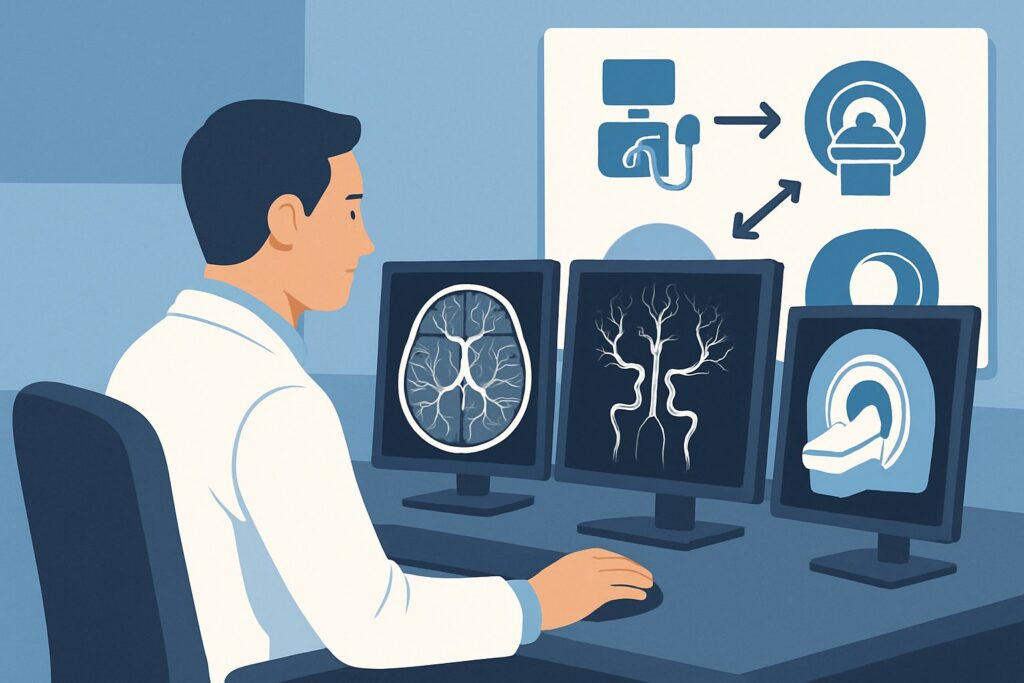
It’s late in the afternoon clinic when you see a 10-year-old with a history of recurrent, transient episodes of left-sided weakness, sometimes triggered by crying or hyperventilation. The episodes resolve spontaneously, and the child is neurologically intact on examination. Given the presentation, you suspect an underlying cerebral arteriopathy, such as moyamoya disease. This is not a hyperacute stroke presentation requiring emergent intervention, but a diagnostic workup is essential. The central question is which initial imaging study will provide the most diagnostic information with the least risk. According to the American College of Radiology (ACR) Appropriateness Criteria, for this specific scenario, MRA head without IV contrast is rated Usually Appropriate.
Who Fits This Clinical Scenario?
This guidance applies to a specific pediatric population: a child with a clinical presentation suggestive of an acute or subacute stroke where an underlying arteriopathy is known or suspected, but the patient is not a candidate for emergent treatment (e.g., thrombolysis or thrombectomy). This includes presentations like transient ischemic attacks (TIAs), fluctuating neurologic deficits, or a completed stroke outside the acute intervention window.
Key inclusion criteria for this workflow are:
- Patient: A child (infant to adolescent).
- Presentation: Symptoms suggestive of cerebral ischemia (e.g., hemiparesis, aphasia, seizure with focal deficit).
- Clinical Suspicion: High suspicion for an underlying structural vessel abnormality, such as moyamoya disease, focal cerebral arteriopathy (FCA), or dissection.
- Timing: The patient is clinically stable and not being evaluated for time-sensitive emergent intervention.
This workflow is distinct from other pediatric cerebrovascular scenarios. It does not apply to children presenting with a hyperacute stroke who may be candidates for emergent intervention, nor does it apply to cases where the primary finding is nontraumatic intraparenchymal or subarachnoid hemorrhage, which have their own dedicated diagnostic pathways.
What Diagnoses Are You Working Up in This Scenario?
When ordering imaging for a child with suspected arteriopathy, you are investigating a specific set of conditions that cause stenosis, occlusion, or structural weakness of the cerebral arteries. The differential diagnosis guides the choice of imaging modality.
Moyamoya Disease/Syndrome: This is a progressive, occlusive disease of the distal internal carotid arteries and the proximal portions of the anterior and middle cerebral arteries. The name, Japanese for “puff of smoke,” describes the appearance of the fine collateral vessels that form to compensate for the blockage. It is a primary consideration in children with recurrent TIAs or strokes, particularly in those of Asian descent, but it occurs in all populations.
Focal Cerebral Arteriopathy (FCA): Also known as transient cerebral arteriopathy, FCA is a leading cause of arterial ischemic stroke in previously healthy children. It is characterized by unilateral stenosis or occlusion of the large intracranial arteries, most commonly the distal internal carotid, proximal middle cerebral, or proximal anterior cerebral artery. The condition is often monophasic and may stabilize or resolve over time.
Central Nervous System (CNS) Vasculitis: An inflammatory process affecting the walls of blood vessels in the brain and spinal cord. It can be a primary, isolated condition or secondary to systemic infections or autoimmune disorders. The presentation can be insidious, with headaches, cognitive changes, and focal neurologic deficits. Imaging aims to identify vessel wall inflammation and resulting luminal irregularities or stenosis.
Arterial Dissection: While often associated with trauma, spontaneous cervicocranial arterial dissections can occur in children and present with stroke-like symptoms. This involves a tear in the vessel wall, leading to stenosis, occlusion, or pseudoaneurysm formation. Though less common than FCA or moyamoya as a cause of non-emergent presentations, it remains a critical diagnosis to exclude.
Why Is MRA Head Without IV Contrast the Recommended Initial Study?
The ACR designates MRA head without IV contrast as Usually Appropriate because it directly visualizes the intracranial vasculature with high resolution and without exposing the child to ionizing radiation or intravenous contrast agents. This aligns with the As Low As Reasonably Achievable (ALARA) principle, which is paramount in pediatric imaging.
The primary technique used is 3D Time-of-Flight (TOF) MRA, which leverages the flow of blood to generate arterial images. It is highly sensitive for detecting the severe stenosis characteristic of moyamoya disease and can clearly delineate the location and severity of vessel narrowing in focal cerebral arteriopathy. Simultaneously, an MRI head without IV contrast is also rated Usually Appropriate and is almost always performed concurrently. The MRI portion, particularly with Diffusion-Weighted Imaging (DWI) sequences, is exquisitely sensitive for detecting acute and subacute ischemic brain injury, providing crucial information about the parenchymal consequences of the vascular disease.
Let’s compare this to other potential studies:
- CTA head with IV contrast: Rated as May be appropriate. While CTA is fast and provides excellent vascular detail, it requires both IV contrast and significant ionizing radiation (Pediatric RRL ☢☢☢☢, 3-10 mSv). In a non-emergent setting, the superior safety profile of MRA makes it the preferred initial test.
- Arteriography cervicocerebral: Rated as Usually not appropriate for initial imaging. Digital subtraction angiography (DSA) is the gold standard for vascular imaging but is an invasive procedure with risks of vessel injury, stroke, and high radiation exposure. It is reserved for cases where noninvasive imaging is inconclusive or when endovascular intervention is being planned.
When ordering, specifying a comprehensive “MRI/MRA Brain without contrast for pediatric stroke/arteriopathy” protocol is key. This ensures the radiologist includes the necessary sequences, such as DWI for ischemia and 3D TOF MRA for vascular anatomy. Once you’ve decided on MRA head without IV contrast, our protocol guide covers the technique, contrast, and reading principles: MRA Brain Without Contrast (3D TOF).
What’s Next After MRA? Downstream Workflow
The results of the initial MRI/MRA will guide the subsequent clinical and diagnostic pathway. The goal is to move from detection to a definitive diagnosis and management plan.
- If the study is positive for moyamoya: A definitive finding of bilateral terminal internal carotid artery stenosis with prominent basal collaterals confirms the diagnosis. The immediate next steps are referral to a pediatric neurologist and a pediatric neurosurgeon with expertise in cerebrovascular disease. Further evaluation may include conventional cerebral arteriography to precisely grade the disease (using the Suzuki staging system) and to plan for surgical revascularization, which is the mainstay of treatment to prevent future strokes.
- If the study is positive for focal cerebral arteriopathy (FCA): Findings of unilateral stenosis, typically in the supraclinoid ICA or proximal MCA/ACA, suggest FCA. Management often involves antiplatelet therapy (e.g., aspirin) and close follow-up imaging in 3-6 months to assess for progression, stability, or resolution of the arteriopathy.
- If the study is negative but clinical suspicion remains high: A normal non-contrast MRA in a patient with compelling symptoms warrants further investigation. If CNS vasculitis is a concern, the next step may be an MRI/MRA of the head with IV contrast to look for vessel wall enhancement, a key sign of active inflammation. Cerebrospinal fluid analysis may also be indicated.
- If the study is indeterminate: In some cases, MRA may show subtle findings or artifacts that limit interpretation. Depending on the specific question, the next step could be a CTA for better vessel resolution or, in select cases, proceeding to conventional arteriography for definitive diagnosis.
Pitfalls to Avoid (and When to Get Help)
Navigating the workup for pediatric arteriopathy requires careful attention to detail. Here are a few common pitfalls to avoid:
- Mistaking TIA for migraine or seizure: The transient nature of symptoms in moyamoya can mimic other conditions. Maintain a high index of suspicion for an underlying vascular cause for any recurrent, focal neurologic deficit in a child.
- Not performing the parenchymal MRI: Ordering only an MRA without a full diagnostic brain MRI is a mistake. The DWI sequence is critical for identifying ischemic injury, which confirms the clinical significance of any vascular findings.
- Delaying referral for positive findings: A diagnosis of moyamoya is a neurosurgical issue. Prompt referral is essential, as timely revascularization surgery can significantly reduce the risk of future strokes and cognitive decline.
- Underestimating the need for sedation: High-quality MRI/MRA requires a motionless patient. For young children, this often necessitates sedation or general anesthesia. Plan for this in advance to avoid motion-degraded, non-diagnostic studies.
If the imaging findings are complex or do not fit a clear pattern, escalate by consulting with a pediatric neuroradiologist and a pediatric neurologist to formulate the best next steps.
Related ACR Topics and Tools
For a comprehensive overview of imaging recommendations across all pediatric cerebrovascular scenarios, this article is best used alongside its parent topic guide. For specific technical details or to explore adjacent clinical questions, the following resources provide direct access to decision support and protocol information.
- For breadth across all scenarios in Cerebrovascular Disease-Child, see our parent guide: Cerebrovascular Disease-Child: ACR Appropriateness Decoded.
- To explore other clinical presentations, use the ACR Appropriateness Criteria Lookup.
- For technical specifications on imaging studies, see the Imaging Protocol Library.
- To discuss radiation exposure with families, consult the Radiation Dose Calculator.
Frequently Asked Questions
Why is MRA without contrast preferred over MRA with contrast for this initial workup?
For this specific scenario, MRA with IV contrast is rated ‘Usually not appropriate’ by the ACR. The primary diagnostic information—visualizing the lumen of the major intracranial arteries for stenosis or occlusion—is excellently provided by non-contrast Time-of-Flight (TOF) MRA. Adding gadolinium-based contrast does not typically improve the detection of these stenotic lesions and introduces the unnecessary, albeit small, risks associated with contrast administration in children. Contrast is reserved for specific follow-up questions, such as assessing for vessel wall inflammation in suspected vasculitis.
What if the child has a contraindication to MRI, like an incompatible implanted device?
If MRI is absolutely contraindicated, the next best imaging modality is CTA head with IV contrast, which is rated ‘May be appropriate.’ While it involves radiation and IV contrast, it provides high-resolution vascular imaging that can diagnose moyamoya, FCA, and other arteriopathies. The diagnostic benefits in this situation would outweigh the risks. A non-contrast CT head would be insufficient as it does not visualize the vessel lumens.
Is transcranial Doppler (TCD) ultrasound useful in this scenario?
Transcranial Doppler (TCD) ultrasound is rated ‘Usually not appropriate’ by the ACR for the *initial diagnosis* of arteriopathy in this context. While TCD is a valuable tool for monitoring known stenosis (especially in sickle cell disease) and assessing cerebral blood flow velocities, it is operator-dependent and has lower spatial resolution than MRA or CTA. It is not considered a primary diagnostic modality for identifying the underlying anatomical cause of the stroke-like symptoms.
How does the imaging workup change if I suspect a venous sinus thrombosis instead of an arteriopathy?
Suspected cerebral venous sinus thrombosis (CVST) is a different clinical scenario requiring a different imaging protocol. The optimal study for CVST is an MRI of the head combined with a Magnetic Resonance Venogram (MRV), often performed with IV contrast to best visualize the dural venous sinuses and cortical veins. A non-contrast MRA focused on the arteries would likely miss a venous thrombosis.
Does this guidance apply to children with sickle cell disease?
While children with sickle cell disease are at high risk for stroke and moyamoya syndrome, they often fall under a separate screening and diagnostic pathway. Routine TCD screening is standard of care for children with sickle cell disease to identify those at high risk who may benefit from chronic transfusion therapy. While MRA is used to confirm suspected vasculopathy, the initial screening and management approach is unique to this population and is addressed in different guidelines.
Reviewed by Pouyan Golshani, MD, Interventional Radiologist — May 29, 2026