What’s the Best First Imaging Test for a Young Child with Suspected Osteomyelitis?
A 3-year-old presents to the emergency department with a two-day history of fever, irritability, and refusal to bear weight on her right leg. On exam, she has focal tenderness over the distal femur and resists any passive motion of the knee. Her inflammatory markers are elevated. You suspect an acute bone or joint infection—septic arthritis or osteomyelitis—but the exact location and nature are unclear. This is a time-sensitive clinical decision, as a delay in diagnosing septic arthritis can lead to permanent joint damage. The immediate question is which imaging study to order first to get the fastest, safest, and most accurate answer.
This article provides a detailed clinical workflow for this specific scenario, based on the American College of Radiology (ACR) Appropriateness Criteria. For a child under five with suspected extremity osteomyelitis or septic arthritis, an Ultrasound (US) of the area of interest is rated Usually appropriate and is often the most effective initial imaging test.
Who Fits This Clinical Scenario for Suspected Pediatric Bone Infection?
This guidance is specifically for the initial imaging workup of a child younger than five years of age presenting with acute symptoms concerning for osteomyelitis or septic arthritis in an extremity (arm or leg). The classic presentation includes fever, localized pain, swelling, limp, or pseudoparalysis (unwillingness to move a limb).
This workflow applies when you are starting the diagnostic process and no prior imaging for this specific clinical episode has been performed. The recommendations here are for the first imaging study.
This article does not apply to several similar-appearing but distinct clinical situations, which have their own recommended workflows:
- Children 5 years of age or older: The differential diagnosis and imaging considerations change as the pediatric skeleton matures. For instance, the vascular supply to the epiphysis changes, making hematogenous septic arthritis less likely to coexist with osteomyelitis.
- Axial skeleton involvement: Concerns for infection in the spine (diskitis, vertebral osteomyelitis) or pelvis (sacroiliitis) require a different imaging approach, often starting with MRI.
- Follow-up imaging: This guidance does not cover situations where initial radiographs have already been obtained and were negative or inconclusive. That represents a separate decision point in the diagnostic pathway.
What Diagnoses Are You Working Up in This Scenario?
When a young child presents with an acute limp and fever, the differential diagnosis is broad, but the primary goal of initial imaging is to distinguish between urgent surgical conditions and those managed medically. The key considerations include:
Septic Arthritis: This is the most time-sensitive diagnosis. A bacterial infection within the joint space is a true orthopedic emergency, as proteolytic enzymes can destroy articular cartilage within hours. In children under five, it often co-exists with osteomyelitis of the adjacent bone because of transphyseal blood vessels that connect the metaphysis and epiphysis.
Osteomyelitis: An infection of the bone itself, most commonly in the metaphysis of long bones due to its rich but slow-flowing sinusoidal vascular network. While also serious, it is typically managed with intravenous antibiotics, though surgical drainage may be required for abscess formation.
Transient Synovitis: A benign, self-limiting inflammation of the hip joint lining, often following a viral illness. It is a common mimic of septic arthritis and is a diagnosis of exclusion. Imaging helps differentiate it by confirming an effusion without evidence of aggressive infection.
Cellulitis or Pyomyositis: These are infections of the skin/subcutaneous tissue or muscle, respectively. They can cause significant pain and swelling that mimic a bone or joint process. Ultrasound is particularly effective at identifying and localizing these soft-tissue fluid collections.
Occult Trauma: Toddlers are prone to minor falls, and an undisplaced “toddler’s fracture” of the tibia or a physeal fracture can present with refusal to bear weight. Radiographs are essential for evaluating for a subtle fracture line.
Why Is Ultrasound the Recommended First Study for This Presentation?
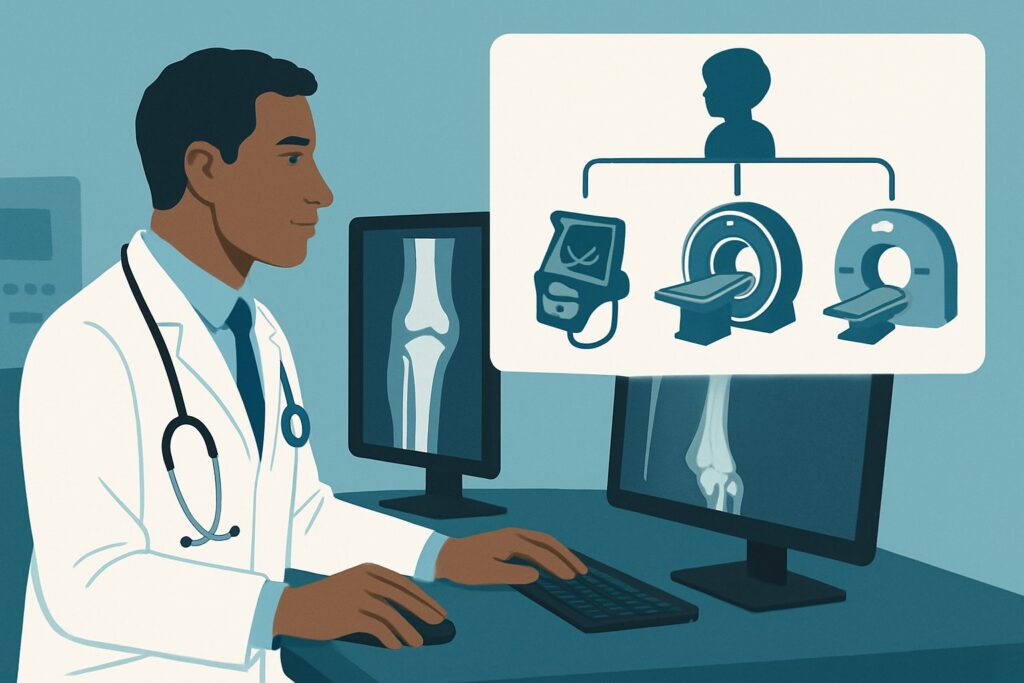
For a child under five with suspected extremity infection, both ultrasound and radiography are rated Usually appropriate by the ACR. However, ultrasound often provides the most critical information first. It directly addresses the most urgent question: is there a joint effusion that could represent septic arthritis? MRI with and without contrast is also rated Usually appropriate but is typically reserved as a second-line or problem-solving tool due to practical considerations.
The rationale for starting with ultrasound includes:
- High Sensitivity for Joint Effusion: Ultrasound is exceptionally sensitive for detecting even small amounts of fluid within a joint, which is the hallmark of septic arthritis. A positive finding can prompt immediate joint aspiration for diagnosis and treatment, dramatically altering the patient’s course.
- Detection of Early Osteomyelitis Signs: While ultrasound cannot see inside the bone marrow, it can detect early periosteal reaction and subperiosteal fluid collections or abscesses, which are specific signs of osteomyelitis that appear long before bony changes are visible on radiographs.
- No Radiation or Sedation: Ultrasound uses no ionizing radiation (0 mSv), a critical consideration in pediatric imaging. It is also a dynamic, real-time exam that can be performed quickly at the bedside without the need for sedation, which is often required for young children undergoing a lengthy MRI.
How do alternative studies compare for this initial workup?
- Radiography: Also rated Usually appropriate, radiographs are complementary and often performed concurrently with ultrasound. Their primary role is to exclude other diagnoses like fractures or bone tumors. However, they are notoriously insensitive for early osteomyelitis, as visible bone destruction (e.g., lytic lesions, periosteal reaction) may not appear for 7 to 14 days after the onset of infection.
- Magnetic Resonance Imaging (MRI): While MRI is the most sensitive and specific modality for detecting early osteomyelitis (marrow edema), it is often not the best initial test. It is more expensive, less available, and typically requires sedation or general anesthesia in children under five, which introduces risks and delays. It is an excellent problem-solving tool when ultrasound and radiographs are inconclusive.
- Computed Tomography (CT) and Bone Scans: These are rated Usually not appropriate. CT involves significant radiation (dose varies) and offers poor soft-tissue contrast for evaluating early marrow changes or joint effusions compared to US and MRI. Nuclear medicine bone scans also deliver a high radiation dose (☢☢☢☢ 3-10 mSv) and have poor anatomic detail, making it difficult to distinguish septic arthritis from osteomyelitis.
What’s Next After Ultrasound? Downstream Workflow
The results of the initial ultrasound and radiographs will guide your next steps in a branching decision tree. The goal is to rapidly confirm or exclude the most serious diagnoses.
- If the US is POSITIVE for a joint effusion: This is a critical finding. The next step is an immediate consultation with an orthopedic surgeon for consideration of diagnostic and therapeutic joint aspiration. The presence of an effusion in a febrile, ill-appearing child is treated as septic arthritis until proven otherwise.
- If the US is NEGATIVE for effusion but POSITIVE for a subperiosteal fluid collection: This is highly suggestive of osteomyelitis. The patient requires admission for intravenous antibiotics and an orthopedic consultation for possible surgical drainage. An MRI may still be ordered to define the full extent of the infection for surgical planning.
- If the US and Radiographs are both NEGATIVE, but clinical suspicion remains high: If the child continues to have fever, focal tenderness, and elevated inflammatory markers, the next step is an MRI of the area of interest with and without IV contrast. MRI is the most sensitive test for detecting early bone marrow edema characteristic of osteomyelitis before any other imaging findings appear.
- If the US is NEGATIVE and clinical symptoms are improving: If the child’s symptoms are mild and improving, and inflammatory markers are trending down, a diagnosis of transient synovitis or a resolving soft-tissue process may be considered, and observation with close follow-up may be appropriate.
Pitfalls to Avoid (and When to Get Help)
Navigating a suspected pediatric bone or joint infection requires vigilance to avoid common diagnostic traps. Be mindful of these potential pitfalls:
- Stopping with a negative radiograph: Remember that plain films can be normal for up to two weeks in early osteomyelitis. A negative radiograph does not rule out infection in a symptomatic child.
- Delaying orthopedic consultation: If septic arthritis is on the differential, involve an orthopedic surgeon early. The joint can be irreversibly damaged in a short period, and their input on the timing of aspiration or washout is crucial.
- Attributing all effusions to transient synovitis: While common, transient synovitis is a diagnosis of exclusion. In a child with systemic signs of illness (fever, high inflammatory markers), an effusion must be presumed to be septic until fluid analysis proves otherwise.
- Underestimating the need for sedation with MRI: Ordering an MRI for a toddler is a significant logistical step. Plan for sedation or anesthesia, which requires coordination with anesthesiology and appropriate pre-procedure evaluation. This reality reinforces the value of ultrasound as a non-sedated first step.
If there is any concern for joint sepsis based on clinical exam or ultrasound findings, escalate immediately to an orthopedic surgeon.
Related ACR Topics and Tools
This article covers one specific scenario in depth. For a broader view of all clinical variants and imaging modalities for this condition, please consult the parent topic article. For additional decision support and technical guidance, the following resources are available:
- For breadth across all scenarios in Osteomyelitis or Septic Arthritis-Child (Excluding Axial Skeleton), see our parent guide: Osteomyelitis or Septic Arthritis-Child (Excluding Axial Skeleton): ACR Appropriateness Decoded.
- To explore other clinical scenarios, use the ACR Appropriateness Criteria Lookup tool.
- For detailed technical parameters of the recommended studies, see the Imaging Protocol Library.
- To discuss radiation exposure with families, the Radiation Dose Calculator can help quantify and contextualize the dose from various studies.
Frequently Asked Questions
Why not just get an MRI on every young child with a limp and fever?
While MRI is the most sensitive test for early osteomyelitis, it has significant practical drawbacks as a first-line test in children under five. It requires the child to remain perfectly still for a long duration, which necessitates sedation or general anesthesia. This adds risk, cost, and logistical delays. Ultrasound is fast, requires no sedation, uses no radiation, and is excellent at answering the most urgent clinical question: is there a joint effusion concerning for septic arthritis?
What if the ultrasound is negative but my clinical suspicion remains very high?
If the ultrasound and initial radiographs are negative but the child remains febrile with focal bone tenderness and elevated inflammatory markers, the next step is an MRI with and without IV contrast. MRI can detect bone marrow edema—the earliest sign of osteomyelitis—long before other imaging modalities show any abnormalities.
Should I order radiographs along with the ultrasound?
Yes, ordering both is considered ‘Usually appropriate’ and they provide complementary information. While ultrasound is best for detecting joint fluid and soft-tissue collections, radiographs are essential for ruling out other causes of limb pain and refusal to bear weight, such as an occult fracture, bone lesion, or other osseous abnormalities.
What if I’m not sure which extremity is affected?
In cases where the child’s pain is poorly localized or there is concern for multifocal infection, a whole-body imaging study may be considered. The ACR rates ‘MRI whole body without IV contrast’ as ‘May be appropriate’ for this indication. However, for a child with a clear focal point of tenderness in one extremity, a targeted ultrasound and radiograph are the preferred initial steps.
Does the ultrasound need IV contrast?
No, a standard grayscale and color Doppler ultrasound is sufficient for the initial evaluation. This technique is highly effective for identifying joint effusions, deep soft-tissue fluid collections, and subperiosteal fluid. Contrast-enhanced ultrasound is an advanced technique not typically used for this primary indication.
Reviewed by Pouyan Golshani, MD, Interventional Radiologist — May 29, 2026