What’s the Best First Imaging Test for Suspected Renovascular Hypertension with Normal Renal Function?
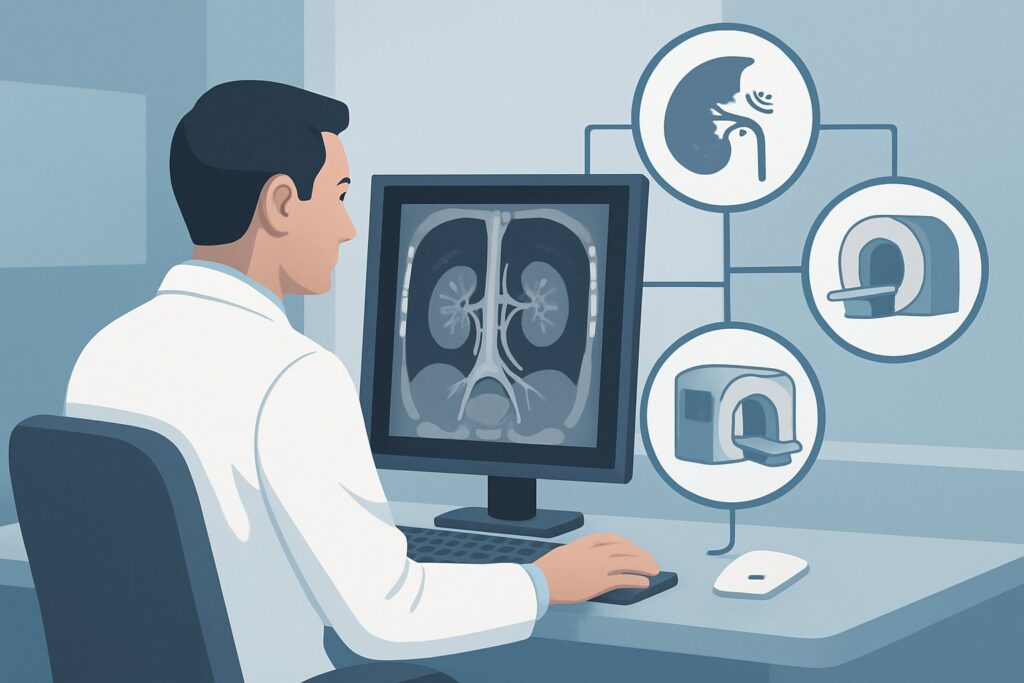
It’s late in the afternoon clinic, and you’re seeing a 45-year-old woman with new-onset, severe hypertension that has been resistant to a three-drug regimen. Her blood pressure is 180/110 mmHg despite compliance. Her labs are notable only for a normal serum creatinine and an estimated Glomerular Filtration Rate (eGFR) well above 60 mL/min/1.73 m2. Given her age and the refractory nature of her hypertension, your clinical suspicion for renovascular hypertension is high. The immediate question is which imaging study to order first to investigate for renal artery stenosis. This article provides a detailed workflow for this specific scenario, guided by the American College of Radiology (ACR) Appropriateness Criteria, which rate US duplex Doppler kidneys retroperitoneal as Usually Appropriate.
Who Fits This Clinical Scenario for Renovascular Hypertension?
This guidance applies to a well-defined patient population: individuals with a high pre-test probability for renovascular hypertension who have preserved renal function. The key inclusion criteria are:
- High Clinical Suspicion: This is not a screening test for all hypertensive patients. This workflow is for patients with clinical clues such as abrupt onset of severe hypertension (especially in patients <30 or >55 years old), hypertension resistant to three or more medications, an unexplained atrophic kidney, or recurrent episodes of flash pulmonary edema.
- Normal Renal Function: The patient should have a normal serum creatinine and an estimated Glomer Filtration Rate (eGFR) that does not indicate significant chronic kidney disease (typically an eGFR >60 mL/min/1.73 m2). This is a critical distinction, as impaired renal function changes the risk-benefit calculation for contrast-based studies.
Conversely, this workflow is not appropriate for patients with a low suspicion of renovascular disease or for those with significantly impaired renal function. Specifically, if your patient has a high suspicion of renovascular hypertension but also has an eGFR <30 mL/min/1.73 m2, they fit a different ACR variant. That scenario requires a distinct imaging strategy due to the heightened risks of gadolinium-based and iodinated contrast agents.
What Diagnoses Are You Working Up in This Scenario?
When ordering imaging for suspected renovascular hypertension, you are primarily investigating causes of renal artery stenosis (RAS), which is the anatomic prerequisite for the condition. The differential diagnosis guides the choice of imaging and interpretation of the results.
Atherosclerotic Renal Artery Stenosis (ARAS) is the most common cause, accounting for approximately 90% of cases. It is typically seen in older patients with other manifestations of atherosclerosis, such as coronary artery disease or peripheral artery disease. The stenosis is usually ostial or involves the proximal segment of the main renal artery.
Fibromuscular Dysplasia (FMD) is a non-atherosclerotic, non-inflammatory vascular disease that is a crucial consideration, especially in younger patients (under 50) and particularly women. It classically affects the mid-to-distal segments of the renal artery and can have a characteristic “string of beads” appearance on angiography. It is the second most common cause of RAS.
Renal Artery Dissection or Aneurysm are less common but consequential causes of renovascular hypertension. A spontaneous dissection can lead to acute stenosis or occlusion, while aneurysms can be associated with FMD or other connective tissue disorders. These are important to identify as their management differs significantly from atherosclerotic disease.
Extrinsic Compression is a rare cause where an external mass, such as a tumor, cyst, or retroperitoneal fibrosis, physically compresses the renal artery. While uncommon, cross-sectional imaging like CT or MRI is well-suited to identify such pathologies if they are present.
Why Is Duplex Ultrasound the Recommended Study for Suspected Renovascular Hypertension?
For a patient with a high suspicion of renovascular hypertension and normal renal function, the ACR rates US duplex Doppler kidneys retroperitoneal as Usually Appropriate. This recommendation is based on a careful balance of diagnostic accuracy, safety, and practicality.
The primary advantage of duplex ultrasound is its non-invasive nature. It uses no ionizing radiation and requires no intravenous contrast, eliminating the risks of radiation exposure and contrast-induced nephropathy. This makes it an exceptionally safe first-line test. A renal duplex study provides both anatomic and physiologic information. The grayscale (B-mode) imaging assesses kidney size and echotexture, while Doppler imaging directly measures blood flow velocities within the renal arteries. A peak systolic velocity (PSV) greater than 200 cm/s is a common criterion for identifying a hemodynamically significant stenosis (typically >60%).
While duplex ultrasound is the initial test of choice, other modalities are also highly rated for this scenario:
- CTA abdomen with IV contrast and MRA abdomen without and with IV contrast are also rated Usually Appropriate. Both provide excellent anatomic detail of the renal vasculature. However, CTA involves both ionizing radiation (1-10 mSv) and iodinated contrast. MRA avoids radiation but requires gadolinium-based contrast, which carries a risk of nephrogenic systemic fibrosis (NSF) in patients with poor renal function (though this risk is very low in the patient described here with normal function).
- Arteriography kidney is rated Usually not appropriate for initial diagnosis. While it is the gold standard for visualizing the renal arteries, it is an invasive procedure with risks of bleeding, vessel dissection, and cholesterol embolization. Its role is reserved for confirming the diagnosis after non-invasive imaging and for guiding potential endovascular intervention, such as angioplasty or stenting.
In this clinical context, starting with the safest effective test is the most prudent approach. Duplex ultrasound provides the necessary hemodynamic information to confirm or exclude significant stenosis without exposing the patient to unnecessary risks.
What’s Next After a Renal Duplex Ultrasound? Downstream Workflow
The results of the renal duplex ultrasound will guide your next steps in a branching clinical pathway. A clear, actionable plan is essential for efficient patient care.
If the study is positive for significant renal artery stenosis: A positive result, such as a peak systolic velocity >200 cm/s and a renal-aortic ratio >3.5, confirms a high-grade stenosis. The next step is typically a referral to a specialist—either an interventional radiologist, vascular surgeon, or nephrologist with expertise in renovascular disease. They will often proceed with a confirmatory study that provides better anatomic detail for intervention planning, such as CTA or MRA. In many cases, the next step may be conventional catheter angiography, which allows for both definitive diagnosis and simultaneous treatment with angioplasty and/or stenting if indicated.
If the study is negative: A technically adequate and completely negative duplex ultrasound makes hemodynamically significant renal artery stenosis highly unlikely. In this case, the focus should shift back to investigating other causes of secondary hypertension or optimizing medical management for essential hypertension. Further vascular imaging is generally not warranted unless the clinical suspicion remains exceptionally high despite the negative ultrasound.
If the study is indeterminate or technically limited: Duplex ultrasound can be limited by patient body habitus, overlying bowel gas, or operator experience. If the study is inconclusive but your clinical suspicion remains high, the next logical step is to proceed to one of the other Usually Appropriate modalities. CTA or MRA would be an excellent choice to obtain definitive anatomic imaging of the renal arteries.
Pitfalls to Avoid (and When to Get Help)
Navigating the workup for renovascular hypertension requires attention to detail to avoid common missteps. Here are several pitfalls specific to this scenario:
- Over-screening Low-Risk Patients: Do not order renal artery imaging for every patient with hypertension. The test’s utility is highest in the specific clinical contexts described earlier; its yield is very low in uncomplicated essential hypertension.
- Ignoring Technical Limitations: A “negative” report from a technically limited ultrasound is not reassuring. If the report indicates that the main renal arteries could not be fully visualized, treat it as an indeterminate study and consider proceeding to CTA or MRA if suspicion is high.
- Confusing Anatomic Stenosis with Renovascular Hypertension: The presence of an anatomic stenosis on imaging does not automatically mean it is the cause of the patient’s hypertension. The decision to intervene is complex and often requires demonstrating a hemodynamic or functional consequence of the lesion.
If the non-invasive imaging is equivocal or contradicts a strong clinical picture, it is time to escalate. A consultation with nephrology or interventional radiology can help determine the utility of further, more invasive testing like catheter angiography or renal vein renin sampling.
Related ACR Topics and Tools
For a comprehensive overview of imaging recommendations across all clinical presentations of this condition, please consult our parent guide. For other tools to assist in ordering the right imaging study, see the resources below.
- For breadth across all scenarios in Renovascular Hypertension, see our parent guide: Renovascular Hypertension: ACR Appropriateness Decoded.
- Imaging Appropriateness Selector — for adjacent scenarios
- Imaging Protocol Library — for technique on the recommended study
- Radiation Dose Calculator — for cumulative dose conversations
Frequently Asked Questions
Why not start with CTA or MRA since they are also rated ‘Usually Appropriate’?
While CTA and MRA are excellent tests, duplex ultrasound is recommended as the initial study because it is the safest option. It involves no radiation and no contrast agents, avoiding the risks associated with CTA (radiation, iodinated contrast) and MRA (gadolinium contrast). In a patient with normal renal function, the principle is to start with the safest test that can effectively answer the clinical question.
What if my patient is obese and I’m concerned the ultrasound will be technically limited?
This is a valid concern. Body habitus is a known limitation for renal duplex ultrasound. If you anticipate a high likelihood of a non-diagnostic study due to patient factors, it is reasonable to consider proceeding directly to CTA or MRA as the initial imaging test. Discussing the case with the radiology department beforehand can help select the best modality for the individual patient.
Does a normal duplex ultrasound completely rule out fibromuscular dysplasia (FMD)?
Not always. While duplex ultrasound is good at detecting stenosis in the main and proximal renal arteries, FMD often affects the mid-to-distal segments and accessory renal arteries, which can be more difficult to visualize. If clinical suspicion for FMD is very high (e.g., a young female with refractory hypertension), and the duplex is negative, CTA or MRA may be necessary for a more definitive evaluation of the entire renal arterial tree.
If the duplex shows stenosis, is intervention always the next step?
No. The decision to intervene on a renal artery stenosis is complex. Large clinical trials have shown that for many patients with atherosclerotic RAS, medical management is as effective as stenting for controlling blood pressure and preserving renal function. Intervention is typically reserved for patients with resistant hypertension, declining renal function, or flash pulmonary edema that is clearly attributable to the stenosis. The decision should be made in consultation with a specialist.
Is there any role for ACE-inhibitor renography in this scenario?
ACE-inhibitor renography is rated as ‘May be appropriate’ by the ACR for this scenario. It is a functional study that assesses the physiologic significance of a stenosis, rather than its anatomic appearance. However, its diagnostic accuracy can be variable, and it is less commonly used now that high-quality anatomic and hemodynamic data are available from ultrasound, CTA, and MRA. It also involves a small amount of radiation (1-10 mSv).
Reviewed by Pouyan Golshani, MD, Interventional Radiologist — May 26, 2026