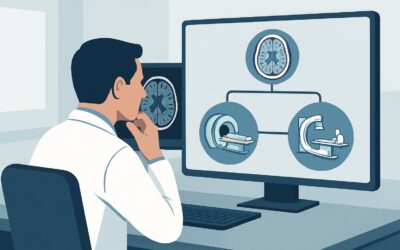
When to Order Imaging for Head Trauma: ACR Appropriateness Decoded

It’s late in the shift, and a patient presents to the emergency department after a fall. Their Glasgow Coma Scale (GCS) is 14, and you’re weighing the risks and benefits of a CT scan. Do they meet criteria? Is MRI a better option? In the evaluation of head trauma, selecting the right initial and follow-up imaging is critical for identifying life-threatening injuries while minimizing unnecessary radiation exposure. The American College of Radiology (ACR) Appropriateness Criteria offer a systematic, evidence-based framework for these decisions. This guide decodes the ACR’s recommendations for various head trauma scenarios, helping you choose the most appropriate study for your patient with confidence.
What Does the ACR Appropriateness Criteria for Head Trauma Cover?
The ACR guidelines for head trauma focus on the use of diagnostic imaging in patients who have sustained a traumatic injury to the head. The criteria are stratified by the severity of the injury, the timing of the evaluation (acute vs. subacute/chronic), and specific clinical questions that arise during patient management.
This topic covers common clinical scenarios, including:
- Initial imaging for mild, moderate, and severe acute head trauma.
- Short-term follow-up imaging for patients with both positive and negative initial scans.
- Evaluation of patients with new or worsening neurologic deficits after an injury.
- Imaging for subacute or chronic trauma presenting with cognitive or neurologic changes.
- Specialized imaging for suspected complications like vascular injury or cerebrospinal fluid (CSF) leaks.
These guidelines do not cover non-traumatic causes of neurologic symptoms, such as stroke or tumor, which are addressed in separate ACR documents. The focus is strictly on the appropriate use of imaging in the context of traumatic brain injury (TBI).
What Imaging Should I Order for Head Trauma? Recommendations by Clinical Scenario
The choice of imaging for head trauma hinges on the patient’s clinical presentation, particularly their GCS score and the presence of risk factors identified by validated clinical decision rules (e.g., Canadian CT Head Rule, PECARN). The ACR provides clear guidance for these distinct situations.
For acute, mild head trauma (GCS 13–15) where imaging is not indicated by a clinical decision rule, nearly all imaging modalities, including non-contrast head CT, are rated Usually not appropriate. The guidance emphasizes avoiding imaging in low-risk patients to prevent unnecessary radiation exposure.
However, for patients with acute, mild head trauma (GCS 13-15) where imaging is indicated by a clinical decision rule, the ACR finds CT head without IV contrast to be Usually appropriate. This is the workhorse study for rapidly identifying acute intracranial hemorrhage, skull fractures, and mass effect.
In cases of acute head trauma that is moderate (GCS 9–12), severe (GCS 3–8), or penetrating, a CT head without IV contrast is also Usually appropriate. Its speed and high sensitivity for acute life-threatening injuries make it the essential first-line imaging test in these critically ill patients.
For short-term follow-up imaging, the recommendations vary. If a patient with acute head trauma has an unchanged neurologic exam and unremarkable initial imaging, both MRI head without IV contrast and CT head without IV contrast May be appropriate. In contrast, if the patient has positive findings on initial imaging (e.g., subdural hematoma) or develops new or progressive neurologic deficits, a follow-up CT head without IV contrast is Usually appropriate to assess for evolution of the injury.
In the subacute or chronic setting for a patient with unexplained cognitive or neurologic deficits, both MRI head without IV contrast and CT head without IV contrast are considered Usually appropriate. MRI offers superior sensitivity for subtle parenchymal injuries, such as diffuse axonal injury or microhemorrhages, that may explain persistent symptoms.
When there is suspicion for a specific complication, such as an intracranial arterial injury, CTA head and neck with IV contrast is Usually appropriate. For suspected intracranial venous injury, CTV head with IV contrast is Usually appropriate. If a cerebrospinal fluid (CSF) leak is suspected, high-resolution non-contrast CT scans of the head, maxillofacial structures, or temporal bones are Usually appropriate to identify the underlying fracture.
ACR Imaging Recommendations Table for Head Trauma
| Clinical Scenario | Top Procedure | ACR Rating | Adult RRL | Pediatric RRL |
|---|---|---|---|---|
| Acute head trauma, mild (GCS 13–15), imaging not indicated by clinical decision rule. Initial imaging. | Imaging usually not appropriate | Usually not appropriate | – | – |
| Acute head trauma, mild (GCS 13-15), imaging indicated by clinical decision rule. Initial imaging. | CT head without IV contrast | Usually appropriate | ☢ ☢ ☢ 1-10 mSv | ☢ ☢ ☢ 0.3-3 mSv [ped] |
| Acute head trauma, moderate (GCS 9–12) or severe (GCS 3–8), or penetrating. Initial imaging. | CT head without IV contrast | Usually appropriate | ☢ ☢ ☢ 1-10 mSv | ☢ ☢ ☢ 0.3-3 mSv [ped] |
| Acute head trauma with unchanged neurologic examination and unremarkable initial imaging. Short-term follow-up imaging. | MRI head without IV contrast | May be appropriate | O 0 mSv | O 0 mSv [ped] |
| Acute head trauma with unchanged neurologic examination and positive finding(s) on initial imaging (eg, subdural hematoma). Short-term follow-up imaging. | CT head without IV contrast | Usually appropriate | ☢ ☢ ☢ 1-10 mSv | ☢ ☢ ☢ 0.3-3 mSv [ped] |
| Acute head trauma with new or progressive neurologic deficit(s). Short-term follow-up imaging. | CT head without IV contrast | Usually appropriate | ☢ ☢ ☢ 1-10 mSv | ☢ ☢ ☢ 0.3-3 mSv [ped] |
| Subacute or chronic head trauma with unexplained cognitive or neurologic deficit(s). Initial imaging. | MRI head without IV contrast | Usually appropriate | O 0 mSv | O 0 mSv [ped] |
| Head trauma with suspected intracranial arterial injury due to clinical risk factors or positive findings on prior imaging. | CTA head and neck with IV contrast | Usually appropriate | ☢ ☢ ☢ 1-10 mSv | ☢ ☢ ☢ ☢ 3-10 mSv [ped] |
| Head trauma with suspected intracranial venous injury due to clinical risk factors or positive findings on prior imaging. | CTV head with IV contrast | Usually appropriate | ☢ ☢ ☢ 1-10 mSv | ☢ ☢ ☢ ☢ 3-10 mSv [ped] |
| Head trauma with suspected cerebrospinal fluid (CSF) leak. Initial imaging. | CT maxillofacial/head/temporal bone without IV contrast | Usually appropriate | ☢ ☢-☢ ☢ ☢ | ☢ ☢ ☢ 0.3-3 mSv [ped] |
Adult vs. Pediatric Head Trauma Imaging: Radiation Dose Tradeoffs
Managing head trauma in children requires special consideration of radiation dose. Children’s developing tissues are more sensitive to radiation, and their longer life expectancy increases the lifetime risk of radiation-induced malignancy. The ACR guidelines reflect this by providing distinct pediatric relative radiation levels (RRLs), guided by the principle of As Low As Reasonably Achievable (ALARA).
While the recommended studies are often the same for adults and children (e.g., non-contrast CT for moderate-to-severe trauma), the threshold to image is higher in pediatrics. Validated clinical decision rules, such as the PECARN TBI prediction rule, are crucial for identifying children at very low risk of clinically important TBI who can safely avoid CT. When CT is necessary, pediatric-specific protocols that reduce the radiation dose are mandatory. As shown in the RRL data, a pediatric head CT typically involves a lower radiation dose (0.3-3 mSv) than a standard adult protocol (1-10 mSv). In non-emergent or follow-up scenarios, MRI, which involves no ionizing radiation, is often preferred in children when available and appropriate.
Imaging Protocol Details for Head Trauma
Once you’ve decided on the right study, the specific imaging protocol is essential for diagnostic quality. Our protocol guides provide detailed, practical information on technique, contrast administration, and interpretation principles for the key studies recommended in the ACR criteria for head trauma.
Tools to Help You Order the Right Study
Navigating imaging guidelines and protocols can be complex. GigHz offers a suite of reference tools designed to support clinicians in making evidence-based decisions at the point of care.
The Imaging Appropriateness Selector provides a fast, searchable interface for the full library of ACR guidelines, extending far beyond head trauma. It helps you find the right imaging test for hundreds of clinical variants.
For detailed procedural information, the Imaging Protocol Library offers concise, actionable guides for a wide range of CT, MRI, and ultrasound examinations. These protocols help ensure the study you order is performed correctly.
To help with patient communication and tracking cumulative exposure, the Radiation Dose Calculator allows you to estimate effective dose for common imaging studies, facilitating informed discussions about the risks and benefits of imaging.
Why is non-contrast CT the first-line imaging for most acute head trauma?
Non-contrast computed tomography (CT) is the primary imaging modality for acute head trauma due to its speed, wide availability, and high sensitivity for detecting acute, life-threatening conditions. It can be performed in seconds and is excellent at identifying skull fractures, acute intracranial hemorrhage (epidural, subdural, subarachnoid, and intraparenchymal), and mass effect that may require immediate neurosurgical intervention.
When should I consider MRI instead of CT for head trauma?
Magnetic resonance imaging (MRI) is generally reserved for subacute or chronic settings, or for specific clinical questions not answered by CT. It is superior for detecting non-hemorrhagic injuries like diffuse axonal injury (DAI), cortical contusions, and brainstem injuries. An MRI may be appropriate for a patient with persistent neurologic symptoms despite a negative initial CT scan, or for follow-up evaluation of known injuries to better characterize their extent and age.
What are clinical decision rules and why are they important in mild head trauma?
Clinical decision rules, such as the Canadian CT Head Rule for adults and the PECARN (Pediatric Emergency Care Applied Research Network) rule for children, are evidence-based tools that help clinicians identify patients with mild head trauma (GCS 13-15) who are at very low risk for a clinically significant brain injury. By applying these rules, clinicians can safely avoid ordering CT scans in a large number of low-risk patients, thereby reducing healthcare costs and, most importantly, minimizing unnecessary radiation exposure, particularly in children.
Is a skull X-ray (radiography) ever appropriate for head trauma?
According to the current ACR Appropriateness Criteria, skull radiography is rated as Usually not appropriate for all major head trauma scenarios. While it can detect skull fractures, it provides no information about the brain parenchyma or potential intracranial hemorrhage, which are the primary concerns. CT is far superior as it visualizes both the bone and the brain, making skull X-rays largely obsolete in the initial evaluation of significant head trauma.
Why is contrast used for CTA and CTV but not for initial trauma head CT?
Intravenous (IV) contrast is not needed for an initial trauma head CT because acute blood is hyperdense (appears bright) on non-contrast images, making it easily detectable. Adding contrast can sometimes obscure small hemorrhages. However, contrast is essential for CT angiography (CTA) and CT venography (CTV). In CTA, the contrast opacifies the arteries to look for injury, dissection, or occlusion. In CTV, the contrast is timed to opacify the dural venous sinuses and cerebral veins to look for thrombosis or injury.
Frequently Asked Questions
Why is non-contrast CT the first-line imaging for most acute head trauma?
Non-contrast computed tomography (CT) is the primary imaging modality for acute head trauma due to its speed, wide availability, and high sensitivity for detecting acute, life-threatening conditions. It can be performed in seconds and is excellent at identifying skull fractures, acute intracranial hemorrhage (epidural, subdural, subarachnoid, and intraparenchymal), and mass effect that may require immediate neurosurgical intervention.
When should I consider MRI instead of CT for head trauma?
Magnetic resonance imaging (MRI) is generally reserved for subacute or chronic settings, or for specific clinical questions not answered by CT. It is superior for detecting non-hemorrhagic injuries like diffuse axonal injury (DAI), cortical contusions, and brainstem injuries. An MRI may be appropriate for a patient with persistent neurologic symptoms despite a negative initial CT scan, or for follow-up evaluation of known injuries to better characterize their extent and age.
What are clinical decision rules and why are they important in mild head trauma?
Clinical decision rules, such as the Canadian CT Head Rule for adults and the PECARN (Pediatric Emergency Care Applied Research Network) rule for children, are evidence-based tools that help clinicians identify patients with mild head trauma (GCS 13-15) who are at very low risk for a clinically significant brain injury. By applying these rules, clinicians can safely avoid ordering CT scans in a large number of low-risk patients, thereby reducing healthcare costs and, most importantly, minimizing unnecessary radiation exposure, particularly in children.
Is a skull X-ray (radiography) ever appropriate for head trauma?
According to the current ACR Appropriateness Criteria, skull radiography is rated as Usually not appropriate for all major head trauma scenarios. While it can detect skull fractures, it provides no information about the brain parenchyma or potential intracranial hemorrhage, which are the primary concerns. CT is far superior as it visualizes both the bone and the brain, making skull X-rays largely obsolete in the initial evaluation of significant head trauma.
Why is contrast used for CTA and CTV but not for initial trauma head CT?
Intravenous (IV) contrast is not needed for an initial trauma head CT because acute blood is hyperdense (appears bright) on non-contrast images, making it easily detectable. Adding contrast can sometimes obscure small hemorrhages. However, contrast is essential for CT angiography (CTA) and CT venography (CTV). In CTA, the contrast opacifies the arteries to look for injury, dissection, or occlusion. In CTV, the contrast is timed to opacify the dural venous sinuses and cerebral veins to look for thrombosis or injury.
Reviewed by Pouyan Golshani, MD, Interventional Radiologist — June 27, 2026