When to Order Imaging for Palpable Abdominal Mass-Suspected Neoplasm: ACR Appropriateness Decoded
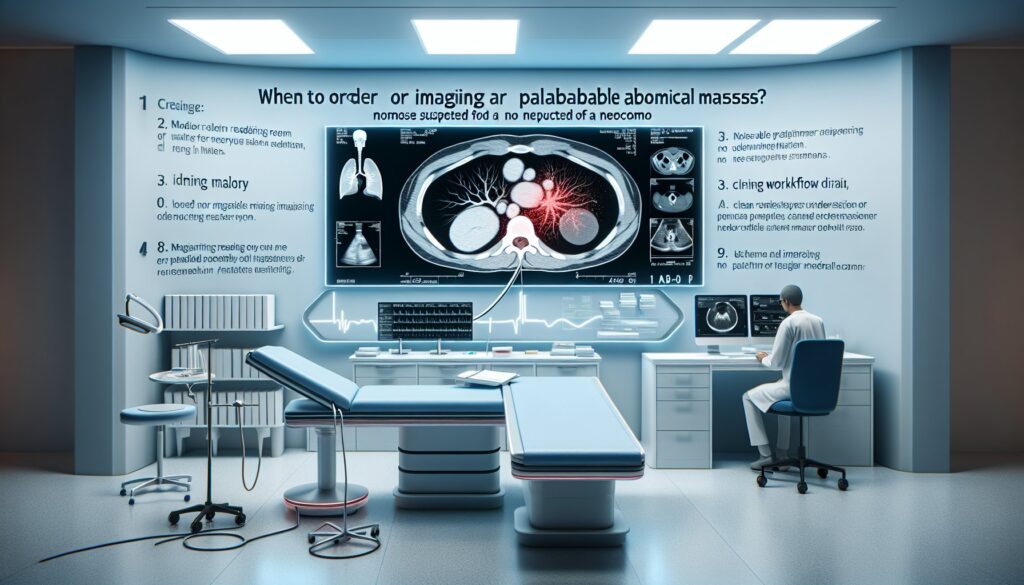
You’re on a busy shift when you’re called to evaluate a patient with a newly discovered palpable abdominal mass. The differential is broad, but neoplasm is high on the list. The immediate question is which imaging study to order first. Do you start with a quick, non-ionizing ultrasound, or go straight to a contrast-enhanced Computed Tomography (CT) scan for a more comprehensive view? The patient’s age, comorbidities, and the specific location of the mass all factor into the decision. This guide breaks down the American College of Radiology (ACR) Appropriateness Criteria for this common clinical scenario, providing a clear, evidence-based framework to help you choose the right initial imaging study confidently and efficiently.
What Does ACR Palpable Abdominal Mass-Suspected Neoplasm Cover?
The ACR Appropriateness Criteria for “Palpable Abdominal Mass-Suspected Neoplasm” provide guidance for the initial, non-invasive diagnostic imaging of a patient who presents with a mass discovered on physical examination. This guideline is intended for situations where a new, previously undiagnosed mass is found, and the clinical suspicion points towards a potential tumor, whether benign or malignant.
The criteria are divided into two primary clinical variants based on the suspected location of the mass:
- Suspected Intra-abdominal Neoplasm: This applies when the mass is thought to originate from an organ or structure within the peritoneal cavity, such as the liver, spleen, pancreas, kidneys, bowel, or mesentery.
- Suspected Abdominal Wall Mass: This applies when the mass is believed to arise from the layers of the abdominal wall itself, including the skin, subcutaneous fat, fascia, or muscle.
These guidelines do not cover the workup of a known or previously characterized mass, surveillance imaging for a diagnosed malignancy, or evaluation of masses in the setting of acute trauma or infection where neoplasm is not the primary concern.
What Imaging Should I Order for Palpable Abdominal Mass-Suspected Neoplasm? Recommendations by Clinical Scenario
The ACR provides specific recommendations tailored to the suspected location of the palpable mass. The choice of initial imaging aims to confirm the presence of a mass, determine its organ of origin, characterize its features, and guide subsequent management, all while considering factors like radiation exposure and cost.
For a Palpable abdominal mass with a suspected intra-abdominal neoplasm, both Ultrasound (US) abdomen and CT abdomen with IV contrast are rated as “Usually Appropriate.” Ultrasound is an excellent initial modality due to its lack of ionizing radiation, wide availability, and ability to differentiate cystic from solid masses. It is particularly effective for evaluating organs like the liver, gallbladder, and kidneys. CT with IV contrast provides a comprehensive, global view of the abdomen, offering superior detail for characterizing solid organ masses, assessing vascular involvement, and detecting metastatic disease. The choice between them often depends on patient factors (age, renal function) and the suspected organ of origin.
In this same scenario, MRI abdomen without and with IV contrast and MRI abdomen without IV contrast are rated “May be Appropriate.” MRI offers outstanding soft-tissue contrast and is a valuable problem-solving tool, especially for characterizing liver lesions or when the patient has a contraindication to iodinated contrast. A non-contrast CT is also “May be Appropriate,” typically reserved for patients with severe contrast allergies or renal failure, or if the primary goal is to detect calcification or hemorrhage.
For a Palpable abdominal mass with a suspected abdominal wall mass, the recommendations shift slightly to favor modalities with high soft-tissue resolution. US abdomen remains “Usually Appropriate” as a first-line tool to quickly confirm a superficial mass and assess its characteristics. In this context, MRI abdomen without and with IV contrast is also “Usually Appropriate.” MRI is the gold standard for evaluating soft-tissue masses, providing detailed anatomical information about the mass’s relationship to the muscle and fascial planes. CT abdomen with IV contrast is also “Usually Appropriate” and can clearly define the extent of a mass, particularly if there is concern for bone involvement or deep extension into the peritoneal cavity.
ACR Imaging Recommendations Table
| Clinical Scenario | Top Procedure(s) | ACR Rating | Adult RRL | Pediatric RRL |
|---|---|---|---|---|
| Palpable abdominal mass. Suspected intra-abdominal neoplasm. Initial imaging. | US abdomen CT abdomen with IV contrast |
Usually appropriate Usually appropriate |
O 0 mSv ☢ ☢ ☢ 1-10 mSv |
O 0 mSv [ped] ☢ ☢ ☢ ☢ 3-10 mSv [ped] |
| Palpable abdominal mass. Suspected abdominal wall mass. Initial imaging. | US abdomen MRI abdomen without and with IV contrast CT abdomen with IV contrast |
Usually appropriate Usually appropriate Usually appropriate |
O 0 mSv O 0 mSv ☢ ☢ ☢ 1-10 mSv |
O 0 mSv [ped] O 0 mSv [ped] ☢ ☢ ☢ ☢ 3-10 mSv [ped] |
Adult vs. Pediatric Palpable Abdominal Mass-Suspected Neoplasm Imaging: Radiation Dose Tradeoffs
When evaluating a palpable abdominal mass in a pediatric patient, minimizing exposure to ionizing radiation is a critical priority. Children are more radiosensitive than adults, and their longer life expectancy increases the lifetime risk of radiation-induced malignancy. This principle, known as As Low As Reasonably Achievable (ALARA), heavily influences the ACR’s pediatric recommendations.
For this reason, Ultrasound (US) abdomen is strongly favored as the initial imaging modality in children for both suspected intra-abdominal and abdominal wall masses. It is radiation-free, non-invasive, and highly effective for evaluating common pediatric abdominal masses like Wilms tumor or neuroblastoma. If further characterization is needed, MRI abdomen without and with IV contrast is often the next step, as it also avoids ionizing radiation while providing excellent soft-tissue detail. CT is generally reserved for specific indications, such as pre-operative planning, assessing for calcifications, or when MRI is not feasible. When CT is necessary, pediatric-specific low-dose protocols must be used to mitigate radiation risk, as reflected in the different Relative Radiation Level (RRL) ratings provided by the ACR for pediatric patients.
Imaging Protocol Details for Palpable Abdominal Mass-Suspected Neoplasm
Once you’ve decided on the right study based on the ACR criteria, ensuring it is performed correctly is the next critical step. The diagnostic yield of a CT or MRI scan depends heavily on the specific protocol used, including contrast timing, slice thickness, and acquisition phases. Our protocol guides provide detailed, practical information for executing these studies.
Tools to Help You Order the Right Study
Navigating imaging guidelines and radiation safety can be complex. GigHz offers a suite of free reference tools designed to support clinical decision-making at the point of care.
For scenarios beyond a palpable abdominal mass, the Imaging Appropriateness Selector provides a searchable interface to the full library of ACR guidelines, helping you find evidence-based recommendations for hundreds of clinical variants.
To ensure the chosen study is performed to the highest standard, our Imaging Protocol Library offers detailed, step-by-step technical guidance for a wide range of CT and MRI examinations.
When discussing radiation exposure with patients or tracking cumulative dose, the Radiation Dose Calculator is a valuable resource for estimating effective dose from various imaging studies and communicating these risks in an understandable way.
Frequently Asked Questions
Why is ultrasound often a first-line choice for a palpable abdominal mass?
Ultrasound is frequently recommended as the initial imaging study because it is non-invasive, widely available, relatively inexpensive, and uses no ionizing radiation. This makes it particularly safe for pediatric patients and pregnant women. It is excellent for determining if a mass is cystic or solid, assessing its vascularity with Doppler, and guiding biopsies if necessary. For superficial (abdominal wall) masses or masses related to the gallbladder, liver, or kidneys, ultrasound often provides sufficient diagnostic information to guide the next steps in management.
When should I choose CT over MRI for a suspected intra-abdominal mass?
CT with IV contrast is often preferred over MRI for the initial evaluation of an intra-abdominal mass when speed and accessibility are critical, such as in an emergency department setting. CT provides a rapid, comprehensive overview of the entire abdomen and pelvis, making it highly effective for identifying the organ of origin, detecting metastatic disease, and evaluating vascular involvement. It is also superior to MRI for detecting calcifications within a mass and is generally better tolerated by claustrophobic or unstable patients.
Why is MRI rated higher for a suspected abdominal wall mass than for an intra-abdominal one?
For a suspected abdominal wall mass, MRI is rated “Usually Appropriate” because of its superior soft-tissue contrast resolution. It can precisely delineate the extent of a mass within the layers of the abdominal wall (skin, fat, muscle, fascia) and its relationship to adjacent structures without ionizing radiation. For a suspected intra-abdominal mass, MRI is rated “May be Appropriate” as a first-line study. While it is an excellent problem-solving tool (especially for liver and kidney lesions), CT and ultrasound are often more practical for the initial global assessment of the entire abdominal cavity.
Is a non-contrast CT ever sufficient for evaluating a palpable abdominal mass?
A non-contrast CT is rated “May be Appropriate” and can be sufficient in specific situations. It is the primary choice for patients with severe contraindications to IV contrast, such as advanced chronic kidney disease or a history of anaphylaxis to iodinated contrast. A non-contrast study is also useful when the main clinical question is the presence of calcification, fat, or acute hemorrhage within a mass, as these can be obscured by contrast.
Why is a standard abdominal radiograph (X-ray) “Usually Not Appropriate”?
A standard abdominal radiograph, or X-ray, is rated “Usually Not Appropriate” because it has very low sensitivity for detecting and characterizing soft-tissue masses. While it can identify secondary signs like organ displacement, abnormal gas patterns, or large calcifications, it cannot directly visualize most abdominal neoplasms. Cross-sectional imaging modalities like CT, MRI, or ultrasound provide far more detailed anatomical information and are the standard of care for evaluating a suspected abdominal neoplasm.
Reviewed by Pouyan Golshani, MD, Interventional Radiologist — May 26, 2026