When to Order Imaging for Pulsatile Abdominal Mass, Suspected Abdominal Aortic Aneurysm: ACR Appropriateness Decoded

A patient presents to the emergency department with a newly discovered pulsatile abdominal mass. They are hemodynamically stable, but the clinical suspicion for an abdominal aortic aneurysm (AAA) is high. The immediate question is which imaging study to order first. Should you start with a rapid, non-ionizing ultrasound at the bedside, or proceed directly to a Computed Tomography Angiography (CTA) for more detailed anatomical information? This decision involves balancing diagnostic speed, radiation exposure, and the need for potential pre-procedural planning. This article provides a clear, scannable guide to the American College of Radiology (ACR) Appropriateness Criteria for the initial imaging of a suspected AAA, helping you make an evidence-based choice for your patient.
What Does ACR Pulsatile Abdominal Mass, Suspected Abdominal Aortic Aneurysm Cover?
The ACR Appropriateness Criteria for “Pulsatile Abdominal Mass, Suspected Abdominal Aortic Aneurysm” focus specifically on the initial diagnostic imaging for a patient in whom a new, previously undiagnosed AAA is suspected based on physical examination. This guidance is intended for hemodynamically stable patients where the primary goal is to confirm the presence of an aneurysm, determine its size, and characterize its extent.
This topic does not cover:
- Screening for AAA in asymptomatic, at-risk populations (e.g., older male smokers).
- Surveillance of a known AAA to monitor for interval growth.
- Evaluation of a suspected ruptured AAA in a hemodynamically unstable patient, which represents a surgical emergency with its own distinct imaging and management pathway.
- Post-operative or post-endovascular repair follow-up.
Understanding this scope ensures that the recommendations are applied to the correct clinical context, guiding the selection of the most appropriate first imaging test.
What Imaging Should I Order for Pulsatile Abdominal Mass, Suspected Abdominal Aortic Aneurysm? Recommendations by Clinical Scenario
For the initial imaging of a patient with a pulsatile abdominal mass and suspected abdominal aortic aneurysm, the ACR provides several options rated as “Usually Appropriate,” reflecting different clinical priorities and patient factors.
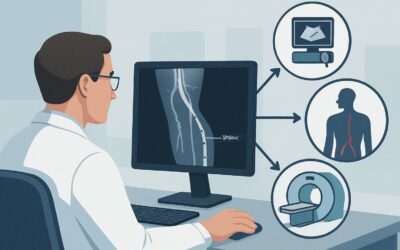
Ultrasound (US) is rated Usually Appropriate and is often the ideal first-line imaging modality. Abdominal aortic ultrasound is non-invasive, uses no ionizing radiation, is widely available, and can be performed quickly at the bedside. It is highly accurate for detecting the presence of an AAA and measuring its maximal anteroposterior and transverse diameters, which are critical for diagnosis and initial risk stratification.
Computed Tomography Angiography (CTA) of the abdomen and pelvis (with or without non-contrast images) is also rated Usually Appropriate. CTA provides a comprehensive assessment of the aorta, including the aneurysm’s size, length, neck characteristics, and relationship to branch vessels like the renal and iliac arteries. This level of detail is essential for pre-operative or pre-endovascular planning. While it involves significant ionizing radiation (☢ ☢ ☢ ☢), its speed and detailed vascular mapping make it the preferred modality if the patient is stable and intervention is being actively considered.
Magnetic Resonance Angiography (MRA) of the abdomen and pelvis (with or without contrast) is another Usually Appropriate option. MRA provides excellent vascular detail comparable to CTA without using ionizing radiation. It is a strong alternative for patients with contraindications to iodinated contrast, such as severe allergy or significant renal impairment. However, MRA is less widely available, takes longer to perform, and may be limited by patient factors like claustrophobia or incompatible metallic implants.
Modalities rated as May Be Appropriate, such as non-angiographic CT or MRI of the abdomen and pelvis, may be considered if the clinical question is less specific or if an aneurysm is suspected incidentally. However, they are not optimized for the detailed vascular assessment provided by CTA or MRA.
Studies rated Usually Not Appropriate for this indication include conventional aortography, abdominal radiography, intravascular ultrasound (IVUS), and FDG-PET/CT. These studies are either too invasive for initial diagnosis (aortography, IVUS), lack the necessary diagnostic sensitivity (radiography), or are designed for different clinical questions (FDG-PET/CT for inflammation/infection).
ACR Imaging Recommendations Table
| Clinical Scenario | Procedure | ACR Rating | Adult RRL | Pediatric RRL |
|---|---|---|---|---|
| Pulsatile abdominal mass, suspected abdominal aortic aneurysm. Initial imaging. | US aorta abdomen | Usually appropriate | O 0 mSv | O 0 mSv [ped] |
| MRA abdomen and pelvis with IV contrast | Usually appropriate | O 0 mSv | O 0 mSv [ped] | |
| MRA abdomen and pelvis without and with IV contrast | Usually appropriate | O 0 mSv | O 0 mSv [ped] | |
| MRA abdomen and pelvis without IV contrast | Usually appropriate | O 0 mSv | O 0 mSv [ped] | |
| CTA abdomen and pelvis with IV contrast | Usually appropriate | ☢ ☢ ☢ ☢ 10-30 mSv | ||
| CTA abdomen and pelvis without and with IV contrast | Usually appropriate | ☢ ☢ ☢ ☢ 10-30 mSv | ||
| MRI abdomen and pelvis with IV contrast | May be appropriate | O 0 mSv | O 0 mSv [ped] | |
| MRI abdomen and pelvis without and with IV contrast | May be appropriate | O 0 mSv | O 0 mSv [ped] | |
| MRI abdomen and pelvis without IV contrast | May be appropriate | O 0 mSv | O 0 mSv [ped] | |
| CT abdomen and pelvis with IV contrast | May be appropriate | ☢ ☢ ☢ 1-10 mSv | ☢ ☢ ☢ ☢ 3-10 mSv [ped] | |
| CT abdomen and pelvis without IV contrast | May be appropriate | ☢ ☢ ☢ 1-10 mSv | ☢ ☢ ☢ ☢ 3-10 mSv [ped] | |
| CT abdomen and pelvis without and with IV contrast | May be appropriate | ☢ ☢ ☢ ☢ 10-30 mSv | ☢ ☢ ☢ ☢ ☢ 10-30 mSv [ped] | |
| US intravascular aorta abdomen | Usually not appropriate | O 0 mSv | O 0 mSv [ped] | |
| Aortography abdomen | Usually not appropriate | ☢ ☢ ☢ 1-10 mSv | ||
| Radiography abdomen and pelvis | Usually not appropriate | ☢ ☢ ☢ 1-10 mSv | ☢ ☢ ☢ 0.3-3 mSv [ped] | |
| FDG-PET/CT skull base to mid-thigh | Usually not appropriate | ☢ ☢ ☢ ☢ 10-30 mSv | ☢ ☢ ☢ ☢ 3-10 mSv [ped] |
Adult vs. Pediatric Pulsatile Abdominal Mass, Suspected Abdominal Aortic Aneurysm Imaging: Radiation Dose Tradeoffs
Abdominal aortic aneurysms are exceedingly rare in the pediatric population and are typically associated with underlying connective tissue disorders (e.g., Marfan syndrome, Ehlers-Danlos syndrome), vasculitis (e.g., Kawasaki disease, Takayasu arteritis), or trauma. When a pulsatile abdominal mass is encountered in a child or adolescent, the principle of ALARA (As Low As Reasonably Achievable) is paramount due to their increased lifetime risk from ionizing radiation.
For this reason, non-ionizing modalities like ultrasound and MRA are strongly preferred as the initial imaging tests in pediatric patients. Ultrasound is an excellent first step to confirm or exclude an aneurysm without any radiation. If advanced cross-sectional imaging is required for anatomical detail or surgical planning, MRA is the preferred modality over CTA. CT should be reserved for situations where MRA is unavailable or contraindicated, or in emergent settings where speed is critical. When CT is necessary, protocols must be tailored to the pediatric patient to minimize the radiation dose.
Imaging Protocol Details for Pulsatile Abdominal Mass, Suspected Abdominal Aortic Aneurysm
Once you’ve decided on the right study, the specific imaging protocol is critical for obtaining diagnostic-quality images. Key considerations include the timing of intravenous contrast, the field of view, and the specific sequences or reconstructions needed for accurate measurement and characterization. Our protocol guides provide detailed, practical information for technologists and radiologists to ensure studies are performed correctly.
Tools to Help You Order the Right Study
Navigating imaging guidelines and protocols can be complex. GigHz offers a suite of reference tools designed to support clinicians in making evidence-based decisions, communicating with patients about radiation, and accessing detailed procedural information quickly.
The Imaging Appropriateness Selector provides direct access to the full ACR guidelines for thousands of clinical scenarios beyond suspected AAA, helping you choose the right test for virtually any presentation. It simplifies the process of finding the most current, evidence-based recommendations.
For detailed procedural steps, our Imaging Protocol Library offers comprehensive guides for a wide range of CT, MRI, and ultrasound examinations. These protocols are designed for radiology trainees and technologists to ensure studies are optimized for the clinical question at hand.
When discussing studies that involve ionizing radiation, the Radiation Dose Calculator is an invaluable tool. It helps you estimate and track cumulative radiation exposure for your patients, facilitating informed consent conversations and reinforcing the principles of radiation safety.
Frequently Asked Questions
What is the best first imaging test for a suspected AAA?
For a hemodynamically stable patient, abdominal ultrasound is the best initial test. It is fast, accurate for diagnosis and measurement, uses no radiation, and is widely available. If the patient is unstable or if surgical planning is immediately required, CTA is often the preferred modality.
Why is CTA preferred over MRA for pre-operative planning if both are “Usually Appropriate”?
CTA is generally faster, more widely available, and less susceptible to motion artifact than MRA. It provides robust, high-resolution images of the aorta and its branches that surgeons and interventional radiologists are very familiar with for planning both open and endovascular repairs. MRA is an excellent alternative, especially if there are contraindications to iodinated contrast, but logistical factors often favor CTA.
Can a plain abdominal X-ray diagnose an AAA?
While a plain radiograph may incidentally show curvilinear calcification in the wall of a large, chronic aneurysm (the “calcified aorta” sign), it is not a sensitive or reliable method for diagnosing an AAA. Many aneurysms are not calcified, and the study provides no information on size or extent. For this reason, it is rated “Usually Not Appropriate” for this clinical indication.
When would a non-contrast CT be ordered for a suspected AAA?
A non-contrast CT of the abdomen and pelvis might be ordered if the clinical suspicion for AAA is low and the pulsatile mass could be due to another cause. It can also be useful as part of a CTA protocol (non-contrast followed by contrast-enhanced phases) to identify intramural hematoma or calcifications, which can be important for planning endovascular repair.
What is the size threshold for considering AAA repair?
The decision to repair an AAA is complex and depends on aneurysm size, growth rate, patient comorbidities, and life expectancy. Generally, repair is considered for asymptomatic aneurysms when the diameter reaches 5.5 cm in men or 5.0 cm in women, as the risk of rupture increases significantly above these thresholds. Any symptomatic or rapidly expanding aneurysm typically warrants repair regardless of size.
Reviewed by Pouyan Golshani, MD, Interventional Radiologist — May 26, 2026