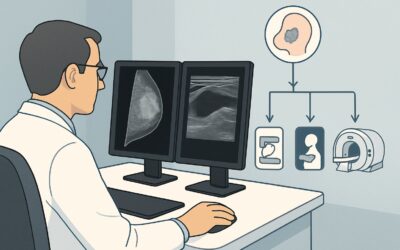
When to Order Imaging for Stage I Breast Cancer: Initial Workup and Surveillance for Local Recurrence and Distant Metastases in Asymptomatic Women: ACR Appropriateness Decoded

You are managing a patient newly diagnosed with Stage I breast cancer. She is asymptomatic, but both you and the patient are anxious about the possibility of metastatic disease. The impulse to order a full-body scan is strong, but is it the right call? For early-stage, asymptomatic breast cancer, extensive imaging for distant metastases can lead to unnecessary radiation exposure, false positives, and patient anxiety without improving outcomes. The American College of Radiology (ACR) provides clear, evidence-based guidelines to navigate this common clinical scenario, distinguishing between the low utility of systemic staging at diagnosis and the crucial role of targeted surveillance for local recurrence over time. This article decodes those recommendations to help you order the right study at the right time.
What Does ACR Stage I Breast Cancer: Initial Workup and Surveillance for Local Recurrence and Distant Metastases in Asymptomatic Women Cover?
This ACR Appropriateness Criteria topic addresses two distinct clinical phases for asymptomatic women with pathologic Stage I (T1, N0, M0) breast cancer. First, it covers the initial workup immediately following diagnosis, specifically evaluating the need for imaging to rule out distant metastases in the bones, chest, abdomen, or brain. Second, it provides guidance on routine surveillance imaging after primary treatment is complete, focusing on detecting local recurrence within the breast tissue and the separate question of screening for distant metastases in the absence of symptoms.
These guidelines apply exclusively to asymptomatic patients. They do not apply to patients with clinical Stage I disease who have signs or symptoms concerning for metastatic spread (e.g., new bone pain, persistent cough, unexplained weight loss, or neurologic symptoms). The recommendations also do not cover symptomatic patients during the surveillance period, nor do they apply to patients with higher-stage (Stage II or greater) breast cancer, where the pretest probability of distant disease is higher and imaging recommendations differ significantly.
What Imaging Should I Order for Stage I Breast Cancer: Initial Workup and Surveillance for Local Recurrence and Distant Metastases in Asymptomatic Women? Recommendations by Clinical Scenario
For a newly diagnosed, asymptomatic patient with Stage I breast cancer, the ACR guidance is unequivocal: systemic imaging to search for distant metastases is not indicated. The likelihood of finding occult metastatic disease is extremely low and does not justify the risks and costs of imaging. For scenarios involving an initial workup to rule out bone, thoracic, abdominal, or brain metastases, the ACR rates all common imaging modalities as Usually not appropriate. This includes whole-body bone scans, FDG-PET/CT, chest radiography, CT scans of the chest, abdomen, and head, and MRI of the abdomen and brain. The consensus is that in this low-risk population, such imaging offers minimal benefit and can lead to a cascade of further unnecessary testing.
The approach to surveillance in asymptomatic women post-treatment is bifurcated. For surveillance to rule out distant metastases (bone, thoracic, abdominal, and brain), the recommendation remains the same as the initial workup. All systemic imaging modalities, from chest radiography and skeletal surveys to CT, MRI, and PET/CT, are rated Usually not appropriate. Routine systemic screening has not been shown to improve survival or quality of life.
In contrast, for surveillance to rule out local recurrence in the breast, imaging is essential. For this scenario, the ACR rates annual screening mammography or digital breast tomosynthesis as Usually appropriate. These studies are the cornerstone of post-treatment surveillance for detecting new primary cancers or local recurrences. In certain clinical situations, such as in patients with dense breast tissue or a high-risk profile, supplemental imaging may be considered. For these patients, bilateral breast ultrasound and bilateral breast MRI without and with IV contrast are rated as May be appropriate. A breast MRI performed without IV contrast is considered Usually not appropriate for this indication.
ACR Imaging Recommendations Table
| Clinical Scenario | Procedure | ACR Rating | Adult RRL | Pediatric RRL |
|---|---|---|---|---|
| Newly diagnosed. Stage I breast cancer. Asymptomatic. Rule out bone metastases. Initial imaging. | Bone scan whole body | Usually not appropriate | ☢ ☢ ☢ 1-10 mSv | ☢ ☢ ☢ ☢ 3-10 mSv [ped] |
| Newly diagnosed. Stage I breast cancer. Asymptomatic. Rule out thoracic metastases. Initial imaging. | CT chest with IV contrast | Usually not appropriate | ☢ ☢ ☢ 1-10 mSv | ☢ ☢ ☢ ☢ 3-10 mSv [ped] |
| Newly diagnosed. Stage I breast cancer. Asymptomatic. Rule out abdominal metastases. Initial imaging. | CT abdomen with IV contrast | Usually not appropriate | ☢ ☢ ☢ 1-10 mSv | ☢ ☢ ☢ ☢ 3-10 mSv [ped] |
| Newly diagnosed. Stage I breast cancer. Asymptomatic. Rule out brain metastases. Initial imaging. | MRI head without and with IV contrast | Usually not appropriate | O 0 mSv | O 0 mSv [ped] |
| Surveillance. Stage I breast cancer. Asymptomatic. Rule out bone, thoracic, abdominal, and brain metastases. | FDG-PET/CT whole body | Usually not appropriate | ☢ ☢ ☢ ☢ 10-30 mSv | ☢ ☢ ☢ ☢ 3-10 mSv [ped] |
| Surveillance. Stage I breast cancer. Asymptomatic. Rule out local recurrence. | Mammography screening | Usually appropriate | ☢ ☢ 0.1-1mSv | |
| Surveillance. Stage I breast cancer. Asymptomatic. Rule out local recurrence. | MRI breast without and with IV contrast bilateral | May be appropriate | O 0 mSv | O 0 mSv [ped] |
Adult vs. Pediatric Stage I Breast Cancer: Initial Workup and Surveillance for Local Recurrence and Distant Metastases in Asymptomatic Women Imaging: Radiation Dose Tradeoffs
While Stage I breast cancer is exceedingly rare in the pediatric and adolescent population, the ACR provides pediatric-specific relative radiation level (RRL) estimates for completeness. These guidelines underscore the critical importance of the As Low As Reasonably Achievable (ALARA) principle, which is paramount in younger patients due to their increased radiosensitivity and longer life expectancy, which allows more time for potential long-term effects of radiation to manifest. For any imaging involving ionizing radiation, such as CT scans, bone scans, or radiography, the cumulative dose over a patient’s lifetime is a significant consideration. The pediatric RRLs are often in a higher tier than their adult counterparts for the same study, reflecting the greater potential risk per unit of radiation. This reinforces the recommendation to avoid unnecessary systemic imaging in low-risk scenarios. For non-ionizing studies like MRI and ultrasound, which have an RRL of zero, radiation is not a concern, but factors like the need for sedation in very young patients and the use of gadolinium-based contrast agents still require careful consideration.
Imaging Protocol Details for Stage I Breast Cancer: Initial Workup and Surveillance for Local Recurrence and Distant Metastases in Asymptomatic Women
Once you’ve decided on the right study, the protocol matters. For the key imaging modalities discussed in these guidelines, precise technical execution is essential for diagnostic accuracy. Our protocol guides cover technique, contrast administration, patient positioning, and interpretation principles for the studies relevant to breast cancer surveillance.
- MRI Breast With and Without Contrast
- CT Chest/Abdomen/Pelvis with IV Contrast
- CT Brain Without Contrast
- Skeletal Survey
Tools to Help You Order the Right Study
Navigating imaging guidelines can be complex. GigHz provides a suite of tools designed to support evidence-based clinical decision-making at the point of care.
For clinical scenarios beyond Stage I breast cancer, the Imaging Appropriateness Selector tool provides rapid access to the full library of ACR guidelines, covering thousands of clinical variants across all specialties. It helps you quickly find the most appropriate imaging study for your patient’s specific presentation.
Once an imaging modality is chosen, our Imaging Protocol Library offers detailed, step-by-step protocols for hundreds of CT, MRI, and ultrasound procedures. This resource ensures that the study is performed correctly for optimal diagnostic quality.
To help manage and communicate radiation exposure with patients, the Radiation Dose Calculator allows for the estimation of effective dose from various imaging studies. This is particularly useful for tracking cumulative exposure and facilitating informed discussions about the risks and benefits of imaging.
Frequently Asked Questions
Why is systemic imaging (CT, PET/CT, bone scan) not recommended for initial staging of asymptomatic Stage I breast cancer?
For asymptomatic patients with Stage I breast cancer, the probability of detecting distant metastases is very low, typically less than 1-2%. The potential harms of these imaging tests—including radiation exposure, high costs, patient anxiety, and the risk of false-positive findings that lead to further invasive testing—outweigh the minimal potential benefit. Major clinical guidelines from the ACR, NCCN, and ASCO all recommend against routine systemic staging for this low-risk population.
What are the specific indications for breast MRI in surveillance after Stage I cancer treatment?
Breast MRI is rated as “May be appropriate” for surveillance and is not a routine recommendation for all patients. It is typically reserved for specific high-risk situations. This may include patients with extremely dense breast tissue where mammography is less sensitive, those with a strong family history or known genetic mutations (e.g., BRCA1/2), or in cases where mammographic or clinical findings are equivocal and require further characterization. The decision to use MRI should be based on an individualized assessment of risk factors.
How often should surveillance mammography be performed after treatment for Stage I breast cancer?
Annual surveillance mammography (or digital breast tomosynthesis) is the standard of care and is rated “Usually appropriate” by the ACR. This should be performed on both the treated and contralateral breast. The goal is to detect local recurrence or a new primary cancer at the earliest possible stage. The schedule typically begins 6-12 months after the completion of radiation therapy and continues annually.
Should serum tumor markers like CA 15-3 or CEA be used for surveillance in asymptomatic Stage I breast cancer?
No. Routine measurement of serum tumor markers (such as CA 15-3, CA 27.29, or CEA) for surveillance in asymptomatic patients who have completed treatment for Stage I breast cancer is not recommended. While these markers can be elevated in metastatic disease, they have low sensitivity and specificity for detecting early recurrence. Their use can lead to false positives and unnecessary anxiety and imaging, and studies have shown that routine monitoring does not improve survival or quality of life.
If a patient is asymptomatic but very anxious about recurrence, is it ever acceptable to order a PET/CT for “peace of mind”?
While patient anxiety is a real and important clinical concern, ordering high-dose radiation imaging that is not clinically indicated is generally discouraged. A PET/CT in this setting has a high rate of false-positive findings, which can initiate a cascade of further, often invasive, testing, ultimately increasing anxiety rather than alleviating it. The best approach is a thorough discussion with the patient, explaining the evidence that routine systemic imaging does not improve outcomes and reinforcing the importance of recommended surveillance (annual mammography and clinical breast exams) and prompt evaluation of any new symptoms.
Reviewed by Pouyan Golshani, MD, Interventional Radiologist — May 26, 2026