When to Order Imaging for Staging and Follow-up of Primary Vaginal Cancer: ACR Appropriateness Decoded

A patient presents with a new diagnosis of primary vaginal cancer, confirmed by biopsy. As the treating clinician, your next step is accurate staging to guide therapy, which will involve a combination of clinical examination and imaging. Deciding between Magnetic Resonance Imaging (MRI), Computed Tomography (CT), and Positron Emission Tomography (PET)/CT involves weighing the need for detailed local staging against the assessment for distant metastatic disease. This guide breaks down the American College of Radiology (ACR) Appropriateness Criteria to help you select the most effective imaging for initial staging, routine surveillance, and evaluation of suspected recurrence.
What Does ACR Staging and Follow-up of Primary Vaginal Cancer Cover?
This ACR guideline focuses exclusively on primary vaginal cancer, a rare gynecologic malignancy. The recommendations apply to adult and pediatric patients in three distinct clinical scenarios: initial pretreatment staging, posttreatment evaluation in asymptomatic patients, and evaluation for suspected or known recurrence. The criteria help differentiate the roles of various imaging modalities in assessing the primary tumor’s extent, parametrial invasion, pelvic sidewall involvement, and the presence of nodal or distant metastases. These guidelines are intended for newly diagnosed or previously treated patients. They do not cover imaging for vaginal bleeding of unknown etiology, screening for vaginal cancer, or evaluation of other gynecologic malignancies that may secondarily involve the vagina, such as cervical or vulvar cancer. Correctly identifying the clinical question is crucial for applying these criteria effectively.
What Imaging Should I Order for Staging and Follow-up of Primary Vaginal Cancer? Recommendations by Clinical Scenario
The optimal imaging strategy for primary vaginal cancer depends on the specific clinical question—be it initial staging, surveillance, or workup for recurrence. The ACR provides clear guidance for each context.
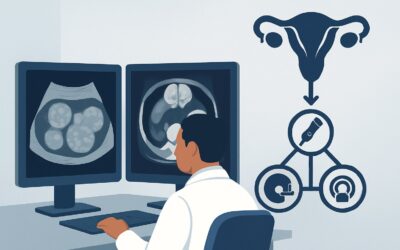
For a patient with newly diagnosed vaginal cancer requiring pretreatment staging, the ACR rates several studies as Usually appropriate. MRI of the pelvis without and with IV contrast is a primary choice for its excellent soft-tissue resolution, which is critical for evaluating local tumor extent, invasion into adjacent structures like the bladder and rectum, and pelvic lymph node involvement. Concurrently, CT of the abdomen and pelvis with IV contrast and FDG-PET/CT from the skull base to mid-thigh are also rated Usually appropriate for their ability to detect distant metastatic disease and nodal involvement beyond the pelvis. The choice between these often depends on the clinical stage and institutional preference. An MRI of the full abdomen and pelvis may also be appropriate in certain cases.
In the context of posttreatment evaluation with no suspected recurrence, imaging serves a surveillance role. Both MRI of the pelvis without and with IV contrast and FDG-PET/CT from the skull base to mid-thigh are considered Usually appropriate. MRI is highly sensitive for detecting subtle local changes and early recurrence in the treatment bed. PET/CT is valuable for a comprehensive survey to detect asymptomatic local, regional, or distant recurrence. CT of the abdomen/pelvis or chest with contrast are rated May be appropriate and can be considered as alternatives, particularly if MRI or PET/CT are unavailable or contraindicated.
When there is a clinical suspicion or known recurrence of vaginal cancer, the goal is to evaluate the full extent of the disease to plan further treatment. The ACR again rates multiple modalities as Usually appropriate. MRI of the pelvis without and with IV contrast is essential for defining the extent of local recurrence. For assessing regional and distant disease, CT of the abdomen and pelvis with IV contrast, CT of the chest with IV contrast, and FDG-PET/CT from the skull base to mid-thigh are all considered Usually appropriate. PET/CT is particularly powerful in this setting for identifying all sites of disease, which can significantly alter management, such as deciding between salvage surgery, radiation, or systemic therapy.
For all scenarios, ultrasound (transabdominal or transvaginal) and fluoroscopic studies are rated Usually not appropriate for staging or follow-up due to their limited ability to assess deep pelvic structures and distant disease.
ACR Imaging Recommendations Table
| Clinical Scenario | Top Procedure | ACR Rating | Adult RRL | Pediatric RRL |
|---|---|---|---|---|
| Vaginal cancer. Pretreatment staging. Initial imaging. | MRI pelvis without and with IV contrast | Usually appropriate | O 0 mSv | O 0 mSv [ped] |
| Posttreatment evaluation of vaginal cancer. No suspected recurrence. Initial imaging. | FDG-PET/CT skull base to mid-thigh | Usually appropriate | ☢ ☢ ☢ ☢ 10-30 mSv | ☢ ☢ ☢ ☢ 3-10 mSv [ped] |
| Vaginal Cancer. Suspected or known recurrence. Evaluate extent of disease. Initial imaging. | FDG-PET/CT skull base to mid-thigh | Usually appropriate | ☢ ☢ ☢ ☢ 10-30 mSv | ☢ ☢ ☢ ☢ 3-10 mSv [ped] |
Adult vs. Pediatric Staging and Follow-up of Primary Vaginal Cancer Imaging: Radiation Dose Tradeoffs
While primary vaginal cancer is exceedingly rare in children, pediatric cases (such as sarcoma botryoides, a subtype of embryonal rhabdomyosarcoma) require special consideration regarding imaging. The ACR provides pediatric-specific relative radiation level (RRL) estimates, reflecting the heightened concern for lifetime cancer risk from ionizing radiation in younger patients. The ALARA (As Low As Reasonably Achievable) principle is paramount.
For CT scans, the pediatric RRLs often indicate a higher radiation risk category (e.g., ☢ ☢ ☢ ☢) even with lower mSv ranges compared to adults. This is because children’s developing tissues are more radiosensitive, and they have a longer lifespan over which radiation-induced effects could manifest. Consequently, non-ionizing modalities like MRI are strongly preferred for local and regional staging in pediatric patients whenever clinically feasible. When CT or PET/CT is necessary for evaluating distant disease, protocols must be optimized to use the lowest possible radiation dose while maintaining diagnostic image quality.
Imaging Protocol Details for Staging and Follow-up of Primary Vaginal Cancer
Once you’ve decided on the right study, the specific imaging protocol is critical for obtaining diagnostic-quality images. Our protocol guides cover key details on technique, contrast administration, and interpretation principles for many of the studies recommended in these guidelines. While a non-contrast CT of the abdomen and pelvis is not a primary tool for this indication, understanding its protocol can be useful in specific situations, such as when IV contrast is contraindicated.
Tools to Help You Order the Right Study
Selecting the correct imaging study from a long list of options can be challenging. GigHz offers several tools designed to streamline this process, ensuring your order is evidence-based and appropriate for the clinical scenario.
For clinical questions beyond the staging and follow-up of primary vaginal cancer, the Imaging Appropriateness Selector provides direct access to the complete, searchable ACR guidelines. This tool helps you quickly find evidence-based recommendations for hundreds of clinical variants.
To ensure the study you order is performed correctly, the Imaging Protocol Library offers detailed, step-by-step protocols for a wide range of CT, MRI, and other imaging procedures. This is a valuable resource for trainees and for ensuring consistency across an institution.
When discussing the risks and benefits of imaging with patients, especially when studies involving ionizing radiation are considered, the Radiation Dose Calculator is an essential aid. It helps estimate and track cumulative radiation exposure, facilitating informed patient consent and adherence to the ALARA principle.
What is the single best imaging test for initial staging of vaginal cancer?
There isn’t a single “best” test, as the optimal approach often combines modalities. However, MRI of the pelvis with and without contrast is considered the best single test for evaluating the local extent of the primary tumor due to its superior soft-tissue contrast. For comprehensive staging, which includes assessment for distant metastases, FDG-PET/CT is often preferred as it can survey the entire body in one examination.
Why is ultrasound rated ‘Usually not appropriate’ for staging vaginal cancer?
While transvaginal ultrasound can sometimes visualize a vaginal mass, it has significant limitations for staging. It cannot reliably assess the depth of invasion into surrounding tissues like the parametria, bladder, or rectum, nor can it evaluate pelvic or distant lymph nodes. MRI and CT/PET-CT provide the comprehensive anatomical and metabolic information necessary for accurate staging.
Is a CT scan sufficient for follow-up after treatment?
A contrast-enhanced CT of the abdomen and pelvis is rated ‘May be appropriate’ for surveillance. It can detect nodal or distant metastatic disease but is less sensitive than MRI for subtle local recurrence within the treated area, where post-treatment changes can be difficult to distinguish from tumor. For this reason, MRI of the pelvis or FDG-PET/CT are often preferred and are rated ‘Usually appropriate’ for post-treatment evaluation.
When is a chest CT necessary in the workup of vaginal cancer?
A chest CT is crucial for detecting pulmonary metastases, which are a potential site of distant spread for vaginal cancer. It is rated ‘Usually appropriate’ when there is a suspected or known recurrence. For initial staging, an FDG-PET/CT includes evaluation of the chest. If PET/CT is not performed, a separate chest CT (with or without contrast) is often included as part of the initial staging workup, especially for locally advanced disease.
Do all patients need imaging for follow-up, or is clinical exam enough?
Routine follow-up after treatment for vaginal cancer typically includes regular physical and pelvic examinations. The role and frequency of surveillance imaging for asymptomatic patients are debated and may vary by institution and patient risk factors. The ACR criteria list MRI and PET/CT as ‘Usually appropriate’ for post-treatment evaluation, suggesting a role for imaging, but the decision to perform it should be individualized based on the initial stage, tumor histology, and treatment received.
Frequently Asked Questions
What is the single best imaging test for initial staging of vaginal cancer?
There isn’t a single “best” test, as the optimal approach often combines modalities. However, MRI of the pelvis with and without contrast is considered the best single test for evaluating the local extent of the primary tumor due to its superior soft-tissue contrast. For comprehensive staging, which includes assessment for distant metastases, FDG-PET/CT is often preferred as it can survey the entire body in one examination.
Why is ultrasound rated ‘Usually not appropriate’ for staging vaginal cancer?
While transvaginal ultrasound can sometimes visualize a vaginal mass, it has significant limitations for staging. It cannot reliably assess the depth of invasion into surrounding tissues like the parametria, bladder, or rectum, nor can it evaluate pelvic or distant lymph nodes. MRI and CT/PET-CT provide the comprehensive anatomical and metabolic information necessary for accurate staging.
Is a CT scan sufficient for follow-up after treatment?
A contrast-enhanced CT of the abdomen and pelvis is rated ‘May be appropriate’ for surveillance. It can detect nodal or distant metastatic disease but is less sensitive than MRI for subtle local recurrence within the treated area, where post-treatment changes can be difficult to distinguish from tumor. For this reason, MRI of the pelvis or FDG-PET/CT are often preferred and are rated ‘Usually appropriate’ for post-treatment evaluation.
When is a chest CT necessary in the workup of vaginal cancer?
A chest CT is crucial for detecting pulmonary metastases, which are a potential site of distant spread for vaginal cancer. It is rated ‘Usually appropriate’ when there is a suspected or known recurrence. For initial staging, an FDG-PET/CT includes evaluation of the chest. If PET/CT is not performed, a separate chest CT (with or without contrast) is often included as part of the initial staging workup, especially for locally advanced disease.
Do all patients need imaging for follow-up, or is clinical exam enough?
Routine follow-up after treatment for vaginal cancer typically includes regular physical and pelvic examinations. The role and frequency of surveillance imaging for asymptomatic patients are debated and may vary by institution and patient risk factors. The ACR criteria list MRI and PET/CT as ‘Usually appropriate’ for post-treatment evaluation, suggesting a role for imaging, but the decision to perform it should be individualized based on the initial stage, tumor histology, and treatment received.
Reviewed by Pouyan Golshani, MD, Interventional Radiologist — May 26, 2026