Which Imaging Is Best for Posttreatment Locoregional Assessment of Anal Cancer?
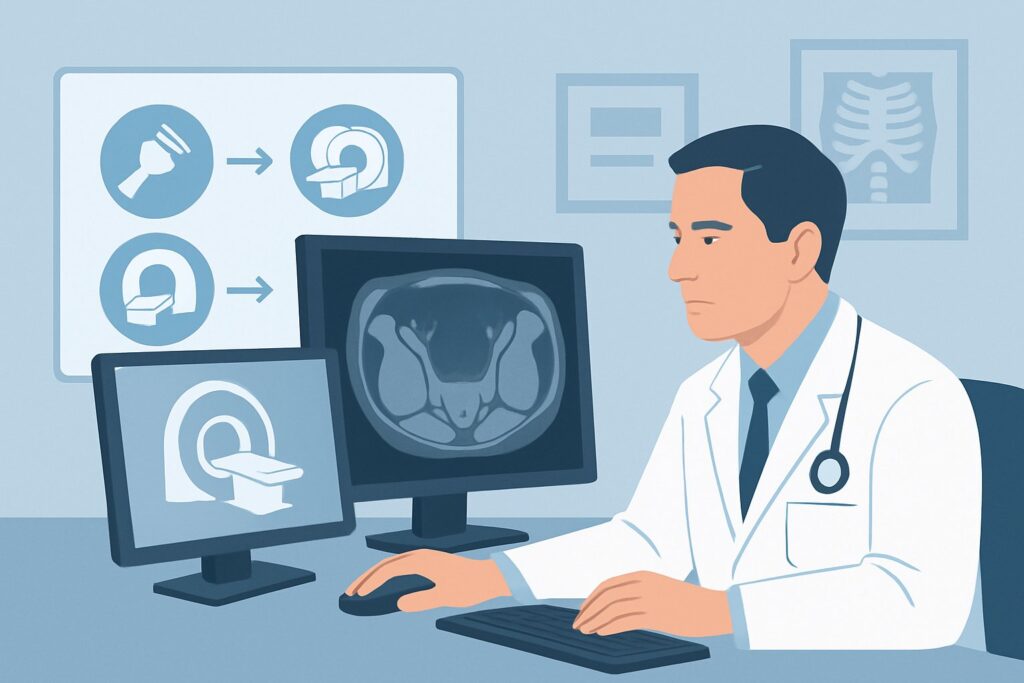
A 58-year-old male with a history of T2N1 squamous cell carcinoma of the anal canal is in your oncology clinic. He completed definitive chemoradiation therapy four months ago and reports resolution of his initial symptoms. On digital rectal examination, you feel induration at the site of the prior tumor, but it is difficult to distinguish post-treatment scarring from residual disease. You need to order imaging to formally assess for locoregional response before deciding on his surveillance plan. This article details the ACR-guided workflow for choosing the right imaging study in this specific posttreatment setting. According to the ACR Appropriateness Criteria, MRI pelvis without and with IV contrast is Usually appropriate for this assessment.
Who Fits This Clinical Scenario for Posttreatment Anal Cancer Assessment?
This guidance applies specifically to adult patients with a history of histologically confirmed squamous cell anal cancer who have completed a course of definitive therapy, most commonly concurrent chemoradiation. The clinical question is the assessment of locoregional disease status—evaluating the primary tumor site and regional lymph nodes (perirectal, inguinal, pelvic sidewall) for response, residual disease, or early recurrence. This evaluation is typically performed between 3 and 6 months following the completion of therapy.
This workflow is distinct from other related clinical situations. This article does not apply to:
- Initial Staging: Patients with a new diagnosis of anal cancer who have not yet undergone treatment require a different imaging workup for initial locoregional staging.
- Assessment for Distant Metastases: While locoregional imaging may be part of a larger workup, the primary evaluation for distant metastatic disease at initial staging or during surveillance often involves different modalities or imaging coverage.
- Non-Squamous Histologies: Patients with other anal canal malignancies, such as adenocarcinoma or melanoma, have different patterns of disease and may require different imaging strategies.
Applying this guidance is appropriate only after the initial treatment course is complete and sufficient time has passed for acute inflammatory effects to subside.
What Diagnoses Are You Working Up in This Scenario?
The core challenge in posttreatment assessment is distinguishing expected, benign changes from persistent or recurrent malignancy. The imaging study is ordered to differentiate among several key possibilities.
Complete Response and Post-Treatment Fibrosis
This is the desired outcome. Successful therapy leads to the replacement of viable tumor cells with fibrotic scar tissue. On imaging, this should manifest as a decrease in the size of the original mass, loss of tumor-specific features (like high cellularity), and the development of non-suspicious, stable scar. This finding allows the patient to proceed with a standard surveillance protocol.
Residual Locoregional Disease
This represents an incomplete response to therapy, where viable cancer persists at the primary site or in the regional lymph nodes. Detecting residual disease is critical, as it may prompt consideration for salvage therapy, most often an abdominoperineal resection. Imaging must be sensitive enough to detect small-volume residual tumor within a complex background of post-radiation changes.
Recurrent Locoregional Disease
This refers to the appearance of a new or enlarging focus of cancer after a complete response was previously documented. Recurrence can occur at the primary site or in the regional nodal basins. The imaging features are often similar to residual disease, but the temporal context is different. Early detection is key to offering potentially curative salvage treatment.
Post-Radiation Inflammatory Changes
A significant diagnostic mimic, post-radiation inflammation can cause tissue thickening, edema, and contrast enhancement that can be difficult to distinguish from tumor. This is particularly problematic in the first 3 months after therapy. A key role of advanced imaging is to leverage techniques that can see beyond these nonspecific inflammatory signs to assess for true underlying malignancy.
Why Is MRI of the Pelvis the Recommended Study for Locoregional Assessment?
For the specific task of evaluating the primary tumor bed and pelvic lymph nodes after chemoradiation for squamous cell anal cancer, the ACR panel rates MRI pelvis without and with IV contrast as Usually appropriate. Its diagnostic strength lies in its superior soft-tissue characterization and multi-parametric capabilities, which are essential for navigating the complex post-treatment environment.
The primary advantage of MRI is its unparalleled soft-tissue contrast resolution. T2-weighted sequences provide exquisite anatomical detail of the anal sphincter complex, pelvic floor muscles, and surrounding tissues, allowing for precise localization of any abnormality. More importantly, MRI incorporates functional techniques that help differentiate viable tumor from benign changes:
- Diffusion-Weighted Imaging (DWI): This sequence measures the random motion of water molecules. Viable, hypercellular tumors restrict this motion, appearing bright on DWI and dark on the corresponding apparent diffusion coefficient (ADC) map. In contrast, post-treatment fibrosis, necrosis, and most inflammatory changes do not typically demonstrate true restricted diffusion. DWI is a powerful tool for increasing confidence in diagnosing or excluding residual/recurrent cancer.
- Dynamic Contrast Enhancement (DCE): Following the administration of IV gadolinium contrast, malignant tissue often demonstrates characteristic enhancement patterns, such as rapid early enhancement and subsequent washout. This can help distinguish vascularized tumor from non-enhancing or slowly enhancing scar tissue.
This multi-parametric approach provides both anatomical and functional information, making it the most robust single test for this clinical question. Furthermore, MRI achieves this with no ionizing radiation (0 mSv), an important consideration for patients who have recently undergone a full course of pelvic radiation therapy.
How Do Alternatives Compare?
Other imaging modalities are rated lower or serve complementary roles for this specific scenario:
- FDG-PET/CT skull base to mid-thigh is also rated Usually appropriate. It provides crucial metabolic information and is excellent for assessing the entire body for nodal or distant disease. However, for the focused locoregional question, it has a significant pitfall: intense post-radiation inflammation is often highly FDG-avid, leading to false-positive results if performed too soon (less than 12 weeks) after treatment. While invaluable in many contexts, MRI is often preferred for its superior morphological detail and lower rate of inflammatory false positives in the primary tumor bed.
- CT pelvis with IV contrast is rated May be appropriate. While it can assess for bulky nodal disease and gross tumor recurrence, its soft-tissue resolution within the anal canal is significantly inferior to MRI. It is very difficult to reliably distinguish small-volume residual tumor from post-treatment scar on CT alone.
What’s Next After MRI Pelvis Without and With IV Contrast? Downstream Workflow
The results of the posttreatment pelvic MRI will directly guide the next steps in patient management. The clinical workflow typically follows one of three paths.
If the MRI shows a complete response:
When the study reveals only expected post-treatment changes, such as fibrosis and scarring, with no evidence of restricted diffusion or suspicious enhancement, the patient is considered to have a complete radiological response. The next step is to continue with the planned clinical surveillance protocol, which typically includes regular digital rectal exams and anoscopy, per institutional or national guidelines (e.g., NCCN).
If the MRI is positive for residual or recurrent disease:
If the MRI identifies a focal area with features concerning for viable tumor (e.g., mass-like T2 signal, restricted diffusion, suspicious enhancement), this finding must be confirmed histologically. The next step is an examination under anesthesia (EUA) with targeted biopsy of the suspicious lesion. A positive biopsy confirms persistent or recurrent cancer and triggers a multidisciplinary discussion about salvage therapy options, most commonly an abdominoperineal resection.
If the MRI is indeterminate or equivocal:
Occasionally, the findings are ambiguous. There may be subtle enhancement or questionable diffusion restriction that could represent either early recurrence or resolving inflammation. In this situation, management requires a multi-pronged approach. Options include a short-term follow-up MRI in 6-12 weeks to assess for stability or progression. Alternatively, an FDG-PET/CT can be performed to provide metabolic correlation; a PET-negative finding would be reassuring, while a PET-positive finding would increase suspicion and support proceeding to biopsy. The final decision often rests on a multidisciplinary tumor board discussion.
Pitfalls to Avoid (and When to Get Help)
Navigating posttreatment imaging requires careful attention to timing and technique to avoid common errors.
- Pitfall: Imaging Too Early. The most common error is performing MRI or PET/CT too soon after chemoradiation is completed. Imaging within the first 12 weeks is fraught with false-positive findings from intense radiation-induced inflammation. Wait at least 3 months, and ideally closer to 6 months, for the initial response assessment.
- Pitfall: Omitting Key MRI Sequences. Ordering a “pelvic MRI” without specifying the need for diffusion-weighted imaging (DWI/ADC) is a critical omission. The functional information from DWI is essential for distinguishing tumor from scar and should be considered a mandatory part of the protocol.
- Pitfall: Over-reliance on Imaging Alone. A suspicious finding on physical examination (e.g., a new, hard nodule) warrants further investigation even if an MRI is reported as negative. If there is a clear discrepancy between a high-risk clinical finding and a negative imaging report, the next step should be an examination under anesthesia with biopsy.
When imaging findings are equivocal or conflict with the clinical picture, escalate the case to a multidisciplinary tumor board including colorectal surgery, radiation oncology, medical oncology, and radiology.
Related ACR Topics and Tools
This article focuses on a single, specific clinical scenario. For a comprehensive overview of all imaging variants related to this condition, from initial diagnosis to surveillance, please consult the parent topic hub article. For additional decision support, the following GigHz resources are available.
- For breadth across all scenarios in Staging and Follow-up of Anal Cancer, see our parent guide: Staging and Follow-up of Anal Cancer: ACR Appropriateness Decoded.
- To look up other clinical scenarios, visit the ACR Appropriateness Criteria Lookup.
- For technical details on performing the recommended study, see the Imaging Protocol Library.
- To discuss radiation exposure with patients, use the Radiation Dose Calculator.
Frequently Asked Questions
How long after completing chemoradiation should the first posttreatment MRI be performed?
The general consensus, supported by major guidelines, is to wait at least 12 weeks (3 months) after the completion of therapy. Performing imaging earlier significantly increases the risk of false-positive results due to intense post-radiation inflammation. Many centers prefer to wait closer to 6 months for the definitive response assessment.
Is FDG-PET/CT a better test than MRI for this specific scenario?
Both MRI and FDG-PET/CT are rated as ‘Usually appropriate’ by the ACR, but they excel at answering slightly different questions. MRI is superior for detailed anatomical and functional assessment of the primary tumor site and pelvic nodes. FDG-PET/CT is excellent for evaluating metabolic response and screening for distant disease. They are often considered complementary rather than competing tests. For the specific question of locoregional assessment, MRI is often the preferred first choice due to its lower rate of false positives from inflammation.
What if my patient has a contraindication to IV gadolinium contrast for their MRI?
An MRI of the pelvis without IV contrast is rated as ‘May be appropriate’ by the ACR. While contrast enhancement provides additional valuable data, the most critical sequences for this indication are often the non-contrast T2-weighted images (for anatomy) and the diffusion-weighted images (for tumor cellularity). A non-contrast study is still highly valuable and far superior to CT for this purpose.
My patient’s MRI report is equivocal. What is the best next step?
Equivocal findings require a multidisciplinary discussion involving the treating oncologist, surgeon, and radiologist. The best course of action depends on the specific findings and the degree of clinical suspicion. Common strategies include a short-term interval follow-up MRI (e.g., in 6-12 weeks) to assess for change, performing an FDG-PET/CT for metabolic correlation, or proceeding directly to an examination under anesthesia with biopsy of the area in question.
Does this guidance apply to routine surveillance imaging years after a complete response?
This guidance is specifically for the first major locoregional assessment after definitive treatment. The strategy for long-term surveillance in an asymptomatic patient who has already demonstrated a complete response can vary. While MRI remains the best tool if a recurrence is clinically suspected, the role and frequency of routine imaging for long-term surveillance is a separate clinical question guided by institutional and national guidelines.
Reviewed by Pouyan Golshani, MD, Interventional Radiologist — May 30, 2026