Which Imaging Is Best for Suspected Inflammatory Vasculitis in the Lower Extremities?
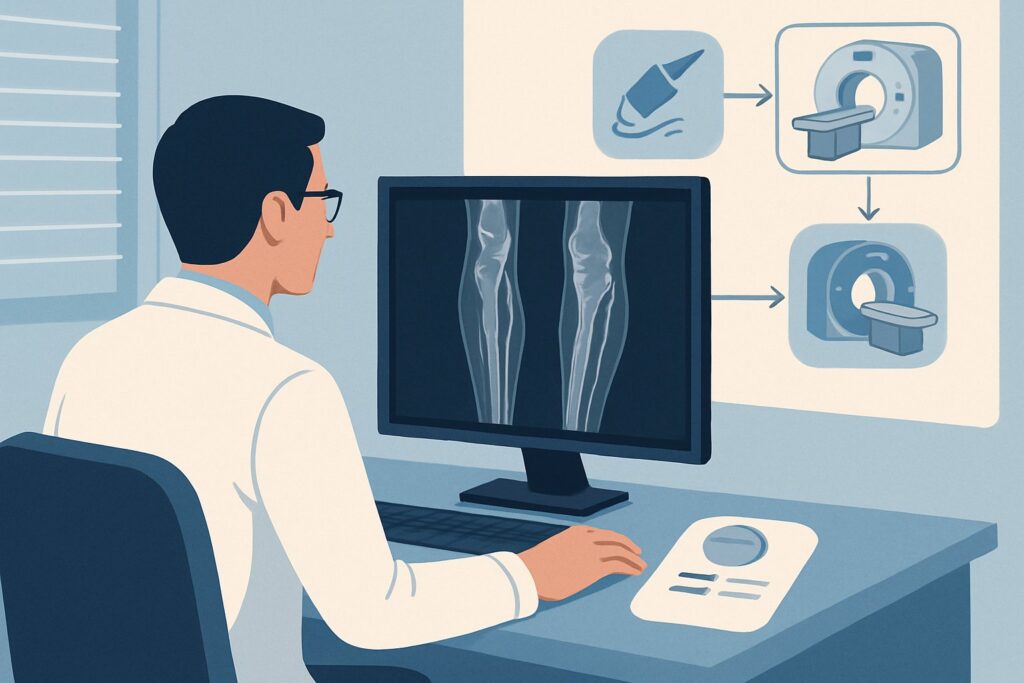
A 34-year-old patient presents to your clinic with a six-month history of progressive bilateral calf claudication. They have no traditional atherosclerotic risk factors but report intermittent low-grade fevers and an unintentional 10-pound weight loss. Labs reveal an elevated erythrocyte sedimentation rate (ESR) and C-reactive protein (CRP). You suspect a nonatherosclerotic cause, specifically an inflammatory vasculitis. The immediate clinical question is which imaging study will most accurately diagnose the condition and guide management. For this specific scenario—suspected or known lower-extremity inflammatory vasculitides—the American College of Radiology (ACR) Appropriateness Criteria rate Arteriography lower extremity as Usually Appropriate.
Who Fits This Clinical Scenario?
This guidance applies to patients where there is a clinical suspicion for an inflammatory vasculitis affecting the lower extremities. The typical patient profile often includes features that are inconsistent with common atherosclerotic peripheral arterial disease. Key inclusion criteria include:
- Younger age at onset (typically under 50) without significant atherosclerotic risk factors (e.g., smoking, diabetes, hyperlipidemia).
- Symptoms of limb ischemia, such as claudication, rest pain, or digital ulcers.
- Presence of constitutional symptoms like fever, malaise, or unexplained weight loss.
- Elevated systemic inflammatory markers (e.g., ESR, CRP).
- Known diagnosis of a systemic vasculitis with new or worsening lower-extremity symptoms.
It is critical to distinguish this presentation from other nonatherosclerotic conditions. This workflow is NOT for patients with a clear history of trauma, as that falls under the Lower-extremity vascular trauma scenario. Similarly, if symptoms are specifically exertional pain in a young athlete, consider suspected popliteal entrapment syndrome. Finally, if the patient is a high-performance cyclist with unilateral symptoms, the workup for external iliac artery endofibrosis follows a different path.
What Diagnoses Are You Working Up in This Scenario?
When ordering imaging for suspected lower-extremity vasculitis, you are primarily investigating a differential of systemic inflammatory conditions that affect medium and large arteries. The goal is to identify characteristic patterns of stenosis, occlusion, aneurysm, or vessel wall changes.
Takayasu Arteritis (TA) is a large-vessel vasculitis that predominantly affects the aorta and its main branches. While often associated with the aortic arch (“pulseless disease”), it can involve the abdominal aorta, iliac, and femoral arteries, leading to lower-extremity claudication. It typically presents in women under the age of 50. Imaging may reveal long, smooth, tapered stenoses or occlusions.
Giant Cell Arteritis (GCA) is another large-vessel vasculitis, classically seen in patients over 50. Though well-known for causing temporal arteritis, it is a systemic disease that can affect the aorta and extremity vessels, presenting with symptoms similar to Takayasu arteritis. Extracranial involvement is increasingly recognized as a common feature.
Buerger Disease (Thromboangiitis Obliterans) is a nonatherosclerotic, segmental, inflammatory vasculitis strongly associated with tobacco use. It affects the small- and medium-sized arteries and veins of the extremities. The classic angiographic finding is the development of distinctive “corkscrew” collateral vessels around areas of occlusion, typically in the distal leg and foot.
Polyarteritis Nodosa (PAN) is a systemic necrotizing vasculitis of medium-sized arteries. While it most commonly affects visceral arteries (renal, mesenteric), it can involve peripheral arteries, leading to stenoses, occlusions, and characteristic small aneurysms.
Why Is Arteriography the Recommended Study for This Presentation?
The ACR rates several modalities as Usually Appropriate for this scenario, including Arteriography, CTA, and MRA. While all are first-line options, conventional catheter-based arteriography is often considered the reference standard due to its superior spatial resolution, which is critical for visualizing the subtle findings of vasculitis.
Digital Subtraction Arteriography (DSA) excels at delineating fine details of the vessel lumen, such as minor wall irregularities, small aneurysms, and the characteristic “beading” or “string of pearls” appearance seen in some vasculitides. It is particularly effective for identifying the “corkscrew” collaterals pathognomonic for Buerger disease. Furthermore, it offers the potential for immediate endovascular intervention if a critical stenosis is identified, though this is less common in the initial diagnostic phase of inflammatory vasculitis.
Alternative Studies and Their Rationale:
- CTA lower extremity with IV contrast and MRA lower extremity without and with IV contrast are also rated Usually Appropriate. These non-invasive modalities are excellent alternatives. MRA has the unique advantage of visualizing vessel wall enhancement after gadolinium administration, which is a direct sign of active inflammation. CTA provides rapid acquisition and high-resolution luminal imaging. The choice between arteriography, CTA, and MRA often depends on institutional expertise, patient factors like renal function, and the specific clinical question.
- US duplex Doppler lower extremity is rated May be appropriate. While non-invasive and free of radiation, its utility is limited in this context. It is highly operator-dependent and may struggle to visualize the full extent of disease, especially in smaller, deeper vessels. It can detect flow-limiting stenoses but often lacks the global overview and fine detail of cross-sectional imaging or arteriography needed to establish a specific vasculitic diagnosis.
Radiation and Contrast Considerations:
Arteriography involves ionizing radiation (Adult RRL=☢☢, 0.1-1 mSv) and iodinated contrast. CTA carries a higher radiation dose (Adult RRL=☢☢☢, 1-10 mSv). MRA with contrast avoids radiation (RRL=O) but requires gadolinium-based contrast agents, which carry a risk of nephrogenic systemic fibrosis in patients with severe renal dysfunction. These trade-offs must be weighed for each patient.
What’s Next After Arteriography? Downstream Workflow
The results of the initial imaging study will guide the subsequent clinical pathway, which almost always involves a multidisciplinary approach with rheumatology and potentially vascular surgery.
If the study is positive for vasculitis: Findings such as long-segment stenoses, vessel wall thickening, aneurysms, or specific collateral patterns strongly support the diagnosis. The next step is typically initiation or adjustment of medical therapy, usually involving corticosteroids and other immunosuppressive agents. The imaging helps establish a baseline to monitor treatment response over time. A tissue biopsy may still be pursued in some cases to confirm the diagnosis histologically, especially if the imaging findings are not pathognomonic.
If the study is negative: A negative high-quality arteriogram, CTA, or MRA makes large- or medium-vessel vasculitis in the imaged territory less likely, but does not entirely exclude it. If clinical suspicion remains high, the next steps may include evaluating for small-vessel disease (which may not be visible on these studies), considering a biopsy of a symptomatic area (e.g., muscle or nerve), or imaging other vascular beds (e.g., aortic arch, mesenteric arteries). Re-evaluation for mimics, such as the noninflammatory arteriopathies seen in the dissection or connective tissue diseases scenario, is also warranted.
If the study is indeterminate: Ambiguous findings, such as mild, nonspecific vessel wall irregularities, may require further workup. This could involve a complementary imaging modality (e.g., an MRA to look for wall enhancement if the initial study was a CTA) or a PET/CT scan, which can highlight areas of active metabolic inflammation in the vessel walls and help confirm the diagnosis.
Pitfalls to Avoid (and When to Get Help)
Navigating the workup for suspected vasculitis requires careful consideration to avoid common diagnostic errors.
- Attribution Error: Do not automatically attribute lower-extremity arterial disease in a young patient to premature atherosclerosis. Always consider inflammatory and other nonatherosclerotic causes.
- Incomplete Workup: Vasculitis is a systemic disease. Finding it in the lower extremities should prompt a systemic evaluation, not just treatment of the local symptoms.
- Ignoring Lab Values: The imaging findings must be interpreted in the context of the patient’s clinical history and inflammatory markers. A “normal” scan in a patient with a very high ESR and claudication still warrants further investigation.
- Pediatric Dosing: When imaging children or young adults, be mindful of radiation dose. The pediatric RRL for arteriography (☢☢☢) and CTA (☢☢☢☢) is higher than for adults, reflecting different protocols and body sizes. Always adhere to ALARA (As Low As Reasonably Achievable) principles.
If imaging confirms significant arterial stenosis or occlusion, or if the diagnosis remains uncertain despite initial imaging, consultation with both Rheumatology and Vascular Surgery is essential for comprehensive management.
Related ACR Topics and Tools
This article focuses on a single clinical scenario. For a broader view of related conditions or to explore the tools used in making these decisions, the following resources are valuable. For breadth across all scenarios in Nonatherosclerotic Peripheral Arterial Disease, see our parent guide: Nonatherosclerotic Peripheral Arterial Disease: ACR Appropriateness Decoded.
- ACR Appropriateness Criteria Lookup: For exploring adjacent scenarios and alternative patient presentations.
- Imaging Protocol Library: For detailed technical specifications of various imaging studies.
- Radiation Dose Calculator: For discussing cumulative radiation exposure with patients.
Frequently Asked Questions
Why is conventional arteriography still recommended when non-invasive CTA and MRA are available?
Conventional arteriography (DSA) offers the highest spatial resolution for visualizing the vessel lumen. This is critical for detecting subtle abnormalities like minor wall irregularities or the tiny ‘corkscrew’ collateral vessels characteristic of Buerger disease. While CTA and MRA are excellent and also rated ‘Usually Appropriate,’ arteriography remains the reference standard for luminal detail and offers the option for immediate intervention if needed.
What is the role of PET/CT in suspected lower-extremity vasculitis?
PET/CT is not typically a first-line imaging test for luminal assessment but is a powerful tool for detecting active inflammation within the vessel wall. It can be very useful when other imaging is equivocal or to assess the systemic extent of the disease and monitor response to therapy. It shows metabolic activity rather than just anatomy.
How can imaging help differentiate Buerger disease from other vasculitides?
The imaging pattern in Buerger disease is often distinctive. It typically involves the small- and medium-sized vessels distal to the knee and elbow while sparing the larger inflow vessels. The most specific finding is the presence of ‘corkscrew’ or ‘spider leg’ collateral vessels that form around occluded artery segments. This, combined with a strong history of tobacco use, is highly suggestive of the diagnosis.
Does a normal imaging study definitively rule out vasculitis?
No. A normal arteriogram, CTA, or MRA makes large- and medium-vessel vasculitis unlikely in the imaged area, but it cannot rule it out completely. The disease may be in an early stage, or it may primarily involve small vessels (small-vessel vasculitis) that are beyond the resolution of these imaging techniques. If clinical suspicion remains high, a tissue biopsy may be the necessary next step.
What are the key findings of Takayasu arteritis in the lower extremities?
In the lower extremities, Takayasu arteritis typically manifests as long, smooth, tapered stenoses or occlusions of the large arteries, such as the distal aorta, common iliac, external iliac, and femoral arteries. On CTA or MRA, you may also see concentric thickening and enhancement of the affected artery walls, which indicates active inflammation.
Reviewed by Pouyan Golshani, MD, Interventional Radiologist — May 29, 2026