Which Imaging Study Should You Order First for Right Upper Quadrant Pain of Unknown Cause?
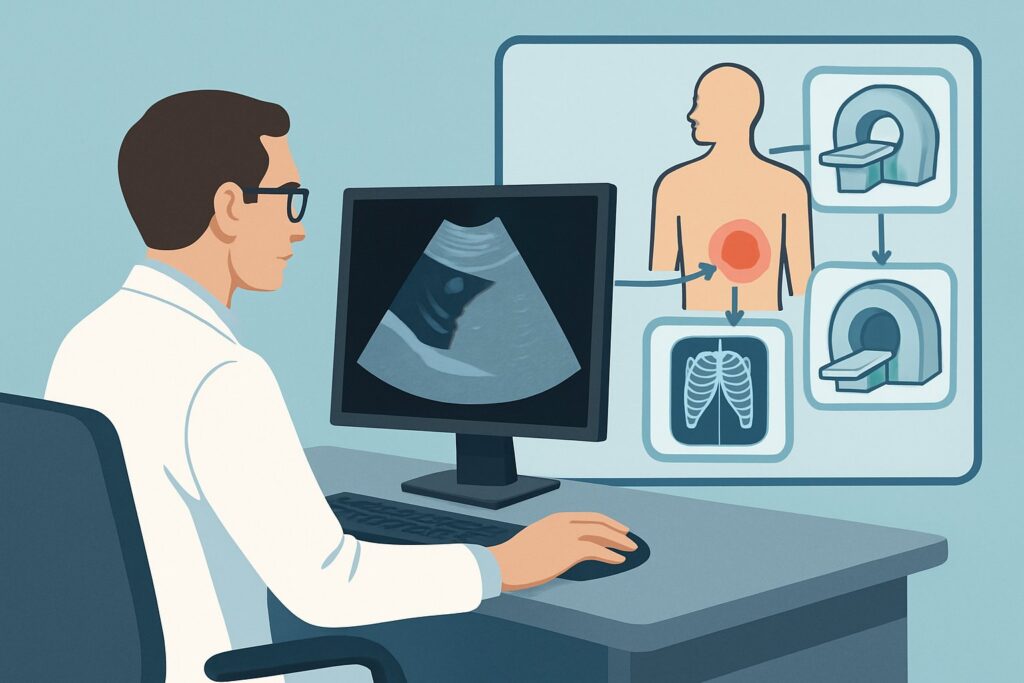
A 45-year-old male presents to the urgent care clinic on a Tuesday afternoon with two days of persistent, nagging right upper quadrant (RUQ) pain. His history is non-contributory, he has no fever, and his physical exam reveals only mild tenderness to palpation in the RUQ without peritoneal signs. Lab work is pending. The clinical picture is vague, lacking the classic features of biliary colic or acute hepatitis, leaving you with a broad differential. You need to choose the initial imaging study that will most efficiently and safely narrow the diagnostic possibilities. This article provides a detailed clinical workflow for this exact scenario: initial imaging for right upper quadrant pain of unknown etiology. Based on the American College of Radiology (ACR) Appropriateness Criteria, the recommended first step is an abdominal ultrasound, which is rated “Usually Appropriate.”
Who Fits This Clinical Scenario?
This guidance applies to the common clinical presentation of a patient with right upper quadrant pain where the etiology is unclear after an initial history and physical exam. The key feature is the lack of a strong leading diagnosis. The patient’s symptoms are not specific enough to point definitively toward biliary, hepatic, renal, or other organ systems. This scenario is intended for the initial diagnostic imaging step, before any other imaging has been performed.
This workflow is distinct from several related, but more specific, clinical situations. It does not apply if:
- There is a high pre-test probability of biliary disease. If the patient presents with classic biliary colic symptoms (postprandial pain, specific radiation patterns), the scenario shifts. That workup is covered in the variant “Right upper quadrant pain. Suspected biliary disease. Initial imaging.”
- An ultrasound has already been performed and was negative or equivocal. If an initial ultrasound fails to identify a cause but clinical suspicion remains high (especially with developing fever or leukocytosis), the decision process moves to a different branch of the ACR guidelines, such as “Right upper quadrant pain. Fever, elevated WBC count. Suspected biliary disease. Negative or equivocal ultrasound. Next imaging study.”
This article is for the undifferentiated patient, where the goal of imaging is to survey the RUQ anatomy broadly to identify the most likely source of the pain.
What Diagnoses Are You Working Up in This Scenario?
With undifferentiated RUQ pain, the differential diagnosis is broad, spanning multiple organ systems. The initial imaging choice is designed to evaluate the most common and most critical potential causes in this region.
Biliary and Gallbladder Pathology: This is the most frequent source of RUQ pain. The primary considerations are cholelithiasis (gallstones), which may be asymptomatic or causing biliary colic, and acute cholecystitis (inflammation of the gallbladder). Less commonly, you might be looking for choledocholithiasis (stones in the common bile duct), which can lead to biliary obstruction and cholangitis.
Hepatic Pathology: The liver itself can be a source of pain. This includes inflammatory conditions like hepatitis (though often diffuse, it can present with RUQ pain), hepatic abscess, or a hepatic mass (benign or malignant). Hepatic steatosis (fatty liver) can cause a dull, chronic ache. Acute portal or hepatic vein thrombosis (Budd-Chiari syndrome) is a rare but critical diagnosis to consider in the right setting.
Renal and Adrenal Pathology: The right kidney and adrenal gland are located in the RUQ. While renal colic often presents as flank pain, it can radiate to the RUQ. Potential diagnoses include nephrolithiasis (kidney stones), pyelonephritis (kidney infection), or a renal mass. An adrenal mass or hemorrhage is a much less common cause.
Extra-organ Pathology: Pain can also originate from adjacent structures. A low-lying right-sided pneumonia or pleural effusion can present with referred RUQ pain. Subphrenic abscesses or even musculoskeletal pain from the abdominal wall can mimic visceral pathology.
Why Is US abdomen the Recommended Initial Study for This Presentation?
For the initial evaluation of undifferentiated right upper quadrant pain, the ACR designates US abdomen as “Usually Appropriate.” This recommendation is based on its excellent diagnostic capability for the most common etiologies, its safety profile, and its accessibility.
Ultrasound is highly sensitive and specific for detecting gallbladder abnormalities, including gallstones, gallbladder wall thickening, pericholecystic fluid, and a sonographic Murphy’s sign, which are key indicators of cholecystitis. It can also readily identify biliary ductal dilation, which would raise suspicion for a downstream obstruction like choledocholithiasis. Beyond the biliary tree, ultrasound provides a good initial assessment of the liver parenchyma for focal lesions like cysts, abscesses, or masses, and can detect ascites. It can also visualize the right kidney to look for hydronephrosis or obvious renal stones. A significant advantage of ultrasound is its complete lack of ionizing radiation (0 mSv), making it the safest option, particularly for younger patients and those who may require serial imaging.
So why are other modalities rated lower for this initial step?
- CT abdomen with IV contrast is also rated “Usually Appropriate,” but it involves ionizing radiation (ACR Relative Radiation Level ☢☢☢, 1-10 mSv). While CT provides a more comprehensive view of the entire abdomen and retroperitoneum, it is often reserved for cases where ultrasound is non-diagnostic, or there is a higher suspicion for non-biliary pathology like a perforated viscus, abscess, or vascular issue. For the initial, undifferentiated case, starting with the no-radiation option is preferable.
- MRI abdomen without and with IV contrast with MRCP is rated “May be appropriate.” MRI with MRCP offers the most detailed evaluation of the biliary tree and is excellent for problem-solving when ultrasound is equivocal for choledocholithiasis. However, it is more expensive, less widely available, and more time-consuming than ultrasound, making it unsuitable as a first-line screening tool for undifferentiated pain.
- Radiography abdomen is rated “May be appropriate (Disagreement).” A plain X-ray has a very low diagnostic yield in this scenario. It can only detect calcified gallstones (a minority of cases), free air, or a large bowel obstruction, but it provides no information about the solid organs or biliary tree, making it an inefficient first step.
What’s Next After US abdomen? Downstream Workflow
The results of the abdominal ultrasound will guide your subsequent management and potential need for further imaging. The decision tree typically branches in one of three directions.
If the ultrasound is positive for acute biliary disease: A finding of gallstones combined with gallbladder wall thickening, pericholecystic fluid, or a sonographic Murphy’s sign strongly suggests acute cholecystitis. The next step is typically a surgical consultation for consideration of cholecystectomy. If the ultrasound shows a dilated common bile duct with or without a visible stone, the workup shifts towards evaluating for choledocholithiasis, which may require an MRCP or therapeutic ERCP.
If the ultrasound is negative or non-diagnostic: A normal ultrasound makes acute cholecystitis and significant biliary obstruction much less likely, but does not rule out all pathology. At this point, you must reassess the patient. If their clinical condition has evolved (e.g., development of fever, leukocytosis, or worsening pain) and suspicion for biliary disease remains, the next appropriate step may align with a different ACR scenario, often involving a hepatobiliary (HIDA) scan to assess gallbladder function or an MRI/MRCP for better ductal evaluation. If biliary disease seems unlikely, you would broaden the differential and consider a CT scan to look for other intra-abdominal or retroperitoneal causes.
If the ultrasound is indeterminate or shows an incidental finding: The ultrasound may reveal an indeterminate finding, such as a liver lesion or a complex renal cyst. The nature of this finding dictates the next step. A simple liver cyst requires no follow-up, but a solid or complex lesion will typically require further characterization with a contrast-enhanced CT or MRI.
Pitfalls to Avoid (and When to Get Help)
When working up undifferentiated RUQ pain, several common pitfalls can delay diagnosis or lead to unnecessary testing. Be mindful of anchoring bias; while biliary disease is common, do not let a negative ultrasound prematurely end the workup if the patient remains symptomatic. Remember that ultrasound performance can be limited by patient body habitus or overlying bowel gas, potentially obscuring pathology. Another pitfall is failing to consider extra-abdominal causes, such as a right lower lobe pneumonia, which will not be seen on a standard abdominal ultrasound. Finally, do not misinterpret the presence of gallstones (cholelithiasis) as the definitive cause of pain; many people have asymptomatic gallstones, and the pain could be from another source.
Escalate immediately if the patient shows signs of sepsis, peritonitis (rebound tenderness, guarding), or hemodynamic instability. In these cases, a rapid, comprehensive study like a CT scan and an urgent surgical consultation are warranted, bypassing the standard stepwise approach.
Related ACR Topics and Tools
This article covers a single, common clinical scenario. For a comprehensive overview of imaging for all presentations of right upper quadrant pain, from suspected biliary disease to post-operative complications, please consult our parent guide. For further exploration of imaging guidelines, protocols, and safety, the following resources are available:
- For breadth across all scenarios in Right Upper Quadrant Pain, see our parent guide: Right Upper Quadrant Pain: ACR Appropriateness Decoded.
- To explore other clinical scenarios, use the ACR Appropriateness Criteria Lookup.
- For detailed procedural techniques, consult the Imaging Protocol Library.
- To discuss radiation exposure with patients, use the Radiation Dose Calculator.
Frequently Asked Questions
Why is CT with contrast also ‘Usually Appropriate’ if ultrasound is the first choice?
CT with IV contrast is also rated ‘Usually Appropriate’ because it is an excellent test that provides a comprehensive view of the entire abdomen. However, for the initial workup of undifferentiated RUQ pain, ultrasound is often preferred as the first step because it is highly effective for the most common causes (gallbladder disease), avoids ionizing radiation, and is typically faster and more accessible. CT becomes a primary choice or a necessary next step if the patient is unstable, if the ultrasound is negative but suspicion for serious pathology remains high, or if a non-biliary cause (like a vascular issue or abscess) is strongly suspected.
What if my patient is pregnant and has RUQ pain?
In a pregnant patient, the imperative to avoid ionizing radiation is even stronger. Abdominal ultrasound is the imaging modality of choice and is considered safe in all trimesters. If the ultrasound is non-diagnostic and there is a strong suspicion for a condition that requires further imaging (like complicated appendicitis presenting high in the abdomen or choledocholithiasis), MRI without gadolinium is the preferred next step.
Does the patient need to be NPO (fasting) for the abdominal ultrasound?
Yes, for optimal evaluation of the gallbladder, patients should ideally fast for 6 to 8 hours before the ultrasound. Fasting allows the gallbladder to distend, making it much easier for the sonographer to visualize the wall, assess for stones, and check for a sonographic Murphy’s sign. In an emergent setting, the scan can be performed without fasting, but the report should note that the gallbladder evaluation may be limited.
If the ultrasound shows gallstones but no signs of cholecystitis, what should I do?
This is a common finding of asymptomatic or minimally symptomatic cholelithiasis. If the patient’s pain is consistent with biliary colic (intermittent, often postprandial), the stones are the likely culprit, and the patient can be managed with dietary advice and referral for elective cholecystectomy. If the pain is atypical or persistent despite a non-inflamed gallbladder on ultrasound, you must consider other causes for their symptoms, as the gallstones may be an incidental finding.
When should I order an MRI/MRCP for initial RUQ pain?
MRI/MRCP is rarely the correct initial imaging test for undifferentiated RUQ pain. It is rated ‘May be appropriate’ because it is a problem-solving tool. You should consider ordering an MRI/MRCP after an initial ultrasound if you specifically need to evaluate the biliary ducts for stones (choledocholithiasis), strictures, or other abnormalities that were not clearly visualized on the ultrasound. It is the non-invasive gold standard for imaging the biliary tree.
Reviewed by Pouyan Golshani, MD, Interventional Radiologist — May 30, 2026