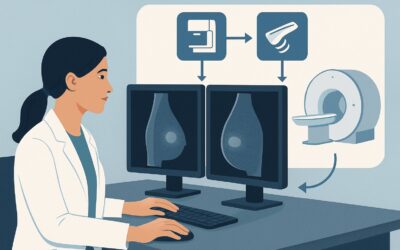
Why Is Imaging Not Recommended for Asymptomatic Saline Breast Implants?

A 42-year-old female with saline breast implants, placed a decade ago for cosmetic augmentation, presents for her annual physical. She has no breast complaints, no new lumps, and no concerns about the appearance or feel of her implants. During the exam, you confirm the implants are intact by physical assessment. You pause before closing the chart, wondering if any routine imaging is indicated to check the integrity of the implants themselves, separate from her standard cancer screening. For this specific clinical scenario—an asymptomatic patient with saline implants—the American College of Radiology (ACR) advises that dedicated implant imaging is Usually not appropriate. This article will detail the clinical workflow and rationale behind this recommendation, explaining why observation is the standard of care and when this approach should change.
Who Fits This Clinical Scenario?
This guidance applies to a very specific patient population: adults of any age, either female or transfeminine, who have saline-filled breast implants and are currently asymptomatic. The key inclusion criteria are the absence of any signs or symptoms related to the implants, such as pain, swelling, a new palpable mass, skin changes, or a visible change in breast size or shape that would suggest implant deflation.
It is critical to distinguish this scenario from others where imaging is often necessary. This workflow does not apply if:
- The patient has silicone implants. Asymptomatic screening for “silent rupture” of silicone implants is a distinct clinical question with different imaging recommendations, often involving MRI at specific intervals.
- Implant rupture is suspected. If a patient with saline implants presents with sudden deflation, pain, or other symptoms suggesting rupture, the clinical question changes. While saline rupture is typically a clinical diagnosis, imaging may be considered in equivocal cases.
- There is a new, palpable breast lump. A new lump requires a diagnostic workup (typically with mammography and/or ultrasound) to evaluate for breast cancer or other pathology, irrespective of the implant’s status. This guidance for implant evaluation does not replace standard breast cancer screening or diagnostic protocols.
What Is the Rationale for Clinical Follow-up Instead of Imaging?
In the asymptomatic patient with saline implants, the primary goal is to confirm the implants are intact and that no new, unrelated breast pathology has developed. Unlike silicone gel, which can leak into surrounding tissues without a noticeable change in breast volume (a “silent rupture”), saline is a sterile saltwater solution that is harmlessly absorbed by the body upon shell failure. This fundamental difference in material properties drives the difference in evaluation.
The “diagnosis” being confirmed in this scenario is, in essence, a normal, functioning implant. The clinical question is whether there is a low-yield indication to search for a problem that isn’t clinically apparent. The differential for an asymptomatic patient is narrow and reassuring:
- Intact Saline Implant: This is the overwhelmingly likely status. The implant shell is intact, and the saline is contained. Physical examination is typically sufficient to confirm this.
- “Silent” Saline Rupture (Extremely Unlikely): A theoretical concern is a slow leak or rupture that has not yet produced a noticeable change in breast volume. However, this is not a recognized clinical entity in the way silent silicone rupture is. A breach in a saline implant shell almost invariably leads to rapid deflation, which is a clinical symptom, moving the patient into a different evaluation pathway. Therefore, imaging to find a “silent” saline leak has virtually no diagnostic yield.
This workflow is separate from, and does not replace, age-appropriate breast cancer screening recommendations, which should be followed regardless of implant status.
Why Is Routine Imaging Usually Not Appropriate for This Presentation?
The ACR Appropriateness Criteria rates all dedicated imaging modalities—including ultrasound, mammography, and MRI—as “Usually not appropriate” for evaluating asymptomatic saline breast implants. The rationale is grounded in the high reliability of clinical examination and the extremely low pre-test probability of finding a clinically significant, occult abnormality related to the implant itself.
The defining characteristic of saline implants is that their rupture is a clinical event, not a radiologic finding. When a saline implant ruptures, the saline solution leaks out and is absorbed by the body, causing the breast to deflate. This change in size and shape is readily apparent to the patient and clinician. Therefore, ordering an imaging study to look for a rupture in an asymptomatic patient with normal-appearing breasts is a zero-yield endeavor.
Let’s review why specific modalities are not recommended:
- US breast: While ultrasound is excellent for evaluating focal breast symptoms and is a key tool in diagnosing silicone implant rupture, it offers no additional information for an intact-appearing saline implant. It is rated Usually not appropriate.
- Mammography and Digital Breast Tomosynthesis (DBT): These are primary tools for breast cancer screening, not implant integrity assessment. While implant-displaced views are used during screening mammography to visualize breast tissue, ordering a mammogram solely to check on an asymptomatic saline implant is not indicated. It exposes the patient to ionizing radiation (☢☢ 0.1-1mSv) without benefit for the clinical question at hand. Both are rated Usually not appropriate for this specific purpose.
- MRI breast (with or without contrast): MRI is the most sensitive study for evaluating silicone implant integrity. However, its high cost, longer scan time, and need for IV contrast (in some protocols) are not justified for evaluating saline implants, where rupture is clinically obvious. It provides no actionable information in this asymptomatic scenario and is rated Usually not appropriate.
What’s Next? Downstream Workflow and Patient Counseling
For a patient who fits this scenario, the workflow is straightforward and focuses on clinical management rather than imaging.
If the clinical exam is normal and the patient is asymptomatic:
The appropriate next step is reassurance and continued routine clinical follow-up. No imaging for the implant is needed. The patient should be counseled on two key points:
- The signs of implant rupture (sudden decrease in breast size, change in shape) and instructed to return if these occur.
- The importance of adhering to their standard, age-appropriate breast cancer screening schedule (e.g., screening mammography), which is a separate clinical pathway.
If the patient develops symptoms in the future:
If the patient later presents with a change in breast size, a palpable lump, or new pain, the clinical scenario has changed, and they no longer fit this “asymptomatic” workflow. The next step would be to re-evaluate based on the new symptom. For example, a suspected rupture would trigger a different ACR variant, and a new palpable lump would initiate a standard diagnostic breast imaging workup, typically starting with diagnostic mammography and/or targeted ultrasound.
Pitfalls to Avoid (and When to Escalate)
The primary pitfall in this scenario is ordering unnecessary imaging. Key mistakes to avoid include:
- Conflating Saline and Silicone Implant Surveillance: Applying silicone implant screening protocols (like periodic MRI) to patients with saline implants is a common error that leads to unnecessary cost and patient anxiety.
- Using Implant “Check-ups” to Justify Cancer Screening: Do not order a diagnostic mammogram to “check the implant” in a patient who is not yet due for her screening mammogram. The indications should be kept separate.
- Ignoring Patient Anxiety: While imaging is not medically indicated, some patients may have significant anxiety about their implants. The best approach is thorough counseling and education about why clinical follow-up is the standard of care, rather than ordering a low-yield test.
Escalation is simple: if the patient’s status changes from asymptomatic to symptomatic at any point, escalate to the appropriate diagnostic imaging workflow based on their new signs or symptoms.
Related ACR Topics and Tools
For a comprehensive overview of all clinical variants related to breast implant imaging, including scenarios involving silicone implants and suspected rupture, please see our parent guide. For further exploration of appropriateness criteria, imaging techniques, and radiation safety, the following resources are available:
- For breadth across all scenarios in Breast Implant Evaluation, see our parent guide: Breast Implant Evaluation: ACR Appropriateness Decoded.
- ACR Appropriateness Criteria Lookup — for adjacent scenarios
- Imaging Protocol Library — for technique on the recommended study
- Radiation Dose Calculator — for cumulative dose conversations
Frequently Asked Questions
Does this mean my patient with saline implants should never get a mammogram?
No. This guidance is strictly for evaluating the implant itself in an asymptomatic patient. It does not replace or alter standard, age-appropriate guidelines for breast cancer screening. Patients with implants should follow the same screening mammography schedule as those without implants.
What if my patient is unsure if her implants are saline or silicone?
If the implant type is unknown, the first step is to attempt to obtain the operative report or implant card from the patient or the original surgeon. If this is not possible and there is a strong clinical concern, the evaluation may need to proceed down a pathway for suspected silicone implant complications, where MRI is often the modality of choice.
If a saline implant ruptures, is it a medical emergency?
Saline implant rupture is not a medical emergency. Saline is sterile saltwater that is safely absorbed by the body. The primary result is a cosmetic change (deflation of the breast). Patients should be advised to schedule a non-urgent consultation with a plastic surgeon to discuss options for removal or replacement.
Can physical exam alone really be trusted to confirm saline implant integrity?
Yes, for saline implants, physical examination is highly reliable. Because rupture leads to deflation and a noticeable change in breast volume and feel, the absence of these signs in an asymptomatic patient provides sufficient confidence that the implant is intact. This is the core reason why imaging for this specific purpose has no added value.
What about concerns for Breast Implant-Associated Anaplastic Large Cell Lymphoma (BIA-ALCL)?
BIA-ALCL is a rare T-cell lymphoma that can develop in patients with textured-surface breast implants (both saline and silicone). The most common presenting symptom is a delayed seroma (fluid collection) causing breast swelling, pain, or a mass. An asymptomatic patient with a normal exam has a very low likelihood of BIA-ALCL. If symptoms develop, a diagnostic workup including ultrasound and fluid aspiration is indicated.
Reviewed by Pouyan Golshani, MD, Interventional Radiologist — May 29, 2026