Why Is Routine Imaging Not Recommended for Transfeminine Breast Cancer Screening Without Hormone Use?

A 48-year-old transfeminine patient presents for her annual physical. She has never used feminizing hormones and feels healthy but asks if she should start getting mammograms for breast cancer screening, similar to her cisgender female friends. She has no family history of breast cancer and no concerning symptoms on exam. As her physician, you must decide whether routine imaging is indicated. This is a common and important question, as guidelines for transgender individuals are evolving and require specific clinical nuance. For this exact scenario—an average-risk transfeminine patient with less than five years of hormone exposure—the American College of Radiology (ACR) rates all screening imaging modalities, including ultrasound, mammography, and MRI, as Usually not appropriate. This article will detail the clinical workflow and rationale behind this recommendation.
Who Fits This Clinical Scenario?
This guidance applies specifically to transfeminine (male-to-female) individuals who are at average risk for breast cancer and meet one of two key criteria regarding hormone use: they have either never used feminizing hormones (like estrogen) or have used them for a cumulative period of less than five years. This applies regardless of the patient’s current age.
“Average risk” implies the absence of significant risk factors that would independently warrant more intensive surveillance. These factors include known pathogenic mutations (e.g., BRCA1/2), a strong family history of breast or ovarian cancer, or a personal history of chest wall radiation at a young age.
It is critical to distinguish this scenario from others where screening is indicated:
- This guidance does not apply to transfeminine individuals with five or more years of cumulative hormone use, particularly those aged 40 and older. Long-term estrogen exposure promotes lobuloalveolar breast development, altering their risk profile to more closely resemble that of cisgender women, and screening mammography is often recommended for that group.
- This workflow is distinct from that for patients with a palpable lump or other clinical symptoms (e.g., nipple discharge, skin changes). A new, concerning physical finding always warrants a diagnostic workup, which is different from routine screening.
- The recommendations for transmasculine (female-to-male) individuals are entirely different and depend on whether they have had chest surgery (mastectomy).
What Diagnoses Are You Working Up in This Scenario?
In a screening context, the primary goal is to assess the patient’s underlying risk to determine if the benefits of detecting an occult cancer outweigh the harms of screening. For this specific patient population, the clinical reasoning centers on why their risk is considered too low to justify routine imaging.
Baseline Male Breast Cancer Risk: The central consideration is that without the proliferative effect of long-term, high-dose estrogen, the breast tissue of a transfeminine person remains structurally similar to that of a cisgender male. Therefore, their risk of developing breast cancer is comparable to the baseline risk in the cisgender male population. Routine population-wide screening is not recommended for cisgender men due to the very low incidence of breast cancer, and this same principle is applied here.
Gynecomastia: This benign enlargement of glandular breast tissue is a common finding and can be a source of patient concern or confusion. It can occur due to various factors, even without exogenous hormone use. While it may present as a palpable finding, gynecomastia itself is not considered a premalignant condition that necessitates routine imaging surveillance in the absence of other suspicious features.
Occult Breast Cancer: This is the theoretical target of any screening program. However, the decision to screen depends on whether the prevalence of the disease in the target population is high enough to make the screening test effective. For transfeminine individuals without significant hormone-driven breast development, the incidence of occult breast cancer is believed to be too low to justify the potential downsides of screening, such as false positives, unnecessary biopsies, patient anxiety, and radiation exposure.
Why Is Routine Imaging Screening Not Recommended for This Patient?
For an average-risk transfeminine patient with no or minimal (less than five years) hormone use, the ACR Appropriateness Criteria rate all available imaging modalities as Usually not appropriate for routine screening. The core rationale is that the potential harms of screening outweigh the very small potential benefit in this low-risk population.
The risk of breast cancer is strongly linked to cumulative estrogen exposure, which stimulates the development of terminal ductal lobular units—the tissue where most breast cancers arise. Without at least five years of consistent feminizing hormone therapy, this development is minimal. Consequently, the patient’s risk profile remains analogous to that of a cisgender man, for whom screening is not indicated.
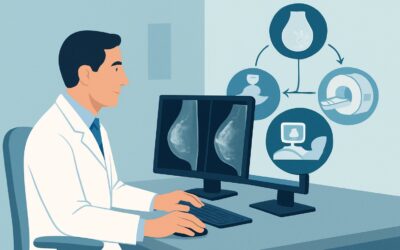
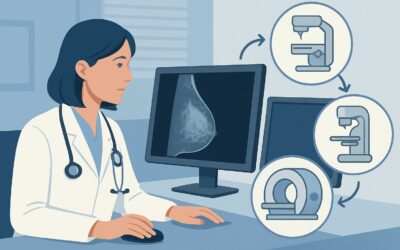
Examining the specific modalities clarifies why none are recommended for screening in this context:
- Mammography and Digital Breast Tomosynthesis (DBT): Both are rated Usually not appropriate. These studies involve ionizing radiation (ACR Relative Radiation Level ☢☢ 0.1-1mSv). In a population with a very low incidence of breast cancer, the small but real risk from cumulative radiation exposure is not justified. Furthermore, mammography in undeveloped or minimally developed breast tissue can be technically challenging and may have a higher rate of false-positive findings, leading to unnecessary follow-up tests and biopsies.
- Breast Ultrasound (US): Also rated Usually not appropriate for screening. While ultrasound involves no radiation (ACR RRL O 0 mSv), it has not been validated as a primary, standalone screening tool for breast cancer in any average-risk population. Its primary role is in the diagnostic setting to evaluate a specific clinical concern, such as a palpable lump found on physical exam. Using it for screening would lead to a high number of false positives for benign findings.
- Breast MRI (with or without contrast): Rated Usually not appropriate. MRI is a highly sensitive test reserved for screening individuals at very high risk (e.g., BRCA mutation carriers). Its lower specificity means it frequently identifies benign abnormalities, leading to a high rate of unnecessary biopsies. Given its high cost and resource intensity, it is unsuitable for screening an average-risk population.
What’s Next? Downstream Clinical Workflow
Since the recommended pathway is to forgo routine screening imaging, the downstream workflow focuses on clinical surveillance, risk assessment, and patient education rather than interpreting imaging results.
If No Imaging Is Ordered (Recommended Path): The cornerstone of management is shared decision-making and education.
- Clinical Breast Exam (CBE): Perform a thorough CBE as part of the annual physical examination.
- Patient Education: Counsel the patient on breast self-awareness. Encourage them to be familiar with their own chest and to report any new or persistent changes, such as a new lump, skin dimpling, redness, or nipple discharge, without delay.
- Re-evaluate Annually: Revisit the topic of hormone use and risk factors at each annual visit. If the patient initiates or continues hormone therapy, their screening eligibility will change once they reach the five-year cumulative use threshold.
If a Patient Develops a Symptom (e.g., a Palpable Lump): The workflow shifts immediately from screening to diagnostic workup. A new, focal, palpable finding is no longer a screening scenario. The first step would typically be a diagnostic mammogram and/or a targeted breast ultrasound to characterize the lesion. This is a different clinical question and falls under a different set of ACR guidelines for symptomatic patients.
Pitfalls to Avoid (and When to Get Help)
The primary pitfall in this scenario is ordering screening imaging based on an incorrect assumption about the patient’s risk level. Avoid applying screening guidelines for cisgender women to this distinct patient population. Another common error is mistaking benign gynecomastia for a finding that requires ongoing surveillance; unless it is symptomatic or has atypical features, it generally does not.
Do not dismiss a patient’s concerns. Even if screening is not indicated, their anxiety is real. Use the opportunity to provide clear education on why screening isn’t recommended and what they should watch for instead.
Escalate if a new, persistent, or suspicious finding emerges on clinical exam. In such cases, a referral for diagnostic imaging (not screening) is the appropriate next step. Consultation with a breast specialist or a provider with expertise in transgender healthcare can be valuable for complex cases or high-risk individuals.
Related ACR Topics and Tools
For a comprehensive overview of imaging recommendations across all transgender patient presentations, this article serves as a deep dive into one specific scenario. It’s important to understand how this guidance fits within the broader topic.
- For breadth across all scenarios in Transgender Breast Cancer Screening, see our parent guide: Transgender Breast Cancer Screening: ACR Appropriateness Decoded.
- To explore other clinical scenarios, use the ACR Appropriateness Criteria Lookup.
- For details on how specific studies are performed, see the Imaging Protocol Library.
- To discuss cumulative radiation exposure with patients, the Radiation Dose Calculator can be a helpful tool.
Frequently Asked Questions
Does this ‘no screening’ recommendation apply if the patient is over 50 years old?
Yes, for this specific scenario, age is not the determining factor. The recommendation to forgo routine screening applies to average-risk transfeminine individuals of any age, as long as they have used feminizing hormones for less than five years. The key driver of increased risk is cumulative estrogen exposure, not age alone.
What if my patient has a family history of breast cancer?
A significant family history may move the patient from ‘average risk’ to ‘high risk.’ This guidance is only for average-risk individuals. If there is a first-degree relative with breast cancer (especially premenopausal) or a known genetic mutation like BRCA1/2 in the family, the patient’s risk should be formally assessed. They may qualify for high-risk surveillance, which could include imaging like breast MRI, and a genetics consultation may be warranted.
If the patient starts hormone therapy tomorrow, when should they begin screening?
Screening recommendations typically change after five years of cumulative hormone use. If the patient starts hormone therapy, you should track their duration of use. Once they have been on hormones for five years and are also over the age of 40, they would fit a different clinical scenario where screening mammography is generally recommended, similar to cisgender women.
Is a clinical breast exam (CBE) sufficient for this population?
Yes, for routine surveillance in this specific low-risk group, a combination of annual clinical breast exams and patient education on breast self-awareness is the recommended standard of care. This approach maximizes the chance of detecting a palpable cancer while avoiding the harms of unnecessary imaging.
What if the patient has dense breast tissue or gynecomastia on exam?
Neither gynecomastia nor clinically assessed breast density in a transfeminine person with minimal hormone exposure is an independent indication for starting screening imaging. These are common, benign findings. The decision to screen should still be based on the overall risk profile, which is primarily determined by the duration of hormone therapy and other major risk factors.
Reviewed by Pouyan Golshani, MD, Interventional Radiologist — May 29, 2026