How Should You Treat Varicose Veins? An ACR-Guided Workflow for Lower Extremity Disease
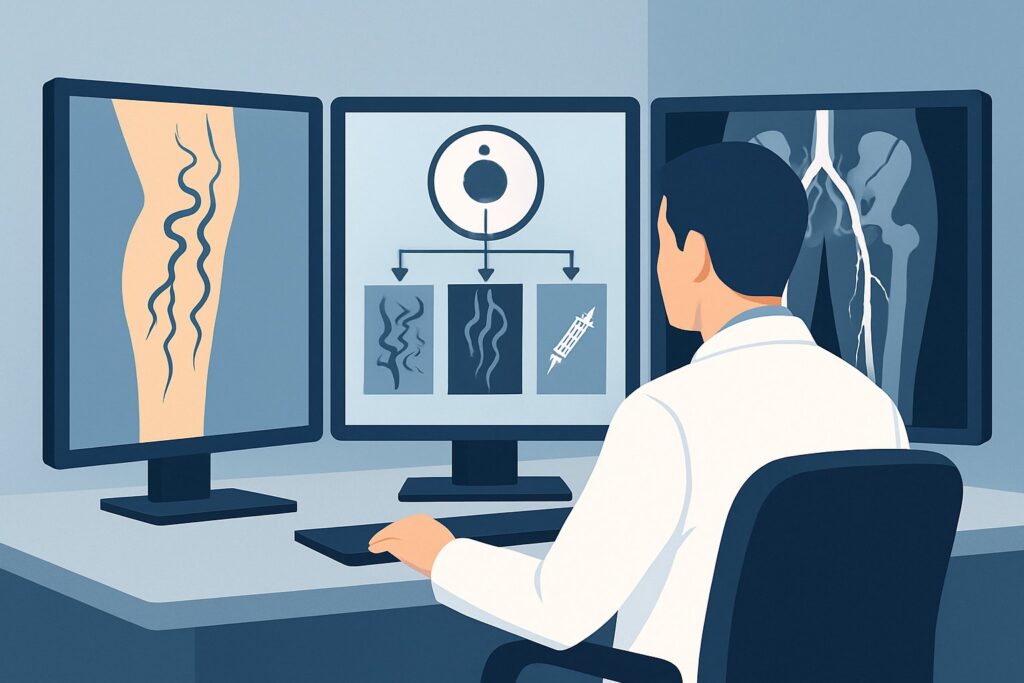
A 48-year-old teacher presents to your clinic for management of painful, bulging veins in her left leg, which have worsened over the past several years. She reports aching and a sense of heaviness, especially at the end of a long day on her feet. A prior diagnostic duplex ultrasound confirmed reflux in the great saphenous vein (GSV). Now, you must formulate a treatment plan. This clinical workflow article details the American College of Radiology (ACR) Appropriateness Criteria for this exact scenario: treatment of established varicose veins. The ACR rates multiple interventions, starting with the foundational, non-invasive approach of ‘Compression therapy’ as ‘Usually Appropriate’.
Who Fits This Clinical Scenario?
This guidance applies specifically to patients who have already been diagnosed with symptomatic varicose veins secondary to superficial venous insufficiency. The key inclusion criteria are:
- Visible, palpable, or symptomatic subcutaneous veins (varicose veins).
- Symptoms attributable to venous dysfunction, such as aching, heaviness, swelling, or throbbing.
- Prior diagnostic imaging (typically duplex ultrasound) confirming superficial venous reflux, most commonly in the great or small saphenous veins.
This workflow is not intended for patients with a different clinical presentation. It is crucial to distinguish this scenario from related but distinct clinical questions:
- Initial Diagnosis: If a patient presents with varicose veins but has not yet had a diagnostic ultrasound to confirm the source and extent of reflux, they fit the Varicose veins. Initial diagnosis. scenario.
- Venous Ulceration: Patients presenting with active or healed venous stasis ulcers require a different workup, detailed in the Venous leg ulcer. Initial diagnosis. and Treatment scenarios.
- Suspected Pelvic Origin: In female patients where varicosities extend to the thigh, perineum, or gluteal region, a pelvic source of reflux should be considered, which falls under the Suspected pelvic-origin lower extremity varicose veins variant.
What Are the Therapeutic Goals for Varicose Vein Treatment?
Unlike a diagnostic workup, the goal here is therapeutic intervention. The “differential” consists of the specific pathophysiologic targets that treatment aims to correct. A successful plan addresses the underlying cause, not just the visible symptoms.
Superficial Venous Insufficiency (SVI)
This is the primary target and the root cause of most varicose veins. Incompetent valves within the major superficial veins—most often the great saphenous vein (GSV) or small saphenous vein (SSV)—allow blood to flow backward (reflux), leading to increased pressure downstream. The primary goal of definitive treatment is to eliminate this source of reflux by closing or removing the incompetent axial vein.
Tributary Varicosities
These are the visible, bulging, and often painful veins on the skin surface. They are dilated branches that arise from the incompetent axial vein (like the GSV). While they are the patient’s chief cosmetic and symptomatic complaint, they are a consequence of the underlying SVI. Treatment must address both the source (axial vein) and these tributaries for a durable and satisfactory result.
Venous Hypertension
This is the underlying physiological consequence of venous reflux. The elevated pressure within the veins of the lower leg causes the classic symptoms of chronic venous disease: aching, pain, heaviness, swelling (edema), and, in advanced stages, skin changes and ulceration. All effective treatments for varicose veins work by reducing this ambulatory venous hypertension, thereby alleviating symptoms and preventing disease progression.
Why Are Minimally Invasive Options Rated ‘Usually Appropriate’ for Varicose Veins?
The ACR panel provides clear guidance on the modern, tiered approach to treating varicose veins, prioritizing conservative and minimally invasive techniques. All recommended procedures are performed without ionizing radiation.
The foundational treatment, rated Usually appropriate, is Compression therapy. Graduated compression stockings or wraps are the cornerstone of conservative management. They work by providing external support to the veins, which reduces venous diameter, improves valvular function, and decreases venous hypertension. This alleviates symptoms like pain and swelling and is a critical first step or adjunct to more invasive procedures. For some patients with mild symptoms or contraindications to procedures, it may be the only treatment required.
For definitive correction of reflux, several minimally invasive options are also rated Usually appropriate:
- Saphenous vein ablation: This includes endovenous thermal ablation techniques like radiofrequency ablation (RFA) and endovenous laser ablation (EVLA). A catheter is inserted into the incompetent saphenous vein under ultrasound guidance, and thermal energy is used to close the vein from the inside. These methods have largely replaced traditional surgery due to high efficacy, minimal discomfort, and rapid recovery.
- Compression sclerotherapy: This involves injecting a chemical sclerosant (often in foam form) into the vein to induce inflammation and closure. It is highly effective for treating tributary varicosities and can also be used for smaller truncal veins.
- Microphlebectomy: Also known as ambulatory phlebectomy, this procedure involves the physical removal of large, bulging varicose veins through tiny incisions. It is often performed at the same time as saphenous vein ablation to provide an immediate cosmetic and symptomatic improvement.
In contrast, the traditional surgical approach, Ligation and stripping, is rated May be appropriate. This procedure involves surgically ligating the saphenofemoral junction and physically removing the saphenous vein. While effective, it is more invasive, requires more anesthesia, results in a longer and more painful recovery, and has a higher risk of complications and neovascularization (the regrowth of new, abnormal veins) compared to endovenous ablation techniques. It is now reserved for select cases, such as extremely large or tortuous veins unsuitable for a catheter.
What’s Next After Treatment? Downstream Workflow
The clinical workflow does not end with the procedure. Careful follow-up is essential to ensure treatment success and manage patient expectations for this chronic condition.
If the initial treatment is successful: A follow-up visit, often including a duplex ultrasound, is typically scheduled between one week and one month post-procedure. The goals are to confirm the successful closure of the treated axial vein (e.g., GSV), assess for any residual reflux, and rule out deep vein thrombosis (DVT), which is a rare but important potential complication. Patients are counseled on continued compression therapy during the recovery period and long-term lifestyle modifications.
If symptoms persist or recur shortly after treatment: If a patient’s symptoms of aching or heaviness do not resolve, a repeat duplex ultrasound is the next step. This evaluation looks for incomplete closure of the treated vein, recanalization, or a missed source of reflux, such as an incompetent perforator vein or accessory saphenous vein. These findings may necessitate a secondary, targeted procedure like additional sclerotherapy.
If new varicose veins appear years later: Chronic venous disease is a progressive condition, and it is not uncommon for new varicose veins to develop over time. This does not necessarily represent a failure of the initial treatment. The next step is a comprehensive clinical and ultrasound re-evaluation to map the new pattern of venous reflux. The patient may be a candidate for further treatment on a different set of veins.
Pitfalls to Avoid (and When to Get Help)
Navigating varicose vein treatment requires careful planning to avoid common errors that can lead to suboptimal outcomes or complications.
- Treating Tributaries, Ignoring the Trunk: A frequent mistake is performing sclerotherapy or microphlebectomy on visible varicosities without first treating the underlying source of axial reflux (e.g., an incompetent GSV). This “treating the branches but not the root” approach almost guarantees rapid recurrence.
- Inadequate Post-Procedure Compression: Failing to ensure patient compliance with prescribed compression therapy after a procedure can compromise results, particularly after sclerotherapy, and increase the risk of side effects like skin staining and phlebitis.
- Overlooking Deep Venous Disease: Before embarking on superficial vein treatment, it is critical to ensure the deep venous system is patent and functional. Ablating a major superficial vein in the setting of deep vein obstruction can have serious consequences. A thorough pre-procedure duplex scan is mandatory.
Escalate immediately if a patient develops significant calf pain and swelling post-procedure that is out of proportion to expected recovery; this is a red flag for DVT and requires an urgent duplex ultrasound.
Related ACR Topics and Tools
For a comprehensive overview of all clinical scenarios related to this condition, from initial diagnosis to managing complications, please see our parent guide. It provides a breadth of information that complements this in-depth workflow.
- Parent Topic Hub: For breadth across all scenarios in Lower Extremity Chronic Venous Disease, see our parent guide: Lower Extremity Chronic Venous Disease: ACR Appropriateness Decoded.
- ACR Criteria Lookup: To explore adjacent scenarios or other clinical questions, use the ACR Appropriateness Criteria Lookup.
- Imaging Protocols: For details on the techniques used in venous duplex ultrasound, consult the Imaging Protocol Library.
- Radiation Dose: While the treatments discussed here do not use ionizing radiation, you can discuss cumulative exposure from other studies with patients using the Radiation Dose Calculator.
Frequently Asked Questions
Is treatment for varicose veins purely cosmetic?
No. While there is a cosmetic component, varicose veins are a manifestation of chronic venous disease and underlying venous hypertension. Treatment is considered medically necessary to alleviate symptoms like pain, swelling, and heaviness, and to prevent progression to more severe stages, such as skin changes or venous ulcers.
Why is compression therapy recommended if it doesn’t eliminate the veins?
Compression therapy is a foundational treatment that manages the symptoms of venous hypertension by providing external support to the veins. It reduces swelling and aching and can slow disease progression. While it doesn’t permanently eliminate the refluxing veins, it is a low-risk, effective way to manage the condition and is a critical adjunct both before and after definitive procedures.
What is the main difference between saphenous vein ablation and sclerotherapy?
Saphenous vein ablation uses thermal energy (heat from radiofrequency or laser) delivered via a catheter to close the main incompetent superficial vein, like the great saphenous vein. Sclerotherapy involves injecting a chemical solution (sclerosant) to damage the vein wall and cause it to close. Ablation is typically used for larger truncal veins, while sclerotherapy is often used for smaller tributary varicosities or residual veins after ablation.
Do varicose veins always come back after treatment?
Modern endovenous treatments have very high long-term success rates for the treated veins. However, chronic venous disease is a progressive condition, and new varicose veins can develop in other locations over a patient’s lifetime. This is not considered a failure of the original treatment but rather a progression of the underlying disease, which may require future evaluation and management.
When is the older ‘vein stripping’ surgery still considered?
Vein ligation and stripping is rated ‘May be appropriate’ and is now used infrequently. It may be considered in specific cases where endovenous catheter-based treatments are not feasible, such as for veins that are exceptionally large in diameter, extremely tortuous, or very superficial. It may also be an option after multiple failed endovenous procedures, though this is rare.
Reviewed by Pouyan Golshani, MD, Interventional Radiologist — May 30, 2026