Should You Biopsy a Large Adrenal Mass in a Patient with a History of Cancer?
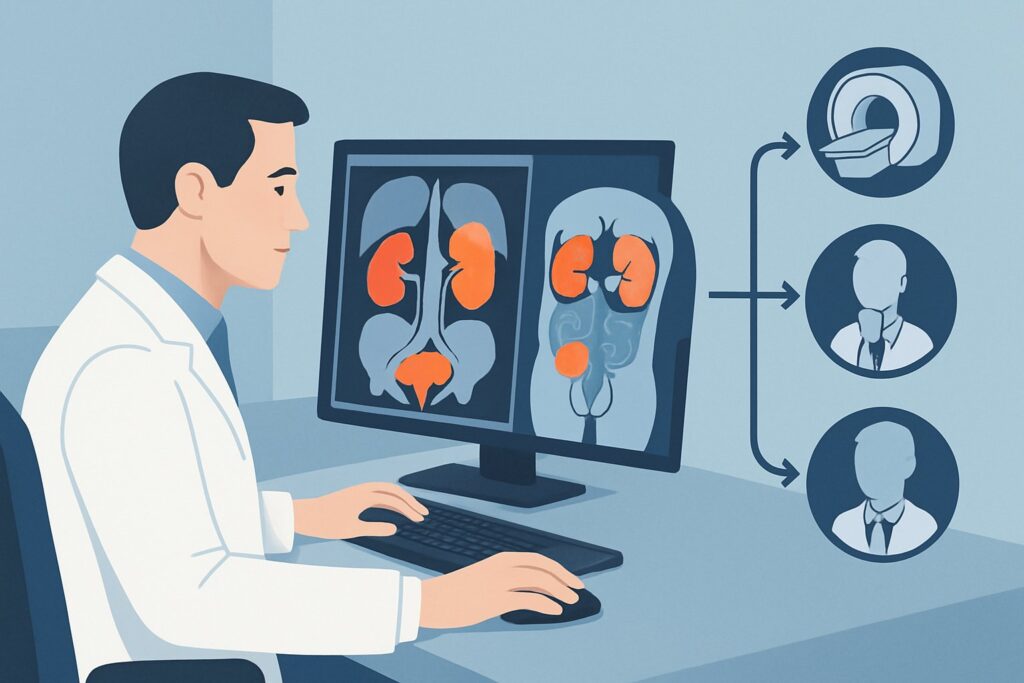
A 68-year-old patient with a history of non-small cell lung cancer, stable after treatment, comes in for routine surveillance imaging. The radiologist calls you: the follow-up chest Computed Tomography (CT) includes the upper abdomen and shows a new, solid-appearing 4.5 cm left adrenal mass. It has no fat and doesn’t look like a simple cyst. The immediate question is whether this represents metastatic disease, a new primary adrenal cancer, or a benign incidental finding. Deciding the next step is critical for staging and treatment planning. This is a high-stakes scenario where further imaging may not be enough, and a tissue diagnosis is often necessary.
For this specific clinical presentation—an adrenal mass ≥ 4 cm with no diagnostically benign features in a patient with a known malignancy—the American College of Radiology (ACR) Appropriateness Criteria rate Image-guided biopsy adrenal gland as Usually Appropriate.
Who Fits This Clinical Scenario?
This guidance applies to a very specific patient population where the clinical suspicion for malignancy is high. The inclusion criteria are precise:
- Adrenal Mass Size: The mass measures 4 centimeters or larger in its greatest dimension. Size is a significant independent risk factor for malignancy.
- Indeterminate Features: The initial imaging (likely a CT or MRI performed for other reasons) does not show features of a definitively benign lesion. This means it is not a simple cyst and does not have the characteristic low density of a lipid-rich adenoma (typically ≤10 Hounsfield units on non-contrast CT).
- History of Malignancy: The patient has a known current or prior diagnosis of an extra-adrenal cancer, such as lung, breast, renal, or melanoma, which have a propensity to metastasize to the adrenal glands.
This workflow is distinct from other common adrenal mass scenarios. For example, a patient with a similar large, indeterminate mass but no history of malignancy would follow a different diagnostic path, often prioritizing surgical evaluation. Similarly, a patient with a history of cancer but a smaller adrenal mass (< 4 cm) might first undergo dedicated non-invasive imaging like an adrenal-protocol CT or chemical-shift MRI to attempt characterization before considering biopsy. This article is exclusively for the high-risk combination of large size and a known primary cancer.
What Diagnoses Are You Working Up in This Scenario?
When a large, indeterminate adrenal mass appears in a patient with a known cancer, the differential diagnosis is narrow but consequential. The primary goal of the workup is to distinguish between a few key possibilities that have vastly different implications for treatment.
Adrenal Metastasis
This is the leading concern. The adrenal glands are a common site for metastatic spread from many primary tumors, most notably lung cancer, breast cancer, renal cell carcinoma, and melanoma. Confirming an adrenal metastasis establishes Stage IV disease, which typically shifts the treatment paradigm to systemic therapy rather than local or surgical intervention for the primary cancer. The biopsy’s role is to provide definitive histologic proof.
Adrenocortical Carcinoma (ACC)
While less common than metastases, a new primary adrenal malignancy must be considered. ACC is a rare but aggressive cancer, and a size greater than 4 cm is a major warning sign. Differentiating an ACC from a metastasis is impossible on imaging alone and requires tissue pathology. This distinction is critical, as the management of ACC involves specialized surgical resection and adjuvant therapy, a completely different path from treating a metastasis.
Pheochromocytoma
This neuroendocrine tumor of the adrenal medulla is a crucial “can’t-miss” diagnosis. While it can be benign or malignant, the immediate risk is the potential for the tumor to secrete catecholamines, leading to life-threatening hypertensive crisis, especially if provoked by a procedure like a biopsy. Though less common than metastases in this context, it must be biochemically excluded before any invasive procedure is planned.
Large, Benign Lesion
It is possible, though less likely given the size, that the mass is a benign entity like a lipid-poor adenoma or a myelolipoma with minimal fat. In a patient without a cancer history, surveillance or non-invasive imaging might be an option. However, in the setting of a known malignancy, the risk of misdiagnosing a metastasis as a benign lesion is too high, making tissue sampling the more prudent course.
Why Is Image-guided Biopsy the Recommended Study for This Presentation?
In this high-risk scenario, the clinical question has evolved from “What is it?” to “Is this a metastasis, and what is the cell type?” Answering this requires tissue. The ACR rates Image-guided biopsy adrenal gland as Usually Appropriate because it provides the most direct and definitive diagnostic information needed to guide oncology treatment.
The primary rationale is to obtain a histologic diagnosis. This confirms or refutes the presence of metastatic disease, which directly impacts the patient’s cancer stage and systemic therapy plan. If the histology is inconsistent with the known primary cancer, it raises the possibility of a new primary like ACC, triggering a different and urgent management pathway.
The ACR also rates FDG-PET/CT skull base to mid-thigh as Usually Appropriate. This study is highly valuable for several reasons. It can confirm the metabolic activity of the adrenal lesion, which is typically high in both metastases and ACC. More importantly, it provides whole-body staging in a single scan, potentially identifying other sites of metastatic disease that were not previously known. For FDG-avid primary tumors (like most non-small cell lung cancers), PET/CT is an excellent choice, sometimes performed in conjunction with or even preceding biopsy.
Why are other imaging studies rated lower?
- CT abdomen without and with IV contrast and MRI abdomen without and with IV contrast are rated Usually Not Appropriate. At this stage, another round of standard cross-sectional imaging is unlikely to be diagnostic. The mass has already been identified as indeterminate on initial imaging. While specialized techniques like adrenal-protocol CT (with washout calculation) or chemical-shift MRI can characterize smaller adenomas, their diagnostic accuracy decreases for large, heterogeneous masses, and they cannot reliably differentiate a metastasis from an ACC. The need for a definitive tissue diagnosis outweighs the potential benefit of more non-invasive imaging.
The radiation dose for a CT-guided biopsy is variable but localized, whereas an FDG-PET/CT involves a significant systemic dose (ACR RRL ☢☢☢☢). The decision between these two appropriate options often depends on whether systemic staging (favoring PET/CT) or a rapid tissue diagnosis (favoring biopsy) is the more pressing clinical need.
What’s Next After Image-guided Biopsy? Downstream Workflow
The pathology results from the adrenal biopsy will dictate the subsequent clinical pathway. The workflow branches significantly based on the findings.
- Result: Metastasis from the known primary cancer.
This confirms Stage IV disease. The patient’s care plan will be managed by their oncologist, focusing on systemic therapy (chemotherapy, immunotherapy, targeted therapy) appropriate for their primary tumor type. Further local treatment of the adrenal mass is typically not pursued unless it is causing symptoms or is part of an oligometastatic treatment strategy.
- Result: Adrenocortical Carcinoma (ACC) or other primary adrenal malignancy.
This is a new cancer diagnosis. The patient requires urgent referral to a multidisciplinary team with expertise in adrenal tumors, including an endocrine surgeon and medical endocrinologist. Staging workup, typically with dedicated chest, abdomen, and pelvis CT, is performed, followed by surgical resection if the disease is localized.
- Result: Pheochromocytoma.
If the biopsy was performed without prior biochemical screening and returns as a pheochromocytoma, the patient must be managed carefully for potential catecholamine-induced hemodynamic instability. The definitive treatment is surgical resection after appropriate medical preparation with alpha- and beta-adrenergic blockade. This result underscores the critical importance of pre-biopsy biochemical testing.
- Result: Benign tissue or non-diagnostic sample.
A benign result (e.g., adenoma) is reassuring but must be interpreted with caution. Given the large size of the mass and the clinical context, sampling error is a concern. If the pre-test suspicion for malignancy remains high, the case should be discussed at a multidisciplinary tumor board. Options include surgical excision for definitive diagnosis or a repeat biopsy, potentially targeting a different area of the mass.
Pitfalls to Avoid (and When to Get Help)
Navigating this scenario requires careful planning to avoid significant complications. Here are key pitfalls to watch for:
1. Biopsy of an Unsuspected Pheochromocytoma: This is the most dangerous pitfall. A percutaneous biopsy can provoke a massive release of catecholamines, leading to a life-threatening hypertensive crisis. Always perform biochemical screening with plasma free metanephrines or 24-hour urinary fractionated metanephrines and catecholamines before scheduling a biopsy.
2. Assuming the Mass is a Metastasis: While metastasis is the most likely diagnosis, the possibility of a new primary cancer (ACC) or a functional tumor must be considered. A tissue diagnosis is essential to avoid incorrect staging or treatment.
3. Accepting a Non-Diagnostic Biopsy at Face Value: Large malignant masses often have areas of central necrosis. A biopsy sample that returns as “necrotic tissue” or is otherwise non-diagnostic is not a negative result. This warrants a discussion with the interventional radiologist about re-sampling or proceeding to surgical excision.
If there is any clinical or biochemical suspicion of a hormonally active tumor (e.g., symptoms of Cushing’s syndrome, hypertension, hypokalemia), an endocrinology consultation is mandatory before any invasive procedure.
Related ACR Topics and Tools
This article covers one specific clinical variant. For a comprehensive overview of all scenarios, from small incidentalomas to functional tumors, refer to the parent topic guide. The following resources can also help you apply these principles in your practice.
- For breadth across all scenarios in Adrenal Mass Evaluation, see our parent guide: Adrenal Mass Evaluation: ACR Appropriateness Decoded.
- ACR Appropriateness Criteria Lookup: Look up other clinical variants or different imaging topics.
- Imaging Protocol Library: Review technical specifications for various imaging studies.
- Radiation Dose Calculator: Discuss cumulative radiation exposure with patients when considering studies like PET/CT.
Frequently Asked Questions
Why is biochemical screening for pheochromocytoma so important before biopsy?
A pheochromocytoma is a tumor that can secrete high levels of catecholamines (e.g., adrenaline). An invasive procedure like a biopsy can trigger a massive release of these hormones, causing a potentially fatal hypertensive crisis, arrhythmia, or myocardial infarction. Screening with blood or urine tests to rule out this diagnosis is a critical safety step before any adrenal biopsy.
If FDG-PET/CT is also ‘Usually Appropriate’, when should I choose it over a biopsy?
FDG-PET/CT is an excellent choice when whole-body staging is a priority. If you need to know whether the patient has other metastatic sites in addition to the adrenal mass, PET/CT provides that information. A biopsy is preferred when a definitive tissue diagnosis from the adrenal lesion itself is the most critical next step to guide immediate treatment, or if the primary tumor is not known to be FDG-avid.
What if the biopsy is non-diagnostic?
A non-diagnostic biopsy from a large, suspicious mass is not a reassuring result. It often means the sample was taken from a necrotic or non-representative area. The next step should be a multidisciplinary discussion with the radiologist, oncologist, and surgeon. Options include a repeat biopsy, possibly targeting a different part of the mass, or proceeding directly to surgical excision for a definitive diagnosis.
Does the type of primary cancer matter in this decision?
Yes, absolutely. If the patient has a primary cancer with a very high likelihood of adrenal metastasis (like lung cancer or melanoma), the pre-test probability that the adrenal mass is a metastasis is extremely high. Conversely, for a primary cancer that rarely metastasizes to the adrenals, the suspicion for a new primary adrenal cancer (ACC) or a benign lesion might be relatively higher. This context helps frame the discussion but does not eliminate the need for a definitive diagnosis.
Is there a risk of tumor seeding with an adrenal biopsy?
There is a theoretical risk of seeding tumor cells along the needle track during a biopsy. This is a particular concern for adrenocortical carcinoma (ACC). However, the risk is generally considered low, and the immediate benefit of obtaining a definitive diagnosis to guide systemic therapy or plan for surgery almost always outweighs this risk. The procedure should be performed by an experienced interventional radiologist to minimize complications.
Reviewed by Pouyan Golshani, MD, Interventional Radiologist — May 29, 2026