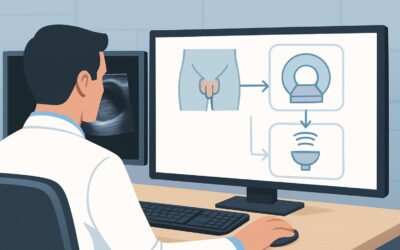
What Imaging Is Best for Symptomatic Nonmuscle Invasive Bladder Cancer Surveillance?

A 68-year-old patient with a history of high-grade nonmuscle invasive bladder cancer (NMIBC), treated six months ago with transurethral resection (TURBT) and intravesical BCG, presents to your urology clinic with new-onset gross hematuria. Office cystoscopy shows some post-treatment inflammation but no obvious intraluminal recurrence. You are concerned about a new or recurrent tumor in the bladder wall or, more critically, in the upper urinary tracts. The immediate clinical question is which imaging study will most effectively evaluate the entire urothelium without exposing the patient to unnecessary risk. According to the American College of Radiology (ACR) Appropriateness Criteria, for this specific scenario, Magnetic Resonance Urography (MRU) without and with IV contrast is rated Usually appropriate.
Who Fits This Clinical Scenario?
This guidance applies specifically to patients undergoing post-treatment surveillance for nonmuscle invasive bladder cancer (NMIBC) who now present with new symptoms or possess specific risk factors for recurrence or progression. NMIBC is defined as urothelial carcinoma confined to the mucosa (stage Ta, Tis) or submucosa (stage T1).
Inclusion criteria for this workflow:
- A confirmed history of NMIBC that has been treated (e.g., via TURBT with or without intravesical therapy).
- The presence of new, concerning clinical symptoms such as gross or microscopic hematuria, flank pain, or irritative voiding symptoms.
- The presence of risk factors for upper tract urothelial carcinoma (UTUC), such as high-grade histology, carcinoma in situ (CIS), large or multifocal bladder tumors, or a tumor located near a ureteral orifice.
It is crucial to distinguish this situation from other common surveillance scenarios. This workflow does not apply to:
- Asymptomatic NMIBC Surveillance: Patients with low-risk NMIBC who are asymptomatic and undergoing routine follow-up. That presentation follows a different surveillance protocol, often relying primarily on cystoscopy and urine cytology.
- Muscle-Invasive Bladder Cancer (MIBC): Patients with a history of T2 or higher stage disease, who have undergone radical cystectomy or chemoradiation. Their surveillance is focused on detecting local recurrence in the pelvis and distant metastatic disease, requiring a different imaging strategy.
What Diagnoses Are You Working Up in This Scenario?
When a patient with a history of NMIBC develops new symptoms, the imaging workup is designed to investigate several potential, and often overlapping, diagnoses. The primary goal is to detect recurrent or new urothelial carcinoma, particularly in locations not easily visualized by cystoscopy.
Upper Tract Urothelial Carcinoma (UTUC): This is the most critical diagnosis to exclude. Patients with bladder cancer have a significantly increased risk of developing synchronous or metachronous tumors in the renal pelvis or ureters. Symptoms like hematuria or flank pain are classic red flags for a new upper tract lesion that requires dedicated urothelial imaging to detect.
Bladder Cancer Recurrence: While office cystoscopy is the gold standard for detecting intraluminal bladder tumors, it can miss small, flat lesions (CIS) or tumors located in a bladder diverticulum. Cross-sectional imaging can identify bladder wall thickening or subtle enhancing lesions that may warrant a repeat TURBT under anesthesia for definitive diagnosis and staging.
Metastatic Disease: Although NMIBC is by definition not invasive into the muscle, high-risk variants (high-grade T1, CIS) carry a risk of progression and metastasis to pelvic lymph nodes or distant sites. While less common than in MIBC, the onset of new symptoms should prompt an evaluation for regional nodal involvement, which is well-visualized on cross-sectional studies.
Benign Post-Treatment Complications: Not all symptoms are due to recurrence. Ureteral strictures secondary to prior surgery or intravesical therapy can cause flank pain and hydronephrosis. Similarly, radiation cystitis or benign inflammatory changes can mimic malignancy. Imaging helps differentiate these etiologies from active cancer.
Why Is MR Urography the Recommended Study for This Presentation?
For a symptomatic patient with a history of NMIBC, the ACR designates both MR Urography (MRU) without and with IV contrast and CT Urography (CTU) without and with IV contrast as Usually appropriate. However, MRU offers distinct advantages in the context of ongoing surveillance.
The primary strength of MRU is its superior soft-tissue contrast resolution without the use of ionizing radiation. This allows for detailed evaluation of the bladder wall, perivesical tissues, and the urothelium of the ureters and renal pelvices. It is highly sensitive for detecting small, enhancing tumors that might be missed on other modalities. The lack of radiation (0 mSv) is a significant benefit for patients who may require repeated imaging studies over many years as part of their cancer surveillance.
In contrast, while CTU is also Usually appropriate and offers excellent spatial resolution and speed, it involves a substantial radiation dose (☢☢☢☢ 10-30 mSv). This cumulative radiation exposure is a key consideration in a surveillance population. CTU remains an excellent alternative if MRU is contraindicated (e.g., incompatible implants, severe claustrophobia) or unavailable.
Other imaging modalities are rated lower for this specific clinical question. For example:
- US pelvis (bladder) is rated Usually not appropriate. While it can detect larger intraluminal bladder masses, it provides poor visualization of the upper tracts and lacks the sensitivity to detect flat lesions or subtle wall thickening, making it inadequate for a comprehensive evaluation in a high-risk, symptomatic patient.
- MRI abdomen and pelvis without IV contrast is also Usually not appropriate. The administration of gadolinium-based contrast is essential for identifying and characterizing enhancing urothelial lesions. A non-contrast study severely limits the diagnostic yield for detecting active tumor recurrence.
When ordering MRU, it is crucial to specify a protocol that includes non-contrast, contrast-enhanced, and delayed excretory-phase imaging to fully opacify and distend the collecting systems, ureters, and bladder for optimal urothelial evaluation.
What’s Next After MR Urography? Downstream Workflow
The results of the MRU will directly guide the subsequent clinical management. The workflow branches based on whether the findings are positive, negative, or indeterminate for malignancy.
If the MRU is positive for a suspected upper tract lesion: The next step is typically diagnostic ureteroscopy. This allows for direct visualization, biopsy, and potential laser ablation of the suspicious lesion. The location and size of the finding on MRU are critical for planning the endoscopic approach.
If the MRU is positive for a suspected bladder lesion: Even if office cystoscopy was equivocal, a new enhancing lesion or focal wall thickening on MRU warrants an examination under anesthesia with repeat TURBT. This allows for definitive histopathologic diagnosis, staging, and treatment.
If the MRU is negative: A negative high-quality MRU provides strong evidence against a significant upper tract or occult bladder tumor. If symptoms like hematuria persist, the focus shifts to other potential causes, such as nephrologic disease, benign prostatic hyperplasia, or urinary tract infection. Further workup may include repeat urine cytology or a renal parenchymal evaluation if not already performed.
If the MRU is indeterminate: Findings such as focal wall thickening, mild hydronephrosis, or a non-specific enhancing focus can be challenging. In these cases, the next step depends on the level of suspicion. Options include short-term follow-up imaging (e.g., a repeat MRU in 3-6 months), proceeding directly to ureteroscopy to investigate an upper tract finding, or performing a TURBT for a suspicious bladder finding.
Pitfalls to Avoid (and When to Get Help)
Navigating the imaging workup for symptomatic NMIBC requires careful attention to detail to avoid common errors.
- Misinterpreting Post-Treatment Inflammation: Both surgery (TURBT) and intravesical therapy (BCG) cause significant inflammation that can mimic tumor recurrence on imaging. Providing a detailed clinical history, including the date and type of recent treatments, is essential for the interpreting radiologist.
- Ordering a Non-Urography Protocol: A standard “MRI of the abdomen/pelvis” is not the same as an MRU. A dedicated urography protocol with specific excretory phase imaging is required to evaluate the ureters and renal pelvices. Be explicit in your order.
- Ignoring Renal Function: Both gadolinium-based contrast agents (for MRU) and iodinated contrast agents (for CTU) have implications for patients with renal insufficiency. Always check the patient’s estimated Glomerular Filtration Rate (eGFR) before ordering a contrast-enhanced study.
- Over-reliance on a Negative Cystoscopy: In a high-risk, symptomatic patient, a negative office cystoscopy is not sufficient to rule out disease. Do not delay upper tract imaging based on a clear bladder alone.
If imaging findings are complex or discordant with the clinical picture, a discussion at a multidisciplinary tumor board with urology, radiology, and oncology can be invaluable for determining the optimal next step.
Related ACR Topics and Tools
For a comprehensive overview of imaging across all bladder cancer surveillance scenarios, from low-risk asymptomatic patients to post-cystectomy follow-up, please consult our parent topic hub article. For tools to assist in ordering the correct study and understanding the technical details, see the resources below.
- For breadth across all scenarios in Post-Treatment Surveillance of Bladder Cancer, see our parent guide: Post-Treatment Surveillance of Bladder Cancer: ACR Appropriateness Decoded.
- To look up appropriateness criteria for adjacent or alternative clinical scenarios, use the Imaging Appropriateness Selector.
- To review technical specifications for various imaging studies, including MRU and CTU, visit the Imaging Protocol Library.
- To discuss cumulative radiation exposure with your patients, especially when considering CTU, our Radiation Dose Calculator can be a helpful aid.
Frequently Asked Questions
If my patient has a contraindication to MRI, what is the best alternative?
If a patient cannot undergo an MRI (e.g., due to an incompatible pacemaker or severe claustrophobia), CT Urography (CTU) without and with IV contrast is the best alternative. It is also rated as ‘Usually appropriate’ by the ACR for this scenario and provides excellent detail of the urothelium, though it involves a significant radiation dose.
Why is CTU also rated ‘Usually appropriate’ if MRU has no radiation?
Both CTU and MRU are highly effective at diagnosing upper tract urothelial carcinoma. The ACR rates both as ‘Usually appropriate’ because they are considered diagnostically equivalent for the primary clinical question. The choice between them often comes down to local availability, radiologist expertise, patient factors (like MRI contraindications or renal function), and the desire to minimize cumulative radiation dose in a surveillance setting, which favors MRU.
How often should upper tract imaging be performed in a patient with high-risk NMIBC?
The optimal frequency is debated and depends on individual risk factors. Guidelines from the American Urological Association (AUA) suggest baseline upper tract imaging for all patients with NMIBC. For high-risk patients, surveillance imaging is recommended, with some experts suggesting imaging every 1-2 years, though this should be tailored to the individual patient’s history and clinical course.
Can I just order a CT of the abdomen and pelvis with contrast instead of a full CT Urography?
No, a standard contrast-enhanced CT of the abdomen and pelvis is not sufficient. A CT Urography protocol is specifically designed to evaluate the urinary system and includes a non-contrast phase (for stones), a nephrographic phase (for renal masses), and a crucial delayed excretory phase. This delayed phase is when contrast fills the collecting systems, ureters, and bladder, allowing for the detection of urothelial tumors, which would be missed on a standard protocol.
What if the patient’s hematuria resolves before the scheduled MRU?
For a patient with high-risk NMIBC, transient or resolved gross hematuria should still be investigated with upper tract imaging. The risk of an underlying malignancy, particularly UTUC, remains high, and the absence of active bleeding does not exclude the presence of a tumor. It is generally recommended to proceed with the scheduled MRU.
Reviewed by Pouyan Golshani, MD, Interventional Radiologist — May 26, 2026