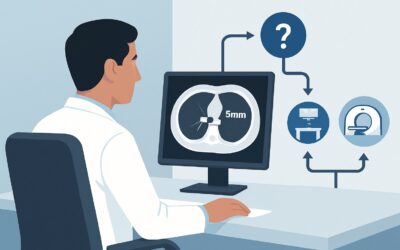
Should You Order a Chest X-Ray for a Cough with a Normal Exam?

A 35-year-old patient presents to your outpatient clinic on a Friday afternoon with a persistent, non-productive cough for the past week. They report feeling tired but have no fevers, chills, or significant shortness of breath. On examination, their vital signs are entirely normal, including an oxygen saturation of 99% on room air. Auscultation of the lungs is clear, with no wheezes, crackles, or rhonchi. The patient is anxious about “walking pneumonia” and asks if they need an x-ray. This common clinical crossroads—balancing diagnostic yield against unnecessary testing in a low-risk patient—is the focus of this workflow.
For an immunocompetent adult with an acute respiratory illness but a negative physical exam and normal vitals, the American College of Radiology (ACR) rates Radiography chest as May be appropriate (Disagreement). This article unpacks the nuance behind that rating, guiding you through the decision-making process, differential diagnosis, and downstream actions for this specific low-acuity scenario.
Who Fits This Clinical Scenario?
This guidance applies to a very specific patient population: an immunocompetent adult presenting with an acute respiratory illness who appears clinically well.
Inclusion criteria for this workflow:
- Patient: An adult who is not significantly immunosuppressed (e.g., not on active chemotherapy, no advanced HIV, not a recent transplant recipient).
- Presentation: Acute onset of respiratory symptoms such as cough, sputum production, or mild dyspnea.
- Examination: A completely normal physical examination, particularly clear lungs on auscultation.
- Vitals: Normal vital signs, including temperature, heart rate, respiratory rate, and oxygen saturation.
- Risk Factors: No other risk factors for a poor outcome, such as advanced age, significant frailty, or severe underlying cardiopulmonary disease.
This scenario is designed to represent the large volume of patients with uncomplicated upper respiratory tract infections or acute bronchitis. It is crucial to distinguish these low-risk individuals from those who require a different diagnostic approach.
Exclusion criteria (patients who fit a different ACR variant):
- Abnormal Findings: If the patient has crackles on auscultation, is febrile, tachycardic, or hypoxic, they fit the sibling scenario for patients with a positive physical examination or abnormal vital signs, where imaging is more clearly indicated.
- Worsening Pneumonia: If a patient has a known or suspected pneumonia and is clinically deteriorating, the concern shifts to complications like a parapneumonic effusion, a distinct clinical question.
- Asthma or COPD: If the patient’s primary symptoms are wheezing and shortness of breath in the context of known reactive airway disease, the workup follows the specific guidelines for acute asthma or COPD exacerbations.
What Diagnoses Are You Working Up in This Low-Risk Patient?
In a patient with a normal exam and vitals, the pre-test probability of serious pathology is low. The decision to image is primarily about ruling out a subtle but clinically meaningful diagnosis that isn’t apparent on physical exam.
Acute Bronchitis This is, by far, the most common diagnosis in this scenario. Acute bronchitis is an inflammation of the large airways, typically caused by a virus. The hallmark is a cough that can last for several weeks, long after other systemic symptoms have resolved. The physical exam is characteristically normal, and imaging is not required for diagnosis. A chest radiograph in a patient with simple acute bronchitis is expected to be negative.
Mild or Early Community-Acquired Pneumonia (CAP) This is the principal diagnosis to exclude. While classic pneumonia often presents with fever, crackles, and abnormal vitals, a subset of patients—particularly younger, healthier individuals—can have an early or atypical pneumonia with minimal physical findings. The primary rationale for considering a chest radiograph in this low-risk scenario is to detect a subtle pulmonary infiltrate that would change management from symptomatic care (for bronchitis) to antibiotics (for pneumonia).
Non-Pulmonary Causes of Cough It is also important to consider that an acute cough can stem from non-parenchymal causes. Conditions like post-nasal drip from sinusitis, gastroesophageal reflux disease (GERD), or even an exacerbation of underlying mild asthma can present with cough as the primary symptom. While a chest radiograph may be obtained to ensure no concurrent process is present, it is not the primary diagnostic tool for these conditions.
Why Is Chest Radiography Rated ‘May Be Appropriate’ in This Scenario?
The ACR rating of May be appropriate (Disagreement) for a chest radiograph is a nuanced position that reflects the low diagnostic yield in this specific clinical setting. It acknowledges that while imaging is not routinely necessary, there are situations where it can be a reasonable choice.
The “Disagreement” among the expert panel highlights that the decision to image is highly dependent on clinical judgment. For most patients who fit this scenario perfectly, the most appropriate course of action is observation and symptomatic treatment without imaging. The risk of finding a clinically significant, unexpected pneumonia is low, and routine imaging contributes to increased healthcare costs and radiation exposure.
However, a chest radiograph may be considered if:
- Symptoms persist beyond the typical duration for a viral illness (e.g., >3 weeks).
- There is a higher index of suspicion based on local epidemiology (e.g., during a known outbreak of atypical pneumonia).
- The patient has subtle risk factors not captured by the main criteria (e.g., recent travel, specific occupational exposures).
- There is significant diagnostic uncertainty or patient anxiety that hinders a safe disposition.
Rationale for Study Choice and Alternatives
- Radiography chest: When imaging is chosen, a standard chest radiograph is the correct initial study. It provides an excellent balance of diagnostic capability for pneumonia, low cost, and minimal radiation exposure (Relative Radiation Level ☢ <0.1 mSv). It can reliably detect or exclude the primary concern: a pulmonary infiltrate.
- CT chest without IV contrast: This study is rated Usually not appropriate. While more sensitive for subtle infiltrates, it delivers a significantly higher radiation dose (RRL ☢☢☢ 1-10 mSv) without a corresponding improvement in clinical outcomes for this low-risk population. Its use as an initial test would represent a significant escalation of care that is not justified by the low pre-test probability.
- US chest: Point-of-care ultrasound (POCUS) is an emerging tool, but its role in this specific outpatient scenario is not well-established, leading to its Usually not appropriate rating. While it is radiation-free, its accuracy is highly operator-dependent, and it is less comprehensive than a standard radiograph for evaluating the entire thorax.
What’s Next After Radiography chest? Downstream Workflow
The results of the chest radiograph will guide your next steps, branching the clinical pathway into clear management plans.
- If the study is negative: A negative chest radiograph effectively rules out pneumonia and reinforces a diagnosis of acute bronchitis or another non-pulmonary cause of cough. The appropriate next step is to discontinue the workup for pneumonia. Management should focus on patient education, reassurance, and symptomatic therapies (e.g., antitussives, hydration). Antibiotics are not indicated.
- If the study is positive for an infiltrate (pneumonia): A positive finding confirms community-acquired pneumonia and dictates a change in management. The next step is to initiate appropriate outpatient antibiotic therapy based on local guidelines and patient-specific factors. Follow-up imaging is generally not needed for immunocompetent adults who respond well to treatment.
- If the study is indeterminate or shows an unexpected finding: Occasionally, a radiograph may reveal an ambiguous opacity, atelectasis, or an incidental finding like a nodule. If the finding is equivocal for an infiltrate and the clinical suspicion remains, a short course of observation with a repeat radiograph in a few weeks or, in rare cases, a non-contrast chest CT may be considered. For incidental nodules, follow-up should be based on established guidelines (e.g., Fleischner Society).
If a patient with an initially negative radiograph fails to improve or develops new symptoms like fever or hypoxia, they no longer fit this low-risk scenario. At that point, they should be re-evaluated, and further workup would follow the pathway for a patient with abnormal vital signs or a complicated clinical course.
Pitfalls to Avoid (and When to Get Help)
Navigating this low-acuity scenario requires avoiding several common pitfalls to ensure both patient safety and appropriate resource stewardship.
- Over-imaging for viral bronchitis: The most frequent error is ordering a chest radiograph for every patient with a cough, even with a normal exam. This leads to unnecessary radiation and cost with a very low diagnostic yield.
- Ignoring a change in clinical status: A patient who initially presents with a normal exam can worsen. Do not anchor on the initial benign presentation; if fever, tachycardia, or hypoxia develops, the patient requires immediate re-evaluation.
- Prescribing antibiotics for a negative x-ray: A negative chest radiograph in this context is strong evidence against bacterial pneumonia. Avoid prescribing antibiotics “just in case,” as this contributes to antimicrobial resistance.
- Misinterpreting the “May be appropriate” rating: This rating is not a blanket endorsement for imaging. It signifies that clinical judgment is paramount, and in most cases, the best action is no imaging at all.
If a patient’s symptoms are atypical, prolonged, or if you are uncertain about the interpretation of a radiograph, consultation with a pulmonology or radiology colleague is always a prudent step.
Related ACR Topics and Tools
For a comprehensive overview of all clinical variants and imaging modalities for this condition, please see the parent topic guide. Additional tools from GigHz can help you apply these standards in your daily practice.
- For breadth across all scenarios in Acute Respiratory Illness in Immunocompetent Patients, see our parent guide: Acute Respiratory Illness in Immunocompetent Patients: ACR Appropriateness Decoded.
- Imaging Appropriateness Selector — for adjacent scenarios
- Imaging Protocol Library — for technique on the recommended study
- Radiation Dose Calculator — for cumulative dose conversations
Frequently Asked Questions
Why is a chest radiograph rated ‘May be appropriate’ instead of ‘Usually appropriate’ for this scenario?
The ‘May be appropriate (Disagreement)’ rating reflects the very low pre-test probability of finding pneumonia in a patient with a normal physical exam and normal vital signs. In most of these cases, the diagnosis is viral bronchitis, and imaging is not needed. The rating acknowledges that while imaging isn’t routinely indicated, clinical judgment may support its use in select situations, such as prolonged symptoms or diagnostic uncertainty.
If I suspect ‘walking pneumonia’ (atypical pneumonia), should I order a chest CT instead of an x-ray?
No. For an initial workup in this low-risk outpatient setting, a chest CT is rated ‘Usually not appropriate.’ While CT is more sensitive, it carries a significantly higher radiation dose and cost. A standard chest radiograph is sufficient to detect the clinically significant airspace disease that would warrant antibiotic treatment. CT should be reserved for complicated cases or when other diagnoses are strongly suspected after initial imaging.
What if the patient insists on getting an x-ray for reassurance?
Patient reassurance can be a factor in shared decision-making, but it should be balanced with the principles of medical necessity and stewardship. The best approach is to educate the patient about why imaging is not typically needed in their situation, the high likelihood of a viral cause, and the risks of unnecessary radiation. Documenting this conversation is key. If, after this discussion, imaging is still deemed necessary, a chest radiograph is the appropriate choice.
How long should I wait before considering an x-ray if the cough doesn’t improve?
A post-viral cough from acute bronchitis can last for 3 to 4 weeks, and sometimes longer. If a cough persists beyond three weeks without improvement, or if new symptoms like fever, worsening dyspnea, or hemoptysis develop, it is reasonable to obtain a chest radiograph to rule out an underlying process like pneumonia or another condition.
Does this guidance apply to elderly or frail patients?
No. This specific scenario is for immunocompetent adults with ‘no other risk factors for poor outcome.’ Advanced age, frailty, or significant comorbidities (like severe COPD or heart failure) are risk factors that would place a patient in a different category, where the threshold to obtain imaging is generally lower due to higher risk of pneumonia and atypical presentations.
Reviewed by Pouyan Golshani, MD, Interventional Radiologist — August 4, 2026